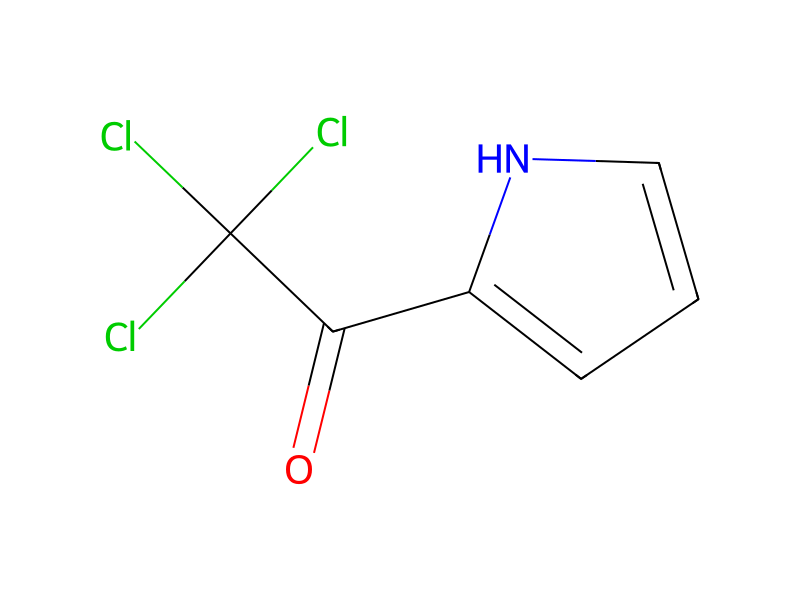
To a 100 mL 3-neck round bottom equipped with a dropping funnel was added trichloroacetyl pyrrole (50 g, 236.4 mmol) and CCl4 (1.0 L). After trichloroacetyl pyrrole was dissolved, the reaction was cooled to 0° C. and iodine (0.176 g) was added to the reaction. At this time, a solution of bromine (12 mL) in CCl4 (100 mL) was added dropwise very slowly to the reaction through a dropping funnel over 20 minutes and the resulting mixture was stirred at 0° C. for additional 20 minutes. The resulting mixture was transferred into a separatory funnel and washed with 10% Na2S2O3 solution, saturated NaHCO3 solution and brine (2×). The organic layer was dried and concentrated to give 50 g (60%) of the title compound as a white solid. LCMS (condition A): m/z=287.8, 289.8, 290.8 −ve. H1 NMR (400 MHz, CDCl3) δ ppm: 12.8 (1H, br.s), 7.56 (1H, m), 7.33 (1H, m).