6-Chloropyrimidine-4-carbonyl chloride → (S)-6-chloro-N-(3-(3,4-dihydroisoquinolin-2(1H)-yl)-2-hydroxypropyl)pyrimidine-4-carboxamide
反応式

[NH2:1][CH2:2][C@H:3]([OH:15])[CH2:4][N:5]1[CH2:14][CH2:13][C:12]2[C:7](=[CH:8][CH:9]=[CH:10][CH:11]=2)[CH2:6]1.[Cl:16][C:17]1[N:22]=[CH:21][N:20]=[C:19]([C:23](Cl)=[O:24])[CH:18]=1>C(Cl)Cl>[Cl:16][C:17]1[N:22]=[CH:21][N:20]=[C:19]([C:23]([NH:1][CH2:2][C@H:3]([OH:15])[CH2:4][N:5]2[CH2:14][CH2:13][C:12]3[C:7](=[CH:8][CH:9]=[CH:10][CH:11]=3)[CH2:6]2)=[O:24])[CH:18]=1参加物
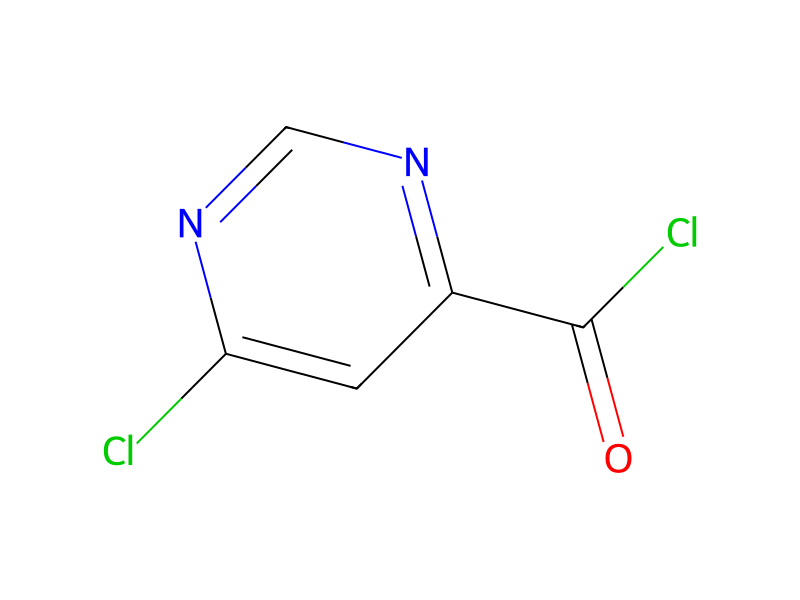



反応条件
- 温度
- 10 °C
実験手順
To a stirred mixture of (S)-1-amino-3-(3,4-dihydroisoquinolin-2(1H)-yl)propan-2-ol (300 g, 1.46 mol), and TEA (300 g, 3 mol) in DCM (4 L) was added 6-chloropyrimidine-4-carbonyl chloride (250 g in 2 L of DCM) slowly at −60° C. over 1 h. After the addition was complete, the mixture was then allowed to warm to 10° C. Stirring was continued for 1 h, at which time TLC showed the reaction was completed. The reaction was quenched by addition of water (2 L). The organic phase was collected, dried (Na2SO4) and evaporated. The residue was purified by flash chromatography (EtOAc˜DCM:MeOH=10:1) to give the desired product as a pale yellow solid. Four batches were run in parallel and produced a combined product weight of 970 g, yield: 49%. 1H NMR (400 MHz, MeOD-d4) δ 8.73 (d, J=1.0 Hz, 1H), 8.07 (d, J=1.2 Hz, 1H), 7.17-7.06 (m, 3H), 7.00 (d, J=7.2 Hz, 1H), 5.51 (s, 1H), 4.12 (q, J=6.0 Hz, 1H), 3.74 (s, 2H), 3.64-3.53 (m, 2H), 2.94 (q, J=5.6 Hz, 2H), 2.92-2.81 (m, 2H), 2.78-2.64 (m, 2H); LCMS (m/z): 347.2 [M+H]+
後処理
- additionAfter the addition
- customThe reaction was quenched by addition of water (2 L)
- customThe organic phase was collected
- dry with materialdried (Na2SO4)
- customevaporated
- customThe residue was purified by flash chromatography (EtOAc˜DCM:MeOH=10:1)
出典と根拠
- ORDレコード
- ord-274aeed34b9b4258b31b263e23f9753f
- 出典データセット
- uspto-grants-2015_03
- 特許番号
- US08993555B2
反応ノート
読み込み中…