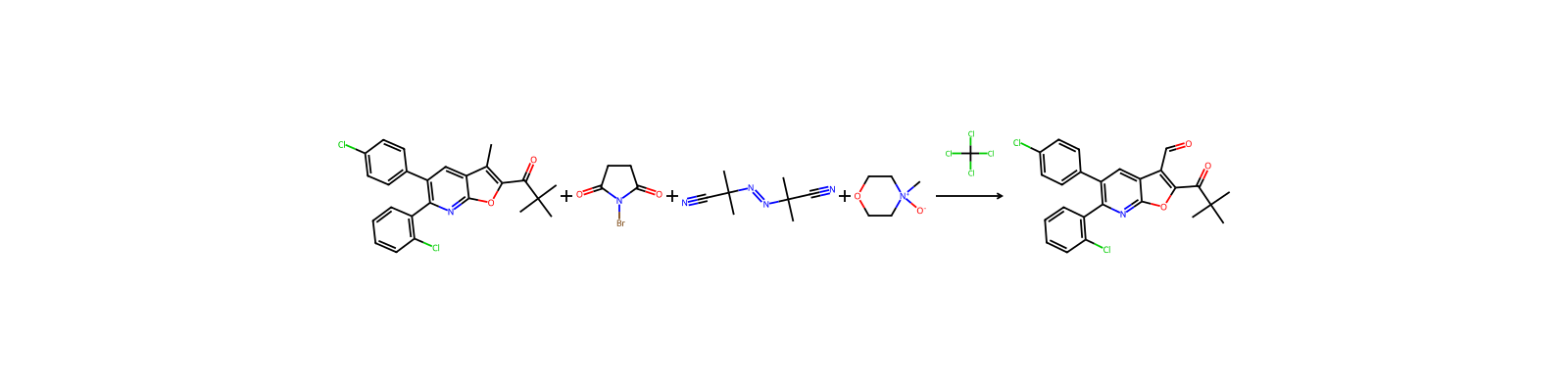
関与物質
| 役割 | 名称 | HCID | 仕込み量 |
|---|
| 反応物 | Azobisisobutyronitrile | HCID 6547 | — |
| 反応物 | N-bromobutanimide | HCID 67184 | — |
| 反応物 | Methyl morpholine oxide | HCID 82029 | — |
| 反応物 | 1-[6-(2-Chlorophenyl)-5-(4-chlorophenyl)-3-methylfuro[2,3-b]pyridin-2-yl]-2,2-dimethylpropan-1-one | HCID 10252566 | — |
| 溶媒 | Carbon Tetrachloride | HCID 5943 | — |
| 生成物 | 6-(2-Chlorophenyl)-5-(4-chlorophenyl)-2-(2,2-dimethylpropanoyl)furo[2,3-b]pyridine-3-carbaldehyde | HCID 10095368 | — |
反応手順
A 10 mL rb flask equipped with a magnetic stir bar was charged with 0.227 g (0.52 mmol) of the product of Example 89, 0.101 g (0.57 mmol) of N-bromosuccinimide, 3 mL CCl4 and ca. 5 mg of 2,2′-azobisisobutyronitrile (AIBN). The reaction mixture was heated to reflux under a nitrogen atmosphere for 2 h then cooled to room temperature and filtered. The filtrate was evaporated in vacuo, and the residue was then redissolved in 2 mL of DMSO. The solution containing the crude bromination product was transferred to a 10 mL reaction tube of a CEM Corporation Discover 300 Watt microwave reactor and 73 mg (0.62 mmol) of N-methylmorpholine-N-oxide was added. The reaction vessel was sealed, placed in the microwave reactor and heated at 150° C. for 2–3 min. After the reaction mixture had cooled to room temperature, it was partitioned between EtOAc and 10% aq. NaHSO4 and extracted. The organic layer was washed with 10% aq. NaHSO4, water, brine, dried (MgSO4), filtered and evaporated. The residue was purified on a silica gel flash chromatography column eluted with 0–10% EtOAc-hexane. Evaporation of the purified fractions and drying in vacuo afforded the title compound. HPLC/MS: 452.1 (M+1), 454.0 (M+3); Rt=4.63 min.
情報源と証拠
| DOI | 10.6084/m9.figshare.5104873.v1 |
|---|
| 特許番号 | US07091216B2 |
|---|
| 出典データセット | uspto-grants-2006_08 |
|---|
| ORD ID | ord-5d4a5433cbe84b68be4d18623d3dc161 |
|---|
| 出典メモ | uspto-grants-2006_08 |
|---|