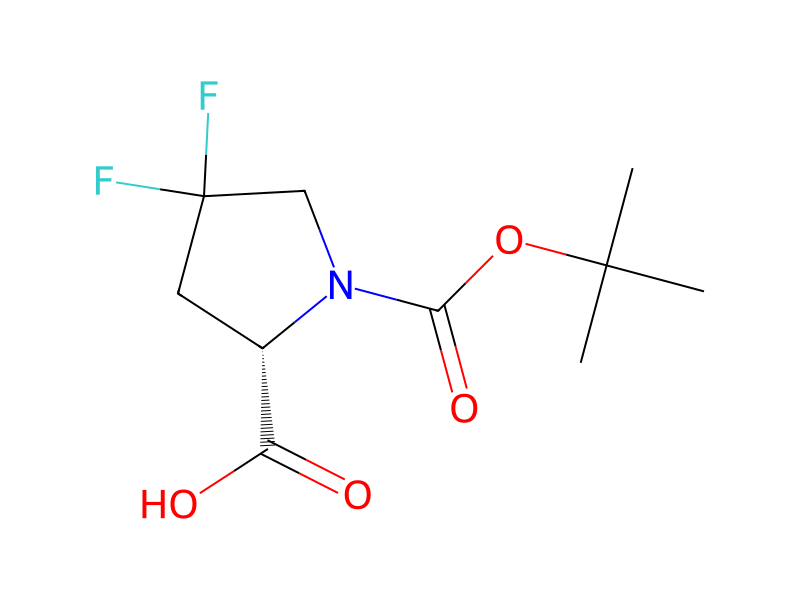
[C:1]([N:8]1[CH2:15][C:14]([F:17])([F:16])[CH2:13][C@H:9]1[C:10]([OH:12])=[O:11])([O:3][C:4]([CH3:7])(C)C)=[O:2].C(O)(C(F)(F)F)=O.C(Cl)Cl.C(Cl)(OCC1[C:44]2[C:39](=[CH:40][CH:41]=[CH:42][CH:43]=2)[C:38]2[C:33]1=[CH:34][CH:35]=[CH:36][CH:37]=2)=O>O1CCOCC1.O>[C:1]([N:8]1[CH2:15][C:14]([F:16])([F:17])[CH2:13][C@H:9]1[C:10]([OH:12])=[O:11])([O:3][CH2:4][CH:7]1[C:37]2[C:38](=[CH:33][CH:34]=[CH:35][CH:36]=2)[C:39]2[C:44]1=[CH:43][CH:42]=[CH:41][CH:40]=2)=[O:2]A solution of 652 mg (2 mmol) of N-Boc-4,4-difluoroproline in 10 mL of 1;1 TFA/CH2Cl2 was stirred at 0° C. for 45 min, and concentrated in vacuo. The residue was taken up in 3 mL of dioxane, and 5 mL of 10% aqueous sodium carbonate was added, followed by a solution of 675 mg (1 eq) of Fmoc-Cl in 5 mL of dioxane. The mixture was stirred at room temperature for 16 h, diluted with 20 mL of water, extracted with 2 20-mL portions of diethyl ether, acidified to pH 2, and extracted with three 30-mL portions of ethyl acetate. The combined organic extracts were washed with 50 mL of brine, dried (MgSO4) and concentrated in vacuo. The residue was purified by column chromatography over silica gel (eluted with CH2Cl2/CH3OH 10:1), to afford 850 mg (88%) of N-Fmoc-4,4-difluoroproline as a brownish solid. 1H NMR (500 MHz, CDCl3) δ 2.55 (m, 1H) 2.95 (m, 1H), 3.80 (m, 2H), 4.20 (m, 1H), 4.30 (m, 2H), 4.55 (m, 1H), 7.32 (m, 2H), 7.45 (m, 2H), 7.70 (m, 2H), 7.90 (m, 2H). Exact mass calculated for C20H17F2NO4 m/e 373.11, found m/e 374.4.