
닌히드린
Ninhydrin
데이터를 보충하는 중입니다. 잠시 후 페이지를 새로 고치면 최신 내용을 볼 수 있습니다

기본 정보
- CAS
485-47-2- 표준 SMILES
O=C1c2ccccc2C(=O)C1(O)O- InChIKey
FEMOMIGRRWSMCU-UHFFFAOYSA-N- 분자식
- C9H6O4
- 평균 분자량
- 178.14 g/mol
- 단동위원소 질량
- 178.02660867
이름 및 식별자
- 우선 이름
- Ninhydrin
- IUPAC
- 2,2-dihydroxyindene-1,3-dione
- 현지명
- 닌히드린
- 영어명
- Ninhydrin hydrate
- 분자식
- C9H6O4
- 분자량
- 178.14
이름 및 동의어
NINHYDRIN485-47-2Ninhydrin hydrate1,2,3-Indantrione monohydrate2,2-Dihydroxy-1H-indene-1,3(2H)-dione1H-Indene-1,3(2H)-dione, 2,2-dihydroxy-Triketohydrindene hydrate2,2-Dihydroxy-1,3-indandione2,2-Dihydroxy-1,3-indanedione1,2,3-Indantrione, 2-hydrateDTXSID70257161,3-Indandione, 2,2-dihydroxy-
이름 더 보기
2,2-다이하이드록시-1,3-인단디온닌히드린닌하이드린닌히드린수화물2,2-Dihydroxyindane-1,3-dione1H-Indene-1,2,3-trione2,2-dihydroxyindene-1,3-dioneNinhydrin, reagent ACS 25GRNINNinthydrin
HCL6S9K23ADTXCID605716CHEBI:86374Indantrione MonohydrateMonohydrate, IndantrioneRefChem:854157207-618-1Ninhydrine
데이터베이스 식별자
- CAS
485-47-2- PubChem CID
- 10236
- DTXSID
DTXSID7025716- ChEMBL
CHEMBL1221925- ChEBI
CHEBI:86374- UNII
- HCL6S9K23A
- Nikkaji
- J6.001A
물성
구조 계산 물성보충 중
- XLogP
- 0.1
- 극성 표면적
- 74.6 Ų
- 수소 결합 공여자 수
- 2
- 수소 결합 수용자 수
- 4
- 회전 가능 결합 수
- 0
- 무거운 원자 수
- 13
- 형식 전하
- 0
- 복잡도
- 243
물리화학적 성질
- 녹는점
- 250 °C · 250 °C (dec.) (lit.)
- 끓는 점
- 230.35 °C · 230.35°C (rough estimate)
- 밀도
- 0.862 · 0.862
- 증기 밀도
- 6.16 · 6.16 (vs air)
- 굴절률
- 1.4209 · 1.4209 (estimate)
- 인화점
- 13 °C · 13 °C
- 저장 조건
- Keep in dark place,Inert atmosphere,Room temperature
- 용해도
- 물(50mg/ml, 초음파 처리 포함), 에탄올(100mg/ml), 클로로포름(약간 용해됨), 에테르(약간 용해됨) 및 메탄올(100mg/ml)에 용해됩니다.
- 물리적 상태
- 분말/고체
- 산도 계수 (pKa)
- 8.47 · 8.47±0.20(Predicted)
- Specific Gravity
- 0.788 · 0.788
- 색상
- 흰색에서 갈색을 띤 흰색, 결정
- 수소이온지수(pH)
- 4.6 · 4.6-5.0 (10g/l, H2O, 20℃)
- 냄새
- 냄새 없는
- 수용성
- 20 °C에서 · 20°C에서 0.1-0.5g/100mL
- Merck
- 14 · 14,6554
- BRN
- 1910963 · 1910963
- 안정성
- 안정적인. 아민, 알칼리, 강염기와 호환되지 않습니다. 감광성.
- 화장품 원료 기능
- 피부의 산화 스트레스를 줄이세요
- InChI
- 1S/C9H6O4/c10-7-5-3-1-2-4-6(5)8(11)9(7,12)13/h1-4,12-13H
- InChIKey
- FEMOMIGRRWSMCU-UHFFFAOYSA-N
- SMILES
- OC1(O)C(=O)c2ccccc2C1=O
- LogP
- 0.67 · 0.670
- NIST
- Ninhydrin(485-47-2)
- EPA
- Ninhydrin (485-47-2)
화학적 성질
Ninhydrin, also known as Ninhydrin hydrate, is a white to pale yellow crystalline powder. It has a melting point of 241°C but decomposes at this temperature. When heated to 100°C or above, it changes color to red. Ninhydrin is soluble in water and ethanol and has slight solubility in ether and chloroform. When exposed to light or air, it gradually changes color and can clump when exposed to moisture. In solution with α-amino acids, or any α-amino substances can form a deep blue or even pink or red material, so it is often used as a detection of α-amino acids and peptides color developer.
안전 및 규제
안전 정보는 참고용이며, 공급업체의 물질안전보건자료(SDS), 관련 법규 및 전문가 평가를 대체하지 않습니다.
안전 데이터
- wgk
- 3
- tsca
- TSCA listed
- rtecs
- NK5425000
- ridadr
- UN 1170 3/PG 2
- 독성
- LD50 orally in Rabbit: 600 mg/kg
- HS 번호
- 29144000
- risk_code
- 22-36/37/38-39/23/24/25-20/21/22-11
- hazard_code
- Xn,T,F
- safety_code
- 26-28A-45-16-36
- 포장분류
- II
- 위험 등급
- 3
- 기존화학 물질
- KE-10839
- F 고인화성물질
- 8
- Hazard Classifications
- Acute Tox. 4 OralEye Irrit. 2Skin Irrit. 2
- 스토리지 클래스
- 11 - Combustible Solids
화학 및 산업
응용 분야
개요Ninhydrin is historically the most common reagent for processing fingerprints on porous substrates. It has been used as a fingerprint reagent since the 1950s but has been used as a cell stain since the early 1900s. Ninhydrin molecules form a complex with amino acids resulting in a purple product known as Ruhmann's purple. Purple fingerprints are easily visible on light-colored porous substrates but may be difficult to see on patterned or dark-colored substrates. DFO reacts with amino acids to produce a fluorescent product that is not readily seen with the naked eye. This makes it a useful reagent on dark or patterned porous items. DFO prints are viewed with an alternate light source or laser set to 530–570 nm (green light) through a red barrier filter. 1,2-indanedione is an emerging fingerprint reagent that results in visible pink fingerprints that are also fluorescent. The fluorescence is viewed under the same conditions as DFO. These chemicals can be used on their own or in sequence to develop latent prints on porous substrates. If they are used in sequence, they are used in the following order: indanedione, DFO, ninhydrin. If a reagent is used out of sequence, it will inhibit or limit the effectiveness of the other reagents. In this laboratory exercise you will develop fingerprints on a porous substrate using indanedione, DFO, and ninhydrin. ninhydrin structure
역사Ninhydrin was discovered in 1910 by the German-English chemist Siegfried Ruhemann (1859–1943). In the same year, Ruhemann observed ninhydrin's reaction with amino acids. In 1954, Swedish investigators Oden and von Hofsten proposed that ninhydrin could be used to develop latent fingerprints.
일반 설명White to light yellow crystals or powder. Becomes anhydrous with reddening at 257-266°F.
상·하류 제품 정보
상류 원료
하류 제품
추가 설명
정의ChEBI: Ninhydrin is a member of the class of indanones that is indane-1,3-dione bearing two additional hydroxy substituents at position 2. It has a role as a colour indicator and a human metabolite. It is a member of indanones, a beta-diketone, an aromatic ketone and a ketone hydrate.
관련 반응
256건
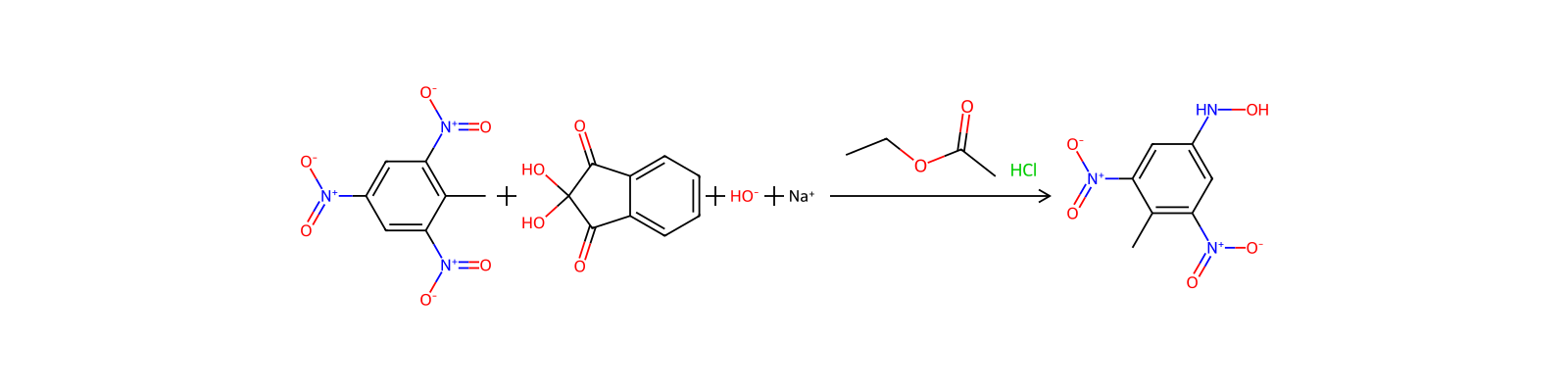


화합물 노트
불러오는 중…