
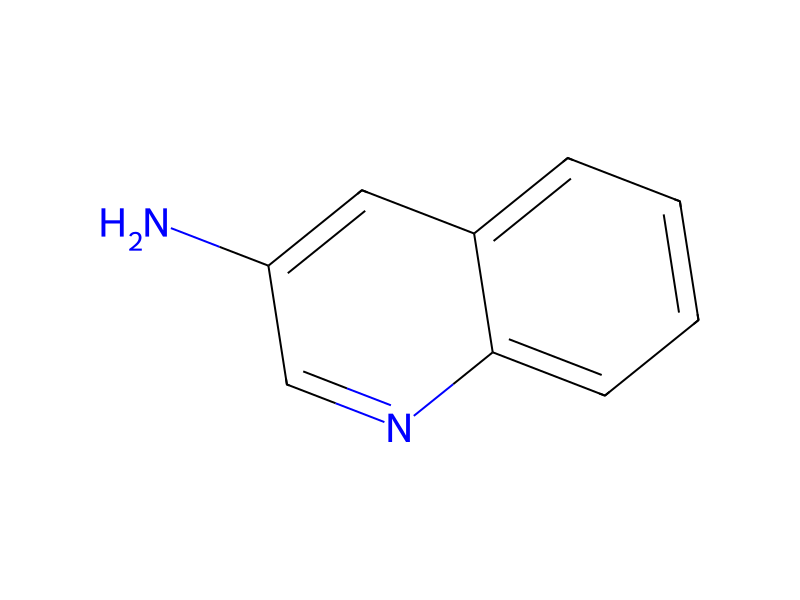
기본 정보
- 표준 SMILES
Nc1cnc2ccccc2c1- InChIKey
SVNCRRZKBNSMIV-UHFFFAOYSA-N- 분자식
- C9H8N2
- 평균 분자량
- 144.17 g/mol
- 단동위원소 질량
- 144.06874826
개요
3-Aminoquinoline is an aminoquinoline.
이름 및 식별자
- 우선 이름
- 3-Aminoquinoline
- IUPAC
- quinolin-3-amine
- 영어명
- 3-Aminoquinoline
- 분자식
- C9H8N2
- 분자량
- 144.17
이름 및 동의어
3-AMINOQUINOLINEquinolin-3-amine3-Quinolinamine3-QuinolylamineQuinoline, 3-amino-3-Quinolineamine(Quinolin-3-yl)amineCCRIS 1678NSC 7934EINECS 209-455-1UNII-98OVL5K3R4BRN 0113317
이름 더 보기
3-AQ3-AminoquinoL3-amino-quinolin6-Amine-quinolineQUINOLIN-3-YLAMINE
98OVL5K3R4NSC-7934AMINOQUINOLINE, 3-DTXSID80603795-22-10-00233 (Beilstein Handbook Reference)RefChem:93006DTXCID5042295InChI=1/C9H8N2/c10-8-5-7-3-1-2-4-9(7)11-6-8/h1-6H,10H
데이터베이스 식별자
- CAS
580-17-6- PubChem CID
- 11375
- DTXSID
DTXSID8060379- ChEMBL
CHEMBL80298- ChEBI
CHEBI:166512- UNII
- 98OVL5K3R4
- EC Number
- 209-455-1
- Nikkaji
- J48.195E
물성
구조 계산 물성
- XLogP
- 1.6
- 극성 표면적
- 38.9 Ų
- 수소 결합 공여자 수
- 1
- 수소 결합 수용자 수
- 2
- 회전 가능 결합 수
- 0
- 무거운 원자 수
- 11
- 형식 전하
- 0
- 복잡도
- 136
실험 및 물리화학적 성질
SpringerMaterials PropertiesChemical shift
물리화학적 성질
- 녹는점
- 91 · 91-92 °C(lit.)
- 끓는 점
- 137 °C · 137 °C / 1mmHg
- 밀도
- 1.1148 · 1.1148 (estimate)
- 굴절률
- 1.708 · 1.7080 (estimate)
- 저장 조건
- 30 °C · Store below +30°C.
- 용해도
- 0.1 g/mL, · 메탄올: 0.1 g/mL, 투명
- 산도 계수 (pKa)
- 4.91 · 4.91(at 20℃)
- 물리적 상태
- 결정질 분말 또는 결정
- 색상
- 흰색에서 베이지색
- 수용성
- 뜨거운 물에 약간 용해됨
- BRN
- 113317 · 113317
- InChI
- 1S/C9H8N2/c10-8-5-7-3-1-2-4-9(7)11-6-8/h1-6H,10H2
- InChIKey
- SVNCRRZKBNSMIV-UHFFFAOYSA-N
- SMILES
- Nc1cnc2ccccc2c1
- NIST
- 3 · 3-Quinolinamine(580-17-6)
- EPA
- 3 · 3-Quinolinamine (580-17-6)
화학적 성질
beige crystals
안전 및 규제
GHS 분류
GHS Classification
Warning
H302 (10.9%): Harmful if swallowed [Warning Acute toxicity, oral]
P261, P264, P264+P265, P270, P271, P280, P301+P317, P302+P352, P304+P340, P305+P351+P338, P317, P319, P321, P330, P332+P317, P337+P317, P362+P364, P403+P233, P405, and P501 (click each P-code to see the statement)
Aggregated GHS information provided per 46 reports by companies from 5 notifications to the ECHA C&L Inventory. Each notification may be associated with multiple companies.
유해성 정보
Hazard Classes and CategoriesAcute Tox. 4 (10.9%)
CSL Reaction Information
CSL00129
3-AMINOQUINOLINE + SODIUM ETHYLXANTHATE
I was attempting to prepare 3-[ethoxy(thiocarbonyl)thio]quinoline by reacting the diazonium salt of 3-aminoquinine with potassium ethyl xanthate when an explosion occurred. Thankfully, the injury I received was minor. I was following the procedure described in the Journal of the Chemical Society, Part III [3, 2384 (1959)] on twice their scale. Jerry March's book "Advanced Organic Chemistry: Reactions, Mechanisms, Structure" (New York: John Wiley & Sons, 1992, 4th edition, page 670) lists the procedure as a customary route for the desired aryl xanthate ester and a convenient method for producing thiophenols. The same procedure is also described in "Organic Syntheses, Collective Volume III" (New York: John Wiley & Sons, page 809), which contains a cautionary note about a reported explosion, although the editors found no unusual reactivity. Since diazo esters were present, the explosion most likely resulted from the diazo ester's tendency to decompose explosively. It is unclear whether the diazo ester is a precursor of the desired product or whether the diazo ester forms through a competitive reaction. The reaction proceeded without event. But unlike the literature preparations, precipitation occurred during product extraction with diethyl ether and was isolated by filtration. A 1H NMR of the wet cake was consistent with the desired structure. The solid was air-dried overnight and weighed 17 g. The detonation occurred when a metal spatula was inserted into the solid. Related work in Tetrahedron Letters [26, 6365 (1985)] successfully demonstrated the safe preparation of diaryl sulfides. However, this was done at 25 ºC (mine at 45 ºC) with care taken to avoid heat, since a reference is cited of an explosion at 60 ºC. Also, the disappearance of the suspected diazo sulfide was monitored by thin layer chromatography, and sluggish reactions were not pushed to conversion. Instead, chromatography was used to remove any intermediates.
Explosive
M (up to 100g)
http://pubs.acs.org/cen/safety/20010709.html
안전 데이터
- wgk
- 3
- tsca
- TSCA listed
- rtecs
- VA9622000
- ridadr
- 2811
- 독성
- mma-sat 5 mmol/plate MUREAV 187,191,87
- HS 번호
- 29334990
- risk_code
- 36/38-68-36/37/38-20/21/22
- hazard_code
- Xi,Xn
- safety_code
- 26-36-36/37/39-22
- 위험 등급
- IRRITANT
- F 고인화성물질
- 2-10
- Hazard Classifications
- Eye Irrit. 2Skin Irrit. 2STOT SE 3
- 스토리지 클래스
- 11 - Combustible Solids
화학 및 산업
용도 및 제조
UsesSynthetic Polymer MALDI Matrix Compounds
General Manufacturing Information3-Quinolinamine: INACTIVE
응용 분야
용도3-Aminoquinoline was used:in liquid matrix for matrix-assisted laser desorption/ionization mass spectrometry (MALDI-MS) for glycopeptides, carbohydrates and phosphopeptidesin liquid matrix during novel glycan-labeling method for quantitative profiling of N-glycan by MALDI-MS analysisas derivatizing reagent for MALDI-MS analysis of oligosachharides
상·하류 제품 정보
상류 원료
하류 제품
공급사50 곳
国药集团化学试剂有限公司86-21-63210123 · [email protected]
梯希爱(上海)化成工业发展有限公司021-67121386 · [email protected]
Hebei Chuanghai Biotechnology Co., Ltd+86-17732866630 · [email protected]
杭州品高化工有限公司0571-87658025 · [email protected]
Shanghai Innopharm Industrial Co., Ltd.+86-21-59960785 +86-17701845089 · [email protected]
INTATRADE GmbH+49 3493/605464 · [email protected]
爱斯特(成都)生物制药股份有限公司+86-28-85122536 85324413 · [email protected]
科瑞迪化学400-821-5857 021-64326257 · [email protected]
Syntechem Co.,Ltd[email protected]
上海迈瑞尔生化科技有限公司4006356688 18621169109 · [email protected]
上海辅欣医药科技有限公司+86-021-021-50872116 · [email protected]
江苏普乐司生物科技有限公司0513-66017706 18551496367 · [email protected]
阿法埃莎(中国)化学有限公司400-6106006 · [email protected]
安耐吉化学&3A(安徽泽升科技股份有限公司)400-0056266 · [email protected]
成都添福瑞生物科技有限公司18030648795 18030648795 · [email protected]
上海瀚鸿科技股份有限公司021-54306202 13764082696 · [email protected]
南通合润生物科技有限公司18362409333 · [email protected]
上海景颜化工科技有限公司13817811078 · [email protected]
嘉兴市艾森化工有限公司0573-85285100 18627885956 · [email protected]
上海隆盛化工有限公司58099637 13585536065 · [email protected]
武汉市皇臻生物化工有限公司13795480948 · [email protected]
杭州东帆化学有限公司86-0571-85151182
山东西亚化学有限公司13355009207 13355009207 · [email protected]
四川库利南科技有限公司400-1166-196 18981987031 · [email protected]
南京维奥化工有限公司Please Send Email 18652950785 · [email protected]
艾科试剂4008-755-333 18080918076 · [email protected]
赛默飞世尔科技(中国)有限公司800-810-5118 · [email protected]
北京伊诺凯科技有限公司400-810-7969 010-59572699 · [email protected]
TCI AMERICA800-4238616 · [email protected]
TOKYO CHEMICAL INDUSTRY CO., LTD.03-36680489 · [email protected]
TCI Europe320-37350700 · [email protected]
上海贤鼎生物科技有限公司4009209199 · [email protected]
上海仁曲医药科技有限公司18171398856 2968382473 · [email protected]
越林试剂021-62960152 · [email protected]
上海睿升化工科技有限公司+86-021-50935922
北京京土恒盛化工科技有限公司00-13911456598 13911456598 · [email protected]
上海丽康新材料有限公司+86-16631818819 +86-17736933208 · [email protected]
安徽科迪达化工有限公司0554-2106669 · [email protected]
HBCChem, Inc.+1-510-219-6317 · [email protected]
上海石洋化工有限公司021-56795766 · [email protected]
雷丁试剂0510-85629785 18013409632 · [email protected]
上海麦克林生化科技股份有限公司15221275939 15221275939 · [email protected]
上海嵩爰化工科技有限公司010-1234567 18521000990 · [email protected]
Sigma-Aldrich西格玛奥德里奇(上海)贸易有限公司021-61415566 800-8193336 · [email protected]
天津荣燊化工有限公司18317763565; 18317763565 · [email protected]
成都佶安特生物医药科技有限公司请加QQ询价,电话不报价 · [email protected]
广东翁江化学试剂有限公司0751-2815987 13927875076 · [email protected]
厦门志信化学有限公司+86-5922680277 +86-13806087780 · [email protected]
昆山中莱特贸易有限公司0512-55170668 13913095008;13770601296 · [email protected]
上海阿拉丁生化科技股份有限公司6206333 13167063860 · [email protected]
관련 반응
143건





연결된 노트
불러오는 중…