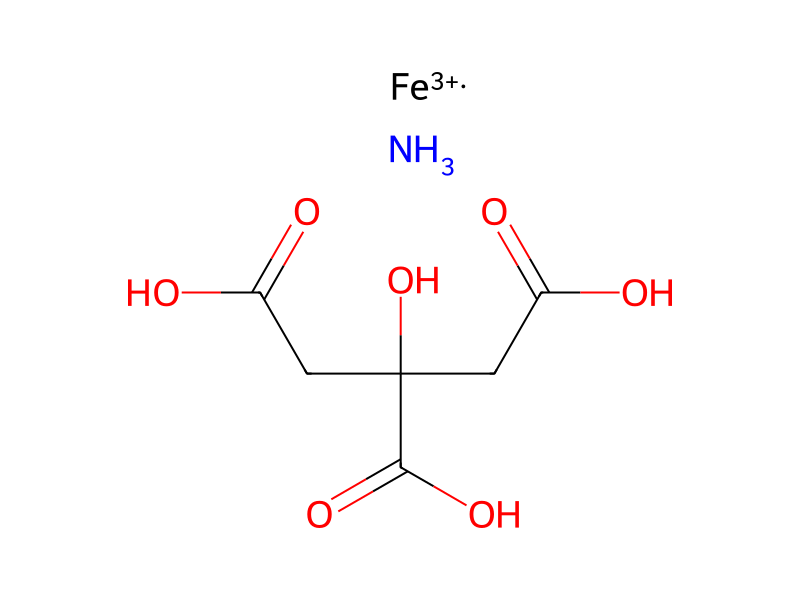
기본 정보
- 표준 SMILES
N.O=C(O)CC(O)(CC(=O)O)C(=O)O.[Fe+3]- InChIKey
FRHBOQMZUOWXQL-UHFFFAOYSA-K- 분자식
- C6H11FeNO7+3
- 평균 분자량
- 265 g/mol
개요
Ferric ammonium citrate is a yellowish brown to red solid with a faint odor of ammonia. It is soluble in water. The primary hazard is the threat to the environment. Immediate steps should be taken to limit its spread to the environment. It is used in medicine, in making blueprints, and as a feed additive.
이름 및 식별자
- 우선 이름
- Ferric Ammonium Citrate
- IUPAC
- azane;2-hydroxypropane-1,2,3-tricarboxylic acid;iron(3+)
- 현지명
- 구연산철 암모늄
- 영어명
- Ammonium ferric citrate
- 분자식
- C6H11FeNO7
- 분자량
- 265
이름 및 동의어
이름 더 보기
데이터베이스 식별자
- CAS
1185-57-5- PubChem CID
- 118984355
- ChEMBL
CHEMBL4301175- UNII
- UVP74NG1C5
- EC Number
- 214-686-6
물성
구조 계산 물성
- 극성 표면적
- 133 Ų
- 수소 결합 공여자 수
- 5
- 수소 결합 수용자 수
- 8
- 회전 가능 결합 수
- 5
- 무거운 원자 수
- 15
- 형식 전하
- 3
- 복잡도
- 227
실험 및 물리화학적 성질
Food Additives
Drugs -> FDA Regulatory Status of Color Additives
NUTRIENT SUPPLEMENT -> FDA Substance added to food
ANTICAKING AGENT OR FREE-FLOW AGENT -> FDA Substance added to food
Density
1.8 at 68 °F (USCG, 1999) - Denser than water; will sink
Specific gravity: 1.8 at 20 °C/4 °C (solid)
Human Drugs
FDA approved drugs -> Active ingredient
FDA approved drugs -> Active ingredient
Physical Description
Ferric ammonium citrate is a yellowish brown to red solid with a faint odor of ammonia. It is soluble in water. The primary hazard is the threat to the environment. Immediate steps should be taken to limit its spread to the environment. It is used in medicine, in making blueprints, and as a feed additive.
Dry Powder; Liquid
Exists in two forms; Brown hydrated form is garnet-red or brownish-yellow solid; Green hydrated form is green deliquescent solid; Soluble in water; [Merck Index] Brown crystalline solid; [MSDSonline]
Other Experimental Properties
Brown form: reddish-brown granules, garnet-red transparent scales, or brownish-yellow powder. Very deliquescent. Odorless or slight ammonia odor; saline, ferruginous taste. Ammonium ferric citrate, brown form reduced to ferrous salt by light. Brown hydrated form is extremely soluble in water and practically insoluble in alcohol. /Hydrated ferric ammonium citrate/
Green form: green transparent, scales, pearls, granules, or powder. Odorless. Mild ferruginous taste. Ammonium ferric citrate, green form is more readily reduced to the ferrous salt by light then the brown form. Green hydrated form is very soluble in water and practically insoluble in alcohol. /Hydrated ferric ammonium citrate/
Deliquescent
물리화학적 성질
- 녹는점
- 193 °C · >193°C (dec.)
- 끓는 점
- 498 ℃[at · 498℃[at 101 325 Pa]
- 밀도
- 1.06 · 1.06[at 20℃]
- 증기압
- 0 Pa · 0Pa at 25℃
- 저장 조건
- Store at RT.
- 용해도
- 1200 g/L · 1200g/L
- 물리적 상태
- 가루
- 색상
- 녹색
- 냄새
- 무취 ~ 약간의 암모니아 냄새
- 수소이온지수(pH)
- 5 · 5.0~8.0
- 생물학적 소스
- synthetic
- 수용성
- 1200 g/L · 1200g/L(20℃)
- Merck
- 14 · 14,4017
- 안정성
- 흡습성
- 화장품 원료 기능
- 머리 염색
- InChI
- 1S/C6H8O7.Fe.H3N/c7-3(8)1-6(13,5(11)12)2-4(9)10;;/h13H,1-2H2,(H,7,8)(H,9,10)(H,11,12);;1H3/q;+3;/p-3
- InChIKey
- FRHBOQMZUOWXQL-UHFFFAOYSA-K
- SMILES
- N.OC12CC(=O)O[Fe](OC(=O)C1)OC(=O)C2
- LogP
- -0.737 at · -0.737 at 25℃
- EPA
- Ferric ammonium citrate (1185-57-5)
화학적 성질
brownish-yellow to brown powder
안전 및 규제
GHS 분류
GHS Classification
This chemical does not meet GHS hazard criteria for 10.2% (161 of 1576) of reports.
Warning
H315 (89.8%): Causes skin irritation [Warning Skin corrosion/irritation]
P264, P264+P265, P280, P302+P352, P305+P351+P338, P321, P332+P317, P337+P317, and P362+P364 (click each P-code to see the statement)
Aggregated GHS information provided per 1576 reports by companies from 11 notifications to the ECHA C&L Inventory. Each notification may be associated with multiple companies.
유해성 정보
Regulatory Information
Chemical: 1,2,3-Propanetricarboxylic acid, 2-hydroxy-, ammonium iron(3+) salt
Commission Regulation (EC) No 1565/2000 (Repealed by Com. Implementing Reg. (EU) No 872/2012)
1,2,3-Propanetricarboxylic acid, 2-hydroxy-, ammonium iron(3+) salt (1:?:?) is listed on the EPA's Chemical Data Reporting (CDR) system. Manufacturers and importers of 1,2,3-Propanetricarboxylic acid, 2-hydroxy-, ammonium iron(3+) salt (1:?:?) are required to report information about their production and use of this chemical to the EPA under the Toxic Substances Control Act (TSCA). (40 eCFR Part 711)
REACH registered substance: Ammonium iron(III) citrate (EC: 214-686-6)
Ferric ammonium citrate: Does not have an individual approval but may be used under an appropriate group standard
The New Jersey Worker and Community Right to Know Act requires public and private employers to provide information about hazardous substances at their workplaces. (N.J.S.A. 34:5A-1 et. seq.)
FDA Requirements
Substance added directly to human food affirmed as generally recognized as safe (GRAS).
Ferric ammonium citrate may be safely used in combination with pyrogallol (as listed in §73.1375), for coloring plain and chromic catgut sutures for use in general and ophthalmic surgery subject to the following conditions: (1) The dyed suture shall conform in all respects to the requirements of the United States Pharmacopeia XX (1980). (2) The level of the ferric ammonium citrate-pyrogallol complex shall not exceed 3 percent of the total weight of the suture material. (3) When the sutures are used for the purposes specified in their labeling, there is no migration of the color additive to the surrounding tissue. (4) If the suture is a new drug, an approved new drug application, pursuant to section 505 of the act, is in effect for it.
Iron ammonium citrate may be safely used in food in accordance with the following prescribed conditions: (a) The additive is the chemical green ferric ammonium citrate. (b) The additive is used, or intended for use as an anticaking agent in salt for human consumption so that the level of iron ammonium citrate does not exceed 25 parts per million (0.0025 percent) in the finished salt.
Iron ammonium citrate may be safely used in animal feed in accordance with the following prescribed conditions: (a) The additive is the chemical green ferric ammonium citrate. (b) The additive is used or intended for use as an anticaking agent in salt for animal consumption so that the level of iron ammonium citrate does not exceed 25 parts per million (0.0025 percent) in the finished salt.
Reactivity Profile
Acidic salts, such as FERRIC AMMONIUM CITRATE, are generally soluble in water. The resulting solutions contain moderate concentrations of hydrogen ions and have pH's of less than 7.0. They react as acids to neutralize bases. These neutralizations generate heat, but less or far less than is generated by neutralization of inorganic acids, inorganic oxoacids, and carboxylic acid. They usually do not react as either oxidizing agents or reducing agents but such behavior is not impossible. Many of these compounds catalyze organic reactions. Special Hazards of Combustion Products: Toxic oxides of nitrogen or ammonia gas may be formed in fires (USCG, 1999).
CERCLA Reportable Quantities
Persons in charge of vessels or facilities are required to notify the National Response Center (NRC) immediately, when there is a release of this designated hazardous substance, in an amount equal to or greater than its reportable quantity of 1000 lb or 454 kg. The toll free number of the NRC is (800) 424-8802; In the Washington D.C. metropolitan area (202) 426-2675. The rule for determining when notification is required is stated in 40 CFR 302.4 (section IV. D.3.b).
안전 및 보호
Cleanup Methods
Environmental considerations: Water spill: Neutralize with agricultural lime (CaO), crushed limestone (CaCO3), or sodium bicarbonate (NaHCO3). Adjust pH to neutral (pH+ 7). Use mechanical dredges or lifts to remove immobilized masses of pollutants and precipitates.
Environmental considerations: Land spill: Big a pit, pond, lagoon, holding area to contain liquid or solid material. /SRP: If time permits, pits, ponds, lagoons, soak holes, or holding areas should be sealed with an impermeable flexible membrane liner./ Cover soldis with a plastic sheet to prevent dissolving in rain or fire fighting water.
Disposal Methods
SRP: The most favorable course of action is to use an alternative chemical product with less inherent propensity for occupational exposure or environmental contamination. Recycle any unused portion of the material for its approved use or return it to the manufacturer or supplier. Ultimate disposal of the chemical must consider: the material's impact on air quality; potential migration in soil or water; effects on animal, aquatic, and plant life; and conformance with environmental and public health regulations.
The following wastewater treatment technologies have been investigated for iron (Fe+2): Concentration process: Biological treatment. /Iron (Fe+2)/
Preventive Measures
Personnel protection: Keep upwind. ... Avoid breathing vapors or dusts. Wash away any material which may have contacted the body with copious amounts of water or soap and water.
If material not involved in fire: Keep material out of water sources and sewers. Build dikes to contain flow as necessary.
SRP: The scientific literature for the use of contact lenses in industry is conflicting. The benefit or detrimental effects of wearing contact lenses depend not only upon the substance, but also on factors including the form of the substance, characteristics and duration of the exposure, the uses of other eye protection equipment, and the hygiene of the lenses. However, there may be individual substances whose irritating or corrosive properties are such that the wearing of contact lenses would be harmful to the eye. In those specific cases, contact lenses should not be worn. In any event, the usual eye protection equipment should be worn even when contact lenses are in place.
All ... /iron/ preparations should be kept in child-proof bottles. /Iron preparations/
Personal Protective Equipment (PPE)
Approved respirator for nuisance dust; chemical goggles or face shield (USCG, 1999)
Approved respirator for nuisance dust, chemical goggles or face shield.
Other Standards Regulations and Guidelines
Australia, Belgium, Finland, Italy, Netherlands, & Switzerland: 1 mg/cu m. /Iron salts/
Australia (1978); Belgium (1978); Finland (1975); Italy (1978); Netherlands (1978); and Switzerland (1978): 1 mg/cu m. /From table/ /Ferric salts, as Fe/
독성 정보
Interactions
...The present study has investigated whether melatonin can alter the proportion of neurons that die in the 24 hr period following 1.0 microL intracortical injections of 1.0 mM ferric ammonium citrate (FAC) or 0.9% saline. Rats which received systemic infusions of melatonin (5 mg/kg bw/day) displayed a 40% reduction (P=0.019) in the proportion of neurons killed by FAC. By contrast, reduction of endogenous melatonin by continuous light exposure did not significantly affect the extent of neuronal death. Furthermore, elevated or reduced melatonin levels did not alter the number of neurons killed by saline injections.
...Specific pathogen free male Fischer-344-rats received daily intraperitoneal injections of ferric-ammonium-citrate (FAC) at 40 mg/kg bw at 1 mL/kg or an equal volume of saline. Beginning on day four, rats were simultaneously exposed to an aerosol of beryllium-sulfate (BeSO4) for 2 hr/day through nose only inhalation. By day 15, mortality was 80% in the BeSO4 plus saline group as compared to 33% in the BeSO4 plus FAC group. Exposure was then discontinued. By day 18, all rats in the BeSO4 plus saline group had died, while the cumulative mortality for the BeSO4 plus FAC group was only 66%. By day 19, mortality in this group had reached a maximum of 76%.
Senile plaques, the major neuropathological lesions of Alzheimer's disease (AD), are composed primarily of amyloid-beta ... peptide and contain high concentrations of iron (1.0 mM). /It was/ previously shown that intracortical injections of 1.0 mM iron to adult rats produce significantly more neuronal loss than control injections of saline vehicle, whereas injections of /amyloid-beta/ do not. Because iron has been shown to increase the in vitro toxicity of /amyloid-beta/, the present study was undertaken to determine whether iron can make /amyloid-beta/ neurotoxic in vivo. /Amyloid-beta/ and 1.0 mM iron (as ferric ammonium citrate) were coinjected into rat cerebral cortex, and the neuronal loss was compared with that produced by pure /amyloid-beta/ or pure iron. The human and rat variants of /amyloid-beta/1-42 were compared to determine whether they produce the same amount of neuronal loss when combined with iron. Coinjection of iron with either /amyloid-beta/ variant caused significantly more neuronal loss than /amyloid-beta/ peptide alone, suggesting that iron may contribute to the toxicity associated with senile plaques. Rat /amyloid-beta/1-42 combined with iron was as toxic as iron alone, whereas iron combined with human /amyloid-beta/1-42 was significantly less toxic.
Ecotoxicity Values
LD50 Anguilla japonica (Japanese eel) injection 80 ug/g/96 hr /Conditions of bioassay not specified in source examined/
LD50 Plecoglossus altivelis (Ayu) injection 123 ug/g/96 hr /Conditions of bioassay not specified in source examined/
Ecotoxicity Excerpts
/AQUATIC SPECIES/ Distribution of radioiron to various tissues after intraperitoneal injections was examined in Atlantic salmon and rainbow trout. Liver and spleen were found to be the major iron storage tissues. Injections of 1 or 5 mg iron as ferric ammonium citrate led to a fall in hemoglobin levels in both species after 2 days. Hemoglobin levels returned to normal levels in rainbow trout after 8 days, but Atlantic salmon had not recovered, and Hb levels fell below 3 g/100 mL. In both species, the fall in Hb was associated with a raise in iron levels in spleen and liver, suggesting damage to erythrocytes. Atlantic salmon liver ferritin showed a two- to threefold increase, while rainbow trout showed a sixfold increase, and a more rapid response.
Non-Human Toxicity Excerpts
/LABORATORY ANIMALS: Acute Exposure/ ...The present study has investigated whether melatonin can alter the proportion of neurons that die in the 24 hr period following 1.0 microL intracortical injections of 1.0 mM ferric ammonium citrate (FAC) or 0.9% saline. Rats which received systemic infusions of melatonin (5 mg/kg bw/day) displayed a 40% reduction (P=0.019) in the proportion of neurons killed by FAC. By contrast, reduction of endogenous melatonin by continuous light exposure did not significantly affect the extent of neuronal death. Furthermore, elevated or reduced melatonin levels did not alter the number of neurons killed by saline injections.
/LABORATORY ANIMALS: Neurotoxicity/ ... rapid injection of FAC pH 7 (ferric ammonium citrate, 5 mM in saline) /into the striatum of rats/ was associated with OH formation whereas rapid injection of FAC pH 3 did not.
/ALTERNATIVE IN VITRO TESTS/ ...To investigate the regulation of iron metabolism in astrocytes we have used primary astrocyte cultures from the brains of newborn rats. After application of ferric ammonium citrate (FAC), cultured astrocytes accumulated iron in a time- (0-48 hr) and concentration-dependent (0.01-1 mm) manner. This accumulation was prevented if FAC was applied in combination with the iron-chelator deferoxamine (DFX). Application of FAC to astrocyte cultures caused a strong increase in the cellular content of the iron storage protein ferritin and a decrease in the amount of transferrin receptor (TfR), which is involved in the transferrin-mediated uptake of iron into cells. In contrast, application of DFX strongly increased the level of TfR. Both up-regulation of ferritin content by iron application and up-regulation of TfR content by DFX were prevented by the protein synthesis inhibitor cycloheximide (CHX). During incubation of astrocytes with FAC, a mild and transient increase in the extracellular activity of the cytosolic enzyme lactate dehydrogenase and in the concentration of intracellular ROS was observed. In contrast, prevention of protein synthesis by CHX during incubation with FAC resulted in significantly more cell loss and a persistent and intense increase in the production of intracellular ROS.
/ALTERNATIVE IN VITRO TESTS/ ...Exposure of BEAS-2B cells to ferric ammonium citrate (FAC) resulted in a decrease in Fe(3+) concentration in the supernatant that was dependent on time and initial iron concentration. In the presence of internalized calcein, FAC quenched the fluorescent signal, indicating intracellular transport of the metal. The Nramp2/DMT1/DCT1 mRNA isoform without an iron-response element (IRE) increased with exposure of BEAS-2B cells to FAC. RT-PCR demonstrated no change in the mRNA for the isoform with an IRE. Similarly, Western blot analysis for the isoform without an IRE confirmed an increased expression of this protein after FAC exposure, whereas the isoform with an IRE exhibited no change. Finally, immunohistochemistry revealed an increase in the isoform without an IRE in the rat lung epithelium after instillation of FAC. Comparable to mRNA and protein increases, iron transport was elevated after pretreatment of BEAS-2B cells with iron-containing compounds. We conclude that airway epithelial cells increase mRNA and expression of the Nramp2/DMT1/DCT1 without an IRE after exposure to iron.
For more Non-Human Toxicity Excerpts (Complete) data for FERRIC AMMONIUM CITRATE (9 total), please visit the HSDB record page.
Populations at Special Risk
...There is concern that the individual with metabolic defects that impair the ability to regulate iron absorption will be at risk from excessive exposure to iron, primarily as a result of acceleration of accumulation of iron in the body and an earlier onset of clinical symptoms of the disease. /Iron salts/
Antidote and Emergency Treatment
Treatment of Exposure: Ingestion: give large amount of water. Eyes or skin: flush with water.
Basic treatment: Establish a patent airway. Suction if necessary. Watch for signs of respiratory insufficiency and assist ventilations if necessary. Administer oxygen by nonrebreather mask at 10 to 15 L/min. Monitor for shock and treat if necessary ... . For eye contamination, flush eyes immediately with water. Irrigate each eye continuously with normal saline during transport ... . Do not use emetics. For ingestion, rinse mouth and administer 5 ml/kg up to 200 ml of water for dilution if the patient can swallow, has a strong gag reflex, and does not drool. /Iron and related compounds/
Advanced treatment: Consider orotracheal or nasotracheal intubation for airway control in the patient who is unconscious. Monitor cardiac rhythm and treat arrhythmias if necessary ... . Start an IV with lactated Ringer's /SRP: "To keep open", minimal flow rate/. Watch for signs of fluid overload. For hypotension with signs of hypovolemia, administer fluid cautiously. Watch for signs of fluid overload ... . Use proparacaine hydrochloride to assist eye irrigation ... . /Iron and related compounds/
Maintain an open airway and assist ventilation if necessary. Treat shock caused by hemorrhagic gastrointestinitis aggressively with intravenous crystalloid fluids, and replace blood if needed. Patients are often markedly hypovolemic owing to gastrointestinal losses and third spacing of fluids into the intestinal wall and interstitial space. Treat coma, seizures, and metabolic acidosis if they occur. For seriously intoxicated victims (eg, shock, severe acidosis, and/or serum iron > 500-600 mcg/dL) administer deferoxamine. Monitor the urine for the urine for the characteristic orange or pink deferoxamine-iron complex. Therapy may be stopped when the urine returns to normal or when the serum iron level decreases to the normal range. Prolonged deferoxamine has been associated with adult respiratory distress syndrome and Yersinia sepsis.
For more Antidote and Emergency Treatment (Complete) data for FERRIC AMMONIUM CITRATE (6 total), please visit the HSDB record page.
규제 정보
FDA Requirements
Substance added directly to human food affirmed as generally recognized as safe (GRAS).
Ferric ammonium citrate may be safely used in combination with pyrogallol (as listed in §73.1375), for coloring plain and chromic catgut sutures for use in general and ophthalmic surgery subject to the following conditions: (1) The dyed suture shall conform in all respects to the requirements of the United States Pharmacopeia XX (1980). (2) The level of the ferric ammonium citrate-pyrogallol complex shall not exceed 3 percent of the total weight of the suture material. (3) When the sutures are used for the purposes specified in their labeling, there is no migration of the color additive to the surrounding tissue. (4) If the suture is a new drug, an approved new drug application, pursuant to section 505 of the act, is in effect for it.
Iron ammonium citrate may be safely used in food in accordance with the following prescribed conditions: (a) The additive is the chemical green ferric ammonium citrate. (b) The additive is used, or intended for use as an anticaking agent in salt for human consumption so that the level of iron ammonium citrate does not exceed 25 parts per million (0.0025 percent) in the finished salt.
Iron ammonium citrate may be safely used in animal feed in accordance with the following prescribed conditions: (a) The additive is the chemical green ferric ammonium citrate. (b) The additive is used or intended for use as an anticaking agent in salt for animal consumption so that the level of iron ammonium citrate does not exceed 25 parts per million (0.0025 percent) in the finished salt.
CERCLA Reportable Quantities
Persons in charge of vessels or facilities are required to notify the National Response Center (NRC) immediately, when there is a release of this designated hazardous substance, in an amount equal to or greater than its reportable quantity of 1000 lb or 454 kg. The toll free number of the NRC is (800) 424-8802; In the Washington D.C. metropolitan area (202) 426-2675. The rule for determining when notification is required is stated in 40 CFR 302.4 (section IV. D.3.b).
Clean Water Act Requirements
Ferric ammonium citrate is designated as a hazardous substance under section 311(b)(2)(A) of the Federal Water Pollution Control Act and further regulated by the Clean Water Act Amendments of 1977 and 1978. These regulations apply to discharges of this substance. This designation includes any isomers and hydrates, as well as any solutions and mixtures containing this substance.
안전 데이터
- wgk
- 3
- tsca
- TSCA listed
- rtecs
- GE7540000
- ridadr
- UN 9118
- 독성
- LD50 orally in Rabbit: > 2000 mg/kg
- HS 번호
- 29181500
- risk_code
- 36/37/38
- hazard_code
- Xi
- safety_code
- 26-36
- 기존화학 물질
- KE-01694
- F 고인화성물질
- 3-8
- 스토리지 클래스
- 11 - Combustible Solids
- 유해 물질 데이터
- 1185-57-5(Hazardous Substances Data)
화학 및 산업
약리 정보
ATC Code
V - Various
QV - Various
Mechanism of Action
... Iron loading by 24-hour incubation with 0.36 mmol/L ferric ammonium citrate resulted in a decrease in the activity of nicotinamide adenine dinucleotide (NADH)-cytochrome c oxidoreductase (complex I+III) to 35.3%+/-11.2% of the value in untreated controls; of succinate-cytochrome c oxidoreductase (complex II+III) to 57.4%+/-3.1%; and of succinate dehydrogenase to 63.5%+/-12.6% (p < 0.001 in all cases). The decrease in activity of other mitochondrial enzymes, including NADH-ferricyanide reductase, succinate ubiquinone oxidoreductase (complex II), cytochrome c oxidase (complex IV), and ubiquinol cytochrome c oxidoreductase (complex III), was less impressive and ranged from 71.5%+/-15.8% to 91.5%+/-14.6% of controls. That the observed loss of respiratory enzyme activity was a specific effect of iron toxicity was clearly demonstrated by the complete restoration of enzyme activities by in vitro iron chelation therapy. Sequential treatment with iron and doxorubicin caused a loss of complex I+III and complex II+III activity that was greater than that seen with either agent alone but was only partially correctable by DF treatment. Alterations in cellular adenosine triphosphate measurements paralleled very closely the changes observed in respiratory complex activity.
Absorption, Distribution and Excretion
The absorption and endogenous excretion of iron in man was studied by monitoring the fecal excretion of a stable iron isotope (58Fe). The study was carried out for 12 healthy volunteers who were divided into two groups. Group I received 58Fe-labeled ferric ammonium citrate (III) (58FeAC) equivalent to 6 mg of iron as a control, and group II received a combination of 500 mg of vitamin C and 58FeAC. A new formula was used to calculate the 58Fe absorption ratio reflecting the pool of iron in the intestinal cells, and the ratio was compared with that obtained from Janghorbani's formula, which has been used as one of the common methods. As a result, the 58Fe absorption ratio in group II was statistically significantly higher than that of group I (34.4 +/- 6.1% vs. 15.0 +/- 5.5%, M +/- SD) using Janghorbani's formula. The similar absorption ratio (34.1 +/- 6.0% vs. 14.8 +/- 5.5%) was also obtained by our new formula. Our results confirmed the previous findings that the availability of iron is stimulated by the supplementation of vitamin C. Both formulae agreed in the absorption of iron, indicating that the endogenous excretion of iron (caused by the desquamated cells) in the intestine does not disguise the iron absorption.
The absorption of a commercial brand of small-particle reduced iron was evaluated in 10 normal subjects. For each subject, the hemoglobin incorporation method was used to measure the true absorption of 60 mg of iron from either ferrous sulfate or ferric ammonium citrate. The iron tolerance test (ITT) was also studied for these two compounds and for reduced iron. This procedure consisted of measuring the area under the curve of plasma iron elevations at specified times for 6 hours, or the peak plasma iron, corrected by the plasma iron disappearance rate obtained from measuring plasma iron at specified times for 4 hours after the slow intravenous injection of 0.4 mg of iron as ferric citrate. Only the ITT was used to measure the absorption of 60 mg of reduced iron. Reference dose iron ascorbate absorption was measured in each subject. The absorption of ferric ammonium citrate and reduced iron was expressed as percent of dose and also as absorption percent of that of ferrous sulfate. Mean % geometric "true absorptions" were 39.0 for reference dose, 10.4 for FeSO4 and 2.4 for ferric ammonium citrate. The later was 23% that of FeSO4. By ITT the mean geometric % absorptions were 7.9, 3.7 and 3.2 for FeSO4, ferric ammonium citrate and reduced iron respectively, or 47 and 41% of that of FeSO4. We propose that the true absorption of the commercial brand of reduced iron tested was 20% that of FeSO4 based on the relation between the ITT results of reduced iron and the ITT and true absorption values of ferric ammonium citrate in relation to FeSO4.
용도 및 제조
Uses
Used in photography (cyanotype); [www.ci.tucson.az.us/arthazards/medium.html] Used in blueprints and as veterinary treatment for iron deficiency anemia; [Merck Index]
Photographic Processing [Category: Other]
For blueprints; in photography.
MEDICATION
MEDICATION (VET):
Therapeutic Catagory: Hematinic; Therapeutic Category (Vet): In iron deficiency anemia.
Methods of Manufacturing
Prepared by addition of Fe(OH)3ferric hydroxide to an aqueous solution of citric acid and ammonia.
Ferric ammonium citrate (iron (III) ammonium citrate) is prepared by the reaction of ferric hydroxide with citric acid, followed by treatment with ammonium hydroxide, evaporating, and drying. The resulting product occurs in two forms depending on the stoichiometry of the initial reactants. (1) Ferric ammonium citrate (iron (III) ammonium citrate, CAS Reg. No. 1332-98-5) is a complex salt of undetermined structure composed of 16.5 to 18.5 percent iron, approximately 9 percent ammonia, and 65 percent citric acid and occurs as reddish brown or garnet red scales or granules or as a brownish-yellowish powder. (2) Ferric ammonium citrate (iron (III) ammonium citrate, CAS Reg. No. 1333-00-2) is a complex salt of undetermined structure composed of 14.5 to 16 percent iron, approximately 7.5 percent ammonia, and 75 percent citric acid and occurs as thin transparent green scales, as granules, as a powder, or as transparent green crystals.
Formulations/Preparations
Ammonium ferric citrate, brown ... Contains about 9% ammonia, 16.5-18.5% iron, and about 65% hydrated citric acid. ...Ammonium ferric citrate, green. Contains about 7.5% ammonia, 14.5-16% iron, and about 75% hydrated citric acid.
Grade: Technical
Use Classification
Food Additives -> ANTICAKING_AGENT; NUTRIENT_SUPPLEMENT -> JECFA Functional Classes
Food Additives -> ANTICAKING_AGENT; NUTRIENT_SUPPLEMENT -> JECFA Functional Classes
Food Additives -> ANTICAKING_AGENT; NUTRIENT_SUPPLEMENT -> JECFA Functional Classes
Food Additives -> ANTICAKING_AGENT; NUTRIENT_SUPPLEMENT -> JECFA Functional Classes
General Manufacturing Information
Synthetic Dye and Pigment Manufacturing
1,2,3-Propanetricarboxylic acid, 2-hydroxy-, ammonium iron(3+) salt (1:?:?): ACTIVE
Iron(III) ammonium citrate ... has an indefinite formula. The brown hydrated form (1332-98-5) contains 16.5-18.5% iron, about 9% ammonia, and 65% citric acid, whereas the green hydrated form (1333-00-2) contains 14.5-16% iron, about 7.5% ammonia, and 75% citric acid.
It is no longer marketed in single-entity preparation. In forms presently marketed, unit dose provides only recommended daily allowance of iron ... So that compound cannot be used to treat anemia.
응용 분야
개요Ammonium ferric citrate is a food additive with E number E381 used as an acidity regulator. It is a green or reddish-brown powder which is very soluble in water. The molecular formula of ammonium iron (III) citrate is variable. It can be prepared by adding Fe(OH)3 to an aqueous solution of citric acid and ammonia . The brown form is approximately 9% NH3, 16.5 – 18.5 % Fe , and 65 % hydrated citric acid; the green form is approximately 7.5 % NH3 , 14.5 – 16 % Fe, and 75% hydrated citric acid. The green type is more readily reduced by light than the brown. Other uses for ammonium ferric citrate include water purification and printing (cyano type). It is used as a reducing agent of metal salts of low activity like gold and silver and is also in a commonly used recipe with potassium ferricyanide to make cyanotype prints. Ammonium ferric citrate is also used in Kligler iron deeps to determine hydrogen sulfide production in microbial metabolism. In medicine, ammonium ferric citrate is used as a contrast medium. It is also used as a hematinic.
용도Hematinic
일반 설명Ammonium ferric citrate is a yellowish brown to red solid with a faint odor of ammonia. Ammonium ferric citrate is soluble in water. The primary hazard is the threat to the environment. Immediate steps should be taken to limit its spread to the environment. Ammonium ferric citrate is used in medicine, in making blueprints, and as a feed additive.
상·하류 제품 정보
상류 원료
하류 제품
공급사50 곳
추가 설명
순도시험(1) 황산염 : 이 품목 0.4g을 취하여 물 50mL를 가해 녹이고 다시 물을 가해 100mL로 하고 이 액 10mL를 취해 염산(1→4) 1mL 및 염산히드록실아민 0.1g을 가하고 1분간 끓이고 식힌 다음 물을 가해 50mL로 한 것을 시험용액으로 하여 황산염시험법에 따라 시험할 때, 그 양은 0.48% 이하이어야 한다. 따로, 비교표준액은 0.01N 황산 0.4mL에 염산(1→4) 1mL 및 물을 가해 50mL 로 한다. (2) 비소 : 이 품목을 비소시험법에 따라 시험할 때, 그 양은 4.0ppm 이하이어야 한다. (3) 납 : 이 품목 5.0g을 취하여 원자흡광광도법 또는 유도결합플라즈마발광광도법에 따라 시험할 때, 그 양은 2.0ppm 이하이어야 한다. (4) 수은 : 이 품목을 수은시험법에 따라 시험할 때, 그 양은 1.0ppm 이하이어야 한다. (5) 구연산철 : 이 품목의 수용액(1→100) 10mL에 페로시안화칼륨시액 1방울을 가할 때, 청색의 침전이 생겨서는 아니 된다.
확인시험(1) 이 품목의 수용액(1→10) 5mL에 수산화나트륨시액 5mL를 가하여 가열하면 암모니아의 냄새가 발생하고 적갈색의 침전이 생긴다. (2) 이 품목의 수용액(1→100)에 암모니아시액을 가하면 흑색을 나타내고 침전이 생기지 아니한다. (3) 이 품목의 수용액(1→100) 5mL에 과망간산칼륨시액 0.3mL 및 황산제이수은시액 4mL를 가하여 끓이면 백색의 침전이 생긴다. (4) 이 품목의 수용액(1→10) 10mL에 수산화칼륨시액 4mL를 가하여 가열하고 여과하여 여액 4mL를 취하여 초산으로 미산성으로 하고 식힌 다음 염화칼슘시액 2mL를 가하여 끓이면 천천히 백색의 결정성침전이 생긴다.
정량법이 품목 1g을 정밀히 달아 공전플라스크에 넣고 물 25mL를 가하여 녹여서 염산 5mL 및 요오드칼륨 4g을 가하여 밀전하고 어두운 곳에 15분간 방치한 다음 물 100mL를 가하여 유리한 요오드를 0.1N 치오황산나트륨용액으로 적정한다(지시약 : 전분시액). 따로 같은 방법으로 공시험을 한다.0.1N 치오황산나트륨용액 1mL = 5.585mg Fe
관련 반응
현재 필터 조건에 해당하는 반응 기록이 없습니다.
연결된 노트
불러오는 중…