
홈MCP워크벤치Skills
홈워크벤치알림마이페이지
llms.txt · MCP 가이드개인정보처리방침 · 이용약관 · 지원v1.8.0
  1. 홈
  2. /화합물

2-페닐-2-프로판올

2-Phenyl-2-propanol

HCID 12053
새 노트새 반응견적 요청하기
인쇄 미리보기

데이터를 보충하는 중입니다. 잠시 후 페이지를 새로 고치면 최신 내용을 볼 수 있습니다
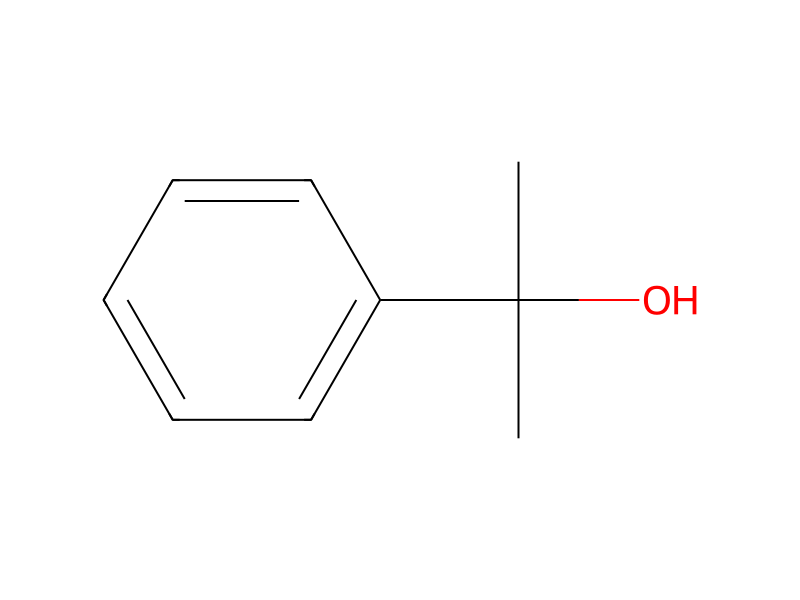
기본 정보개요이름 및 식별자물성안전 및 규제화학 및 산업관련 반응화합물 노트
부분 구조 검색유사 구조 찾기

기본 정보

CAS
617-94-7
표준 SMILES
CC(C)(O)c1ccccc1
InChIKey
BDCFWIDZNLCTMF-UHFFFAOYSA-N
분자식
C9H12O
평균 분자량
136.19 g/mol
단동위원소 질량
136.088815

개요

2-phenylpropan-2-ol is a tertiary alcohol that is isopropanol in which the hydrogen attached to the carbon bearing the hydroxy group has been replaced by a phenyl group. It has a role as a Mycoplasma genitalium metabolite and a human xenobiotic metabolite. It is a member of benzyl alcohols and a tertiary alcohol. It derives from a hydride of a cumene.

이름 및 식별자

우선 이름
2-Phenyl-2-propanol
IUPAC
2-phenylpropan-2-ol
현지명
2-페닐-2-프로판올
영어명
2-Phenyl-2-propanol
분자식
C9H12O
분자량
136.19

이름 및 동의어

2-Phenyl-2-propanol2-Phenylpropan-2-ol617-94-7Dimethylphenylcarbinol1-Hydroxycumenealpha-Cumyl alcoholDimethylphenylmethanol2-PHENYLISOPROPANOLPhenyldimethylcarbinol2-Propanol, 2-phenyl-alpha,alpha-DimethylbenzenemethanolDTXSID3027247
이름 더 보기
2-페닐-2-프로판올2-펜닐-2-프로판올Benzenemethanol, .alpha.,.alpha.-dimethyl-Benzenemethanol, α,α-dimethyl-α-Cumyl alcohol2-phenyl-2-propano2-phenyl-propan-2-ol2-Phenyl-2-propanol (2-Phenylisoprapanol)
2-phenylpropanol-2Benzyl alcohol, alpha,alpha-dimethyl-Benzenemethanol, alpha,alpha-dimethyl-JE030BGE05DTXCID107247CHEBI:131607RefChem:478192210-539-5

데이터베이스 식별자

CAS
617-94-7
PubChem CID
12053
DTXSID
DTXSID3027247
ChEMBL
CHEMBL3185495
ChEBI
CHEBI:131607
UNII
JE030BGE05
EC Number
210-539-5
Nikkaji
J28.650H

물성

구조 계산 물성보충 중

XLogP
1.8
극성 표면적
20.2 Ų
수소 결합 공여자 수
1
수소 결합 수용자 수
1
회전 가능 결합 수
1
무거운 원자 수
10
형식 전하
0
복잡도
101

실험 및 물리화학적 성질

PolymersOther Classes -> Alcohols and Polyols, Other
SpringerMaterials Properties13C nuclear magnetic resonance spectrum
Density · 2건

0.9735 @ 20 °C/4 °C

0.9735 @ 20°C

Flavoring AgentsEU Flavoring substances
Color/FormPRISMS
SolubilityINSOL IN WATER; SOL IN ETHANOL, ETHER, BENZENE
Corrosivity · 1건

The /process/ of corrosion was studied at several points along the flow in a biological treatment facility for phenolic waters. The waters contained phenol, sulfate, isopropylbenzene hydroperoxide, butylphenol, dimethylphenylcarbinol and other organic substances. Sulfate has been reduced by the action of Desulfovibrio desulfuricans. The rate of corrosion was assessed quantitatively using gravimetric and penetration indices, qualitatively by macroscopic observation. The rate of corrosion on carbon steel ranged from 0.04 to 0.8 g/sq m/hr where local forms of corrosion were detected. ...

Boiling Point · 2건

202 °C @ 760 MM HG

202 °C @760 [mm Hg]

안전 및 규제

안전 정보는 참고용이며, 공급업체의 물질안전보건자료(SDS), 관련 법규 및 전문가 평가를 대체하지 않습니다.

GHS 분류

GHS Classification · 6건

This chemical does not meet GHS hazard criteria for 1.2% (24 of 1959) of reports.

Warning

H302 (98.8%): Harmful if swallowed [Warning Acute toxicity, oral]

P264, P264+P265, P270, P280, P301+P317, P302+P352, P305+P351+P338, P321, P330, P332+P317, P337+P317, P362+P364, and P501 (click each P-code to see the statement)

Aggregated GHS information provided per 1959 reports by companies from 12 notifications to the ECHA C&L Inventory. Each notification may be associated with multiple companies.

Danger

유해성 정보

Regulatory Information · 5건

Chemical: Benzenemethanol, .alpha.,.alpha.-dimethyl-

Commission Regulation (EC) No 1565/2000 (Repealed by Com. Implementing Reg. (EU) No 872/2012)

Benzenemethanol, .alpha.,.alpha.-dimethyl- is listed on the EPA's Chemical Data Reporting (CDR) system. Manufacturers and importers of Benzenemethanol, .alpha.,.alpha.-dimethyl- are required to report information about their production and use of this chemical to the EPA under the Toxic Substances Control Act (TSCA). (40 eCFR Part 711)

Status: Active Update: 30-04-2019 https://echa.europa.eu/registration-dossier/-/registered-dossier/10103

2-Phenyl-2-propanol: Does not have an individual approval but may be used under an appropriate group standard

Hazards Summary · 1건

Higher alcohols are not highly toxic in the industrial setting; Can cause liver injury, somnolence, and respiratory depression in experimental animals; [HSDB] Caused somnolence and changes in liver enzymes in inhalation study of rats; [RTECS] An irritant; [MSDSonline]

Special ReportsPereira WE et al; Environ Sci Technol 16 (7): 387-96 (1982). Characterization of organic contaminants in environmental samples associated with Mount St. Helens 1980 volcanic eruption.
Hazard Classes and Categories · 2건

화학 및 산업

약리 정보

Metabolism/Metabolites · 2건

DIMETHYLPHENYLCARBINOL IS A METABOLITE OF ISOPROPYLBENZENE.

The enantioselective metabolism of cumene was studied in rabbits. The major metabolites identified /in urine/ were 2-phenyl-2-propanol, (R)-(+)-2-phenyl-1-propanol, (S)-(+)-2-phenylpropanoic acid and (R)-(-)-2-hydroxy-2-phenylpropanoic acid. Based on these metabolites, two routes of cumene metabolism were /noted/.

용도 및 제조

Uses · 4건

Used as a solvent, chemical intermediate, and flotation frother; [HSDB]

Metal Extraction and Refining [Category: Industry]

SOLVENT; CHEM INT

As a flotation frother.

U.S. Production2023: 250,000 - <400,000 lb
Industry UsesIntermediate
General Manufacturing Information · 2건

All Other Basic Organic Chemical Manufacturing

Benzenemethanol, .alpha.,.alpha.-dimethyl-: ACTIVE

응용 분야

용도2-Phenyl-2-propanol is an important raw material and intermediate used in organic synthesis, pharmaceuticals, agrochemicals and dyestuff.

상·하류 제품 정보

상류 원료

디에틸에테르벤조산에틸에스테르요오드 메탄2-페닐프로필렌산화물

관련 반응

75건
반응 기록 만들기
HRID 18859 반응식
HRID 18859생성물로uspto-grants-2010_06
HRID 18860 반응식
HRID 18860생성물로uspto-grants-2010_06
HRID 18861 반응식
HRID 18861생성물로uspto-grants-2010_06
HRID 23828 반응식
HRID 23828생성물로uspto-grants-2005_02
HRID 42549 반응식
HRID 42549반응물로uspto-grants-2013_09
HRID 66633 반응식
HRID 66633반응물로uspto-grants-1982_08
HRID 147748 반응식
HRID 147748생성물로Training data from https://doi.org/10.1039/C8SC04228D (9/10)
HRID 153013 반응식
HRID 153013생성물로반응물로Training data from https://doi.org/10.1039/C8SC04228D (9/10)
1 / 10 페이지

화합물 노트

불러오는 중…

이 페이지에서기본 정보개요이름 및 식별자물성안전 및 규제화학 및 산업관련 반응화합물 노트
더보기
새 노트새 반응견적 요청하기
Melting Point
36 °C
Vapor Pressure · 2건

Vapor pressure = 0.52 mm Hg at 37.8 °C

0.52 [mm Hg] @37 °C

Refractive IndexINDEX OF REFRACTION: 1.5325 @ 20 °C/D
Physical Description · 2건

CBI; Liquid

Solid; [HSDB] Yellow liquid; mp = 32-34 deg C; [MSDSonline]

물리화학적 성질

녹는점
28 · 28-32 °C (lit.)
끓는 점
202 °C · 202 °C (lit.)
밀도
0.973 g/mL · 0.973 g/mL at 25 °C (lit.)
증기압
23 Pa · 23Pa at 20℃
굴절률
20 · n20/D 1.5196(lit.)
인화점
190 °F · 190 °F
저장 조건
Sealed in dry,Room Temperature
용해도
에 용해됨클로로포름, 메탄올 (약간 용해됨)
물리적 상태
녹은 후에 액체
산도 계수 (pKa)
14.49 · 14.49±0.29(Predicted)
색상
무색투명~연황색
냄새
100 %에서 · 100.00%에서. 온화한 녹색 달콤한 흙빛
냄새 유형
녹색
수용성
물에 불용성.
BRN
1905012 · 1905012
Henry's Law Constant
2 · 2.0×101 mol/(m3Pa) at 25℃, Wang et al. (2017)
화장품 원료 기능
향수
LogP
1.89 at · 1.89 at 25℃
EPA
2 · 2-Phenyl-2-propanol (617-94-7)

화학적 성질

clear colorless to yellow liquid after melting

Acute Tox. 4 (98.8%)

Acute toxicity (Oral) - Category 4

안전 및 보호

Disposal Methods · 1건

SRP: At the time of review, criteria for land treatment or burial (sanitary landfill) disposal practices are subject to significant revision. Prior to implementing land disposal of waste residue (including waste sludge), consult with environmental regulatory agencies for guidance on acceptable disposal practices.

Protective Action Criteria (PAC) · 3건

3.1 [mg/m3]

34 [mg/m3]

210 [mg/m3]

독성 정보

Environmental Fate · 3건

TERRESTRIAL FATE: Based on a recommended classification scheme(1), estimated Koc values of 36 to 270(SRC), determined from a structure estimation method(2), and an estimated log Kow(3,SRC) with a recommended regression-derived equation(5), indicate that 2-phenylisopropanol will have medium to very high mobility in soil(SRC). Volatilization of 2-phenylisopropanol may not be important from moist soil surfaces(SRC) given an estimated Henry's Law constant of 3.8X10⁻⁷ atm-cu m/mole(4,SRC), but may be important from dry soil surfaces(SRC) based on an estimated vapor pressure of 0.047 mm Hg at 25 °C(5,SRC) and a measured vapor pressure of 0.52 mm Hg at 37.8 °C(7). According to a Zahn-Wellens test, 2-phenylisopropanol will biodegrade readily in soil(6).

AQUATIC FATE: Based on a recommended classification scheme(1), estimated Koc values of 36 to 270(SRC), determined from a structure estimation method(2), and an estimated log Kow(3,SRC) with a recommended regression-derived equation(5), indicate that 2-phenylisopropanol has the potential to adsorb to suspended solids and sediment(SRC) in the water. 2-Phenylisopropanol should not volatilize from water surfaces based on an estimated Henry's Law constant of 3.8X10⁻⁷ atm-cu m/mole(SRC), developed using a fragment constant estimation method(4). An estimated BCF value of 18(4,SRC), from an estimated log Kow(3,SRC), suggests that 2-phenylisopropanol will not bioconcentrate in aquatic organisms(SRC) according to a recommended classification scheme(6). According to a Zahn-Wellens test, 2-phenylisopropanol will biodegrade readily in water(7). 2-Phenylisopropanol may undergo reaction with photochemically produced hydroxyl radicals in water(8) with a half-life of approximately 170 days(8,9,SRC).

ATMOSPHERIC FATE: According to a suggested classification scheme(1), an estimated vapor pressure of 0.047 mm Hg at 25 °C(2,SRC) indicates that 2-phenylisopropanol will exist in the vapor phase in the ambient atmosphere. Vapor-phase 2-phenylisopropanol is degraded in the atmosphere by reaction with photochemically produced hydroxyl radicals(SRC); the half-life for this reaction in air is estimated to be about 3 days(3,SRC).

Food Survey Values2-Phenylisopropanol has been qualitatively identified in corbicula(1).
Adverse EffectsNeurotoxin - Acute solvent syndrome
Effluent Concentrations · 1건

2-Phenylisopropanol has been detected in wastewater from the organics and plastics (23 ng/ul extract) and transportation equipment (2513 ng/ul extract) industries(1). At the Northeast Sewage Treatment plant located on the Delaware River near Philadelphia, 2-phenylisopropanol was detected at 70 ppb in the inflow, at 70 ppb in the outflow, at 2 ppb 2 miles upstream, and at 0.5 ppb one mile downstream(2). 2-Phenylisopropanol has been qualitatively identified in advanced waste treatment water from Orange County, CA(3).

Soil Adsorption/Mobility · 1건

Using a structure estimation method based on molecular connectivity indexes(1), the Koc for 2-phenylisopropanol can be estimated to be about 36(SRC). The Koc of 2-phenylisopropanol can also be estimated to be approximately 274(SRC), using an estimated log Kow of 1.95(2,SRC) and a regression-derived equation(3,SRC). According to a recommended classification scheme(4), these estimated Koc values suggest that 2-phenylisopropanol has very high to medium mobility in soil(SRC).

TSCA Test Submissions · 5건

2-Phenyl-2-propanol (CAS # 617-94-7) was evaluated for acute oral toxicity. The LD50 was determined to range from 1,400 to 3,000 mg/kg. No further information was submitted.

2-Phenyl-2-propanol (CAS # 617-94-7) was evaluated for dermal sensitization. Fifty-five human subjects received 24 hour exposures to test patches 3 times a week for 3 weeks and a challenge patch in the 6th week. There was little or no primary irritation. There was an indication of skin sensitization in 7 of the 55 subjects, and equivocal evidence of sensitization in 10 other subjects.

2-Phenyl-2-propanol (CAS # 617-94-7) was evaluated for primary dermal irritation. Daily application of the test substance to the skin of guinea pigs produced mild primary irritation. No further information was submitted.

2-Phenyl-2-propanol (CAS # 617-94-7) was evaluated for primary dermal irritation. Daily application of the test substance to the skin of rabbits produced mild primary irritation. No further information was submitted.

For more TSCA Test Submissions (Complete) data for 2-PHENYLISOPROPANOL (6 total), please visit the HSDB record page.

Artificial Pollution Sources2-Phenylisopropanol's production and use as a flotation frother(1) may result in its release to the environment through various waste streams(SRC).
Environmental Biodegradation · 2건

Using the Zahn-Wellens test, 2-phenylisopropanol biodegraded completely in 9 days(1).

Nine strains of non-pathogenic gram negative soil bacteria able to degrade dimethylphenylcarbinol ... a component of the wastes from phenol production, were selected. The dynamics of degradation of this substrate and changes in the UV spectra of the growth medium typical of all the strains obtained are described for the strain Pseudomonas putida GFS-106. This strain, which is also able to degrade phenol, was successfully used for the purification of phenolic wastes. It is shown that the culture liquid after complete dimethylphenylcarbinol by strains cultivated on a mineral medium is less toxic for some microorganisms than the initial soln of this cmpd.

Environmental Bioconcentration · 1건

An estimated BCF value of 18 was calculated for 2-phenylisopropanol(SRC), using an estimated log Kow of 1.95(1,SRC) and a recommended regression-derived equation(2). According to a recommended classification scheme(3), this BCF value suggests that bioconcentration in aquatic organisms will not be an important fate process(SRC).

Volatilization from Water/Soil · 1건

The Henry's Law constant for 2-phenylisopropanol is estimated as 3.8X10⁻⁷ atm-cu m/mole(SRC) using a fragment constant estimation method(1). This value indicates that 2-phenylisopropanol will be essentially nonvolatile from water surfaces(2,SRC). 2-Phenylisopropanol's vapor pressure, 0.047 mm Hg(3,SRC) indicates that volatilization from dry soil surfaces may occur. However, 2-phenylisopropanol's Henry's Law constant(1,SRC) indicates that volatilization from moist soil may not occur(SRC).

Non-Human Toxicity Excerpts · 5건

THE ORAL LD50 VALUE OF DIMETHYLPHENYLCARBINOL WAS 1.950 G/KG IN MICE AND 2.250 G/KG IN RATS. THE CLINICAL TOXIC SYMPTOMS WERE SIMILAR TO THOSE OF CNS DEPRESSANTS. DERMATITIS WAS INDUCED IN GUINEA PIGS, AS WERE OCULAR BURNS IN RABBITS.

THE SENSITIVITY OF RATS AND MICE TO DIMETHYLPHENYLCARBINOL (I) WAS PRACTICALLY SIMILAR. I AFFECTED THE NERVOUS SYSTEM, LIVER, AND KIDNEYS. UNDER ACUTE INHALATION, I CAUSES A STEADY DECREASE IN THE PEROXIDASE ACTIVITY AND INCREASE IN THE BLOOD CHOLINESTERASE IN RATS. CHRONIC I INCREASED THE NUMBER OF LEUKOCYTES SUBSTANTIALLY, REDUCED HEMOGLOBIN CONTENT OF THE BLOOD, AND INCREASED THE ACTIVITY OF AMINOTRANSFERASE.

Eye irritation score of 5 /From table/

Skin irritation score of 3 /From table/

Maximum inhalation exposure of saturated vapor with no mortality = 8 hours /From table/

Environmental Abiotic Degradation · 1건

The rate constant for the vapor-phase reaction of 2-phenylisopropanol with photochemically produced hydroxyl radicals has been estimated as 5.5X10⁻¹² cu cm/molecule-sec at 25 °C(SRC) using a structure estimation method(1,SRC). This corresponds to an atmospheric half-life of about 3 days at an atmospheric concentration of 5X10+5 hydroxyl radicals per cu cm(1,SRC). The rate constant for the reaction between photochemically produced hydroxyl radicals in water and 2-phenylisopropanol is 4.6X10+9 L/mole-sec(2); assuming that the concentration of hydroxyl radicals in brightly sunlit natural water is 1X10-17 M(3), the half-life would be about 174 days(SRC).

안전 데이터

wgk
3
tsca
TSCA listed
rtecs
DO4562000
ridadr
1325
HS 번호
2906299090
risk_code
22-36/37/38
hazard_code
Xn,Xi
safety_code
26-36
기존화학 물질
KE-11212
위험 참고 사항
Irritant
유해 물질 데이터
617-94-7(Hazardous Substances Data)
안식향산메틸
큐멘하이드로퍼옥사이드
알파-메틸 스타이렌

하류 제품

요오드시클로헥산1H-Azepine-1-carbothioic acid, hexahydro-, S-(1-methyl-1-phenylethyl) ester알파,알파-디메틸벤질클로라이드3,3-diMethylbenzo[c][1,2]oxaborol-1(3H)-ol3,3-디메틸프탈라이드

추가 설명

정의ChEBI: A tertiary alcohol that is isopropanol in which the hydrogen attached to the carbon bearing the hydroxy group has been replaced by a phenyl group.