골수펩티드
Myelopeptides
HCID 123792
기본 정보
- CAS
137833-32-0- 표준 SMILES
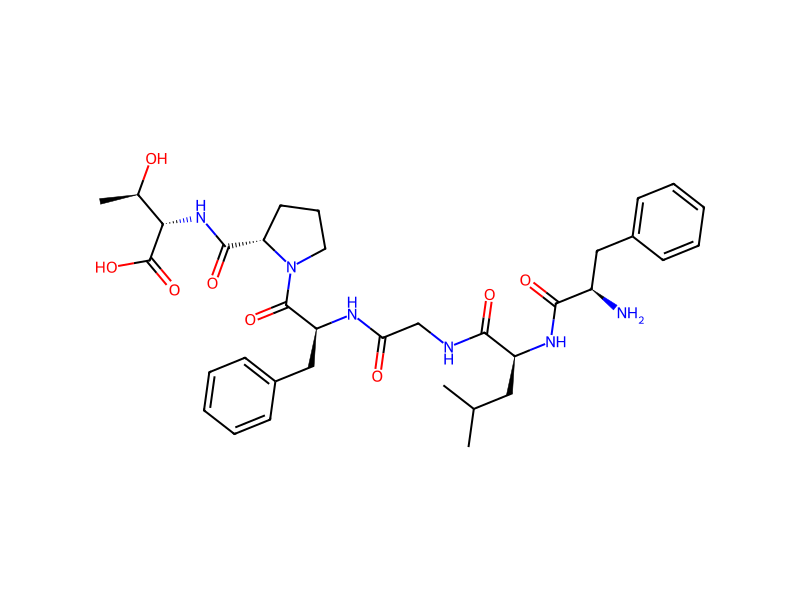
CC(C)C[C@H](NC(=O)[C@H](N)Cc1ccccc1)C(=O)NCC(=O)N[C@@H](Cc1ccccc1)C(=O)N1CCC[C@H]1C(=O)N[C@H](C(=O)O)[C@@H](C)O- InChIKey
GJQDTIRGBUXHLF-PKNHJBQWSA-N- 분자식
- C35H48N6O8
- 평균 분자량
- 680.8 g/mol
- 단동위원소 질량
- 680.35336251
개요
RN refers to myelopeptide 1; immune system peptides from bone marrow; act as analgesics and immunoregulators; MP-1 to MP-4 have been sequenced
이름 및 식별자
- 우선 이름
- Myelopeptides
- IUPAC
- (2S,3R)-2-[[(2S)-1-[(2S)-2-[[2-[[(2S)-2-[[(2R)-2-amino-3-phenylpropanoyl]amino]-4-methylpentanoyl]amino]acetyl]amino]-3-phenylpropanoyl]pyrrolidine-2-carbonyl]amino]-3-hydroxybutanoic acid
- 현지명
- 골수펩티드
- 영어명
- myelopeptides
- 분자식
- C35H48N6O8
- 분자량
- 680.79
이름 및 동의어
myelopeptidesMP-1 PeptideMP-2 PeptideMP-3 Peptide137833-32-0DTXSID20160337RefChem:160348DTXCID4082828Myelopeptide 1Myelopeptide 2Myelopeptide 3Myelopeptide (sap)
이름 더 보기
골수펩티드L-Threonine, L-phenylalanyl-L-leucylglycyl-L-phenylalanyl-L-prolyl-
MP-4 Peptide(2S,3R)-2-[[(2S)-1-[(2S)-2-[[2-[[(2S)-2-[[(2R)-2-amino-3-phenylpropanoyl]amino]-4-methylpentanoyl]amino]acetyl]amino]-3-phenylpropanoyl]pyrrolidine-2-carbonyl]amino]-3-hydroxybutanoic acidSCHEMBL29429570D-Phenylalanyl-L-leucylglycyl-L-phenylalanyl-L-prolyl-L-threonine
데이터베이스 식별자
- CAS
137833-32-0- PubChem CID
- 123792
- DTXSID
DTXSID20160337
물성
구조 계산 물성
- XLogP
- -0.5
- 극성 표면적
- 220 Ų
- 수소 결합 공여자 수
- 7
- 수소 결합 수용자 수
- 9
- 회전 가능 결합 수
- 17
- 무거운 원자 수
- 49
- 형식 전하
- 0
- 복잡도
- 1,140
물리화학적 성질
- 끓는 점
- 1074.3 · 1074.3±65.0 °C(Predicted)
- 밀도
- 1.27 · 1.270±0.06 g/cm3(Predicted)
- 산도 계수 (pKa)
- 3.28 · 3.28±0.10(Predicted)
화학 및 산업
약리 정보
MeSH Pharmacological Classification
Substances that augment, stimulate, activate, potentiate, or modulate the immune response at either the cellular or humoral level. The classical agents (Freund's adjuvant, BCG, Corynebacterium parvum, et al.) contain bacterial antigens. Some are endogenous (e.g., histamine, interferon, transfer factor, tuftsin, interleukin-1). Their mode of action is either non-specific, resulting in increased immune responsiveness to a wide variety of antigens, or antigen-specific, i.e., affecting a restricted type of immune response to a narrow group of antigens. The therapeutic efficacy of many biological response modifiers is related to their antigen-specific immunoadjuvanticity.
Compounds capable of relieving pain without the loss of CONSCIOUSNESS.
Biologically active substances whose activities affect or play a role in the functioning of the immune system.
관련 반응
0건
아직 관련 반응이 없습니다