
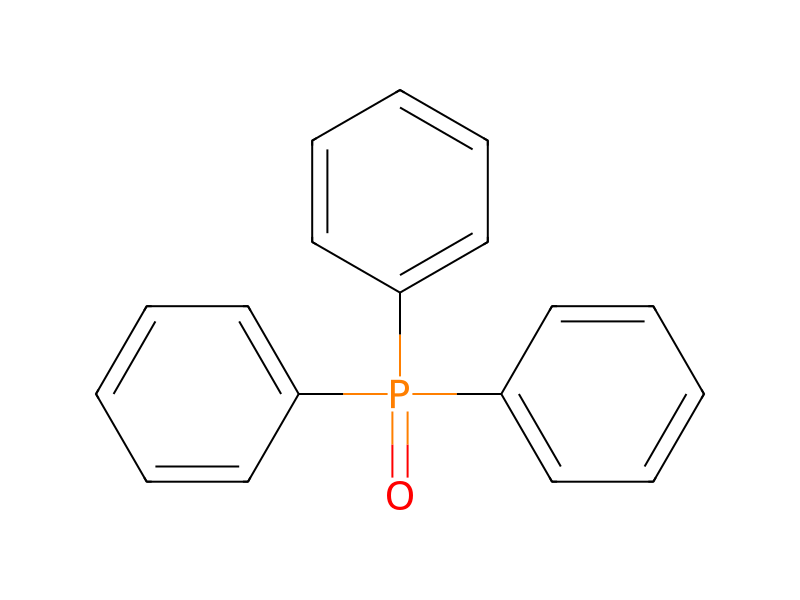
기본 정보
- 표준 SMILES
O=P(c1ccccc1)(c1ccccc1)c1ccccc1- InChIKey
FIQMHBFVRAXMOP-UHFFFAOYSA-N- 분자식
- C18H15OP
- 평균 분자량
- 278.3 g/mol
- 단동위원소 질량
- 278.0860521
이름 및 식별자
- 우선 이름
- Triphenylphosphine Oxide
- IUPAC
- diphenylphosphorylbenzene
- 현지명
- 트리페닐포스핀 옥사이드
- 영어명
- Triphenylphosphine oxide
- 분자식
- C18H15OP
- 분자량
- 278.28
이름 및 동의어
TRIPHENYLPHOSPHINE OXIDE791-28-6Phosphine oxide, triphenyl-Triphenyl phosphine oxideTriphenyl phosphorus oxideDTXSID2022121TRIPHENYLPHOSPHINE MONOXIDEZ69161FKI3phosphorane, triphenyl-, oxideDTXCID402121NSC-398RefChem:191910
이름 더 보기
트라이페닐포스파인옥사이드산화트라이페닐포스핀트리페닐포스핀옥사이드산화트라이페닐포스핀트라이페닐포스파인 옥사이드다이(페닐)포스포릴벤젠트라이페닐인 옥사이드트라이페닐포스핀 모노옥사이드트라이페닐포스핀 산화물TPOTTPO(C6H5)3P=OOrlistat Related CoMpound CTriphenylphosphinoxidTrisphenylphosphine oxide
212-338-8triphenylphosphane oxidediphenylphosphorylbenzeneTriphenylphosphineoxide(diphenylphosphoroso)benzeneTPPOPH3PONSC 398
데이터베이스 식별자
- CAS
791-28-6- PubChem CID
- 13097
- DTXSID
DTXSID2022121- ChEMBL
CHEMBL482091- ChEBI
CHEBI:36601- UNII
- Z69161FKI3
- EC Number
- 212-338-8
- Nikkaji
- J541J
물성
구조 계산 물성
- XLogP
- 2.8
- 극성 표면적
- 17.1 Ų
- 수소 결합 공여자 수
- 0
- 수소 결합 수용자 수
- 1
- 회전 가능 결합 수
- 3
- 무거운 원자 수
- 20
- 형식 전하
- 0
- 복잡도
- 281
실험 및 물리화학적 성질
Physical DescriptionSolid; [IUCLID] Beige crystalline solid; [Aldrich MSDS]
Kovats Retention Index2561;2576
Collision Cross Section
162.9 Ų [M+H]+ [CCS Type: DT; Buffer gas: N2; Ionization: ESI+; Dataset: TOXCAST; Source Identifier: DTXSID2022121];163.0 Ų [M+H]+ [CCS Type: DT; Buffer gas: N2; Ionization: APCI+; Dataset: TOXCAST; Source Identifier: DTXSID2022121];182.6 Ų [M+Na]+ [CCS Type: DT; Buffer gas: N2; Ionization: ESI+; Dataset: TOXCAST; Source Identifier: DTXSID2022121]
물리화학적 성질
- 녹는점
- 150 · 150-157 °C(lit.)
- 끓는 점
- 360 °C · 360 °C
- 밀도
- 1 · 1,212 g/cm3
- 증기압
- 1 hPa · <1 hPa (50 °C)
- 인화점
- 180 °C · 180 °C
- 저장 조건
- 30 °C · Store below +30°C.
- 용해도
- 25 mg/mL, · 메탄올: 25mg/mL, 투명
- 물리적 상태
- 결정질 분말 또는 플레이크
- Specific Gravity
- 1.212 · 1.212
- 색상
- 흰색에서 분홍색 갈색
- 수용성
- 약간 용해됨
- BRN
- 745854 · 745854
- Henry's Law Constant
- 1.9 · 1.9×104 mol/(m3Pa) at 25℃, Zhang et al. (2010)
- 주요 응용
- 제약
- InChI
- 1S/C18H15OP/c19-20(16-10-4-1-5-11-16,17-12-6-2-7-13-17)18-14-8-3-9-15-18/h1-15H
- InChIKey
- FIQMHBFVRAXMOP-UHFFFAOYSA-N
- SMILES
- O=P(c1ccccc1)(c2ccccc2)c3ccccc3
- LogP
- 2.8 · 2.8
- NIST
- (C6H5)3PO(791-28-6)
- EPA
- Triphenylphosphine oxide (791-28-6)
화학적 성질
White solid
안전 및 규제
GHS 분류
GHS Classification
This chemical does not meet GHS hazard criteria for 2% (5 of 245) of reports.
Warning
H302 (98%): Harmful if swallowed [Warning Acute toxicity, oral];H315 (18%): Causes skin irritation [Warning Skin corrosion/irritation];H319 (18.4%): Causes serious eye irritation [Warning Serious eye damage/eye irritation];H335 (18%): May cause respiratory irritation [Warning Specific target organ toxicity, single exposure; Respiratory tract irritation];H412 (96.3%): Harmful to aquatic life with long lasting effects [Hazardous to the aquatic environment, long-term hazard]
P261, P264, P264+P265, P270, P271, P273, P280, P301+P317, P302+P352, P304+P340, P305+P351+P338, P319, P321, P330, P332+P317, P337+P317, P362+P364, P403+P233, P405, and P501 (click each P-code to see the statement)
Aggregated GHS information provided per 245 reports by companies from 12 notifications to the ECHA C&L Inventory. Each notification may be associated with multiple companies.;Reported as not meeting GHS hazard criteria per 5 of 245 reports by companies.;There are 11 notifications provided by 240 of 245 reports by companies with hazard statement code(s).;Information may vary between notifications depending on impurities, additives, and other factors. The percentage value in parenthesis indicates the notified classification ratio from companies that provide hazard codes. Only hazard codes with percentage values above 10% are shown. For more detailed information, please visit ECHA C&L website.
유해성 정보
Regulatory Information
Chemical: Phosphine oxide, triphenyl-
Regulation (EC) No 1831/2003 (amended)
Status: Active Update: 10-10-2019 https://echa.europa.eu/registration-dossier/-/registered-dossier/25368;Status: Active Update: 05-09-2016 https://echa.europa.eu/registration-dossier/-/registered-dossier/17507
Triphenylphosphine oxide: Does not have an individual approval but may be used under an appropriate group standard
Hazards Summary
Causes convulsions, aggression, and dyspnea in oral lethal-dose studies of dogs (LD50 = 500 mg/kg); [RTECS] Causes liver injury in 3-month feeding study of dogs at 2,000 ppm; [IUCLID] An irritant; Harmful by ingestion; Targets nerves; [Aldrich MSDS] See Triphenylphosphine.
Hazard Classes and Categories
Acute Tox. 4 (98%);Skin Irrit. 2 (18%);Eye Irrit. 2 (18.4%);STOT SE 3 (18%);Aquatic Chronic 3 (96.3%)
Acute toxicity (Oral) - Category 4;Specific target organ toxicity - Single exposure - Category 2 (central nervous system);Specific target organ toxicity - Repeated exposure - Category 2 (liver);Hazardous to the aquatic environment (Acute) - Category 3;Hazardous to the aquatic environment (Long-term) - Category 3
독성 정보
Adverse EffectsNeurotoxin - Other CNS neurotoxin;Occupational hepatotoxin - Secondary hepatotoxins: the potential for toxic effect in the occupational setting is based on cases of poisoning by human ingestion or animal experimentation.
RAIS Toxicity Values
0.02
PPRTV Current
0.02
PPRTV Current
EPA Provisional Peer-Reviewed Toxicity Values
Triphenylphosphine Oxide
2 x 10^-2 mg/kg-day
2 x 10^-2 mg/kg-day
PDF Document
Inadequate information to assess carcinogenic potential
2007
Hazard Quotient Level 0.1 or Cancer Risk Level 1E-06
1.30e+03
1.60e+04
3.60e+02
5.00e+01
1.50e+00
2.00e-02
Hazard Quotient Level 3 or Cancer Risk Level 1E-04
3.80e+03
4.90e+04
1.10e+03
5.00e+01
2.00e-02
Volatile
규제 정보
Regulatory Information
Chemical: Phosphine oxide, triphenyl-
Regulation (EC) No 1831/2003 (amended)
Status: Active Update: 10-10-2019 https://echa.europa.eu/registration-dossier/-/registered-dossier/25368;Status: Active Update: 05-09-2016 https://echa.europa.eu/registration-dossier/-/registered-dossier/17507
Triphenylphosphine oxide: Does not have an individual approval but may be used under an appropriate group standard
안전 데이터
- wgk
- 2
- tsca
- TSCA listed
- rtecs
- SZ1676000
- ridadr
- 3077
- 독성
- LD50 orally in Rabbit: 685 mg/kg
- HS 번호
- 29310095
- risk_code
- 22-36/37/38-52/53
- hazard_code
- Xn,Xi
- safety_code
- 26-61-36
- 포장분류
- III
- 위험 등급
- 9
- 기존화학 물질
- KE-34741
- 자연 발화 온도
- 590 °C
- Hazard Classifications
- Acute Tox. 4 OralAquatic Chronic 3
- 스토리지 클래스
- 11 - Combustible Solids
화학 및 산업
용도 및 제조
UsesUsed for processing (extraction, separation, and spectrophotometric determination) environmental samples of cadmium and mercury; [ChemIDplus]
General Manufacturing InformationPhosphine oxide, triphenyl-: ACTIVE
응용 분야
개요Triphenylphosphine oxide (TPPO) is a coordinating solvent used to activate crystallization of chemical compounds. It has been used in flame retardant applications, as an epoxy cure catalyst, and more recently, to produce nanostructures.
용도Triphenylphosphine oxide is a phosphine ligand used for coupling reactions, epoxidations, and Michael reactions
상·하류 제품 정보
상류 원료
하류 제품
공급사50 곳
国药集团化学试剂有限公司86-21-63210123 · [email protected]
梯希爱(上海)化成工业发展有限公司021-67121386 · [email protected]
衢州润东化工有限公司0570-8789886 18892685668 · [email protected]
上海阿拉丁生化科技股份有限公司400-6206333 13167063860 · [email protected]
艾特(浙江)供应链管理有限公司15553101207 18615619105
上海煦邦医药科技有限公司13020239911 13020239911
爱斯特(成都)生物制药股份有限公司+86-28-85122536 85324413 · [email protected]
上海如吉生物科技发展有限公司+86-21-65211385-8001 36031160 · [email protected]
南京兰亚化工贸易有限公司+86-25-8331-5620 · [email protected]
韶远科技(上海)有限公司021-50795510 4000665055 · [email protected]
科瑞迪化学400-821-5857 021-64326257 · [email protected]
Syntechem Co.,Ltd[email protected]
上海迈瑞尔生化科技有限公司4006356688 18621169109 · [email protected]
阿法埃莎(中国)化学有限公司400-6106006 · [email protected]
安耐吉化学&3A(安徽泽升科技股份有限公司)400-0056266 · [email protected]
上海臣莱化工科技有限公司18717782967 · [email protected]
上海瀚鸿科技股份有限公司021-54306202 13764082696 · [email protected]
上海柯维化学技术有限公司021-64609169 18901607656 · [email protected]
上海尚饮思生化医药有限公司021-021-57872719 13761402923 · [email protected]
嘉兴市艾森化工有限公司0573-85285100 18627885956 · [email protected]
池州捷峰生物科技有限公司0566-8928158 · [email protected]
武汉卓嘉科技有限公司027-51118240 18627830133;13476056444
上海长根化学科技有限公司021-69106814 13917161715
杭州东帆化学有限公司86-0571-85151182
孝感深远化工有限公司15527621225; 15527621225 · [email protected]
Beckmann-Kenko GmbH+49 4241 9308 88 · [email protected]
山东西亚化学有限公司13355009207 13355009207 · [email protected]
大赛璐药物手性技术(上海)有限公司021-50460086-9 15921403865 · [email protected]
玛雅试剂+86 (573) 82222445 (0)18006601000 452520369 · [email protected]
四川库利南科技有限公司400-1166-196 18981987031 · [email protected]
天津希恩思生化科技有限公司400 638 7771 · [email protected]
南京维奥化工有限公司Please Send Email 18652950785 · [email protected]
河南多贝化工有限公司0370-2785118 17550508557 · [email protected]
艾科试剂4008-755-333 18080918076 · [email protected]
上海思域化工科技有限公司86-21-34053660 · [email protected]
赛默飞世尔科技(中国)有限公司800-810-5118 · [email protected]
北京伊诺凯科技有限公司400-810-7969 010-59572699 · [email protected]
上海健超生物科技有限公司150-2103-5486 18017383231 · [email protected]
TOKYO CHEMICAL INDUSTRY CO., LTD.03-36680489 · [email protected]
上海贤鼎生物科技有限公司4009209199 · [email protected]
深圳振强药物研发有限公司0755-66853366 13670046396 · [email protected]
深圳康特腾科技有限公司86-0755-86635001 · [email protected]
越林试剂021-62960152 · [email protected]
北京环宇世纪化学科技有限公司hysj_bj.com
上海将来实业股份有限公司021-61552785 · [email protected]
安徽科迪达化工有限公司0554-2106669 · [email protected]
HBCChem, Inc.+1-510-219-6317 · [email protected]
上海笛柏生物科技有限公司400-008-9730,021-54359730 400-008-9730 · [email protected]
郑州阿尔法化工有限公司0371-53732842 15981811963 · [email protected]
青岛德达志成化工有限公司18766299236 · [email protected]
추가 설명
정의ChEBI: A phosphine oxide in which the substituents on phosphorus are three phenyl groups.
관련 반응
457건




연결된 노트
불러오는 중…