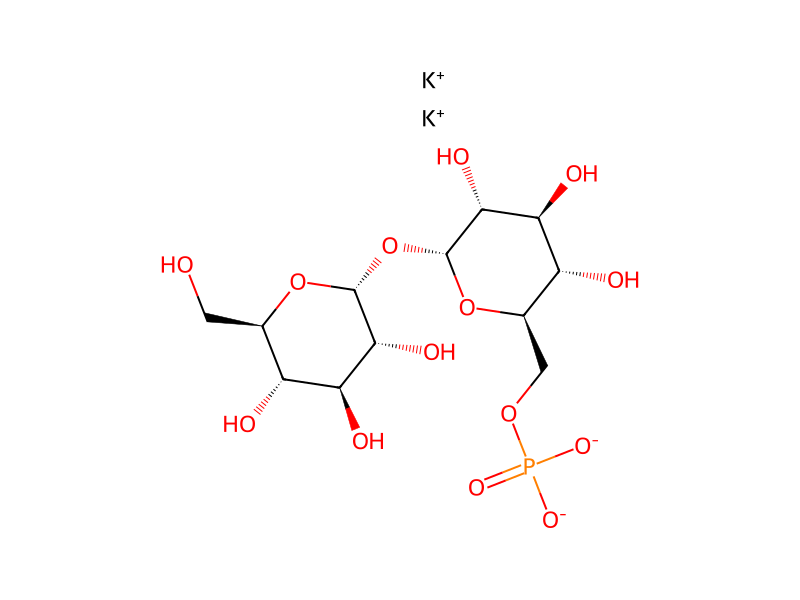
트레할로스6-인산이칼륨염
trehalose 6-phosphate dipotassium salt
HCID 132285186
데이터를 보충하는 중입니다. 잠시 후 페이지를 새로 고치면 최신 내용을 볼 수 있습니다
기본 정보
- CAS
136632-28-5- 표준 SMILES
O=P([O-])([O-])OC[C@H]1O[C@H](O[C@H]2O[C@H](CO)[C@@H](O)[C@H](O)[C@H]2O)[C@H](O)[C@@H](O)[C@@H]1O.[K+].[K+]- InChIKey
YKCUKYNZTFYPHM-PVXXTIHASA-L- 분자식
- C12H21K2O14P
- 평균 분자량
- 498.46 g/mol
- 단동위원소 질량
- 497.9943053
이름 및 식별자
- 우선 이름
- trehalose 6-phosphate dipotassium salt
- IUPAC
- dipotassium;[(2R,3S,4S,5R,6R)-3,4,5-trihydroxy-6-[(2R,3R,4S,5S,6R)-3,4,5-trihydroxy-6-(hydroxymethyl)oxan-2-yl]oxyoxan-2-yl]methyl phosphate
- 현지명
- 트레할로스6-인산이칼륨염
- 영어명
- TREHALOSE 6-PHOSPHATE DIPOTASSIUM SALT
- 분자식
- C12H21K2O14P
- 분자량
- 498.46
이름 및 동의어
Trehalose 6-phosphate dipotassium salt136632-28-5RefChem:898938635-058-1Tre6P (potassium)orb1694057orb2278598DTXSID501377340TREHALOSE6-PHOSPHATEDIPOTASSIUMSALTalpha,alpha-Trehalose 6-phosphate potassiumG77958T36081
이름 더 보기
트레할로스6-인산이칼륨염YKCUKYNZTFYPHM-CTDSUHBFSA-Ltrehalose-6-phosphate dipotassiumTrehalose 6-phosphate diammonium saltTrehalose 6-phosphate (potassium salt)Α-D-GLUCOPYRANOSYL Α-D-GLUCOPYRANOSIDE 6-(DIHYDROGEN PHOSPHATE)α-D-glucopyranosyl α-D-glucopyranoside 6-(dihydrogen phosphate)TREHALOSE 6-PHOSPHATE DIPOTASSIUM SALT(SALTDATA: dipotassium salt)Α-D-GLUCOPYRANOSYL Α-D-GLUCOPYRANOSIDE 6-(DIHYDROGEN PHOSPHATE)DIPOTASSIUM SALT[(2S,3R,4S,5S,6S)-3,4,5-trihydroxy-6-[(2S,3S,4S,5R,6S)-3,4,5-trihydroxy-6-(hydroxymethyl)tetrahydropyran-2-yl]oxy-tetrahydropyran-2-yl]methyl dihydrogen phosphate
T78471I+/--D-Glucopyranoside, I+/--D-glucopyranosyl, 6-(dihydrogen phosphate), potassium salt (1:2)
물성
구조 계산 물성보충 중
- 극성 표면적
- 242 Ų
- 수소 결합 공여자 수
- 7
- 수소 결합 수용자 수
- 14
- 회전 가능 결합 수
- 5
- 무거운 원자 수
- 29
- 형식 전하
- 0
- 복잡도
- 517
물리화학적 성질
- 녹는점
- 140 °C · >140°C (dec.)
- 저장 조건
- 20 °C · −20°C
- 용해도
- 물(약간 용해됨, 초음파 처리)
- 물리적 상태
- 고체
- 색상
- 흰색에서 옅은 갈색까지
- 안정성
- 흡습성
- 주요 응용
- 농업
- InChIKey
- KSPIKJRSOAXHOT-PVXXTIHASA-N
- SMILES
- [K].[H][C@@]1(O[C@H](CO)[C@@H](O)[C@H](O)[C@H]1O)O[C@H]2O[C@H](COP(O)(O)=O)[C@@H](O)[C@H](O)[C@H]2O
안전 및 규제
안전 정보는 참고용이며, 공급업체의 물질안전보건자료(SDS), 관련 법규 및 전문가 평가를 대체하지 않습니다.
GHS 분류
GHS Classification
Warning
H302 (100%): Harmful if swallowed [Warning Acute toxicity, oral]
P261, P264, P270, P271, P280, P301+P317, P302+P352, P304+P340, P317, P321, P330, P362+P364, and P501 (click each P-code to see the statement)
Aggregated GHS information provided per 39 reports by companies from 2 notifications to the ECHA C&L Inventory. Each notification may be associated with multiple companies.
유해성 정보
Hazard Classes and CategoriesAcute Tox. 4 (100%)
안전 데이터
- wgk
- 3
- risk_code
- 20/21/22-68/20/21/22-39/23/24/25-11
- hazard_code
- Xn,T,F
- safety_code
- 36/37
- Hazard Classifications
- Acute Tox. 3 DermalAcute Tox. 4 InhalationAcute Tox. 4 OralSTOT SE 1
- 스토리지 클래스
- 6.1C - Combustible acute toxic Cat.3toxic compounds or compounds which causing chronic effects
화학 및 산업
응용 분야
용도Trehalose is a natural non-reducing disaccharide found in plants, invertebrates, fungi, and bacteria. In addition to roles as an energy source and stress protectant, trehalose can function as a signaling molecule. Trehalose 6-phosphate is an intermediate in the biosynthesis of trehalose. It is generated from UDP-glucose and glucose 6-phosphate by trehalose 6-phosphate synthase (TPS or otsA). In plants, changes in trehalose 6-phosphate levels positively correlate with diurnal changes in sucrose and may regulate diverse processes, including starch degradation and flowering.
관련 반응
0건
아직 관련 반응이 없습니다