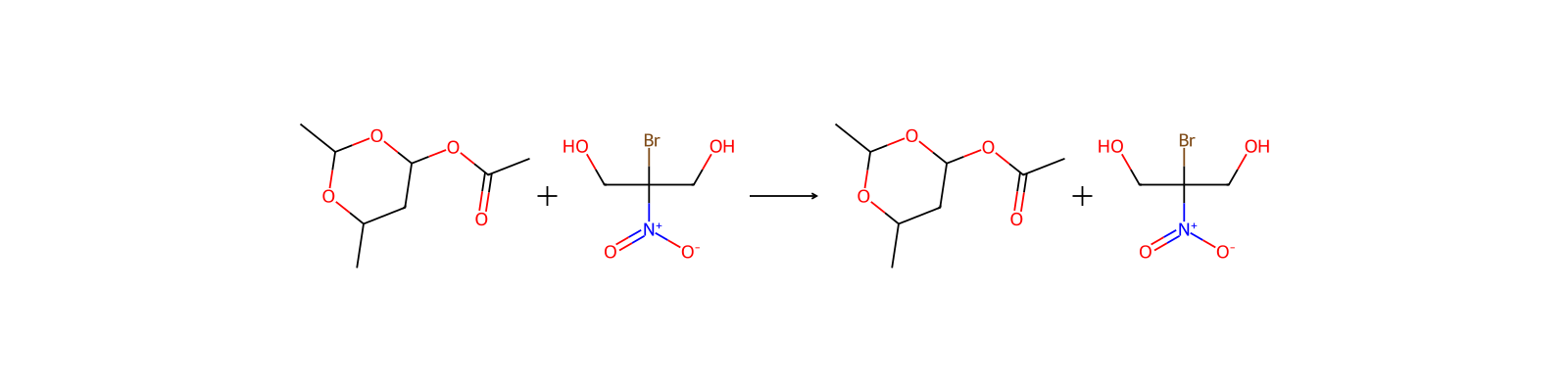

기본 정보
- 표준 SMILES
CC(=O)OC1CC(C)OC(C)O1- InChIKey
PHMNXPYGVPEQSJ-UHFFFAOYSA-N- 분자식
- C8H14O4
- 평균 분자량
- 174.19 g/mol
- 단동위원소 질량
- 174.08920893
개요
Dimethoxane is a clear light yellow to light amber slightly viscous liquid with a mustard-like odor. (NTP, 1992)
이름 및 식별자
- 우선 이름
- Dimethoxane
- IUPAC
- (2,6-dimethyl-1,3-dioxan-4-yl) acetate
- 현지명
- 디메톡산
- 영어명
- 2,6-DIMETHYL-1,3-DIOXAN-4-OL ACETATE
- 분자식
- C8H14O4
- 분자량
- 174.19
이름 및 동의어
DIMETHOXANE828-00-2AcetomethoxaneGIV Gard DXNDdoaGIV Gard DXN-COG1V Gard DXN1,3-Dioxan-4-ol, 2,6-dimethyl-, acetateAcetomethoxan6-Acetoxy-2,4-dimethyl-1,3-dioxane2,6-Dimethyl-1,3-dioxan-4-ol acetateNCI-C56213
이름 더 보기
디메톡산디메톡산(DIMETHOXANE)2,6-다이메틸-1,3-다이옥산-4-일아세테이트6-아세톡시-2,4-다이메틸-m-다이옥산다이메톡세인,o-아세톡시-2,4-다이메틸-m-다이옥세인2,6-디메틸-1,3-디옥산-4-올아세테이트givgarddxng1vgarddxngivgarddxn-codioxin(bactericide)(obs.)2,6-dimethyl-m-dioxan-4-oacetate
6-Acetoxy-2,4-dimethyl-m-dioxane2,4-Dimethyl-6-m-dioxanyl acetateDioxin (bactericide) (Obs.)2,6-Dimethyl-m-dioxan-4-ol acetate2,6-Dimethyl-m-dioxan-4-yl acetate2,4-Dimethyl-6-acetoxy-1,3-dioxaneDTXSID6020480m-Dioxan-4-ol, 2,6-dimethyl-, acetate
데이터베이스 식별자
- CAS
828-00-2- PubChem CID
- 13232
- DTXSID
DTXSID6020480- ChEMBL
CHEMBL1484947- ChEBI
CHEBI:82450- UNII
- S0859MSI8I
- EC Number
- 212-579-9
- Nikkaji
- J39.122K
물성
구조 계산 물성
- XLogP
- 1.1
- 극성 표면적
- 44.8 Ų
- 수소 결합 공여자 수
- 0
- 수소 결합 수용자 수
- 4
- 회전 가능 결합 수
- 2
- 무거운 원자 수
- 12
- 형식 전하
- 0
- 복잡도
- 168
실험 및 물리화학적 성질
Chemical ClassesOther Classes -> Esters, Other
OdorMUSTARD-LIKE ODOR
Density
1.0655 at 68 °F (NTP, 1992) - Denser than water; will sink
1.0655 @ 20 °C/4 DEG
Color/Form
LIQUID
CLEAR YELLOW TO LIGHT AMBER LIQUID
Solubility
Miscible (NTP, 1992)
MISCIBLE WITH WATER, MANY ORG SOLVENTS
Flash Point
142 °F (NTP, 1992)
61 °C
Boiling Point
367 °F at 760 mmHg (NTP, 1992)
74-75 °C @ 6 mm Hg
Melting Point
less than -13 °F (NTP, 1992)
FP: LESS THAN 25 °C
Vapor Pressure0.14 [mmHg]
Refractive IndexINDEX OF REFRACTION: 1.430 @ 20 °C/D
Physical Description
Dimethoxane is a clear light yellow to light amber slightly viscous liquid with a mustard-like odor. (NTP, 1992)
Liquid
Yellow liquid; [Hawley] Mustard-like odor; [Merck Index]
Stability/Shelf LifeHYDROLYZES IN AQ SOLN TO PRODUCE ACETIC ACID & CORRESPONDING FREE ALCOHOL
물리화학적 성질
- 녹는점
- -7.15 °C · -7.15°C
- 끓는 점
- 66 · 66-68 °C/3 mmHg(lit.)
- 밀도
- 1.067 g/mL · 1.067 g/mL at 25 °C(lit.)
- 굴절률
- 20 · n20/D 1.433(lit.)
- 인화점
- 52 °C · 52 °C
- 저장 조건
- -20 °C · Hygroscopic, -20°C Freezer, Under inert atmosphere
- 용해도
- 클로로포름, 에틸아세테이트에 용해됨
- 물리적 상태
- 기름
- 색상
- 노란색에서 호박색의 투명한 액체
- Merck
- 13 · 13,3250
- Henry's Law Constant
- 8 · 8.0×101 mol/(m3Pa) at 25℃, HSDB (2015)
- EPA
- Dimethoxane (828-00-2)
안전 및 규제
GHS 분류
GHS Classification
This chemical does not meet GHS hazard criteria for 15.5% (29 of 187) of reports.
Warning
H226 (48.7%): Flammable liquid and vapor [Warning Flammable liquids]
P203, P210, P233, P240, P241, P242, P243, P261, P264, P264+P265, P270, P271, P272, P280, P301+P317, P302+P352, P303+P361+P353, P304+P340, P305+P351+P338, P317, P318, P319, P321, P330, P332+P317, P333+P317, P337+P317, P362+P364, P370+P378, P403+P233, P403+P235, P405, and P501 (click each P-code to see the statement)
Aggregated GHS information provided per 187 reports by companies from 8 notifications to the ECHA C&L Inventory. Each notification may be associated with multiple companies.
Warning
유해성 정보
Regulatory Information
Chemical: 1,3-Dioxan-4-ol, 2,6-dimethyl-, acetate
1,3-Dioxan-4-ol, 2,6-dimethyl-, 4-acetate is listed on the EPA's Chemical Data Reporting (CDR) system. Manufacturers and importers of 1,3-Dioxan-4-ol, 2,6-dimethyl-, 4-acetate are required to report information about their production and use of this chemical to the EPA under the Toxic Substances Control Act (TSCA). (40 eCFR Part 711)
1,3-Dioxan-4-ol, 2,6-dimethyl-, acetate: Does not have an individual approval but may be used under an appropriate group standard
Other Safety InformationIMAP assessments - 1,3-Dioxan-4-ol, 2,6-dimethyl-, acetate: Environment tier I assessment
Fire HazardsThis chemical is combustible. (NTP, 1992)
Health HazardsSYMPTOMS: Symptoms of exposure to this compound may include irritation of the skin and eyes. It may also cause allergic sensitization.
Hazards SummaryA skin and eye irritant; May cause allergic sensitization; [CAMEO] An irritant; Causes bladder and liver injury in high-dose animal studies; Oral LD50 (rat) = 1930 mg/kg; [MSDSonline]
Reactive GroupEsters, Sulfate Esters, Phosphate Esters, Thiophosphate Esters, and Borate Esters
Special ReportsDHHS/NTP; Toxicology & Carcinogenesis Studies of Dimethoxane (Commercial Grade) in F344/N Rats and B6C3F1 Mice (Gavage Studies) Technical Report Series No. 354 (1989) NIH Publication No. 89-2809
TSCA Requirements
Pursuant to section 8(d) of TSCA, EPA promulgated a model Health and Safety Data Reporting Rule. The section 8(d) model rule requires manufacturers, importers, and processors of listed chemical substances and mixtures to submit to EPA copies and lists of unpublished health and safety studies. 1,3-Dioxin-4-ol, 2,6 dimethyl-, acetate is included on this list.
FIFRA Requirements
As the federal pesticide law FIFRA directs, EPA is conducting a comprehensive review of older pesticides to consider their health and environmental effects and make decisions about their future use. Under this pesticide reregistration program, EPA examines health and safety data for pesticide active ingredients initially registered before November 1, 1984, and determines whether they are eligible for reregistration. In addition, all pesticides must meet the new safety standard of the Food Quality Protection Act of 1996. Pesticides for which EPA had not issued Registration Standards prior to the effective date of FIFRA, as amended in 1988, were divided into three lists based upon their potential for human exposure and other factors, with List B containing pesticides of greater concern and List D pesticides of less concern. Dimethyl-m-dioxan-4-ol acetate is found on List C. Case No: 3064; Pesticide type: fungicide, antimicrobial; Case Status: RED Approved 06/95; OPP has made a decision that some/all uses of the pesticide are eligible for reregistration, as reflected in a Reregistration Eligibility Decision (RED) document.; Active ingredient (AI): Dimethyl-m-dioxan-4-ol acetate; Data Call-in (DCI) Date(s): 03/11/92; AI Status: OPP has completed a Reregistration Eligibility Decision (RED) document for the case/AI.
Reactivity ProfileDIMETHOXANE is incompatible with strong acids and strong bases. (NTP, 1992)
Air and Water ReactionsSlowly hydrolyzes upon exposure to moisture. Water soluble.
Hazard Classes and Categories
Flam. Liq. 3 (48.7%)
Acute toxicity - category 4
Flammable liquids - Category 3
안전 및 보호
Fire FightingFires involving this material can be controlled with a dry chemical, carbon dioxide or Halon extinguisher. (NTP, 1992)
First Aid
EYES: First check the victim for contact lenses and remove if present. Flush victim's eyes with water or normal saline solution for 20 to 30 minutes while simultaneously calling a hospital or poison control center. Do not put any ointments, oils, or medication in the victim's eyes without specific instructions from a physician. IMMEDIATELY transport the victim after flushing eyes to a hospital even if no symptoms (such as redness or irritation) develop.
Nonfire Spill Response
SMALL SPILLS AND LEAKAGE: If you should spill this chemical, use absorbent paper to pick up all liquid spill material. Seal the absorbent paper, as well as any of your clothing which may be contaminated, in a vapor-tight plastic bag for eventual disposal. Wash any surfaces you may have contaminated with a soap and water solution. Do not reenter the contaminated area until the Safety Officer (or other responsible person) has verified that the area has been properly cleaned.
Disposal Methods
SRP: At the time of review, criteria for land treatment or burial (sanitary landfill) disposal practices are subject to significant revision. Prior to implementing land disposal of waste residue (including waste sludge), consult with environmental regulatory agencies for guidance on acceptable disposal practices.
Personal Protective Equipment (PPE)MINIMUM PROTECTIVE CLOTHING: If Tyvek-type disposable protective clothing is not worn during handling of this chemical, wear disposable Tyvek-type sleeves taped to your gloves.
독성 정보
Environmental Fate
TERRESTRIAL FATE: If released on soil, dimethoxane would readily leach. Based on limited data, it may biodegrade. Although information on rates are unavailable, dimethoxane may also hydrolyze. Hydrolysis of the ring would be favored under acidic conditions and ester hydrolysis would be favored under alkaline conditions. (SRC)
AQUATIC FATE: If released in water, dimethoxane would be expected to hydrolyze. Hydrolysis of the ring would be favored under acidic conditions and ester hydrolysis would be favored under alkaline conditions. Information on hydrolysis of the acetal-containing ring structure is lacking. The base-catalyzed hydrolytic half-life of the ester linkage is estimated to be 7.4 days at pH 8. Based on the results of a screening test, dimethoxane may also biodegrade. Volatilization from water and adsorption to sediment are not expected to be important fate processes. (SRC)
ATMOSPHERIC FATE: Dimethoxane will react with photochemically-produced hydroxyl radicals in the atmosphere, resulting in an estimated atmospheric half-life of 7.9 hr(1). Since dimethoxane is miscible in water(2), one would expect it to wash out in rain(SRC).
Adverse EffectsOccupational hepatotoxin - Secondary hepatotoxins: the potential for toxic effect in the occupational setting is based on cases of poisoning by human ingestion or animal experimentation.
Ongoing Test Status
The following link will take the user to the National Toxicology Program (NTP) Test Agent Search Results page, which tabulates all of the "Standard Toxicology & Carcinogenesis Studies", "Developmental Studies", and "Genetic Toxicity Studies" performed with this chemical. Clicking on the "Testing Status" link will take the user to the status (i.e., in review, in progress, in preparation, on test, completed, etc.) and results of all the studies that the NTP has done on this chemical. [http://ntp-apps.niehs.nih.gov/ntp_tox/index.cfm?fuseaction=ntpsearch.searchresults&searchterm=828-00-2]
Soil Adsorption/MobilityThe Koc for dimethoxane estimated from molecular structure is 0.56(1). According to a suggested classification scheme(2), this estimated Koc indicates that dimethoxane would be highly mobile in soil.
Artificial Pollution Sources
Dimethoxane will be released to the environment as a result of its use as a bacteriostatic and fungistatic preservative for cutting oil, resin emulsions, water-based paints, cosmetics and inks and as agasoline additive(1,2). It may also be released during its production, transport, formulation, and disposal(SRC).
Environmental BiodegradationIn a 4-week biodegradation screening test (MITI test) using dimethoxane (100 ppm) and an activated sludge inoculum, 76-83% of BOD was removed(1).
Carcinogen Classification
Dimethoxane
Group 3: Not classifiable as to its carcinogenicity to humans
Volume 15: (1977) Some Fumigants, the Herbicides 2,4-D and 2,4,5-T, Chlorinated Dibenzodioxins and Miscellaneous Industrial Chemicals
1987
1987
Dimethoxane
Environmental BioconcentrationUsing an estimated log Kow of 0.49(1,SRC), one would estimate a BCF of 1.4 for dimethoxane using a recommended regression equation(2). This would indicate that dimethoxane would not bioconcentrate in aquatic organisms(2).
Volatilization from Water/Soil
The Henry's Law constant for dimethoxane estimated from structure activity relationships is 1.24X10⁻⁷ atm-cu-m/mol(1). Using this value of the Henry's Law constant, one would estimate a volatilization half-life of 390 days for dimethoxane from a model river 1 m deep with a 1 m/s current and a 3 m/s wind(3,SRC). Therefore dimethoxane would be essentially nonvolatile from water. The vapor pressure of dimethoxane is estimated to be 0.14 mm Hg(3). Considering this and its low adsorptivity to soil, some dimethoxane may volatilize from the soil surface(SRC).
Non-Human Toxicity Excerpts
/MALE WISTAR RATS GIVEN 1% SOLN IN WATER DAILY FOR 613 DAYS TO GIVE AVG TOTAL DOSE OF 237 G/ANIMAL & TERRAMYCIN 1 WK BEFORE EXPT STARTED. MALIGNANCIES IN/... 14/25...8 HEPATOMAS...2 LYMPHOSARCOMAS, /CONTROLS 1/, 1 TRANSITIONAL-CELL CARCINOMA OF KIDNEY, 1 LEUKEMIA, 1 EPIDERMOID CARCINOMA OF NECK & 1 SC FIBROSARCOMA.
Dimethoxane was found to be positive when tested for mutagenicity using the Salmonella/microsome preincubation assay, using the standard protocol approved by the National Toxicology Program (NTP). Dimethoxane was tested in as many as 5 Salmonella typhimurium strains (TA1535, TA1537, TA97, TA98, and TA100) in the presence and absence of rat and hamster liver S-9, at doses of 0.033, 0.100, 0.333, 1.000, 2.000, 2.150, 3.333, 4.444, 5.500, 5.555, and 6.666 mg/plate. The compound was positive in strain TA100 with and without activation and ineffective in the other strains (TA1535, TA1537, and TA98). The lowest positive dose tested was 3.333 mg/plate in strain TA100 without activation.
Dimethoxane was reported to be positive for the induction of sex-linked recessive lethal mutations in Drosophila melanogaster. This reference reports on the testing of 53 chemicals, including Dimethoxane, by one or more of 3 different laboratories under contract to the National Toxicology Program (NTP) using a standard protocol approved by the NTP. Canton-S wild-type males were treated with concentrations of the test chemical that result in approximately 30% mortality. Following treatment, males were mated individually to 3 harems of Basc virgin females to produce 3 broods of 3, 2 and 2 days for analysis. Dimethoxane at a dose of 10,000 ppm when administered to males by injection was positive in this assay.
Fourteen tumors were found in rats fed 1.2 g/kg /of dimethoxane/ per day for 213 days. The tumors included hepatomas that resembled those found in rats exposed to dioxane. It is not know whether a single sublethal exposure to dimethoxane can lead to tumor formation.
... Conclusions: Under the conditions of these 2-year corn oil gavage studies, there was no evidence of carcinogenic activity of dimethoxane for male F344/N rats receiving 62.5 or 125 mg/kg or for female F344/N rats receiving 125 or 250 mg/kg per day. There was equivocal evidence of carcinogenic activily of dimethoxane for male B6C3Fl mice, as indicated by an increased incidence of forestomach neoplasms. There was no evidence of carcinogenic activity for female B6C3F1 mice receiving 250 or 500 mg/kg per day. ...
Evidence for Carcinogenicity
Cancer Classification: Suggestive Evidence for Carcinogenicity in Humans
No data are available in humans. Limited evidence of carcinogenicity in animals. OVERALL EVALUATION: Group 3: The agent is not classifiable as to its carcinogenicity to humans.
Environmental Abiotic Degradation
Dimethoxane hydrolyzes in water to form active aldehyde-containing compounds plus some acetic acid(1). Acetals, to which dimethoxane is related, are hydrolyzed easily by acid, but are extremely stable under basic conditions(2). The hydrolysis of the ester linkage of dimethoxane is base-catalyzed and the estimated reaction rate is 1.079 L/mol-sec(3). The half-life for the hydrolysis of this moiety of dimethoxane is therefore 74 days at pH 7 and 7.4 days at pH 8(3,SRC). No hydrolysis rates were located for dimethoxane or similar compounds. In the atmosphere, dimethoxane reacts with photochemically-produced hydroxyl radicals with an estimated rate constant of 48.9X10⁻¹² cu cm/molecule-s at 25 °C(4). Assuming a hydroxyl radical concn of 5X10+5 radicals/cu cm, the half-life of dimethoxane in the atmosphere would be 7.9 hr(SRC).
규제 정보
TSCA Requirements
Pursuant to section 8(d) of TSCA, EPA promulgated a model Health and Safety Data Reporting Rule. The section 8(d) model rule requires manufacturers, importers, and processors of listed chemical substances and mixtures to submit to EPA copies and lists of unpublished health and safety studies. 1,3-Dioxin-4-ol, 2,6 dimethyl-, acetate is included on this list.
FIFRA Requirements
As the federal pesticide law FIFRA directs, EPA is conducting a comprehensive review of older pesticides to consider their health and environmental effects and make decisions about their future use. Under this pesticide reregistration program, EPA examines health and safety data for pesticide active ingredients initially registered before November 1, 1984, and determines whether they are eligible for reregistration. In addition, all pesticides must meet the new safety standard of the Food Quality Protection Act of 1996. Pesticides for which EPA had not issued Registration Standards prior to the effective date of FIFRA, as amended in 1988, were divided into three lists based upon their potential for human exposure and other factors, with List B containing pesticides of greater concern and List D pesticides of less concern. Dimethyl-m-dioxan-4-ol acetate is found on List C. Case No: 3064; Pesticide type: fungicide, antimicrobial; Case Status: RED Approved 06/95; OPP has made a decision that some/all uses of the pesticide are eligible for reregistration, as reflected in a Reregistration Eligibility Decision (RED) document.; Active ingredient (AI): Dimethyl-m-dioxan-4-ol acetate; Data Call-in (DCI) Date(s): 03/11/92; AI Status: OPP has completed a Reregistration Eligibility Decision (RED) document for the case/AI.
안전 데이터
- tsca
- TSCA listed
- rtecs
- AH1350000
- ridadr
- 1993
- 독성
- LD50 oral in rat: 1930mg/kg
- risk_code
- 36/37/38-40
- hazard_code
- Xn
- safety_code
- 22-26-36
- 포장분류
- III
- 위험 등급
- 3.2
- 기존화학 물질
- KE-00070
- 유해 물질 데이터
- 828-00-2(Hazardous Substances Data)
화학 및 산업
용도 및 제조
Uses
Used as a preservative (cutting oil, resin emulsions, water-based paints, cosmetics, and inks) and a gasoline additive; [Merck Index] Used in dyestuffs, fabric softeners, adhesives, and antistatic lubricants; [HSDB]
Working with Glues and Adhesives [Category: Other]
Preservative for cutting oil, resin emulsions, water-based paints, cosmetics, inks. Effective range of concn: 0.03-0.1%. Gasoline additive.
...ANTIMICROBIAL AGENT...USED TO PROTECT AGAINST...SPOILAGE DUE TO BACTERIA, FUNGI & YEASTS IN...WATER-BASED PAINTS... IT CAN BE USED IN WATER-BASED CUTTING OILS, SPECIALTY TEXTILE CHEM EMULSIONS, DYESTUFFS, FABRIC SOFTENERS, LATEX EMULSIONS, SIZINGS, ADHESIVES, ANTISTATIC LUBRICANTS & SPINNING EMULSIONS @...500-1500 MG/KG.
U.S. Exports
(1977) No Data
(1979) No Data
U.S. Imports
(1977) No Data
(1979) No Data
U.S. Production
2023: <50,000 lb
(1977) PROBABLY GREATER THAN 2.27X10+6 GRAMS
(1979) PROBABLY GREATER THAN 2.27X10+6 GRAMS
Methods of Manufacturing
REACTION OF 2,4-DIMETHYL-6-HYDROXY-META-DIOXANE WITH ACETIC ANHYDRIDE IN PYRIDINE
C.S. Marvel J Org Chem 4, 252 1939); Spath et al., Ber 76, 57 (1943). Description: Am Perfum Cosmet 77, no 12, 32-34 (1962), C.A. 58,8848c (1963).
CHAFETZ ET AL, US PATENT 3,036,904 (1962 TO TEXACO).
Formulations/PreparationsPURITY: ...AVAIL IN US AS TECHNICAL GRADE CONTAINING 93% OF PURE CHEM. PREPN: ...WAS PREPARED IN 1943 BY REACTION OF 2,4-DIMETHYL-6-HYDROXY-META-DIOXANE WITH ACETIC ANHYDRIDE IN PYRIDINE.
Household ProductsInformation on 1 consumer products that contain Dimethoxane in the following categories is provided:
General Manufacturing Information
1,3-Dioxan-4-ol, 2,6-dimethyl-, 4-acetate: ACTIVE
...ALSO USED TO PREVENT CONTAMINATION OF WATER-BASED PRINTING INKS & PAINTS. ... DIMETHOXANE WAS RECOMMENDED FOR USE IN COSMETICS IN PAST. IN US...REGISTERED AS ANTIMICROBIAL AGENT 'FOR MFR USE ONLY'. ...IS NOT KNOWN TO OCCUR IN NATURE.
응용 분야
용도Dimethoxane is used as an antimicrobial agent in water-based paints, dyestuffs, fabric softeners, sizings, and spinning emulsions.
일반 설명Clear light yellow to light amber slightly viscous liquid with a mustard-like odor.
공급사10 곳
安耐吉化学&3A(安徽泽升科技有限公司)021-58432009 400-005-6266 · [email protected]
凯试(上海)科技有限公司021-50135380 · [email protected]
艾吉析科技(上海)有限公司17721401538;17717235263 17721401538 · [email protected]
Capot Chemical Co.,Ltd.+86-(0)57185586718 +86-13336195806 · [email protected]
深圳聚合生化科技有限公司+86-400-002-6226 · [email protected]
陕西缔都医药化工有限公司029-029-029-81148696 18161915376 · [email protected]
Capot Chemical Co., Ltd+86 (0) 571 85 58 67 18
北京百灵威科技有限公司18210857532 18210857532 · [email protected]
DAYANG CHEM (HANGZHOU) CO.,LTD+86-88938639 +86-17705817739 · [email protected]
上海陶术生物科技股份有限公司+1-781-999-5354 · [email protected]
관련 반응
1건
연결된 노트
불러오는 중…