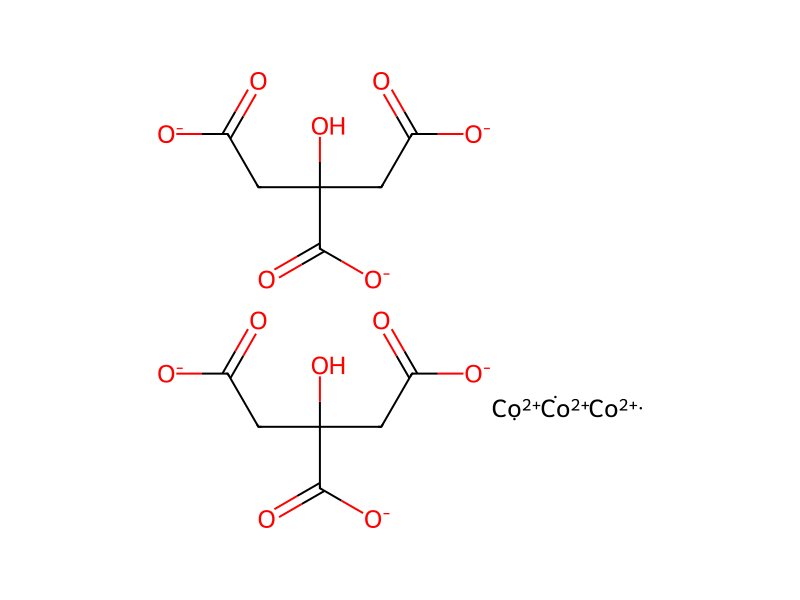
기본 정보
- 표준 SMILES
O=C([O-])CC(O)(CC(=O)[O-])C(=O)[O-].O=C([O-])CC(O)(CC(=O)[O-])C(=O)[O-].[Co+2].[Co+2].[Co+2]- InChIKey
IEXXNGVQCLMTKU-UHFFFAOYSA-H- 분자식
- C12H10Co3O14
- 평균 분자량
- 555 g/mol
- 단동위원소 질량
- 554.80664
개요
Cobalt(II) citrate is a chemical compound of cobalt. Cobalt is a metallic element with the atomic number 27. It is found naturally in rocks, soil, water, plants, and animals. In small amounts cobalt is an essential element for life, as it is part of vitamin B12. However, excess exposure is known to exhibit toxic effects. (L29, L30)
이름 및 식별자
- 우선 이름
- Cobaltous citrate
- IUPAC
- tris(cobalt(2+));bis(2-hydroxypropane-1,2,3-tricarboxylate)
- 현지명
- 시트르산 코발트(2가)
- 영어명
- COBALT CITRATE
- 분자식
- C12H10Co3O14
- 분자량
- 555
이름 및 동의어
이름 더 보기
데이터베이스 식별자
- CAS
866-81-9- PubChem CID
- 13343
- DTXSID
DTXSID70889440- UNII
- 07D5053T1R
- EC Number
- 212-751-3
물성
구조 계산 물성
- 극성 표면적
- 281 Ų
- 수소 결합 공여자 수
- 2
- 수소 결합 수용자 수
- 14
- 회전 가능 결합 수
- 4
- 무거운 원자 수
- 29
- 형식 전하
- 0
- 복잡도
- 211
실험 및 물리화학적 성질
Solubility
Mol wt: 591.028. Solubility: 0.8 g/100 mL cold water at 15 °C /Cobaltous citrate dihydrate/
In water, 27.67 g/L at 20 deg and pH 6.6
물리화학적 성질
- 녹는점
- 150 °C · 150°C (dec.)
- 밀도
- 2.02 g/cm3 · 2.02g/cm3 at 20℃
- 물리적 상태
- 가루
- 색상
- 밝은 보라색
- InChI
- InChI=1S/2C6H8O7.3Co/c2*7-3(8)1-6(13,5(11)12)2-4(9)10;;;/h2*13H,1-2H2,(H,7,8)(H,9,10)(H,11,12);;;/q;;3*+2/p-6
- InChIKey
- IEXXNGVQCLMTKU-UHFFFAOYSA-H
- SMILES
- C1(O)(CC(=O)O[Co]OC1=O)CC(=O)O[Co]OC(=O)CC1(O)CC(=O)O[Co]OC1=O
- EPA
- 1 · 1,2,3-Propanetricarboxylic acid, 2-hydroxy-, cobalt(2+) salt (2:3) (866-81-9)
화학적 성질
Rose-red, amorphous powder. Mp 150C (loses 2H2O). Slightly soluble in water; soluble in dilute acids.
안전 및 규제
GHS 분류
GHS Classification
Danger
H302 (99.3%): Harmful if swallowed [Warning Acute toxicity, oral]
P203, P233, P260, P261, P264, P264+P265, P270, P271, P272, P273, P280, P284, P301+P317, P302+P352, P304+P340, P305+P354+P338, P317, P318, P319, P321, P330, P333+P317, P342+P316, P362+P364, P391, P403, P405, and P501 (click each P-code to see the statement)
Aggregated GHS information provided per 149 reports by companies from 5 notifications to the ECHA C&L Inventory. Each notification may be associated with multiple companies.
Danger
H302: Harmful if swallowed [Warning Acute toxicity, oral]
유해성 정보
Regulatory Information
Chemical: 1,2,3-Propanetricarboxylic acid, 2-hydroxy-, cobalt(2+) salt (2:3)
REACH registered substance: Tricobalt dicitrate (EC: 212-751-3)
Atmospheric Standards
Listed as a hazardous air pollutant (HAP) generally known or suspected to cause serious health problems. The Clean Air Act, as amended in 1990, directs EPA to set standards requiring major sources to sharply reduce routine emissions of toxic pollutants. EPA is required to establish and phase in specific performance based standards for all air emission sources that emit one or more of the listed pollutants. Cobaltous citrate is included on this list.
Hazard Classes and Categories
Acute Tox. 4 (99.3%)
Acute toxicity - category 4
안전 및 보호
Cleanup Methods
Liquid material spills can be copiously flushed with water and channeled to a treatment system or holding tank for reclamation or proper disposal. Spills of dry material can be removed by vacuuming or wet mopping. Some spills can be removed by hosing, first with a mist of water to dampen the spilled material and then with a more forceful stream that flushes it into a holding tank or other facility for handling contaminated water. Work surfaces or contaminated clothing should never be cleaned by dry sweeping or blowing with pressurized hoses. Recovery systems used to reclaim waste metals should comply with federal, state, and local regulations. All waste materials generated in the handling of cobalt-containing substances should be disposed of in compliance with federal, state, and local regulations. /Cobalt and cobalt salts/
Disposal Methods
SRP: Recycle any unused portion of the material for its approved use or return it to the manufacturer or supplier. Ultimate disposal of the chemical must consider: the material's impact on air quality; potential migration in air, soil or water; effects on animal, aquatic and plant life; and conformance with environmental and public health regulations. If it is possible or reasonable use an alternative chemical product with less inherent propensity for occupational harm/injury/toxicity or environmental contamination.
Preventive Measures
Employers should institute programs that emphasize good personal hygiene to prevent skin and respiratory irritation caused by cobalt containing dusts. After working with cobalt products, workers should thoroughly wash their hands and face before drinking, eating, or smoking. If skin contact with cobalt solutions occurs, the worker should wash the affected skin promptly. The employer should provide showers if workers have substantial contact with cobalt. These workers should be encouraged to wash or shower after each workshift. Employers should prohibit smoking or carrying of tobacco products, and should prohibit eating, food handling, or food storage within the work area. /Cobalt and cobalt salts/
General plant maintenance must be conducted regularly to prevent cobalt containing dusts from accumulating in work areas. Cleaning should be performed with vacuum pickup or wet mopping to minimize the amount of dust dispersed into the air. A decontamination room should be available for cleaning equipment that is to receive major overhaul or maintenance. Spills of cobalt-containing material should be promptly cleaned up to minimize inhalation or dermal contact. /Cobalt and cobalt salts/
Special precautions are necessary when workers must enter tanks or vessels, such as reaction vessels containing cobalt catalysts or vessels used to prepare cobalt salts. Before any worker enters a vessel, all sources for transferring cobalt and other materials into or out of the vessel must be blanked to prevent their entry. The vessel interior must then be washed with water and purged with air. After purging the vessel's atmosphere with suitable instruments to ensure that no hazards from fire, explosion, oxygen deficiency, or dust inhalation exist. No one should enter a tank or vessel without first being equipped with an appropriate respirator and a secured lifeline or harness. Mechanical ventilation should be provided continuously when workers are inside the tank. At least one other worker similarly equipped with respiratory protection, lifeline, and harness should watch at all times from outside the vessel. Workers inside the tank must be able to communicate with those persons outside. Other workers must be available to assist in an emergency. Flame- or spark-generating operations, such as welding or cutting, should be performed only when an authorized representative of the employer has signed a permit based on a finding that all necessary safety precautions have been taken. /Cobalt and cobalt salts/
Threshold Limit Values (TLV)
0.02 [mg/m3], as Co
8 hr Time Weighted Avg (TWA): 0.02 mg/cu m. /Cobalt and inorganic compounds, as Co/
Peak Exposure Recommendation: Transient increases in workers' exposure levels may exceed 3 times the value of the TLV-TWA level for no more than 15 minutes at a time, on no more than 4 occasions spaced 1 hour apart during a workday, and under no circumstances should they exceed 5 times the value of the TLV-TWA level. In addition, the 8-hour TWA is not to be exceeded for an 8-hour work period. /Cobalt and inorganic compounds, as Co/
A3: Confirmed animal carcinogen with unknown relevance to humans. /Cobalt and inorganic compounds, as Co/
Biological Exposure Index (BEI): Determinant: cobalt in urine; Sampling Time: end of shift at end of workweek; BEI: 15 ug/L. Notation: The determinant is nonspecific, since it is also observed after after exposure to other chemicals. /Cobalt and inorganic compounds, including cobalt oxides but not combined with tungsten carbide/
Biological Exposure Index (BEI): Determinant: cobalt in urine; Sampling Time: end of shift at end of workweek; BEI: None. Notation: The determinant is nonspecific, since it is also observed after exposure to other chemicals. Biological monitoring should be considered for this compound based on the review; however, a specific BEI could not be determined due to insufficient data. /Cobalt with tungsten carbide/
독성 정보
Environmental Fate
ATMOSPHERIC FATE: Inorganic cobalt compounds are nonvolatile and released into the atmosphere in particulate form(1). Particulate-phase cobalt compounds are removed from the air by wet and dry deposition(SRC). Cobalt has been detected in atmospheric deposition(2) and in rain-snow precipitation(3).
Toxicity Summary
IDENTIFICATION AND USE: Cobalt citrate is rose-red, amorphous powder. it is used in vitamin preparations and therapeutic agents. HUMAN EXPOSURE AND TOXICITY: There are no data available. ANIMAL STUDIES: Rabbits survived injections of 100 mg of cobalt citrate (20% cobalt).
Cobalt is believed to exhibit its toxicity through a oxidant-based and free radical-based processes. It produces oxygen radicals and may be oxidized to ionic cobalt, causing increased lipid peroxidation, DNA damage, and inducing certain enzymes that lead to cell apoptosis. Cobalt has also been shown to block inorganic calcium channels, possibly impairing neurotransmission. Cobalt can also chelate lipoic acids, impairing oxidation of pyruvate or fatty acids. In addition, cobalt may inhibit DNA repair by interacting with zinc finger DNA repair proteins, and has also been shown to inhibit heme synthesis and glucose metabolism. Cobalt may activate specific helper T-lymphocyte cells and interact directly with immunologic proteins, such as antibodies (IgA and IgE) or Fc receptors, resulting in immunosensitization. (L29)
Artificial Pollution Sources
Cobaltous citrate's production and use as a chemical intermediate(1) may result in its release to the environment through various waste streams(SRC). Release to the environment of this substance is likely to occur from industrial use: as an intermediate step in further manufacturing of another substance (use of intermediates), formulation of mixtures, for thermoplastic manufacture and of substances in closed systems with minimal release(1).
Evidence for Carcinogenicity
There is inadequate evidence for the carcinogenicity of cobalt and cobalt compounds in humans. There is sufficient evidence for the carcinogenicity of cobalt metal powder in experimental animals. There is limited evidence for the carcinogenicity of metal alloys containing cobalt, chromium and molybdenum in experimental animals. ... Overall Evaluation: Cobalt and cobalt compounds are possibly carcinogenic to humans (Group 2B). /Cobalt and cobalt compounds/
A3: Confirmed animal carcinogen with unknown relevance to humans. /Cobalt and inorganic compounds, as Co/
Cobalt and cobalt compounds that release cobalt ions in vivo are reasonably anticipated to be human carcinogens based on sufficient evidence of carcinogenicity from studies in experimental animals and supporting data from studies on mechanisms of carcinogenesis. /Cobalt and cobalt compounds/
Antidote and Emergency Treatment
/SRP:/ Immediate First Aid: Ensure that adequate decontamination has been carried out as needed. If patient is not breathing, start artificial respiration, preferably with a demand valve resuscitator, bag-valve-mask device, or pocket mask, as trained. Perform CPR if necessary. Immediately flush contaminated eyes with gently flowing water. Do not induce vomiting. If vomiting occurs, lean patient forward or place on left side (Head-down position, if possible) to maintain an open airway and prevent aspiration. Keep patient quiet and maintain normal body temperature. Obtain medical attention. /Cobalt and Related Compounds/
/SRP:/ Basic treatment: Establish a patent airway (oropharyngeal or nasopharyngeal airway, if needed). Suction if necessary. Watch for signs of respiratory insufficiency and assist ventilations if needed. Administer oxygen by nonrebreather mask at 10 to 15 L/min. Monitor for pulmonary edema and treat if necessary ... . Monitor for shock and treat if necessary ... . For eye contamination, flush eyes immediately with water. Irrigate each eye continuously with normal saline during transport ... . Do not use emetics. For ingestion, rinse mouth and administer 5 mL/kg up to 200 mL of water for dilution if the patient can swallow, has a strong gag reflex, and does not drool. Administer activated charcoal ... . /Cobalt and Related Compounds/
/SRP:/ Advanced treatment: Consider orotracheal or nasotracheal intubation for airway control in the patient who is unconscious, has severe pulmonary edema, or is in respiratory arrest. Positive pressure ventilation techniques with a bag valve mask device may be beneficial. Consider drug therapy for pulmonary edema ... . Consider administering a beta agonist such as albuterol for severe bronchospasm... . Monitor cardiac rhythm and treat arrhythmias as necessary ... . Start IV administration of D5W TKO (to keep open). Use 0.9% saline (NS) or lactated Ringer's if signs of hypovolemia are present. For hypotension with signs of hypovolemia, administer fluid cautiously. Watch for signs of fluid overload ... . Use proparacaine hydrochloride to assist eye irrigation ... . /Cobalt and Related Compounds/
규제 정보
Atmospheric Standards
Listed as a hazardous air pollutant (HAP) generally known or suspected to cause serious health problems. The Clean Air Act, as amended in 1990, directs EPA to set standards requiring major sources to sharply reduce routine emissions of toxic pollutants. EPA is required to establish and phase in specific performance based standards for all air emission sources that emit one or more of the listed pollutants. Cobaltous citrate is included on this list.
안전 데이터
- tsca
- TSCA listed
- risk_code
- 20/21/22
- safety_code
- 22-36/37/39
- 기존화학 물질
- 2013-1-654
- 유해 물질 데이터
- 866-81-9(Hazardous Substances Data)
- 함량 및 규제정보
- 물질구분: 유독물질; 혼합물(제품)함량정보: 시트르산 코발트(2가) (2:3) 및 이를 1% 이상 함유한 혼합물
- 유해화학물질 필터링
- 2013-1-654
화학 및 산업
약리 정보
Metabolism/Metabolites
Cobalt is absorbed though the lungs, gastrointestinal tract, and skin. Since it is a component of the vitamin B12 (cyanocobalamin), it is distributed to most tissues of the body. It is transported in the blood, often bound to albumin, with the highest levels being found in the liver and kidney. Cobalt is excreted mainly in the urine and faeces. (L29)
용도 및 제조
Uses
Dihydrate: Used in dietary supplements; [Hawley]
Vitamin preparations, therapeutic agents.
응용 분야
용도Vitamin preparations, therapeutic agents.
공급사25 곳
관련 반응
현재 필터 조건에 해당하는 반응 기록이 없습니다.
연결된 노트
불러오는 중…