
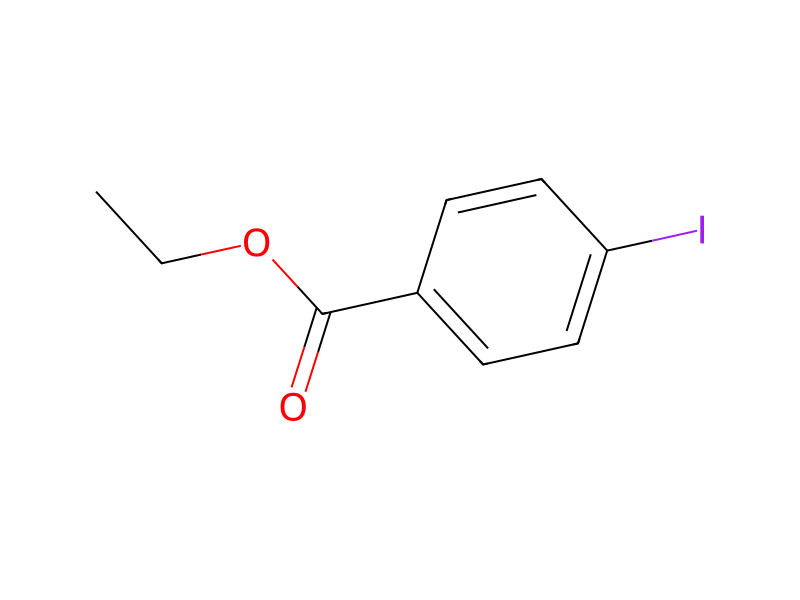
기본 정보
- 표준 SMILES
CCOC(=O)c1ccc(I)cc1- InChIKey
YCBJOQUNPLTBGG-UHFFFAOYSA-N- 분자식
- C9H9IO2
- 평균 분자량
- 276.07 g/mol
- 단동위원소 질량
- 275.96472753
이름 및 식별자
- 우선 이름
- Ethyl 4-iodobenzoate
- IUPAC
- ethyl 4-iodobenzoate
- 영어명
- Ethyl 4-iodobenzoate
- 분자식
- C9H9IO2
- 분자량
- 276.07
이름 및 동의어
Ethyl 4-iodobenzoate51934-41-9DTXSID0049311DTXCID502926752J05H935TYCBJOQUNPLTBGG-UHFFFAOYSA-BENZOIC ACID, 4-IODO-, ETHYLESTERRefChem:595453429-550-3610-760-0InChI=1/C9H9IO2/c1-2-12-9(11)7-3-5-8(10)6-4-7/h3-6H,2H2,1H3p-Iodobenzoic acid ethyl ester
이름 더 보기
Ethyl-4-zodabenzoateETHY1-4-IODOBENZOATE4-Iodobenzoic acid ethylIBEETHYL 4-IODOBENEthyl 4-IodobenzoETHYL 4-IODOBENZENERARECHEM AL BI 0710
ethyl p-iodobenzoate4-Iodobenzoic Acid Ethyl Ester4-iodo-benzoic acid ethyl esterBenzoic acid, 4-iodo-, ethyl esterethyl-4 iodobenzoateethyl 4-iodo-benzoateEthyl -4-iodobenzoateMFCD00017344
데이터베이스 식별자
- CAS
51934-41-9- PubChem CID
- 142891
- DTXSID
DTXSID0049311- ChEMBL
CHEMBL3185411- UNII
- 52J05H935T
- EC Number
- 429-550-3、610-760-0
- Nikkaji
- J47.219K
물성
구조 계산 물성
- XLogP
- 3.3
- 극성 표면적
- 26.3 Ų
- 수소 결합 공여자 수
- 0
- 수소 결합 수용자 수
- 2
- 회전 가능 결합 수
- 3
- 무거운 원자 수
- 12
- 형식 전하
- 0
- 복잡도
- 151
실험 및 물리화학적 성질
SpringerMaterials PropertiesDiamagnetic susceptibility
물리화학적 성질
- 녹는점
- 267 °C · 267 °C
- 끓는 점
- 281 · 281-283 °C
- 밀도
- 1.641 g/mL · 1.641 g/mL at 25 °C (lit.)
- 굴절률
- 20 · n20/D 1.5880(lit.)
- 인화점
- 230 °F · >230 °F
- 저장 조건
- Keep in dark place,Sealed in dry,Room Temperature
- 용해도
- 클로로포름, 디클로로메탄, 에틸아세테이트, 헥산에 용해됨
- 물리적 상태
- 액체
- Specific Gravity
- 1.66 · 1.66
- 색상
- 무색~황색으로 투명함
- 수용성
- 불용성
- BRN
- 2208568 · 2208568
- InChI
- 1S/C9H9IO2/c1-2-12-9(11)7-3-5-8(10)6-4-7/h3-6H,2H2,1H3
- InChIKey
- YCBJOQUNPLTBGG-UHFFFAOYSA-N
- SMILES
- CCOC(=O)c1ccc(I)cc1
- NIST
- 4 · Ethyl 4-iodobenzoate(51934-41-9)
화학적 성질
Light Yellow Oil
안전 및 규제
GHS 분류
GHS Classification
Warning
H315 (22.4%): Causes skin irritation [Warning Skin corrosion/irritation]
P264, P264+P265, P280, P302+P352, P305+P351+P338, P321, P332+P317, P337+P317, and P362+P364 (click each P-code to see the statement)
Aggregated GHS information provided per 49 reports by companies from 4 notifications to the ECHA C&L Inventory. Each notification may be associated with multiple companies.
Warning
H315 (100%): Causes skin irritation [Warning Skin corrosion/irritation]
유해성 정보
Regulatory InformationStatus: Active Update: 10-11-2008 https://echa.europa.eu/registration-dossier/-/registered-dossier/4370
Hazard Classes and Categories
Skin Irrit. 2 (100%)
Skin Irrit. 2 (22.4%)
안전 데이터
- wgk
- 3
- ridadr
- UN 3082 9/PG 3
- HS 번호
- 29163990
- risk_code
- 51/53-36/37/38
- hazard_code
- N,Xi,C
- safety_code
- 61-24/25
- 위험 등급
- IRRITANT, LIGHT SENSITIVE
- F 고인화성물질
- 8
- 위험 참고 사항
- Irritant
- 스토리지 클래스
- 10 - Combustible liquids
화학 및 산업
응용 분야
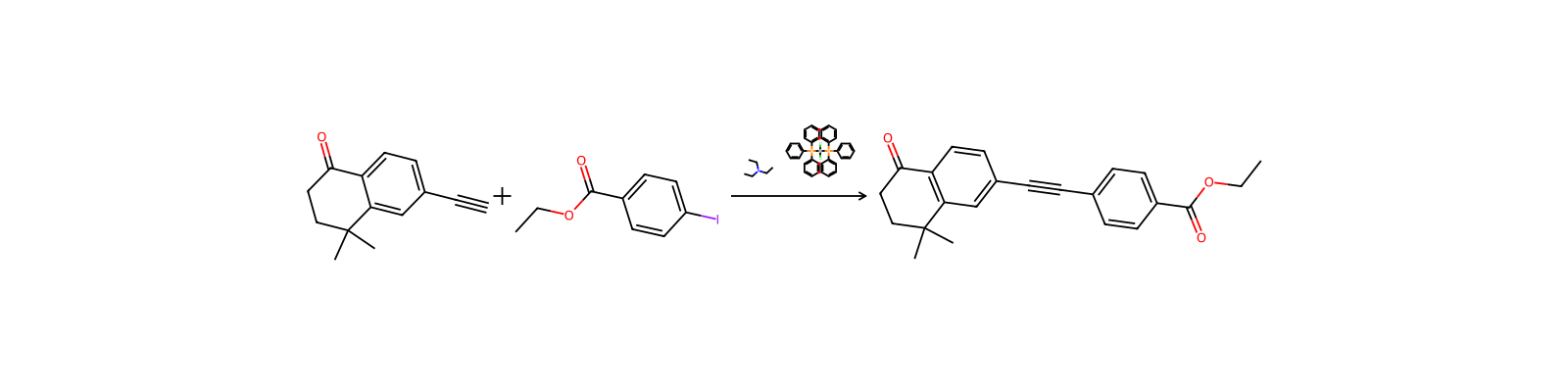
용도Ethyl 4-iodobenzoate can be used in the synthesis of biphenyl derivatives via Negishi cross coupling with the intermediates of the type ArMg(tmp)·2LiCl (tmp = trimethylolpropane). It can also be used as a starting material in the synthesis of p-carbomethoxyphenylmagnesium bromide, a polyfunctional organometallic reagent that can be used as building block in the synthesis of complex target molecules.
상·하류 제품 정보
상류 원료
하류 제품
공급사50 곳
国药集团化学试剂有限公司86-21-63210123 · [email protected]
梯希爱(上海)化成工业发展有限公司021-67121386 · [email protected]
衢州润东化工有限公司0570-8789886 18892685668 · [email protected]
上海阿拉丁生化科技股份有限公司400-6206333 13167063860 · [email protected]
常州市金坛区薛沃化工技术服务有限公司18921008881 · [email protected]
INTATRADE GmbH+49 3493/605464 · [email protected]
Baoji Guokang Healthchem co.,ltd+8615604608665 15604608665 · [email protected]
Dayang Chem (Hangzhou) Co.,Ltd.+86-0571-88938639 17705817739 · [email protected]
韶远科技(上海)有限公司021-50795510 4000665055 · [email protected]
科瑞迪化学400-821-5857 021-64326257 · [email protected]
上海迈瑞尔生化科技有限公司4006356688 18621169109 · [email protected]
北京华威锐科化工有限公司0757-86329057 18934348241 · [email protected]
武汉易泰科技有限公司上海分公司18930552037 · [email protected]
阿法埃莎(中国)化学有限公司400-6106006 · [email protected]
安耐吉化学&3A(安徽泽升科技股份有限公司)400-0056266 · [email protected]
武汉凯威斯科技有限公司86-027-67849912 · [email protected]
上海恩诺生物科技有限公司+86 (21) 6435-5022
上海瀚鸿科技股份有限公司021-54306202 13764082696 · [email protected]
上海相辉医药科技有限公司13761987713 · [email protected]
嘉兴市艾森化工有限公司0573-85285100 18627885956 · [email protected]
上海攀鸿化工科技有限公司021-56491756 13512199871 · [email protected]
苏州施亚生物科技有限公司86(512)5235 8471 17715136450 · [email protected]
山东西亚化学有限公司13355009207 13355009207 · [email protected]
玛雅试剂+86 (573) 82222445 (0)18006601000 452520369 · [email protected]
四川库利南科技有限公司400-1166-196 18981987031 · [email protected]
天津希恩思生化科技有限公司400 638 7771 · [email protected]
Xiamen AmoyChem Co., Ltd+86-86-5926051114 · [email protected]
南京维奥化工有限公司Please Send Email 18652950785 · [email protected]
河南多贝化工有限公司0370-2785118 17550508557 · [email protected]
艾科试剂4008-755-333 18080918076 · [email protected]
上海思域化工科技有限公司86-21-34053660 · [email protected]
赛默飞世尔科技(中国)有限公司800-810-5118 · [email protected]
上海健超生物科技有限公司150-2103-5486 18017383231 · [email protected]
TCI AMERICA800-4238616 · [email protected]
TOKYO CHEMICAL INDUSTRY CO., LTD.03-36680489 · [email protected]
TCI Europe320-37350700 · [email protected]
Shanghai Witofly Chemical Co.,Ltd[email protected]
越林试剂021-62960152 · [email protected]
Clearsynth Labs Limited+91-22-26355700 · [email protected]
上海贺康生物技术有限公司17721021104 18939837085 · [email protected]
上海将来实业股份有限公司400-0066400 13621662912 · [email protected]
上海将来实业股份有限公司021-61552785 · [email protected]
HBCChem, Inc.+1-510-219-6317 · [email protected]
郑州阿尔法化工有限公司0371-53732842 15981811963 · [email protected]
北京福源坊科技有限公司010-57903446 15869909019 · [email protected]
上海马氏化学科技有限公司19916721580 · [email protected]
上海嵩爰化工科技有限公司010-1234567 18521000990 · [email protected]
江苏艾康生物医药研发有限公司025-66028182 17714375163 · [email protected]
苏州氟洛科医药技术有限公司0512-62706796 · [email protected]
凯试(上海)科技有限公司021-50135380 · [email protected]
관련 반응
628건





연결된 노트
불러오는 중…