
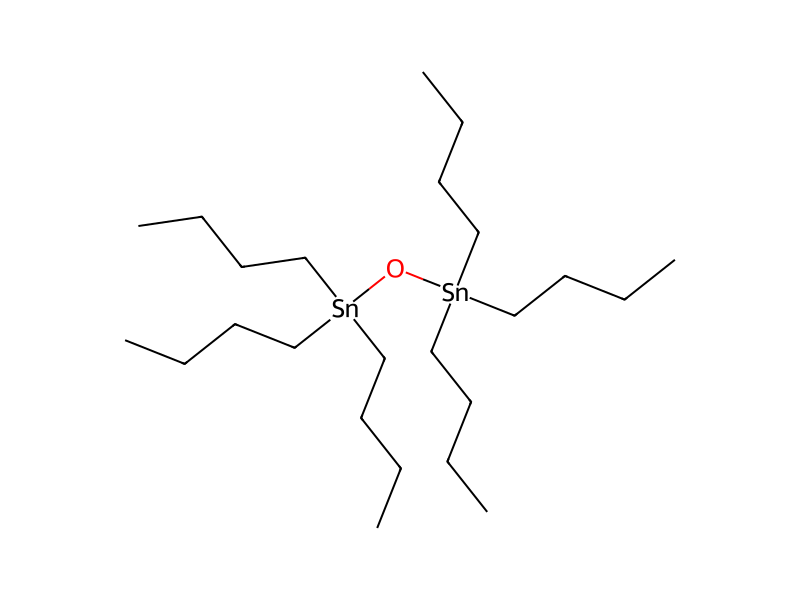
기본 정보
- CAS
56-35-9- 표준 SMILES
CCC[CH2][Sn]([CH2]CCC)([CH2]CCC)[O][Sn]([CH2]CCC)([CH2]CCC)[CH2]CCC- InChIKey
APQHKWPGGHMYKJ-UHFFFAOYSA-N- 분자식
- C24H54OSn2
- 평균 분자량
- 596.1 g/mol
- 단동위원소 질량
- 598.22185575
개요
Bis(tributyltin) oxide appears as clear pale yellow liquid. Toxic by skin absorption or inhalation of vapors. Used as a bactericide, fungicide and chemical intermediate.
이름 및 식별자
- 우선 이름
- Bis(tributyltin) oxide
- IUPAC
- tributyl(tributylstannyloxy)stannane
- 현지명
- 비스(트리노르말부틸틴)옥사이드
- 영어명
- Bis(tributyltin) oxide
- 분자식
- C24H54OSn2
- 분자량
- 596.1
이름 및 동의어
Tributyltin oxide56-35-9BIS(TRIBUTYLTIN) OXIDEBis(tributyltin)oxideHexabutyldistannoxaneButinoxDistannoxane, hexabutyl-Bis(tri-n-butyltin) oxideStannicide ALastanox QLastanox TBiomet TBTO
이름 더 보기
비스(트리노르말부틸틴)옥사이드비스-트라이-n-뷰틸주석산화물트라이부틸틴옥사이드비스(트라이부틸틴)옥사이드비스(트라이뷰틸주석) 옥사이드1,1,1,3,3,3-헥사뷰틸다이스탄녹세인5,5,7,7-테트라뷰틸-6-옥사-5,7-다이스탄나운데케인산화 비스(트라이뷰틸)주석산화 비스(트라이뷰틸주석)산화 비스-n-트라이뷰틸주석산화 트라이-n-뷰틸주석산화 트라이뷰틸주석옥시비스트라이뷰틸스탄네인트리부틸주석산화물헥사뷰틸다이스탄녹세인TBOTTBTOHBDBTO1,1,1,3,3,3-HexabutyldistannoxaneBis(tributyloxide) of tinOTBEdrall
Mykolastanox FBiomet 66Lastanox FBis(tri-n-butyltin)oxideBioMeT SRMOxybis(tributylstannane)Bis(tributylstannyl)oxideLastanox T 20
데이터베이스 식별자
- CAS
56-35-9、813-19-4- PubChem CID
- 16682746
- DTXSID
DTXSID9020166- ChEBI
CHEBI:81543- UNII
- 3353Q84MKM
- EC Number
- 200-268-0
- Nikkaji
- J4.568C
물성
구조 계산 물성
- 극성 표면적
- 9.2 Ų
- 수소 결합 공여자 수
- 0
- 수소 결합 수용자 수
- 1
- 회전 가능 결합 수
- 20
- 무거운 원자 수
- 27
- 형식 전하
- 0
- 복잡도
- 246
실험 및 물리화학적 성질
Chemical Classes
Metals -> Tin Compounds, Organic
Teratogens
Pesticides
Pesticide -> EPA IRIS
Fungicides
Active substance -> EU Pesticides database: Not approved
LogP
log Kow= 3.84
3.84
OdorWeak odor
Density
1.17 at 77 °F (NTP, 1992) - Denser than water; will sink
1.17 g/cu cm @ 25 °C
Relative density (water = 1): 1.17 (20 °C)
Viscosity4.8 Centistokes at 25 °C
Color/FormSlightly yellow liquid.
Solubility
less than 1 mg/mL at 70.7 °F (NTP, 1992)
0.1% in hot water.
Less than 20 ppm in water at 20 °C.
Miscible with organic solvents.
Water solubility of 4 mg/l at pH 7.0 and 20 °C.
The solubility of bis(tributyltin) oxide in water ranges from <1 to >100 mg/liter, depending on temperature and pH. Bis(tributyltin) oxide is soluble in lipids and very soluble in a number of organic solvents (e.g., ethanol, ether, halogenated hydrocarbons).
Flash Point
greater than 200 °F (NTP, 1992)
>212 °F (100 °C) (closed cup)
190 °C c.c.
Boiling Point
356 °F at 2 mmHg (NTP, 1992)
180 °C at 2 mm Hg.
180 °C
DecompositionWhen heated to decomposition it emits acrid and irritating fumes.
Melting Point45 °C
물리화학적 성질
- 녹는점
- -45 °C · -45°C
- 끓는 점
- 180 °C2 · 180 °C2 mm Hg(lit.)
- 밀도
- 1.17 g/mL · 1.17 g/mL at 25 °C(lit.)
- 증기압
- 0.01 mm · <0.01 mm Hg ( 25 °C)
- 굴절률
- 20 · n20/D 1.486(lit.)
- 인화점
- 230 °F · >230 °F
- 저장 조건
- 4 °C · +4°C
- 용해도
- 클로로포름, 메탄올(약간)에 용해됨
- 물리적 상태
- 액체
- Specific Gravity
- 1.17 · 1.170
- 색상
- 무색의
- 수용성
- 불용성
- BRN
- 745057 · 745057
- Henry's Law Constant
- 7.6 · 7.6×101 mol/(m3Pa) at 25℃, HSDB (2015)
- 안정성
- 수분에 민감한
- InChI
- 1S/6C4H9.O.2Sn/c6*1-3-4-2;;;/h6*1,3-4H2,2H3;;;
- InChIKey
- APQHKWPGGHMYKJ-UHFFFAOYSA-N
- SMILES
- CCCC[Sn](CCCC)(CCCC)O[Sn](CCCC)(CCCC)CCCC
- LogP
- 3.84 · 3.840 (est)
- NIST
- Distannoxane, hexabutyl-(56-35-9)
- EPA
- Bis(tributyltin) oxide (56-35-9)
화학적 성질
Clear colorless liquid
안전 및 규제
GHS 분류
GHS Classification
This chemical does not meet GHS hazard criteria for 1.1% (5 of 451) of reports.
Danger
H301 (98.9%): Toxic if swallowed [Danger Acute toxicity, oral]
P203, P260, P261, P264, P264+P265, P270, P271, P273, P280, P301+P316, P302+P352, P304+P340, P305+P351+P338, P316, P317, P318, P319, P321, P330, P332+P317, P337+P317, P362+P364, P391, P403+P233, P405, and P501 (click each P-code to see the statement)
Aggregated GHS information provided per 451 reports by companies from 19 notifications to the ECHA C&L Inventory. Each notification may be associated with multiple companies.
Danger
유해성 정보
Regulatory Information
Chemical: Distannoxane, 1,1,1,3,3,3-hexabutyl-
Hazard Traits - Bioaccumulation; Environmental Persistence; Environmental tox
Council Regulation (EEC) No 315/1993
2002/2076
Status: Active Update: 03-07-2020 https://echa.europa.eu/registration-dossier/-/registered-dossier/12201
Substance: Bis(tributyltin) oxide (TBTO)
DOT LabelPoison
Fire Hazards
This chemical is probably combustible. (NTP, 1992)
Combustible.
Fire PotentialCombustible.
Health HazardsACUTE/CHRONIC HAZARDS: This material is toxic by ingestion and inhalation and is a skin and eye irritant. (NTP, 1992)
Hazards Summary
Classified as moderately toxic, some formulations are for Restricted Use. [EXTOXNET] Occupational asthma reported in venipuncture technician (phlebotomist) using needles treated with bis(tri-n-butyltin)oxide; [Malo] Tributyltin oxide is a strong skin irritant. [Kanerva, p. 1841] Skin contact may cause redness and delayed burns; Inhalation of aerosol may cause pneumonitis and pulmonary edema; [ICSC] Low acute toxicity by skin absorption with an LD50 of >9000 mg/kg for the rabbit; Causes heptocellular necrosis in rats fed 25 mg/kg for 4 weeks; Causes adverse effects to the thymus, impairing cell mediated immunity at doses as low as 5 mg/kg in rats; No convincing evidence that TBTO is mutagenic; No teratogenic effects at doses below those that cause maternal toxicity; Tumors have been seen in animal studies, but their significance is questionable; [Reference #1] Skin, eye, and respiratory tract irritation, dermatitis, headache, nausea, and vomiting have been reported in occupationally exposed individuals; [HSDB] See Tin, organic compounds.
FDA RequirementsBis(tri-n-butyltin) oxide is an indirect food additive for use as a preservative only as a component of adhesives.
Reactive GroupOrganometallics
EC ClassificationSymbol: T, N; R: 21-25-36/38-48/23/25-50/53; S: (1/2)-35-36/37/39-45-60-61; Note: A
UN ClassificationUN Hazard Class: 6.1; UN Pack Group: II
FIFRA Requirements
As the federal pesticide law FIFRA directs, EPA is conducting a comprehensive review of older pesticides to consider their health and environmental effects and make decisions about their future use. Under this pesticide reregistration program, EPA examines health and safety data for pesticide active ingredients initially registered before November 1, 1984, and determines whether they are eligible for reregistration. In addition, all pesticides must meet the new safety standard of the Food Quality Protection Act of 1996. Pesticides for which EPA had not issued Registration Standards prior to the effective date of FIFRA, as amended in 1988, were divided into three lists based upon their potential for human exposure and other factors, with List B containing pesticides of greater concern and List D pesticides of less concern. Bis(tributyltin) oxide is found on List B. Case No: 2620; Pesticide type: Fungicide, biocide; Case Status: OPP is reviewing data from the pesticide's producers regarding its human health and/or environmental effects, or OPP is determining the pesticide's eligibility for reregistration and developing the Reregistration Eligibility Decision (RED) document.; Active ingredient (AI): Bis(tributyltin) oxide; Data Call-in (DCI) Date(s): 03/30/91, 10/13/95; AI Status: The producers of the pesticide has made commitments to conduct the studies and pay the fees required for reregistration, and are meeting those commitments in a timely manner.
Reactivity ProfileBIS(TRIBUTYLTIN) OXIDE may react vigorously with oxidizing agents and with reducing agents.
안전 및 보호
Fire Fighting
Fires involving this material can be controlled with a dry chemical, carbon dioxide or Halon extinguisher. (NTP, 1992)
In case of fire in the surroundings, use appropriate extinguishing media.
First Aid Measures
Fresh air, rest. Half-upright position. Refer for medical attention.
Rinse and then wash skin with water and soap. Refer for medical attention .
First rinse with plenty of water for several minutes (remove contact lenses if easily possible), then refer for medical attention.
Give one or two glasses of water to drink. Refer for medical attention .
First Aid
EYES: First check the victim for contact lenses and remove if present. Flush victim's eyes with water or normal saline solution for 20 to 30 minutes while simultaneously calling a hospital or poison control center. Do not put any ointments, oils, or medication in the victim's eyes without specific instructions from a physician. IMMEDIATELY transport the victim after flushing eyes to a hospital even if no symptoms (such as redness or irritation) develop.
Safe StorageWell closed. Provision to contain effluent from fire extinguishing. Store in an area without drain or sewer access.
Exposure Control and Personal Protection0.02 [mg/m3], inhalable fraction, as Sn[German Research Foundation (DFG)]
Fire Fighting Procedures
Provision to contain effluent from fire extinguishing.
In case of fire in the surroundings: all extinguishing agents allowed.
Storage ConditionsNO open flames.
Cleanup MethodsDo NOT wash away into sewer. Carefully collect remainder, then remove to safe place. Do NOT let this chemical enter the environment.
Nonfire Spill Response
SMALL SPILLS AND LEAKAGE: If you should spill this chemical, use absorbent paper to pick up all liquid spill material. Your contaminated clothing and absorbent paper should be sealed in a vapor-tight plastic bag for eventual disposal. Solvent wash all contaminated surfaces with acetone followed by washing with a strong soap and water solution. Do not reenter the contaminated area until the Safety Officer (or other responsible person) has verified that the area has been properly cleaned.
Disposal Methods
SRP: At the time of review, criteria for land treatment or burial (sanitary landfill) disposal practices are subject to significant revision. Prior to implementing land disposal of waste residue (including waste sludge), consult with environmental regulatory agencies for guidance on acceptable disposal practices.
Spillage Disposal
Personal protection: chemical protection suit including self-contained breathing apparatus. Do NOT let this chemical enter the environment. Carefully collect remainder. Then store and dispose of according to local regulations. Do NOT wash away into sewer.
Preventive Measures
Employees who handle ... bis(tri-n-butyltin)oxide ... should wash their hands thoroughly with soap or mild detergent & water before eating, smoking, or using toilet facilities.
If ... bis(tri-n-butyltin)oxide ... gets on the skin, immediately flush with large amounts of water, then wash with soap or mild detergent & water. If ... bis(tri-n-butyltin)oxide ... soaks through the clothing, remove the clothing immediately & flush with large amounts of water & then wash using soap or mild detergent & water. Get medical attention immediately.
Eating & smoking should not be permitted in areas where ... bis(tri-n-butyltin)oxide ... is handled, processed, or stored.
SRP: The scientific literature for the use of contact lenses in industry is conflicting. The benefit or detrimental effects of wearing contact lenses depend not only upon the substance, but also on factors including the form of the substance, characteristics and duration of the exposure, the uses of other eye protection equipment, and the hygiene of the lenses. However, there may be individual substances whose irritating or corrosive properties are such that the wearing of contact lenses would be harmful to the eye. In those specific cases, contact lenses should not be worn. In any event, the usual eye protection equipment should be worn even when contact lenses are in place.
독성 정보
Target OrgansImmune
Health EffectsBreathing or swallowing, or skin contact with organotins, can interfere with the way the brain and nervous system work, causing death in severe cases. Organic tin compounds may also damage the immune and reproductive system. (L307, L308)
Ecotoxicity Values
LC50 Pimephales promelas (fathead minnow) 2.7 ug/l/96 hr (confidence limit 2.4 - 3.0 mg/l), flow-through bioassay with measured concentrations, 24.0 °C, dissolved oxygen 7.5 mg/l, hardness 51.5 mg/l calcium carbonate, alkalinity 41.1 mg/l calcium carbonate, and pH 7.5.
Environmental Fate
TERRESTRIAL FATE: Bis(tributyltin) oxide will bind strongly to soil(1) and thus is expected to have low mobility in soil(SRC). Bis(tributyltin) oxide is susceptible to biodegradation in soil and has a half-life of 15-20 weeks(2). Bis(tributyltin) oxide may slowly photodegrade on the soil surface(3) but would not be expected to volatilize from near-surface soil(4,5).
AQUATIC FATE: If bis(tributyltin) oxide is released to water, it will be expected to exist mainly as the tributyltin cation(1). It may react with sulfides present in sediment, which would lead to the formation of bis(tributyltin) sulfide(2). Analysis of extracts of tributyltin cations in dissolved in seawater showed that the equilibrium mixture of speciation products is composed of tributyltin chloride, tributyltin hydroxide, the aquo complex (TBTOH2+), and a tributyltincarbonato species(3). The equilibrium distribution is a function of chloride concn, dissolved CO2, and pH(3). Tributyltin cation is stable (as defined by lack of debutylation) in distilled, deionized water kept in the dark at 20 °C for over 63 days at pH between 2.9 and 10.3(4). No degradation of tributyltin was observed in 11 months in KCN-poisoned water sediment mixtures from an area of Toronto Harbor(5). Tributyltin is susceptible to biodegradation in water with half-lives of between 6 days and 35 weeks reported in water and water-sediment mixtures, many of which had been previously contaminated with tributyltin species(5,6). Results from experiments in water and water sediment mixtures indicate that abiotic degradation of tributyltin species will be limited to direct photolysis in surface water(4,5,7). The half-life for sunlight photolysis of tributyltin cation was determined to be >89 days both in distilled water and water from Hamilton Harbor (Toronto, Canada)(4). Based on a classification scheme(8), a Koc value of 90,800(7,9,10), indicates that bis(tributyltin) oxide is expected to adsorb to suspended solids and sediment(SRC). Based upon a BCF of >6,000(3), tributyltin can bioconcentrate strongly in various aquatic organisms(SRC). Based upon laboratory observations(4) and the fact that tributyltin cations are the dominant species in water, volatilization from water is not expected to be important(SRC).
AQUATIC FATE: Radiolabeled tributyltin was added to a 13 cu m marine mesocosm with near natural water column and benthos in summer and monitored for 278 days to study the behavior of tributyltin and its degradation products(1). The removal of tributyltin from the water column was the result of biological degradation, scavenging to the sediment and presumed loss to the atmosphere with an overall removal half-life of 6-12 days(1). Tributyltin initially decreased in the water column at a rate of 0.20/day (half-life 3.5 days) for 15 days and then slowed to 0.10/day (half-life 6.9 days)(1). The change in removal rate corresponded to a roughly 50% decrease in chlorophyll concn(1). Most of the tributyltin was lost from the water column due to biodegradation which occurred at a rate of 0.08/day(1). A third of the tributyltin degraded directly to monobutyltin and the other two-third degraded first to dibutyltin and then to monobutyltin (about 0.04/day). There was no evidence that monobutyltin degraded in the water column(1). Some tributyltin sorbed to the sediment in which it did not measurably degrade(1). Some of the tributyltin was lost into the air(1). Of the activity added to the mesocosm, 60% had left the water column after 50 days(1). After the first two weeks about 30% of the activity was found in the sediment, after which there did not appear to be any remobilization back into the water column(1). Also after the first two weeks, the activity in the water column did not change except for the loss of CO2 to the atmosphere(1). Tributyltin incorporated into the sediment degraded very slowly or not at all; degradation rates were <0.0001/day(1). About 30% of the activity left the water column within 7 days(1). Only 0.9% of the activity loss could be accounted for by adsorption to the walls(1). The loss of tributyltin from the water column to the air is much more rapid than can be ascribed to normal volatilization(1). In this case it was noted that there was a rapid transfer into the surface microlayer, from which loss occurred either by direct volatilization through prior photodegradation(1). Tributyltin compounds in seawater are degraded in summer to give dibutyltins, hydroxylated tributyltins, hydroxylated dibutyltins, carboxylated derivatives and monobutyltin(2). These compounds were formed, if at all, in limited quantities in the other seasons(2). The ratio of these organotins in oysters collected in the same area showed similar values indicating that microbial degradation may be an important degradation pathway for tributyltins(2). Monitoring studies indicate that tributyltin is very persistent in anoxic sediment from the marine environment(3). The same is true, although to a lesser extent for triphenyl tin. Laboratory studies show that the half-life of tributyltin in sediment is in the range of years(3). Degradation is slower under anaerobic conditions than under aerobic conditions; half-lives in anaerobic sediment is in the range of 2-3 years(3). Desorption from sediment is low(3).
ATMOSPHERIC FATE: According to a model of gas/particle partitioning of semivolatile organic compounds in the atmosphere(1), bis(tributyltin) oxide, which has an estimated vapor pressure of 7.8X10⁻⁶ mm Hg at 25 °C(SRC), determined from a fragment constant method(2), will exist in both the vapor and particulate phases in the ambient atmosphere(SRC). Vapor-phase bis(tributyltin) oxide is degraded in the atmosphere by reaction with photochemically-produced hydroxyl radicals(SRC); the half-life for this reaction in air is estimated to be 1.5 hours(SRC), calculated from its rate constant of 85X10-12 cu cm/molecule-sec at 25 °C(SRC) determined using a structure estimation method(3). Particulate-phase bis(tributyltin) oxide may be removed from the air by wet and dry deposition(SRC). There are no experimental studies relating to bis(tributyltin) oxide's photodegradation in air(SRC). However, tributyltin species present in water solutions has been observed to slowly photodegrade in sunlight(4).
Food Survey Values
In a survey of Canadian wines from 3 provinces, tributyltin levels were much lower than either mono or dibutyltin with levels of <0.1-1.9 ng/ml. The sources of butyltin residues appeared to be the use of non-food grade PVC as liners in transport tanks(1).
Adverse EffectsNeurotoxin - Other CNS neurotoxin
Exposure Routes
The substance can be absorbed into the body by inhalation of its aerosol and by ingestion.
Oral (L308) ; inhalation (L308) ; dermal (L308)
Toxicity Summary
.../Tributyltin oxide/ bioaccumulates in organisms, with the highest concentrations found in liver and kidney. Uptake from food is more important than uptake directly from water. ... /In humans tributyltin oxide/ is a severe dermal and respiratory irritant. ... Tributyltin oxide is moderately to highly acutely toxic to laboratory mammals in short term studies. In numerous well conducted studies, both short term and long term, the critical effect of tributyltin oxide is immunotoxicity (depression of immune functions dependent on the thymus). ... In a carcinogenicity study in rats, there was an increased incidence of some tumors in some endocrine tissues. These tumors ... are of unknown significance for a human health risk assessment. Tributyltin oxide is not carcinogenic in mice. The weight of evidence shows that tributyltin oxide is not genotoxic. There is no indication that reproductive or developmental effects occur at an exposure below that identified ... for immunotoxicity. Effects on reproduction and development occur only at exposures near those causing maternal toxicity. Data show that tributyltin oxide is a severe respiratory tract and skin irritant. ... Tributyltin oxide is extremely hazardous to some aquatic organisms. It is an endocrine disruptor to some aquatic organisms. . ... Adverse effects have been sufficiently severe to lead to reproductive failure and population decline in some /coastal/ areas. The general hazard to the terrestrial environment is likely to be low.
Organotin compounds produce neurotoxic and immunotoxic effects. Organotins may directly activate glial cells contributing to neuronal cell degeneration by local release of pro-inflammatory cytokines, tumor necrosis factor-_, and/or interleukins. They may also induce apoptosis by direct action on neuronal cells. Organotin compounds stimulate the neuronal release of and/or decrease of neuronal cell uptake of neurotransmitters in brain tissue, including aspartate, GABA, glutamate, norepinephrine, and serotonin. This may be either a contributing factor to or result of the neuronal cell loss. The immunotoxic effects of organotins are characterized by thymic atrophy caused by the suppression of proliferation of immature thymocytes and apoptosis of mature thymocytes. Organotin compounds are believed to exert these effects by suppressing DNA and protein synthesis, inducing the expression of genes involved in apoptosis (such as nur77), and disrupting the regulation of intracellular calcium levels, giving rise to the uncontrolled production of reactive oxygen species, release of cytochrome c to the cytosol, and the proteolytic and nucleolytic cascade of apoptosis. The suppression of proliferation of immature thymocytes further results in the suppression of T-cell-mediated immune responses. Organotins are also endocrine disruptors and are believed to contribute to obesity by inappropriate receptor activation, leading to adipocyte differentiation. Inorganic tin triggers eryptosis, contributing to tin-induced anemia. (L308, A182, A184)
Signs and Symptoms
Abdominal cramps. Cough. Diarrhoea. Laboured breathing. Nausea. Sore throat. Vomiting. Symptoms may be delayed.
Redness. Delayed skin burns.
Redness. Pain.
Abdominal cramps. Diarrhoea. Nausea. Vomiting.
Inorganic or organic tin compounds placed on the skin or in the eyes can produce skin and eye irritation. (L308)
ICSC Environmental Data
The substance is very toxic to aquatic organisms. The substance may cause long-term effects in the aquatic environment. Bioaccumulation of this chemical may occur along the food chain, for example in fish and molluscs. This substance does enter the environment under normal use. Great care, however, should be taken to avoid any additional release, for example through inappropriate disposal.
EPA IRIS Information
Tributyltin oxide (TBTO)
Immune
3 x 10 ^-4 mg/kg-day
Soil Adsorption/Mobility
No leaching of tributyltin was observed in several soils (clay, sand, topsoil and silt) during periods as long as 16 weeks(1). Tributyltin binds strongly to sediment with the distribution constant for Toronto Harbor sediment and water as 2180 at 20 °C(2). Very little tributyltin or inorganic tin was released from unshaken sediment in 10 months(2). However, other studies have shown that tributyltin does not adsorb appreciably to suspended particulate matter and that it is primarily associated with the dissolved fraction of estuarine water(3,4). This is in line with the observation that addition of humic acids or kaolin clay material does not significantly affect the measured bis(tributyltin) BCF in mussels(5), suggesting that bis(tributyltin) species are only weakly bound to these materials(SRC). Studies on the adsorption of tributyltin to a wide variety of sorbents yield sorption coefficients ranging from 110 to 350,000 l/kg, but the majority of sorption coefficients are about 1,000 l/kg(6). Adsorption is relatively fast (hours) and reversible(6). In a 278-day marine mesocosm experiment, the transport rate from the water column to sediment was 0.045/day(7). The distribution coefficient between dissolved state and particulate matter calculated from data between days 2-19 was 60,000 (standard deviation 30,000)(7). Other investigators obtained distribution constants for adsorption of tributyltin to particulate matter and sediment of 3400-9300 l/kg and 200-55,000 l/kg, respectively; values were a function of sediment type and location(7). The Freundlich parameters, log k and 1/n, for tributyl tin to sediment was 1.07 and 0.359, respectively(8). In soil microcosm experiments, small bis(tributyltin) oxide releases from wood treated with the compound was observed to migrate >10 cm from the wood with 86% of the compound residing within 5 cm of the wood; none of the compound was found in any layer below 10 cm nor in groundwater at the bottom of the microcosm chamber(8). These data suggest that bis(tributyltin) oxide can strongly bind to soil and sediment but that adsorption to suspended particulate and humic matter may be much weaker(SRC).
규제 정보
FDA RequirementsBis(tri-n-butyltin) oxide is an indirect food additive for use as a preservative only as a component of adhesives.
FIFRA Requirements
As the federal pesticide law FIFRA directs, EPA is conducting a comprehensive review of older pesticides to consider their health and environmental effects and make decisions about their future use. Under this pesticide reregistration program, EPA examines health and safety data for pesticide active ingredients initially registered before November 1, 1984, and determines whether they are eligible for reregistration. In addition, all pesticides must meet the new safety standard of the Food Quality Protection Act of 1996. Pesticides for which EPA had not issued Registration Standards prior to the effective date of FIFRA, as amended in 1988, were divided into three lists based upon their potential for human exposure and other factors, with List B containing pesticides of greater concern and List D pesticides of less concern. Bis(tributyltin) oxide is found on List B. Case No: 2620; Pesticide type: Fungicide, biocide; Case Status: OPP is reviewing data from the pesticide's producers regarding its human health and/or environmental effects, or OPP is determining the pesticide's eligibility for reregistration and developing the Reregistration Eligibility Decision (RED) document.; Active ingredient (AI): Bis(tributyltin) oxide; Data Call-in (DCI) Date(s): 03/30/91, 10/13/95; AI Status: The producers of the pesticide has made commitments to conduct the studies and pay the fees required for reregistration, and are meeting those commitments in a timely manner.
State Drinking Water Guidelines(FL) FLORIDA 4.4 ug/L
안전 데이터
- wgk
- 3
- tsca
- TSCA listed
- rtecs
- JN8750000
- ridadr
- UN 2788 6.1/PG 2
- 독성
- LD50 oral in rat: 87mg/kg
- HS 번호
- 29310095
- risk_code
- 21-25-36/38-48/23/25-50/53
- hazard_code
- T,N
- safety_code
- 35-36/37/39-45-60-61
- 포장분류
- II
- 위험 등급
- 6.1
- 기존화학 물질
- KE-03442
- Hazard Classifications
- Acute Tox. 3 DermalAcute Tox. 3 InhalationAcute Tox. 3 OralAquatic Acute 1Aquatic Chronic 1Eye Irrit. 2Repr. 1BSkin Irrit. 2STOT RE 1
- 스토리지 클래스
- 6.1A - Combustible acute toxic Cat. 1 and 2very toxic hazardous materials
- 유해 물질 데이터
- 56-35-9(Hazardous Substances Data)
- 함량 및 규제정보
- 물질구분: 제한물질; 혼합물(제품)함량정보: 수산화 트리알킬주석[Trialkyl tin hydroxide]과 그 염류(산화 트리알킬주석을 포함한다) 및 트리부틸주석화합물(tributyltin compound), 또는 그 중 하나를 0.1% 이상 함유한 혼합물
- 유해화학물질 필터링
- 97-1-139;06-5-4
- 중점관리물질 필터링
- 별표2-6
화학 및 산업
약리 정보
Biological Half-LifeThe calculated half-time for elimination of TBTO residues in mice is 29 days.
Metabolism/Metabolites
The GI tract is a major route by which humans are exposed to environmental chemicals. We have examined in these studies the effects of oral admin of organotin cmpds in the small intestinal epithelium, an organ which exhibits highly active drug & other chemical metab. A series of n-butyltin cmpds was admin by gavage to male Sprague-Dawley rats (225-275g) in single doses up to to 250 umol/kg bw. Bis(tri-n-butyltin)oxide produced dose & time dependent decr in the content & functional activity of intestinal cytochrome p450, together with an elevation (3-fold) in the activity of microsomal heme oxygenase. The effects of di-n-butyltin dichloride on heme oxygenase & cytochrome p450 were pronounced in the small intestine & extended to the liver & kidneys within 21hr after oral exposure, whereas bis(tri-n-butyltin)oxide did not affect the liver until much later (6 days), when cytochrome p450 content was reduced markedly (30%). Furthermore, the effects produced by tetra-n-butyltin on cytochrome p450 at 24hr were localized in the intestinal epithelium. These studies indicate important pharmacological effects of organotin cmpd in the gut, & raise the possibility that concurrent oral ingestion of organotins with other environmental pollutants may alter the cytochrome p450 dependent metab of xenobiotics & natural substrates of this monooxygenase system in the small intestine.
Metab in mammals is rapid; metabolites are detectable in the blood within 3hr of TBTO admin. The principal metabolite appears to be the hydroxybutyl cmpd, which is unstable & rapidly splits to form the dibutyl derivative & butanol. In in vitro studies, it has been shown that TBTO is a substrate for mixed-function oxidases, but these enzymes are inhibited by very high concn of TBTO.
Tributyltin metab also occurs in lower organisms, but it is slower, particularly in mollusks, than in mammals. The capacity for bioaccumulation is, therefore, much greater in lower organisms than in mammals. /Tributyl tin/
Though tin metal is very poorly absorbed, tin compounds may be absorbed via oral, inhalation, or dermal routes, with organotin compounds being much more readily absorbed than inorganic tin compounds. Tin may enter the bloodstream and bind to hemoglobin, where it is distributed and accumulates mainly in the kidney, liver, lung, and bone. Organotin compounds may undergo dealkylation, hydroxylation, dearylation, and oxidation catalyzed by cytochrome P-450 enzymes in the liver. The alkyl products of dealkylation are conjugated with glutathione and further metabolized to mercapturic acid derivatives. Tin and its metabolites are excreted mainly in the urine and feces. (L308)
MeSH Pharmacological Classification
Substances used on inanimate objects that destroy harmful microorganisms or inhibit their activity. Disinfectants are classed as complete, destroying SPORES as well as vegetative forms of microorganisms, or incomplete, destroying only vegetative forms of the organisms. They are distinguished from ANTISEPTICS, which are local anti-infective agents used on humans and other animals. (From Hawley's Condensed Chemical Dictionary, 11th ed)
Chemicals that kill or inhibit the growth of fungi in agricultural applications, on wood, plastics, or other materials, in swimming pools, etc.
Agents that suppress immune function by one of several mechanisms of action. Classical cytotoxic immunosuppressants act by inhibiting DNA synthesis. Others may act through activation of T-CELLS or by inhibiting the activation of HELPER CELLS. While immunosuppression has been brought about in the past primarily to prevent rejection of transplanted organs, new applications involving mediation of the effects of INTERLEUKINS and other CYTOKINES are emerging.
Absorption, Distribution and Excretion
The calculated half-time for elimination of TBTO residues in mice is 29 days.
TBTO is absorbed from the gut (20-50%, depending on the vehicle) & via the skin of mammals (approx 10%). Other data suggest absorption in the 1-5% range via the skin. TBTO can be transferred across the blood-brain barrier & from the placenta to the fetus. ... Absorbed material is rapidly & widely distributed among tissues (principally the liver and kidney). ... The rate of TBTO loss differs with different tissues. TBTO & its metabolites are eliminated principally via the bile.
용도 및 제조
Uses
Used as antimicrobial and slimicide for cooling-water treatment, disinfectant for hard-surface, sanitizer for laundry, mildewcides in water-based emulsion paints, preservative for timber, millwork, wood, textiles, paper, leather, and glass, and as fungicide and bactericide in underwater and antifouling paints; Also used as pesticide, molluscicide, rodent repellant, and insecticide; [HSDB] Used as a bactericide, fungicide, and chemical intermediate; [CAMEO] Used as fungicide, disinfectant, algicide, microbiocide, and microbiostat for cooling tower water, wood preservation (paints, stains, and waterproofing formulations), hard surfaces (livestock, veterinary, and other animal facilities), building materials (drywall, joint compound MDF board, and particulate board), building material adhesives, and adhesives for other manufacturing applications; Also used to treat textile fabrics (except laundry and clothing), paper, fiberfill, foam, rope, sponges, and other materials; Tributyltin products are also used in petrochemical injection fluids, metal working fluids, irrigation tubing for non-agricultural uses, rubber for sonar domes, and instruments for oceanographic observations; [EPA RED]
Tributyltin compounds are regulated by the EPA under the Organotin Antifouling Paint Control Act of 1988; Registration cancelled in 2005 for tributyltin ship hull coatings; International ban effective as of September 2008; [Reference #2]
Pulp and Paper Processing [Category: Industry]
For Bis(tributyltin) oxide (USEPA/OPP Pesticide Code: 083001) ACTIVE products with label matches. /SRP: Registered for use in the U.S. but approved pesticide uses may change periodically and so federal, state and local authorities must be consulted for currently approved uses./
Antimicrobials and slimicides for cooling-water treatment and as hard-surface disinfectants. Also laundry sanitizers and mildewcides to prevent mildew formation in the dried film of water-based emulsion paints.
Widely used in Europe for the preservation of timber, millwork, and wood joinery, e.g., window sashes and door frames.
Methods of ManufacturingHydrolysis of tributyl tin chloride.
Formulations/PreparationsUSEPA/OPP Pesticide Code 083001; Trade Names: Self polishing copolymer, TBTO, Biomet, Biomet 75, AW 75-D, Butinox, Bio-met TBTO, Bis(tri-N-butyltin)oxide, BTO, SN-9, ENT 24,979, L.S. 3394.
Household ProductsInformation on 14 consumer products that contain bis(Tributyltin) oxide in the following categories is provided:
General Manufacturing Information
Distannoxane, 1,1,1,3,3,3-hexabutyl-: ACTIVE
Tributyltin antifouling paint can be classified into three chemical groups based on the way the tributyltin is incorporated into the paint coating and subsequently released. The first group includes paints in which the tributyltin active ingredient is mixed into the paint matrix and the tributyltin ion is released from the paint by diffusion. These are called free association paints. The second group has the tributyltin moiety chemically bound to the paint matrix. These paints are called copolymer paints and under slightly alkaline conditions (such as sea water), the tributyltin ion is released by chemical hydrolysis. Because the paint surface is softened by the loss of the tributyltin moiety, the outer layer is exposed. A third category, tributyltin ablative paints, have characteristics of both groups. The tributyltin active ingredient is mixed into the paint matrix, but because these are relatively soft paints, the surface ablates or sloughs off as the painted vessel moves through the water.
The use of tributyltin compounds in antifoulants are restricted because of their toxicity to aquatic organisms and EPA is cooperating in international efforts for a global phase-out.
응용 분야
개요TBTO (bis(tri-n-butyltin)oxide) appears as thin, colourless to pale yellow, flammable and combustible liquid. It is soluble in organic solvents. TBTO, or bis(tri-n-butyltin)oxide, is an organotin compound used as a biocide, fungicide, and molluscicide. Uses of tributyltin also include as an anti-fouling chemical in marine paints for boats, anti-fungal agent in textiles and industrial water systems, in cooling tower and refrigeration water systems, wood pulp preservative in paints and paper mill systems, inner surfaces of cardboard, and in the manufacturing processes of leather goods, textiles, wood, plastics, and mothproof stored garments. In fact, TBT compounds are considered the most hazardous of all tin compounds.
용도Bis(tributyltin) Oxide is an organotin compound used as a fungicide and molluscicide, particularly in wood preservation. Bis(tributyltin) Oxide was used as an active component in marine antifouling paints but is not longer used due to its toxicity and is considered a severe marine pollutant.
일반 설명Clear pale yellow liquid. Toxic by skin absorption or inhalation of vapors. Used as a bactericide, fungicide and chemical intermediate.
상·하류 제품 정보
상류 원료
하류 제품
공급사103 곳
国药集团化学试剂有限公司86-21-63210123 · [email protected]
江西益众化工有限公司15307925109 15350027073 · [email protected]
阿诺西(上海)生物技术有限公司400-1107768 15058188853 · [email protected]
上海阿拉丁生化科技股份有限公司400-6206333 13167063860 · [email protected]
上海康朗生物科技有限公司021-61998208 18217752821 · [email protected]
湖北宥澄新材料科技有限公司17764017698 13163370568 · [email protected]
湖北鑫杰成化工科技有限公司13554075426 · [email protected]
广州佳途科技股份有限公司81960175 18933936954 · [email protected]
INTATRADE GmbH+49 3493/605464 · [email protected]
武汉绿景丰华生物科技有限公司19972070065 · [email protected]
常州凯瑞化学科技有限公司+86 (519) 8689-6136 · [email protected]
科瑞迪化学400-821-5857 021-64326257 · [email protected]
上海迈瑞尔生化科技有限公司4006356688 18621169109 · [email protected]
武汉易泰科技有限公司上海分公司18930552037 · [email protected]
上海汉尊生物科技有限公司021-50215258
武汉市聚舜化工有限公司027-02783261126 18971318572 · [email protected]
阿法埃莎(中国)化学有限公司400-6106006 · [email protected]
太原市瑞和丰科贸有限公司+86 351 7031519 · [email protected]
安耐吉化学&3A(安徽泽升科技股份有限公司)400-0056266 · [email protected]
上海瀚鸿科技股份有限公司021-54306202 13764082696 · [email protected]
山东洛克化工有限公司17653113209 13065062079 · [email protected]
嘉兴市艾森化工有限公司0573-85285100 18627885956 · [email protected]
池州捷峰生物科技有限公司0566-8928158 · [email protected]
武汉市皇臻生物化工有限公司13795480948 · [email protected]
山东西亚化学有限公司13355009207 13355009207 · [email protected]
广东大小化工有限公司1866-171603 18666171603 · [email protected]
玛雅试剂+86 (573) 82222445 (0)18006601000 452520369 · [email protected]
四川库利南科技有限公司400-1166-196 18981987031 · [email protected]
天津希恩思生化科技有限公司400 638 7771 · [email protected]
上海思域化工科技有限公司86-21-34053660 · [email protected]
赛默飞世尔科技(中国)有限公司800-810-5118 · [email protected]
北京伊诺凯科技有限公司400-810-7969 010-59572699 · [email protected]
成都麦卡希化工有限公司028-85632863 18108198598 · [email protected]
武汉卡诺斯科技有限公司153-37111468 15337111468 · [email protected]
深圳康特腾科技有限公司86-0755-86635001 · [email protected]
北京京土恒盛化工科技有限公司00-13911456598 13911456598 · [email protected]
HBCChem, Inc.+1-510-219-6317 · [email protected]
日照力德士化工有限公司010-51268198 · [email protected]
美岚实业(上海)有限公司021-58958189 · [email protected]
上海爱蝶实业有限公司021-58957966 18930537195 · [email protected]
成都零六生物科技有限公司400-1166-196 13458535857 · [email protected]
广拓化学(上海)有限公司021-60899189-8001 18918189673 · [email protected]
上海御略医药科技有限公司021-60345187 13671753212 · [email protected]
上海麦克林生化科技股份有限公司15221275939 15221275939 · [email protected]
杭州杰恒化工有限公司0571-87396432 · [email protected]
康迪斯化工(湖北)有限公司13125172151 · [email protected]
上海嵩爰化工科技有限公司010-1234567 18521000990 · [email protected]
凯试(上海)科技有限公司021-50135380 · [email protected]
池州凯隆进出口贸易有限公司[email protected]
Sigma-Aldrich西格玛奥德里奇(上海)贸易有限公司021-61415566 800-8193336 · [email protected]
관련 반응
29건


화합물 노트
불러오는 중…