

기본 정보
- 표준 SMILES
Clc1cc(Cl)c(Cl)nc1Cl- InChIKey
FATBKZJZAHWCSL-UHFFFAOYSA-N- 분자식
- C5HCl4N
- 평균 분자량
- 216.9 g/mol
- 단동위원소 질량
- 214.88630975
이름 및 식별자
- 우선 이름
- 2,3,5,6-Tetrachloropyridine
- IUPAC
- 2,3,5,6-tetrachloropyridine
- 영어명
- 2,3,5,6-Tetrachloropyridine
- 분자식
- C5HCl4N
- 분자량
- 216.88
이름 및 동의어
2,3,5,6-TETRACHLOROPYRIDINE2402-79-1Pyridine, 2,3,5,6-tetrachloro-DTXSID7027467Tetrachloropyridine, 2,3,5,6-NSC-2009MFCD00092428WJR8HAY65EDTXCID107467SCHEMBL2366051NSC20095-20-05-00421 (Beilstein Handbook Reference)
이름 더 보기
SYMTETTetrapyridine2.3.5.6-TetracBifeprunox Impurity 502,3,5,6-tetrachlorpyridine2,3,5,7-tetrachloropyridine2,3,5,6-tetrachloro-pyridin2,3,5,6-Tetrachloropyridine 98+%
AKOS005258026NCGC00257813-01CAS-2402-79-1CS-01284152,3,5,6-TETRACHLOROPYRIDINE [HSDB]NSC 2009EINECS 219-283-9UNII-WJR8HAY65E
데이터베이스 식별자
- CAS
2402-79-1、33752-16-8- PubChem CID
- 16990
- DTXSID
DTXSID7027467- ChEMBL
CHEMBL3187097- UNII
- WJR8HAY65E
- EC Number
- 219-283-9
- Nikkaji
- J32.653D
물성
구조 계산 물성
- XLogP
- 3.3
- 극성 표면적
- 12.9 Ų
- 수소 결합 공여자 수
- 0
- 수소 결합 수용자 수
- 1
- 회전 가능 결합 수
- 0
- 무거운 원자 수
- 10
- 형식 전하
- 0
- 복잡도
- 108
실험 및 물리화학적 성질
Chemical ClassesNitrogen Compounds -> Pyridines
LogP
log Kow= 3.32
3.32
SolubilityVery soluble in ether, ethanol, petroleum ether
Boiling Point250.5 °C
DecompositionWhen heated to decomposition it emits very toxic fumes of /chlorides/ and /nitrogen oxides/.
Melting Point90.5 °C
Vapor Pressure0.00606 [mmHg]
Physical Description
Other Solid
White solid; Darkens upon exposure to light and air; [CHEMINFO] White crystals with a camphor-like odor; [AIHA]
Dissociation ConstantspKa= -0.80
물리화학적 성질
- 녹는점
- 90.5 °C · 90.5°C
- 끓는 점
- 251.6 °C · 251.6°C
- 밀도
- 2.0309 · 2.0309 (rough estimate)
- 증기압
- 3 Pa · 3Pa at 25℃
- 굴절률
- 1.6 · 1.6000 (estimate)
- 인화점
- 188 °C · 188°C
- 저장 조건
- Inert atmosphere,Room Temperature
- 용해도
- very soluble in Ether,Ethanol
- 물리적 상태
- 수정 같은
- 산도 계수 (pKa)
- -5.5 · -5.50±0.50(Predicted)
- 색상
- 흰색에서 거의 흰색
- BRN
- 129639 · 129639
- Henry's Law Constant
- 1.2 · 1.2×10-3 mol/(m3Pa) at 25℃, HSDB (2015)
- InChIKey
- FATBKZJZAHWCSL-UHFFFAOYSA-N
- LogP
- 3.87 at · 3.87 at 30℃ and pH7
- 표면장력
- 72.4 mN/m · 72.4mN/m at 20.7mg/L and 21.3℃
- EPA
- 2 · 2,3,5,6-Tetrachloropyridine (2402-79-1)
안전 및 규제
GHS 분류
GHS Classification
Danger
H301 (37.9%): Toxic if swallowed [Danger Acute toxicity, oral]
P261, P264, P270, P272, P273, P280, P301+P316, P301+P317, P302+P352, P321, P330, P333+P317, P362+P364, P391, P405, and P501 (click each P-code to see the statement)
Aggregated GHS information provided per 103 reports by companies from 5 notifications to the ECHA C&L Inventory. Each notification may be associated with multiple companies.
Warning
H302: Harmful if swallowed [Warning Acute toxicity, oral]
유해성 정보
Regulatory Information
Pyridine, 2,3,5,6-tetrachloro- is listed on the EPA's Chemical Data Reporting (CDR) system. Manufacturers and importers of Pyridine, 2,3,5,6-tetrachloro- are required to report information about their production and use of this chemical to the EPA under the Toxic Substances Control Act (TSCA). (40 eCFR Part 711)
Status: Cease Manufacture Update: 11-06-2014 https://echa.europa.eu/registration-dossier/-/registered-dossier/13192
Pyridine, 2,3,5,6-tetrachloro-: Does not have an individual approval but may be used as a component in a product covered by a group standard. It is not approved for use as a chemical in its own right.
Hazards SummaryMay cause irritation; Effects in high-dose animal studies include fatty liver degeneration; [MSDSonline] A mild skin and eye irritant; Evidence of liver and kidney injury after high-dose feeding studies of rats; [AIHA] See Pyridine.
Hazard Classes and Categories
Acute Tox. 3 (37.9%)
Acute toxicity (Oral) - Category 4
Skin, Eye, and Respiratory IrritationsPyridine and its derivatives cause local irritation on contact with the skin, mucous membranes and cornea. /Pyridine and its derivatives/
안전 및 보호
Disposal Methods
SRP: At the time of review, criteria for land treatment or burial (sanitary landfill) disposal practices are subject to significant revision. Prior to implementing land disposal of waste residue (including waste sludge), consult with environmental regulatory agencies for guidance on acceptable disposal practices.
Preventive Measures
SRP: The scientific literature for the use of contact lenses in industry is conflicting. The benefit or detrimental effects of wearing contact lenses depend not only upon the substance, but also on factors including the form of the substance, characteristics and duration of the exposure, the uses of other eye protection equipment, and the hygiene of the lenses. However, there may be individual substances whose irritating or corrosive properties are such that the wearing of contact lenses would be harmful to the eye. In those specific cases, contact lenses should not be worn. In any event, the usual eye protection equipment should be worn even when contact lenses are in place.
Personal Protective Equipment (PPE)
Depending on the extent of possible contact, workers should be provided with personal protective equipment. A charcoal gas mask canister respirator has been found to be effective against a 2% pyridine concentration at 30 l/min for 1 hr. Rubber and plastic gloves should not be relied upon to prevent skin contact because pyridine and many of its derivatives penetrate these materials ... . /Pyridine, homologs, and derivatives/
독성 정보
Environmental Fate
TERRESTRIAL FATE: Based on a classification scheme(1), an estimated Koc value of 1500(SRC), determined from a log Kow of 3.32(2) and a regression-derived equation(3), indicates that 2,3,5,6-tetrachloropyridine is expected to have low mobility in soil(SRC). Volatilization of 2,3,5,6-tetrachloropyridine from moist soil surfaces may be an important fate process(SRC) given an estimated Henry's Law constant of 8.5X10⁻³ atm-cu m/mole(SRC), using a fragment constant estimation method(4) although adsorption to soil surfaces may attenuate the rate of this process(SRC). 2,3,5,6-Tetrachloropyridine is not expected to volatilize from dry soil surfaces(SRC) based upon an estimated vapor pressure of 6.1X10⁻³ mm Hg(SRC), determined from a fragment constant method(5). 2,3,5,6-Tetrachloropyridine is expected to be resistant to biodegradation under aerobic conditions in soil based on data from structurally-similar compounds(SRC). Only <0.1% and 3% of the available nitrogen was released over 64 days following the application of 2,3- and 2,6-dichloropyridine to soil(6). This compound may be susceptible to anaerobic biodegradation via dehalogenation(7).
AQUATIC FATE: Based on a classification scheme(1), an estimated Koc value of 1500(SRC), determined from a log Kow of 3.32(2) and a regression-derived equation(3), indicates that 2,3,5,6-tetrachloropyridine may adsorb to suspended solids and sediment(SRC). Volatilization from water surfaces is expected(3) based upon an estimated Henry's Law constant of 8.5X10⁻³ atm-cu m/mole(SRC), developed using a fragment constant estimation method(4). Using this Henry's Law constant and an estimation method(3), volatilization half-lives for a model river and model lake are 4 hours and 6 days, respectively(SRC). However, volatilization from water surfaces is expected to be attenuated by adsorption to suspended solids and sediment in the water column. The estimated volatilization half-life from a model pond is 2.7 years if adsorption is considered(7). According to a classification scheme(5), an estimated BCF of 70(SRC), from its log Kow(2) and a regression-derived equation(6), suggests the potential for bioconcentration in aquatic organisms is moderate(SRC). 2,3,5,6-Tetrachloropyridine is expected to be resistant to biodegradation under aerobic conditions in water based on soil data from structurally-similar compounds(SRC). Only <0.1% and 3% of the available nitrogen was released over 64 days following the application of 2,3- and 2,6-dichloropyridine to soil(8). This compound may be susceptible to anaerobic biodegradation via dehalogenation(9).
ATMOSPHERIC FATE: According to a model of gas/particle partitioning of semivolatile organic compounds in the atmosphere(1), 2,3,5,6-tetrachloropyridine, which has an estimated vapor pressure of 6.1X10⁻³ mm Hg at 25 °C(SRC), determined from a fragment constant method(2), is expected to exist solely as a vapor in the ambient atmosphere. Vapor-phase 2,3,5,6-tetrachloropyridine is degraded in the atmosphere by reaction with photochemically-produced hydroxyl radicals(SRC); the half-life for this reaction in air is estimated to be nearly 3 years(SRC), calculated from its rate constant of 1.6X10⁻¹⁴ cu cm/molecule-sec at 25 °C(SRC) determined using a structure estimation method(3).
Adverse EffectsOccupational hepatotoxin - Secondary hepatotoxins: the potential for toxic effect in the occupational setting is based on cases of poisoning by human ingestion or animal experimentation.
Soil Adsorption/Mobility
The Koc of 2,3,5,6-tetrachloropyridine is estimated as 1500(SRC), using a log Kow of 3.32(1) and a regression-derived equation(2). According to a classification scheme(3), this estimated Koc value suggests that 2,3,5,6-tetrachloropyridine is expected to have low mobility in soil.
Artificial Pollution Sources2,3,5,6-Tetrachloropyridine's production and use as a chemical intermediate in the production of pesticides such as chlorpyrifos and triclopyr(1) may result in its release to the environment through various waste streams(SRC).
Environmental Biodegradation
Information pertaining to the biodegradation of 2,3,5,6-tetrachloropyridine in soil and water was not located in the available literature. However, an aerobic biological screening study, which utilized a 10 mg/L yeast extract and an Aeric Ocharaqualf soil for inocula, indicates that chloropyridines are not readily biodegradable(1). At 24 °C and a pH of 7, less than 1% and 14% of the initial 2,3- and 2,6-dichlorpyridine were mineralized within 30 days as evidenced via the release of inorganic nitrogen(1). An aerobic soil grab sample study also demonstrated that dichlorpyridines are not readily biodegradable(2). 2,3- and 2,6-Dichloropyridine were added to fincastle silt loam (Aeric Ochraqualf) with a pH of 6.7 and incubated at 25 °C(2). Within 64 days, less than 0.1% and 3% of the available nitrogen were released to inorganic forms(2). Sterilized controls lost less than 5% of the starting material to volatilization and did not release inorganic nitrogen(2).
Environmental Bioconcentration
An estimated BCF of 70 was calculated for 2,3,5,6-tetrachloropyridine(SRC), using a log Kow of 3.32(1) and a regression-derived equation(2). According to a classification scheme(3), this BCF suggests the potential for bioconcentration in aquatic organisms is moderate(SRC).
Volatilization from Water/Soil
The Henry's Law constant for 2,3,5,6-tetrachloropyridine is estimated as 8.5X10⁻³ atm-cu m/mole(SRC) using a fragment constant estimation method(1). This Henry's Law constant indicates that 2,3,5,6-tetrachloropyridine is expected to volatilize from water surfaces(2). Based on this Henry's Law constant, the volatilization half-life from a model river (1 m deep, flowing 1 m/sec, wind velocity of 3 m/sec)(2) is estimated as 4 hours(SRC). The volatilization half-life from a model lake (1 m deep, flowing 0.05 m/sec, wind velocity of 0.5 m/sec)(2) is estimated as 6 days(SRC). However, volatilization from water surfaces is expected to be attenuated by adsorption to suspended solids and sediment in the water column. The estimated volatilization half-life from a model pond is 2.7 years if adsorption is considered(4). 2,3,5,6-Tetrachloropyridine's Henry's Law constant(1) indicates that volatilization from moist soil surfaces may occur(SRC). 2,3,5,6-Tetrachloropyridine is not expected to volatilize from dry soil surfaces(SRC) based upon an estimated vapor pressure of 6.1X10⁻³ mm Hg(SRC), determined from a fragment constant method(3).
Environmental Abiotic Degradation
The rate constant for the vapor-phase reaction of 2,3,5,6-tetrachloropyridine with photochemically-produced hydroxyl radicals has been estimated as 1.6X10⁻¹⁴ cu cm/molecule-sec at 25 °C(SRC) using a structure estimation method(1). This corresponds to an atmospheric half-life of nearly 3 years at an atmospheric concentration of 5X10+5 hydroxyl radicals per cu cm(1). 2,3,5,6-Tetrachloropyridine is not expected to undergo hydrolysis in the environment due to the lack of hydrolyzable functional groups(2). Pyridine has a weak absorption band that extends into the environmental UV spectrum(3), which suggests that direct photolysis is not likely to be an important fate process for 2,3,5,6-tetrachloropyridine (SRC).
Probable Routes of Human Exposure
The most probable human exposure to 2,3,5,6-tetrachloropyridine would be occupational exposure, which may occur through dermal contact or inhalation at places where it is produced or used. NIOSH (NOES Survey 1981-83) has estimated that 311 workers are potentially exposed to 2,3,5,6-tetrachloropyridine in the USA(1).
Environmental Fate/Exposure Summary
2,3,5,6-Tetrachloropyridine's production and use as a chemical intermediate in the production of pesticides such as chlorpyrifos and triclopyr may result in its release to the environment through various waste streams. If released to air, an estimated vapor pressure of 6.1X10⁻³ mm Hg at 25 °C indicates 2,3,5,6-tetrachloropyridine will exist solely as a vapor. Vapor-phase 2,3,5,6-tetrachloropyridine will be degraded in the atmosphere by reaction with photochemically-produced hydroxyl radicals; the half-life for this reaction in air is estimated to be 3 years. If released to soil, 2,3,5,6-tetrachloropyridine is expected to have low mobility based upon an estimated Koc of 1500. Volatilization from moist soil surfaces is expected to be an important fate process based upon an estimated Henry's Law constant of 8.5X10⁻³ atm-cu m/mole. 2,3,5,6-Tetrachloropyridine is expected to be resistant to biodegradation under aerobic conditions in both soil and water based on soil data from structurally-similar compounds. Only <0.1% and 3% of the available nitrogen was released over 64 days following the application of 2,3- and 2,6-dichloropyridine to soil. 2,3,5,6-Tetrachloropyridine may be susceptible to anaerobic biodegradation via dehalogenation. If released into water, 2,3,5,6-tetrachloropyridine may adsorb to suspended solids and sediment based upon the estimated Koc. Volatilization from water surfaces may be an important fate process based upon this compound's estimated Henry's Law constant. Estimated volatilization half-lives for a model river and model lake are 4 hours and 6 days, respectively. However, volatilization from water surfaces is expected to be attenuated by adsorption to suspended solids and sediment in the water column; a half-life of 2.7 years is estimated if adsorption is considered in a model pond scenario. An estimated BCF of 70 suggests the potential for bioconcentration in aquatic organisms is moderate. Occupational exposure to 2,3,5,6-tetrachloropyridine may occur through inhalation and dermal contact with this compound at workplaces where 2,3,5,6-tetrachloropyridine is produced or used. (SRC)
Antidote and Emergency Treatment
/SRP:/ Basic treatment: Establish a patent airway. Suction if necessary. Watch for signs of respiratory insufficiency and assist ventilations if needed. Administer oxygen by nonrebreather mask at 10 to 15 L/min. Monitor for pulmonary edema and treat if necessary ... . Monitor for shock and treat if necessary ... . Anticipate seizures and treat if necessary ... . For eye contamination, flush eyes immediately with water. Irrigate each eye continuously with normal saline during transport ... . Do not use emetics. For ingestion, rinse mouth and administer 5 ml/kg up to 200 ml of water for dilution if the patient can swallow, has a strong gag reflex, and does not drool ... . Cover skin burns with dry sterile dressings after decontamination ... . /Poison A and B/
/SRP:/ Advanced treatment: Consider orotracheal or nasotracheal intubation for airway control in the patient who is unconscious, has severe pulmonary edema, or is in respiratory arrest. Positive pressure ventilation techniques with a bag valve mask device may be beneficial. Monitor cardiac rhythm and treat arrhythmias as necessary ... . Start an IV with D5W /SRP: "To keep open", minimal flow rate/. Use lactated Ringer's if signs of hypovolemia are present. Watch for signs of fluid overload. Consider drug therapy for pulmonary edema ... . For hypotension with signs of hypovolemia, administer fluid cautiously. Watch for signs of fluid overload ... . Treat seizures with diazepam (Valium) ... . Use proparacaine hydrochloride to assist eye irrigation ... . /Poison A and B/
Toxicity DataLC50 (rat) = 98,000 mg/m3/4h
안전 데이터
- tsca
- TSCA listed
- rtecs
- UT8225000
- ridadr
- 2811
- 독성
- mouse,LD50,intraperitoneal,1150mg/kg (1150mg/kg),BEHAVIORAL: SOMNOLENCE (GENERAL DEPRESSED ACTIVITY)LIVER: FATTY LIVER DEGERATIONBEHAVIORAL: ANTIPSYCHOTIC,Toxicology and Applied Pharmacology. Vol. 11, Pg. 361, 1967.
- HS 번호
- 2933392000
- risk_code
- 20/21/22-36/37/38-51/53
- hazard_code
- Xi
- safety_code
- 26-36/37/39-60-61-36
- 포장분류
- III
- 위험 등급
- 6.1
- 위험 참고 사항
- Harmful/Irritant
- 유해 물질 데이터
- 2402-79-1(Hazardous Substances Data)
화학 및 산업
용도 및 제조
Uses
Used as a chemical intermediate in the production of chlorpyrifos and triclopyr; [HSDB]
2,3,5,6-Tetrachloropyridine is used as a chemical intermediate in the production of chlorpyrifos and triclopyr.
U.S. Production2023: 5,000,000 - <10,000,000 lb
Industry UsesIntermediate
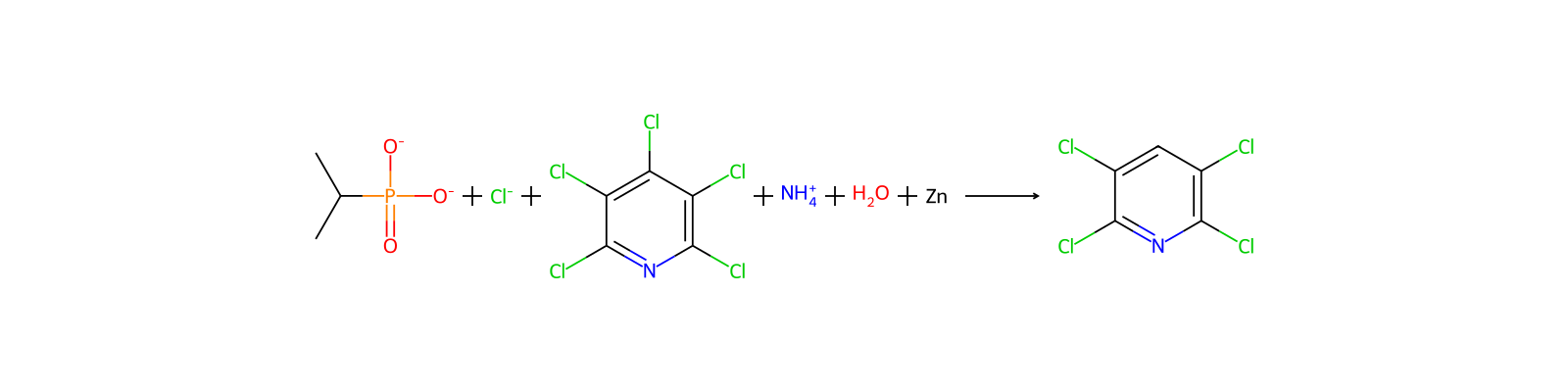
Methods of ManufacturingReduction /of pentachloropyridine/ with zinc, or electrochemically, yields 2,3,5,6-tetrachloropyridine.
General Manufacturing Information
Pesticide, Fertilizer, and Other Agricultural Chemical Manufacturing
Pyridine, 2,3,5,6-tetrachloro-: ACTIVE
응용 분야
용도2,3,5,6-Tetrachloropyridine is used as a chemical intermediate in the production of chlorpyrifos and triclopyr.
상·하류 제품 정보
하류 제품
공급사50 곳
国药集团化学试剂有限公司86-21-63210123 · [email protected]
梯希爱(上海)化成工业发展有限公司021-67121386 · [email protected]
上海阿拉丁生化科技股份有限公司400-6206333 13167063860 · [email protected]
Shandong chuangyingchemical Co., Ltd.18853181302 · [email protected]
武汉欣扬瑞和化学科技有限公司153-07155313 15307155313 · [email protected]
爱斯特(成都)生物制药股份有限公司+86-28-85122536 85324413 · [email protected]
Dayang Chem (Hangzhou) Co.,Ltd.+86-0571-88938639 17705817739 · [email protected]
北京安司莫森技术有限公司010-82954736 13391601435 · [email protected]
上海将来实业股份有限公司400-0066400 13621662912 · [email protected]
Syntechem Co.,Ltd[email protected]
上海迈瑞尔生化科技有限公司4006356688 18621169109 · [email protected]
北京华威锐科化工有限公司0757-86329057 18934348241 · [email protected]
阿法埃莎(中国)化学有限公司400-6106006 · [email protected]
安耐吉化学&3A(安徽泽升科技股份有限公司)400-0056266 · [email protected]
石家庄斯迪亚诺精细化工有限公司0311-89250318 13582355795 · [email protected]
上海瀚鸿科技股份有限公司021-54306202 13764082696 · [email protected]
上海钰康生物科技有限公司+86-18930848214 +86-021-56762820 · [email protected]
上海景颜化工科技有限公司13817811078 · [email protected]
嘉兴市艾森化工有限公司0573-85285100 18627885956 · [email protected]
Pure Chemistry Scientific Inc.001-857-928-2050 or 1-888-588-9418 · [email protected]
上海隆盛化工有限公司58099637 13585536065 · [email protected]
上海攀鸿化工科技有限公司021-56491756 13512199871 · [email protected]
南京蓝白化工有限公司025-85499326 15366059326;13813836665 · [email protected]
孝感深远化工有限公司15527621225; 15527621225 · [email protected]
山东西亚化学有限公司13355009207 13355009207 · [email protected]
玛雅试剂+86 (573) 82222445 (0)18006601000 452520369 · [email protected]
四川库利南科技有限公司400-1166-196 18981987031 · [email protected]
天津希恩思生化科技有限公司400 638 7771 · [email protected]
南京维奥化工有限公司Please Send Email 18652950785 · [email protected]
上海思域化工科技有限公司86-21-34053660 · [email protected]
张家港保税区凯利特化工有限公司18606289633 15862625988 · [email protected]
江苏艾康生物医药研发有限公司025-66113011 13913916777 · [email protected]
TOKYO CHEMICAL INDUSTRY CO., LTD.03-36680489 · [email protected]
越林试剂021-62960152 · [email protected]
北京环宇世纪化学科技有限公司hysj_bj.com
上海将来实业股份有限公司400-0066400 13621662912 · [email protected]
上海将来实业股份有限公司021-61552785 · [email protected]
安徽科迪达化工有限公司0554-2106669 · [email protected]
HBCChem, Inc.+1-510-219-6317 · [email protected]
上海笛柏生物科技有限公司400-008-9730,021-54359730 400-008-9730 · [email protected]
湖南华腾制药有限公司400-8592883 · [email protected]
上海有朋化工有限公司021-69005955 13701776567 · [email protected]
北京海力扬化学科技有限公司13718199399 · [email protected]
北京欣赛维化学科技有限公司010-56218822 13717722232 · [email protected]
四川海诺威科技有限公司13708085536 13708085536 · [email protected]
上海凯赛化工有限公司021-33516722 13701817765 · [email protected]
上海彤源化工有限公司021-021-69182866 13701855675 · [email protected]
北京华扬致成科技有限公司13716033033 · [email protected]
上海蓝润化学有限公司021-69515658 ; 69515628 13701998368 · [email protected]
上海容立化学科技有限公司021-69992220 13701886816 · [email protected]
관련 반응
54건




연결된 노트
불러오는 중…