Homovanillic Acid
HVA · Homovanilic acid · 4-HYDROXY-3-METHOXYPHENYLACETIC ACID · 4-Hydroxy-3-methoxybenzeneacetic acid · Benzeneacetic acid, 4-hydroxy-3-methoxy- · JACS-306-08-1 · homovanillicaci · Vanilacetic acid
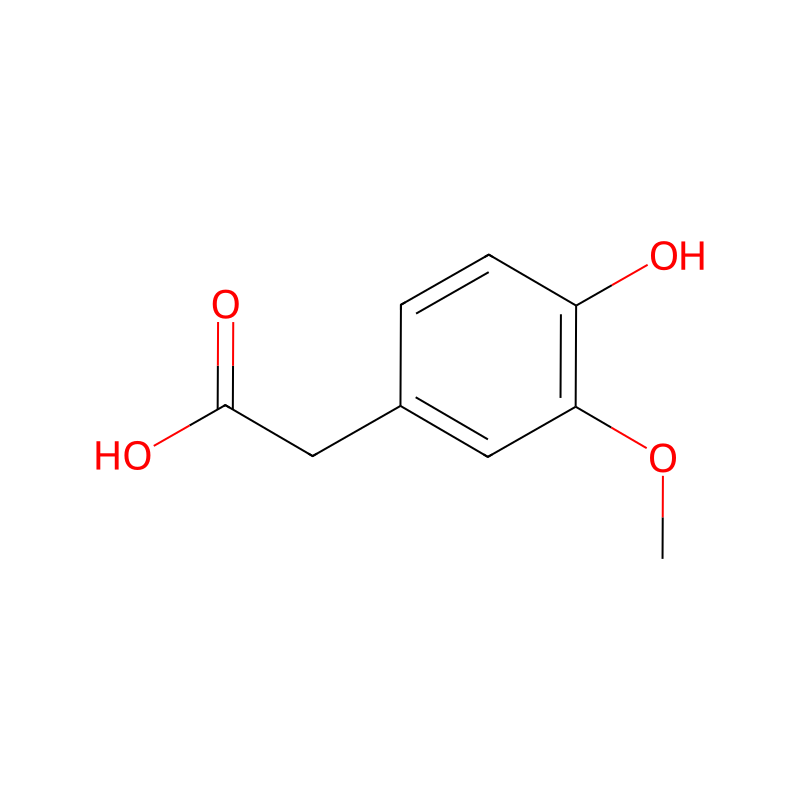
식별자 및 물리적 특성
| CAS No. | 306-08-1 |
|---|---|
| 분자식 | C9H10O4 |
| 평균 분자량 | 182.17 g/mol |
| 단동위원소 질량 | 182.0579088 g/mol |
| SMILES | COc1cc(CC(=O)O)ccc1O |
| InChIKey | QRMZSPFSDQBLIX-UHFFFAOYSA-N |
| PubChem CID | 1738 |
| ChEMBL | CHEMBL1562 |
| ChEBI | CHEBI:545959 |
| EC No. | 206-176-7 |
| DTXSID | DTXSID5059791 |
화학 및 물리적 성질
| XLogP | 0.4 |
|---|---|
| 극성 표면적 | 66.8 |
| 수소 결합 공여자 수 | 2 |
| 수소 결합 수용자 수 | 4 |
| 회전 가능 결합 수 | 3 |
| 무거운 원자 수 | 13 |
| 형식 전하 | 0 |
| 복잡도 | 180 |
| 물질 분류 | Biological Agents -> Other Biomolecules |
| LogP(분배 계수) | 0.33 |
| 용해도 | 17 mg/mLDMSO(약간 용해됨), 메탄올(약간 용해됨, 가열) |
| 녹는점 | 138 - 140 °C142-145 °C(lit.) |
| 증기압 | 0.00000823 [mmHg] |
| Physical Description | White solid[Merck Index] White to pale brown crystalline powder[Alfa Aesar MSDS] |
| Collision Cross Section | 134.15 Ų [M-H]- [CCS Type: DTMethod: single field calibrated with Agilent tune mix (Agilent)]140.75 Ų [M-H]- [CCS Type: DTMethod: stepped-field]146.2 Ų [M+Na]+ [CCS Type: DTMethod: single field calibrated with ESI Low Concentration Tuning Mix (Agilent)]145.9 Ų [M+Na]+ |
| 끓는 점 | 235.56°C (rough estimate) |
| 밀도 | 1.1634 (rough estimate) |
| 굴절률 | 1.4209 (estimate) |
| 저장 조건 | Keep in dark place,Inert atmosphere,Room temperature |
| pKa(산도 계수) | 4.39±0.10(Predicted) |
| 물리적 상태 | 결정성 분말 |
| 색상 | 흰색에서 베이지색 |
| 용해도 | 녹는 |
| Merck | 14,4740 |
| BRN | 2213447 |
| 안정성 | 흡습성 |
| 주요 응용 | 제약 |
| InChI | 1S/C9H10O4/c1-13-8-4-6(5-9(11)12)2-3-7(8)10/h2-4,10H,5H2,1H3,(H,11,12) |
| InChIKey | QRMZSPFSDQBLIX-UHFFFAOYSA-N |
| SMILES | COc1cc(CC(O)=O)ccc1O |
| LogP(분배 계수) | 0.330 |
| NIST | Benzeneacetic acid, 4-hydroxy-3-methoxy-(306-08-1) |
| EPA | Homovanillic acid (306-08-1) |
화학적 성질
white to beige crystalline powder
안전 및 규제
| GHS 분류 | WarningH315 (100%): Causes skin irritation [Warning Skin corrosion/irritation]P261, P264, P264+P265, P271, P280, P302+P352, P304+P340, P305+P351+P338, P319, P321, P332+P317, P337+P317, P362+P364, P403+P233, P405, and P501 (click each P-code to see the statement)Aggregated GHS information provided per 46 reports by companies from 6 notifications to the ECHA C&L Inventory. Each notification may be associated with multiple companies. |
|---|---|
| 규제 정보 | Benzeneacetic acid, 4-hydroxy-3-methoxy-: Does not have an individual approval but may be used under an appropriate group standard |
| 유해성 요약 | A skin, respiratory tract, and strong eye irritant[Alfa Aesar MSDS] |
| Hazard Classes and Categories | Skin Irrit. 2 (100%) |
| 수질 위해 등급(WGK) | 3 |
| TSCA 등재 상태 | TSCA listed |
| 관세 코드 | 29189900 |
| 위험 문구(R) | 36/37/38 |
| 위험 표시 | Xi |
| 안전 문구(S) | 26-36 |
| 위험 등급 | IRRITANT |
| F 고인화성물질 | 10-23 |
| 저장 분류 | 11 - Combustible Solids |
용도
개요
Homovanillic acid (HVA) is a dopamine metabolite. It is formed via deamination of dopamine by monoamine oxidase (MAO) to produce 3,4-dihydroxyphenylacetic acid (DOPAC; ) followed by DOPAC metabolism by catechol-O-methyltransferase (COMT). HVA undergoes hydrogen peroxide-dependent oxidation in the presence of horseradish peroxidase to form a fluorescent dimer that displays excitation/emission maxima of 312/420 nm, respectively. It has been used to quantify hydrogen peroxide production in macrophages and neutrophils.
용도
Fluorimetric reagent and major catecholamine metaboliteHomovanillic acid is used as a reagent in the determination of oxidative enzymes. It is associated with dopamine levels in the brain. Its presence supports a diagnosis of neuroblastoma and malignant pheochromocytoma.