
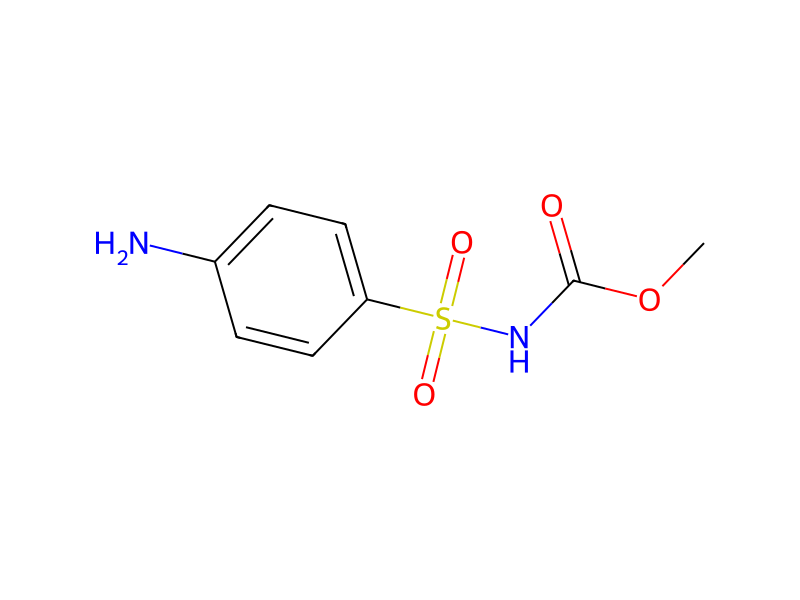
기본 정보
- 표준 SMILES
COC(=O)NS(=O)(=O)c1ccc(N)cc1- InChIKey
VGPYEHKOIGNJKV-UHFFFAOYSA-N- 분자식
- C8H10N2O4S
- 평균 분자량
- 230.24 g/mol
- 단동위원소 질량
- 230.0361278
개요
Asulam is a carbamate ester that is methyl carbamate substituted by a (4-aminophenyl)sulfonyl group at the nitrogen atom. A dihydropteroate synthase inhibitor, it is used (normally as the corresponding sodium salt, asulam-sodium) as a herbicide, mainly for killing bracken. It has a role as a herbicide, an agrochemical, a xenobiotic, an EC 2.5.1.15 (dihydropteroate synthase) inhibitor and an environmental contaminant. It is a carbamate ester, a sulfonamide, a substituted aniline and a primary amino compound. It is a conjugate acid of an asulam(1-).
이름 및 식별자
- 우선 이름
- Asulam
- IUPAC
- methyl N-(4-aminophenyl)sulfonylcarbamate
- 영어명
- Asulam
- 분자식
- C8H10N2O4S
- 분자량
- 230.24
이름 및 동의어
ASULAM3337-71-1AsuloxAsilanAsulox FJonnixPlakinAsulox 40Methyl sulfanilylcarbamateMethyl sulphanilylcarbamateMB 9057Asulame
이름 더 보기
AsulonArulamAsilamasulanASULUM
Methyl sulfanilyl carbamateM and B 9057Methyl N-(4-aminobenzenesulfonyl)carbamateCarbamic acid, [(4-aminophenyl)sulfonyl]-, methyl esterCarbamic acid, sulfanilyl-, methyl esterCaswell No. 062AMethyl N-(4-aminophenyl)sulfonylcarbamateMethyl ((4-aminophenyl)sulfonyl)carbamate
데이터베이스 식별자
- CAS
3337-71-1- PubChem CID
- 18752
- DTXSID
DTXSID8023890- ChEMBL
CHEMBL2137678- ChEBI
CHEBI:81696- UNII
- 0Y5ASM7P5S
- EC Number
- 222-077-1、689-264-1
- Nikkaji
- J3.401K
물성
구조 계산 물성
- XLogP
- -0.3
- 극성 표면적
- 107 Ų
- 수소 결합 공여자 수
- 2
- 수소 결합 수용자 수
- 5
- 회전 가능 결합 수
- 3
- 무거운 원자 수
- 15
- 형식 전하
- 0
- 복잡도
- 314
실험 및 물리화학적 성질
SpringerMaterials PropertiesFusion temperature
Pesticides
Pesticide -> EPA IRIS
Agrochemicals -> Pesticide active substances
Active substance -> EU Pesticides database: Not approved
Pesticides -> Herbicides, Carbamate
Environmental transformation -> Pesticides (parent, predecessor)
Pesticide (Asulam) -> USDA PDB
LogP
log Kow = -0.27
-0.27
Color/Form
White crystals
Colorless crystals
Solubility
In water, 5.0X10+3 mg/L at 22 °C
In water, 5 g/L
Solubility: water, 0.5%
Stable in boiling water over 6 hours
For more Solubility (Complete) data for Asulam (7 total), please visit the HSDB record page.
Endocrine DisruptorsPotential endocrine disrupting compound
DecompositionWhen heated to decomposition it emits very toxic fumes of /nitrogen oxides and sulfur oxides/.
Melting Point
144.2 °C
MP: 143-144 °C (decomposes)
Vapor Pressure0.00000144 [mmHg]
Physical DescriptionWhite solid; [Merck Index]
Dissociation ConstantspKa = 4.82
Collision Cross Section150.4 Ų [M-H]- [CCS Type: DT; Buffer gas: N2; Ionization: ESI-; Dataset: TOXCAST; Source Identifier: DTXSID8023890]
물리화학적 성질
- 녹는점
- 142 · 142-144°C (dec.)
- 밀도
- 1.4655 · 1.4655 (rough estimate)
- 굴절률
- 1.569 · 1.5690 (estimate)
- 저장 조건
- 0 · 0-6°C
- 용해도
- DMSO(약간 용해됨), 메탄올(약간 용해됨)
- 산도 계수 (pKa)
- 4.82 · 4.82(at 25℃)
- 색상
- 옅은 갈색에서 밝은 갈색까지
- 수용성
- 5 g/L · 5g/L(상온)
- Merck
- 13 · 13,862
- BRN
- 2697523 · 2697523
- 주요 응용
- 농업환경
- InChI
- 1S/C8H10N2O4S/c1-14-8(11)10-15(12,13)7-4-2-6(9)3-5-7/h2-5H,9H2,1H3,(H,10,11)
- InChIKey
- VGPYEHKOIGNJKV-UHFFFAOYSA-N
- SMILES
- COC(=O)NS(=O)(=O)c1ccc(N)cc1
- LogP
- -0.27 · -0.270
- NIST
- Asulam(3337-71-1)
- EPA
- Asulam (3337-71-1)
화학적 성질
Light Brown Solid
안전 및 규제
GHS 분류
GHS Classification
This chemical does not meet GHS hazard criteria for 4.2% (3 of 71) of reports.
Warning
H302 (95.8%): Harmful if swallowed [Warning Acute toxicity, oral]
P264, P270, P301+P317, P330, and P501 (click each P-code to see the statement)
Aggregated GHS information provided per 71 reports by companies from 3 notifications to the ECHA C&L Inventory.
Warning
유해성 정보
Regulatory Information
Asulam + sodium salt is listed in the dataset of EPA Human Health Benchmarks for Pesticides under the Safe Drinking Water Act (40 eCFR 141)
Reg. (EU) 1045/2011
Asulam: Does not have an individual approval but may be used under an appropriate group standard
The New Jersey Worker and Community Right to Know Act requires public and private employers to provide information about hazardous substances at their workplaces. (N.J.S.A. 34:5A-1 et. seq.)
Other Safety InformationIMAP assessments - Carbamic acid, [(4-aminophenyl)sulfonyl]-, methyl ester: Environment tier I assessment
Hazards Summary
Thyroid follicular hyperplasia observed in male rats at the LOAEL (180 mg/kg/day) following two year chronic feeding study; Other sub-chronic animal studies produced increase in absolute and relative thyroid weights; Considerable reduction in live births per litter observed in two generation study of rats; [Reference #1] A mild skin and moderate eye irritant in rabbits; Solid evidence of skin sensitization in Maximisation test; Targets thyroid and erythrocytes in 90 day rat study; Thyroid identified as target organ in dogs as well; Hematological and histopathological effects consistent with mild anemia noted in chronic rodent studies; Adrenal medullary hyperplasia and limited evidence of carcinogenicity (phaeochromocytoma of higher frequency) observed at highest doses in male rats in chronic studies; Multi-generational rat study produced reduction in litter size (doses >= 5000 ppm); No evidence of teratogenicity, developmental toxicity, or cholinesterase inhibition; [EFSA] See Asulam-sodium.
Special Reports
USEPA/Office of Prevention, Pesticides and Toxic Substances; Reregistration Eligibility Decision Document - Asulam, EPA 738-R-95-024 (September 1995). The RED summarizes the risk assessment conclusions and outlines any risk reduction measures necessary for the pesticide to continue to be registered in the USA.[Available from, as of July 3, 2018: http://www.epa.gov/pesticides/reregistration/status.htm]
FIFRA Requirements
Tolerances are established for the combined residues of asulam (methyl sulfanilylcarbamate) and its sulfanilamide containing metabolites in or on the following food commodities:[Table#6058]
Based on the reviews of the generic data for the active ingredients asulam and its sodium salt, the Agency has sufficient information on the health effects of asulam and its sodium salt and on its potential for causing adverse effects in fish and wildlife and the environment. Although levels of concern are exceeded for endangered and non-endangered plant species and surfacewater and groundwater quality, the Agency concludes that products containing asulam and its sodium salt for all uses, with the exception of sugarcane, once amended to reflect the risk mitigation measures imposed in this RED, are eligible for reregistration.
As the federal pesticide law FIFRA directs, EPA is conducting a comprehensive review of older pesticides to consider their health and environmental effects and make decisions about their continued use. Under this pesticide reregistration program, EPA examines newer health and safety data for pesticide active ingredients initially registered before November 1, 1984, and determines whether the use of the pesticide does not pose unreasonable risk in accordance to newer safety standards, such as those described in the Food Quality Protection Act of 1996. Asulalm is found on List A, which contains most pesticides that are used on foods and, hence, have a high potential for human exposure. List A consists of the 194 chemical cases (or 350 individual active ingredients) for which EPA issued registration standards prior to FIFRA '88. Case No: 0265; Pesticide type: herbicide; Registration Standard Date: 12/31/87; Case Status: RED Approved 06/95; OPP has made a decision that some/all uses of the pesticide are eligible for reregistration, as reflected in a Reregistration Eligibility Decision (RED) document.; Active ingredient (AI): asulam; Data Call-in (DCI) Date(s): 08/07/91, 10/11/95; AI Status: OPP has completed a Reregistration Eligibility Decision (RED) for the case/AI.
As the federal pesticide law FIFRA directs, EPA is conducting a comprehensive review of older pesticides to consider their health and environmental effects and make decisions about their continued use. Under this pesticide reregistration program, EPA examines newer health and safety data for pesticide active ingredients initially registered before November 1, 1984, and determines whether the use of the pesticide does not pose unreasonable risk in accordance to newer safety standards, such as those described in the Food Quality Protection Act of 1996. Sodium asulalm is found on List A, which contains most pesticides that are used on foods and, hence, have a high potential for human exposure. List A consists of the 194 chemical cases (or 350 individual active ingredients) for which EPA issued registration standards prior to FIFRA '88. Case No: 0265; Pesticide type: herbicide; Registration Standard Date: 12/31/87; Case Status: RED Approved 06/95; OPP has made a decision that some/all uses of the pesticide are eligible for reregistration, as reflected in a Reregistration Eligibility Decision (RED) document.; Active ingredient (AI): asulam; Data Call-in (DCI) Date(s): 08/07/91, 03/03/95, 10/11/95, 10/13/95; AI Status: OPP has completed a Reregistration Eligibility Decision (RED) for the case/AI. /Asulam sodium/
Hazard Classes and CategoriesAcute Tox. 4 (95.8%)
Skin, Eye, and Respiratory Irritations
Application of technical asulam to rabbit eyes produced mild chemosis, irritation, and redness which cleared by day seven posttreatment. Asulam was not an irritant in a primary skin irritation study in rabbits. It did not cause dermal sensitization in guinea pigs.
안전 및 보호
Disposal Methods
SRP: Recycle any unused portion of the material for its approved use or return it to the manufacturer or supplier. Ultimate disposal of the chemical must consider: the material's impact on air quality; potential migration in air, soil or water; effects on animal, aquatic and plant life; and conformance with environmental and public health regulations. If it is possible or reasonable use an alternative chemical product with less inherent propensity for occupational harm/injury/toxicity or environmental contamination.
Preventive Measures
SRP: The scientific literature for the use of contact lenses by industrial workers is inconsistent. The benefits or detrimental effects of wearing contact lenses depend not only upon the substance, but also on factors including the form of the substance, characteristics and duration of the exposure, the uses of other eye protection equipment, and the hygiene of the lenses. However, there may be individual substances whose irritating or corrosive properties are such that the wearing of contact lenses would be harmful to the eye. In those specific cases, contact lenses should not be worn. In any event, the usual eye protection equipment should be worn even when contact lenses are in place.
Allowable TolerancesTolerances are established for the combined residues of asulam (methyl sulfanilylcarbamate) and its sulfanilamide containing metabolites in or on the following food commodities:[Table#6057]
독성 정보
Treatment
If the compound has been ingested, rapid gastric lavage should be performed using 5% sodium bicarbonate. For skin contact, the skin should be washed with soap and water. If the compound has entered the eyes, they should be washed with large quantities of isotonic saline or water. In serious cases, atropine and/or pralidoxime should be administered. Anti-cholinergic drugs work to counteract the effects of excess acetylcholine and reactivate AChE. Atropine can be used as an antidote in conjunction with pralidoxime or other pyridinium oximes (such as trimedoxime or obidoxime), though the use of '-oximes' has been found to be of no benefit, or possibly harmful, in at least two meta-analyses. Atropine is a muscarinic antagonist, and thus blocks the action of acetylcholine peripherally.
If the compound has been ingested, rapid gastric lavage should be performed using 5% sodium bicarbonate. For skin contact, the skin should be washed with soap and water. If the compound has entered the eyes, they should be washed with large quantities of isotonic saline or water. In serious cases, atropine and/or pralidoxime should be administered. Anti-cholinergic drugs work to counteract the effects of excess acetylcholine and reactivate AChE. Atropine can be used as an antidote in conjunction with pralidoxime or other pyridinium oximes (such as trimedoxime or obidoxime), though the use of '-oximes' has been found to be of no benefit, or possibly harmful, in at least two meta-analyses. Atropine is a muscarinic antagonist, and thus blocks the action of acetylcholine peripherally.
Target OrgansHepatic
Health Effects
Acute exposure to cholinesterase inhibitors can cause a cholinergic crisis characterized by severe nausea/vomiting, salivation, sweating, bradycardia, hypotension, collapse, and convulsions. Increasing muscle weakness is a possibility and may result in death if respiratory muscles are involved. Accumulation of ACh at motor nerves causes overstimulation of nicotinic expression at the neuromuscular junction. When this occurs symptoms such as muscle weakness, fatigue, muscle cramps, fasciculation, and paralysis can be seen. When there is an accumulation of ACh at autonomic ganglia this causes overstimulation of nicotinic expression in the sympathetic system. Symptoms associated with this are hypertension, and hypoglycemia. Overstimulation of nicotinic acetylcholine receptors in the central nervous system, due to accumulation of ACh, results in anxiety, headache, convulsions, ataxia, depression of respiration and circulation, tremor, general weakness, and potentially coma. When there is expression of muscarinic overstimulation due to excess acetylcholine at muscarinic acetylcholine receptors symptoms of visual disturbances, tightness in chest, wheezing due to bronchoconstriction, increased bronchial secretions, increased salivation, lacrimation, sweating, peristalsis, and urination can occur. Certain reproductive effects in fertility, growth, and development for males and females have been linked specifically to organophosphate pesticide exposure. Most of the research on reproductive effects has been conducted on farmers working with pesticides and insecticdes in rural areas. In females menstrual cycle disturbances, longer pregnancies, spontaneous abortions, stillbirths, and some developmental effects in offspring have been linked to organophosphate pesticide exposure. Prenatal exposure has been linked to impaired fetal growth and development. Neurotoxic effects have also been linked to poisoning with OP pesticides causing four neurotoxic effects in humans: cholinergic syndrome, intermediate syndrome, organophosphate-induced delayed polyneuropathy (OPIDP), and chronic organophosphate-induced neuropsychiatric disorder (COPIND). These syndromes result after acute and chronic exposure to OP pesticides.
Acute exposure to cholinesterase inhibitors can cause a cholinergic crisis characterized by severe nausea/vomiting, salivation, sweating, bradycardia, hypotension, collapse, and convulsions. Increasing muscle weakness is a possibility and may result in death if respiratory muscles are involved. Accumulation of ACh at motor nerves causes overstimulation of nicotinic expression at the neuromuscular junction. When this occurs symptoms such as muscle weakness, fatigue, muscle cramps, fasciculation, and paralysis can be seen. When there is an accumulation of ACh at autonomic ganglia this causes overstimulation of nicotinic expression in the sympathetic system. Symptoms associated with this are hypertension, and hypoglycemia. Overstimulation of nicotinic acetylcholine receptors in the central nervous system, due to accumulation of ACh, results in anxiety, headache, convulsions, ataxia, depression of respiration and circulation, tremor, general weakness, and potentially coma. When there is expression of muscarinic overstimulation due to excess acetylcholine at muscarinic acetylcholine receptors symptoms of visual disturbances, tightness in chest, wheezing due to bronchoconstriction, increased bronchial secretions, increased salivation, lacrimation, sweating, peristalsis, and urination can occur. Certain reproductive effects in fertility, growth, and development for males and females have been linked specifically to organophosphate pesticide exposure. Most of the research on reproductive effects has been conducted on farmers working with pesticides and insecticdes in rural areas. In females menstrual cycle disturbances, longer pregnancies, spontaneous abortions, stillbirths, and some developmental effects in offspring have been linked to organophosphate pesticide exposure. Prenatal exposure has been linked to impaired fetal growth and development. Neurotoxic effects have also been linked to poisoning with OP pesticides causing four neurotoxic effects in humans: cholinergic syndrome, intermediate syndrome, organophosphate-induced delayed polyneuropathy (OPIDP), and chronic organophosphate-induced neuropsychiatric disorder (COPIND). These syndromes result after acute and chronic exposure to OP pesticides.
Ecotoxicity Values
LC50; Species: Anas platyrhynchos (Mallard Duck); diet >75000 ppm for 8 days /60% purity/
LC50; Species: Phasianus colchicus (Ring-Necked Pheasant) age 7 days; diet >75000 ppm for 8 days /60% purity/
Environmental Fate
TERRESTRIAL FATE: Based on a classification scheme(1), Koc values of 40 and 300(2,3) indicate that asulam is expected to have high to moderate mobility in soil(SRC). The pKa of asulam is 4.82(4), indicating that this compound will exist almost entirely in the anion form in the environment and anions generally do not adsorb more strongly to soils containing organic carbon and clay than their neutral counterparts(5). Volatilization from moist soil is not expected because the compound exists as an anion and anions do not volatilize. Asulam is not expected to volatilize from dry soil surfaces(SRC) based upon an estimated vapor pressure of 1.4X10⁻⁶ mm Hg at 25 °C(SRC), determined from a fragment constant method(6). Asulam exhibited photolytic degradation half-lives of 40 and 208 hrs in air-dried and moist soil , respectively(7). Biodegradation half-lives of 8-28 days in soil(8) suggest that biodegradation is an important environmental fate process in soil(SRC).
FIELD STUDY: Asulam, applied at 2.5 kg/ha to three Saskatchewan, Canada (sandy loam, heavy clay, silty clay) soils was present at less than 5% in the 12 months following May 1975-1977 applications(1).
AQUATIC FATE: Based on a classification scheme(1), reported Koc values of 40 and 300(2,3) indicate that asulam is not expected to adsorb to suspended solids and sediment(SRC). A pKa of 4.82(4) indicates asulam will exist almost entirely in the anion form at pH values of 5 to 9 and, therefore, volatilization from water surfaces is not expected to be an important fate process(SRC). According to a classification scheme(5), an estimated BCF of 3(SRC), from its log Kow of -0.27(6) and a regression-derived equation(7), suggests the potential for bioconcentration in aquatic organisms is low(SRC). Asulam is stable to hydrolysis at pH's of 5, 7 and 9(8). The compound photodegrades very rapidly in aqueous solution at pH 9 (half-life = 2 hrs)(8). A biodegradation half-life of greater than 1 year(6) indicates that biodegradation is not an important environmental fate process in water(SRC).
ATMOSPHERIC FATE: According to a model of gas/particle partitioning of semivolatile organic compounds in the atmosphere(1), asulam, which has an estimated vapor pressure of 1.4X10⁻⁶ mm Hg at 25 °C(SRC), determined from a fragment constant method(2), will exist in both the vapor and particulate phases in the ambient atmosphere. Vapor-phase asulam is degraded in the atmosphere by reaction with photochemically-produced hydroxyl radicals(SRC); the half-life for this reaction in air is estimated to be 15 hrs(SRC), calculated from its rate constant of 1.6X10⁻¹¹ cu cm/molecule-sec at 25 °C(SRC) that was derived using a structure estimation method(2). Particulate-phase asulam may be removed from the air by wet and dry deposition(SRC). Asulam absorbs UV at wavelength 270 nm(3) and, therefore, is not expected to be susceptible to direct photolysis by sunlight(SRC).
Adverse EffectsSkin Sensitizer - An agent that can induce an allergic reaction in the skin.
Exposure Routes
Inhalation (L793) ; oral (L793); dermal (L793)
Inhalation (L793) ; oral (L793); dermal (L793)
Toxicity Summary
IDENTIFICATION AND USE: Asulam is a herbicide used for weed control. Asulam is formulated into and applied as the asulam sodium salt. HUMAN STUDIES: In vitro cytogenetics assay in human lymphocytes were negative for asulam. ANIMAL STUDIES: Application of technical asulam to rabbit eyes produced mild chemosis, irritation, and redness which cleared by day seven posttreatment. Asulam was not an irritant in a primary skin irritation study in rabbits. It did not cause dermal sensitization in guinea pigs. In a six-month feeding study of asulam in beagle dogs doses of asulam at 300 mg/kg/day and 1,500 mg/kg/day were associated with reductions in food consumption, body weight gain, emesis, diarrhea, and reductions in red blood cells, hemoglobin and packed cell volume. There were also elevated thyroid and kidney weights and reduced testicular weights. In a two-year carcinogenicity study mice, asulam was administered in the diet at 0, 500, 5,000 or 50,000 ppm. There was no increase in the incidence of any tumors. A two-year combined chronic feeding/carcinogenicity study was conducted using rats. Hyperplastic changes were observed in the adrenal medulla and in thyroid follicular cells of males at the doses of 180 and 953 mg/kg/day. There was a statistically significant increase in thyroid gland c-cell carcinomas and in adenomas and carcinomas combined in both the low- and mid-dose males. There was a statistically-significant increase in benign adrenal medullary pheochromocytomas at the high dose in males. No teratogenic effects were produced by asulam in either rats or rabbits. The Ames Assay which is used to detect gene mutation with Salmonella typhimurium was negative. Mutagenicity assays which detect structural chromosome aberrations included the dominant lethal test in mice and were negative for asulam. ECOTOXICITY STUDIES: When tested in bobwhite quail (Colinus virginianus) dietary study, asulam had no effect on food consumption, body weight, or cumulative mortality, and no signs of toxicity were seen during the 28-day feeding period. Similarly, the chemical had no effect on egg production, fertility, or hatchability of fertile eggs, or on abnormalities in the F1 generation.
Asulam is a cholinesterase or acetylcholinesterase (AChE) inhibitor. A cholinesterase inhibitor (or 'anticholinesterase') suppresses the action of acetylcholinesterase. Because of its essential function, chemicals that interfere with the action of acetylcholinesterase are potent neurotoxins, causing excessive salivation and eye-watering in low doses, followed by muscle spasms and ultimately death. Nerve gases and many substances used in insecticides have been shown to act by binding a serine in the active site of acetylcholine esterase, inhibiting the enzyme completely. Acetylcholine esterase breaks down the neurotransmitter acetylcholine, which is released at nerve and muscle junctions, in order to allow the muscle or organ to relax. The result of acetylcholine esterase inhibition is that acetylcholine builds up and continues to act so that any nerve impulses are continually transmitted and muscle contractions do not stop. Among the most common acetylcholinesterase inhibitors are phosphorus-based compounds, which are designed to bind to the active site of the enzyme. The structural requirements are a phosphorus atom bearing two lipophilic groups, a leaving group (such as a halide or thiocyanate), and a terminal oxygen.
Asulam, sodium salt is a cholinesterase or acetylcholinesterase (AChE) inhibitor. A cholinesterase inhibitor (or 'anticholinesterase') suppresses the action of acetylcholinesterase. Because of its essential function, chemicals that interfere with the action of acetylcholinesterase are potent neurotoxins, causing excessive salivation and eye-watering in low doses, followed by muscle spasms and ultimately death. Nerve gases and many substances used in insecticides have been shown to act by binding a serine in the active site of acetylcholine esterase, inhibiting the enzyme completely. Acetylcholine esterase breaks down the neurotransmitter acetylcholine, which is released at nerve and muscle junctions, in order to allow the muscle or organ to relax. The result of acetylcholine esterase inhibition is that acetylcholine builds up and continues to act so that any nerve impulses are continually transmitted and muscle contractions do not stop. Among the most common acetylcholinesterase inhibitors are phosphorus-based compounds, which are designed to bind to the active site of the enzyme. The structural requirements are a phosphorus atom bearing two lipophilic groups, a leaving group (such as a halide or thiocyanate), and a terminal oxygen.
Ecotoxicity Excerpts
/BIRDS and MAMMALS/ Sixteen, 22, and 27 week old bobwhite quail (Colinus virginianus) were maintained for 4 weeks on diets containing 0, 1.5, 6.0, or 25.0 ppm asulam. During the following 3 weeks, they were maintained on normal diets without asulam. The pesticide residues in various tissues were analyzed using the Bratton-Marshall reaction. Asulam had no effect on food consumption, body weight, or cumulative mortality, and no signs of toxicity were seen during the 28-day feeding period. Similarly, the chemical had no effect on egg production, fertility, or hatchability of fertile eggs, or on abnormalities in the F1 generation. The amounts of asulam recovered from the tissues varied according to the tissues studied; the kidenys, leg muscles, and liver contained the greatest amounts, 0.13, 0.14, and 0.11 ppm, respectively. During the withdrawal period, the liver contained 0.12 ppm asulam, but residues were not found in any other tissues. The data indicate that there are no imminent or long term hazards to quail from the application of asulam in the field.
/AQUATIC SPECIES/ The fungicide fluazinam, the insecticide lambda-cyhalothrin, and the herbicides asulam and metamitron were applied to indoor freshwater microcosms (water volume approximately 0.6 cu m). The treatment regime was based on a realistic application scenario in tulip cultivation. Concentrations of each pesticide were equal to 0%, 0.2%, 0.5%, 2%, and 5% spray drift emission of label-recommended rates. Contribution of compounds to the toxicity of the pesticide package was established by expressing their concentrations as fractions of toxic units. The fate of the compounds in the water, and responses of phytoplankton, zooplankton, periphyton, macroinvertebrates, macrophytes, decomposition, and water quality were followed for 13 weeks. The half-lives of lambda-cyhalothrin, metamitron, and fluazinam were 1 to 2 d; that of asulam was >30d. No consistent effects could be demonstrated for the 0.2% treatment regime that was therefore considered the no-observed-effect concentration (NOEC). The macroinvertebrate populations of Gammarus pulex, Asellus aquaticus, and Proasellus meridianus were the most sensitive end points, followed by species of copepods and cladocerans. Responses mainly were due to lambda-cyhalothrin. The 0.5% treatment regime resulted in short-term effects. Pronounced effects were observed at the 2% and 5% treatment levels. At the end of the experiment, the macrophyte biomass that consisted of Elodea nuttallii, showed a decline at the two highest treatment levels, asulam being the causal factor (NOEC: 0.5% treatment level). Primary production was reduced at the 5% treatment level only. In our experiment, the first-tier risk assessment procedure for individual compounds was adequate for protecting sensitive populations exposed to realistic combinations of pesticides. Spray drift reduction measures seem to be efficient in protecting aquatic ecosystems in agricultural areas.
Signs and Symptoms
As with organophosphates, the signs and symptoms are based on excessive cholinergic stimulation. Unlike organophosphate poisoning, carbamate poisonings tend to be of shorter duration because the inhibition of nervous tissue acetylcholinesterase is reversible, and carbamates are more rapidly metabolized. Muscle weakness, dizziness, sweating and slight body discomfort are commonly reported early symptoms. Headache, salivation, nausea, vomiting, abdominal pain and diarrhea are often prominent at higher levels of exposure. Contraction of the pupils with blurred vision, incoordination, muscle twitching and slurred speech have been reported. (L795)
As with organophosphates, the signs and symptoms are based on excessive cholinergic stimulation. Unlike organophosphate poisoning, carbamate poisonings tend to be of shorter duration because the inhibition of nervous tissue acetylcholinesterase is reversible, and carbamates are more rapidly metabolized. Muscle weakness, dizziness, sweating and slight body discomfort are commonly reported early symptoms. Headache, salivation, nausea, vomiting, abdominal pain and diarrhea are often prominent at higher levels of exposure. Contraction of the pupils with blurred vision, incoordination, muscle twitching and slurred speech have been reported. (L795)
Ongoing Test Status
EPA has released the Interactive Chemical Safety for Sustainability (iCSS) Dashboard. The iCSS Dashboard provides an interactive tool to explore rapid, automated (or in vitro high-throughput) chemical screening data generated by the Toxicity Forecaster (ToxCast) project and the federal Toxicity Testing in the 21st century (Tox21) collaboration. /The title compound was tested by ToxCast and/or Tox21 assays/[USEPA; ICSS Dashboard Application; Available from, as of August 9, 2018: http://actor.epa.gov/dashboard/]
EPA IRIS Information
Asulam
Hepatic
5 x 10 ^-2 mg/kg-day
규제 정보
FIFRA Requirements
Tolerances are established for the combined residues of asulam (methyl sulfanilylcarbamate) and its sulfanilamide containing metabolites in or on the following food commodities:[Table#6058]
Based on the reviews of the generic data for the active ingredients asulam and its sodium salt, the Agency has sufficient information on the health effects of asulam and its sodium salt and on its potential for causing adverse effects in fish and wildlife and the environment. Although levels of concern are exceeded for endangered and non-endangered plant species and surfacewater and groundwater quality, the Agency concludes that products containing asulam and its sodium salt for all uses, with the exception of sugarcane, once amended to reflect the risk mitigation measures imposed in this RED, are eligible for reregistration.
As the federal pesticide law FIFRA directs, EPA is conducting a comprehensive review of older pesticides to consider their health and environmental effects and make decisions about their continued use. Under this pesticide reregistration program, EPA examines newer health and safety data for pesticide active ingredients initially registered before November 1, 1984, and determines whether the use of the pesticide does not pose unreasonable risk in accordance to newer safety standards, such as those described in the Food Quality Protection Act of 1996. Asulalm is found on List A, which contains most pesticides that are used on foods and, hence, have a high potential for human exposure. List A consists of the 194 chemical cases (or 350 individual active ingredients) for which EPA issued registration standards prior to FIFRA '88. Case No: 0265; Pesticide type: herbicide; Registration Standard Date: 12/31/87; Case Status: RED Approved 06/95; OPP has made a decision that some/all uses of the pesticide are eligible for reregistration, as reflected in a Reregistration Eligibility Decision (RED) document.; Active ingredient (AI): asulam; Data Call-in (DCI) Date(s): 08/07/91, 10/11/95; AI Status: OPP has completed a Reregistration Eligibility Decision (RED) for the case/AI.
As the federal pesticide law FIFRA directs, EPA is conducting a comprehensive review of older pesticides to consider their health and environmental effects and make decisions about their continued use. Under this pesticide reregistration program, EPA examines newer health and safety data for pesticide active ingredients initially registered before November 1, 1984, and determines whether the use of the pesticide does not pose unreasonable risk in accordance to newer safety standards, such as those described in the Food Quality Protection Act of 1996. Sodium asulalm is found on List A, which contains most pesticides that are used on foods and, hence, have a high potential for human exposure. List A consists of the 194 chemical cases (or 350 individual active ingredients) for which EPA issued registration standards prior to FIFRA '88. Case No: 0265; Pesticide type: herbicide; Registration Standard Date: 12/31/87; Case Status: RED Approved 06/95; OPP has made a decision that some/all uses of the pesticide are eligible for reregistration, as reflected in a Reregistration Eligibility Decision (RED) document.; Active ingredient (AI): asulam; Data Call-in (DCI) Date(s): 08/07/91, 03/03/95, 10/11/95, 10/13/95; AI Status: OPP has completed a Reregistration Eligibility Decision (RED) for the case/AI. /Asulam sodium/
안전 데이터
- wgk
- 3
- rtecs
- FD1190000
- 독성
- LD50 in rats, mice, dogs, rabbits (mg/kg): >5000, >5000, >5000, >2000 orally; in rats (mg/kg): >1200 dermally (Brockelsby)
- HS 번호
- 29350090
- risk_code
- 22
- hazard_code
- Xn
- Hazard Classifications
- Acute Tox. 4 Oral
- 스토리지 클래스
- 13 - Non Combustible Solids
- 유해 물질 데이터
- 3337-71-1(Hazardous Substances Data)
화학 및 산업
약리 정보
Metabolism/Metabolites
... Two goats were dosed with ring-labeled (14)C-asulam at 20 ppm in the diet for 7 consecutive days. The total radioactive residues were nondetectable (<0.005 ppm) in fat and muscle, 0.162 ppm in kidneys, 0.090 ppm in liver, and up to 0.021 ppm in milk. The parent compound, asulam, constituted the majority of the residues in milk (81% of total reactive reside (TRR)) and kidneys (100% of TRR) and its metabolite N4-acetylsulfanilamide constitutes the majority of residues in liver (58% of TRR). The parent was not identified in liver samples. In a previous study, sulfanilamide was found in ruminant liver and muscle, and N4-acetylasulam was found in liver, kidney, milk, muscle, and fat.
... Laying hens were dosed with ring-labeled (14)C-asulam at 22.5 ppm in the diet for 7 consecutive days. The maximum total radioactive residues were 0.027 ppm in egg yolks, 0.062 ppm in egg whites, 0.011 ppm in fat, 0.074 ppm in muscle, 0.444 ppm in kidneys, and 0.086 ppm in liver. The parent compound asulam, and its metabolite N4-acetylsulfanilamide constituted the majority of the residues in poultry, comprising 63 and 44% of the total reactive reside (TRR), respectively, in egg yolks, 21 and 52% of the TRR, respectively, in egg whites, 35 and 51% of the TRR, respectively, in muscle, and 83 and 14% of the TRR, respectively, in kidney. The parent was not identified in liver samples; N4-acetyl sulfanilamide represented 81% of the TRR in liver samples.
Metabolism studies were conducted in male and female Sprague- Dawley rats. The tests used a single oral or iv dose, or repeated i.v. doses for 14 days. The pharmacokinetics of asulam were similar after all dose regimens in both sexes. Peak blood levels were attained at 0.5 hours. No unusual localization of asulam occurred in tissues and all tissue levels were low at 72 hours. Asulam was rapidly eliminated, mostly within 24 hours. 76.5% to 101.5% of the administered dose was eliminated in the urine, and 1.4% to 25.3% of the dose in feces. The major excretory product was unchanged parent compound (70% to 80%), with acetylasulam (3% to 8%) and acetylsulphanilamide (<3%) being the two major metabolites.
The metabolism of [ring-(14)C]asulam, a systemic herbicide highly effective against bracken, has been studied in rats. Most of the radioactivity (76-100% dose) administered orally or intravenously is excreted in the urine in 24 hr as unchanged asulam (61-74% dose), N4-acetylasulam (8-14%) and N4-acetylsulphanilamide (0.1-2.6%). Small amounts of radioactivity (0.3-7.4% dose) were present in the feces, only traces (0.2-0.3%) were excreted in the bile, and no significant (14)CO2 was detected. Perfusion of rat liver with (14)C-asulam resulted in more extensive metabolism. Total amounts present in perfusate (81% total), bile (1%) plus liver (14%) were 23.1% for unchanged asulam, 25.7% for acetylasulam, less than 1% for acetylsulphanilamide, and 4.5% as conjugates of asulam and acetylasulam, together with several other unidentified metabolites. Asulam is acetylated more readily than sulphanilamide, by rat-liver homogenate, and the highest enzyme activity was associated with the mitochondrial fraction (2.4 pmol/mg protein per min). Although not hydroxylated by rats in vivo, evidence was obtained for the hydroxylation of asulam by rat-liver microsomal preparations in vitro.
The carbamates are hydrolyzed enzymatically by the liver; degradation products are excreted by the kidneys and the liver. (L793)
The carbamates are hydrolyzed enzymatically by the liver; degradation products are excreted by the kidneys and the liver. (L793)
Absorption, Distribution and Excretion
... Two goats were dosed with ring-labeled (14)C-asulam at 20 ppm in the diet for 7 consecutive days. The total radioactive residues were nondetectable (<0.005 ppm) in fat and muscle, 0.162 ppm in kidneys, 0.090 ppm in liver, and up to 0.021 ppm in milk. The parent compound, asulam, constituted the majority of the residues in milk (81% of total reactive reside (TRR)) and kidneys (100% of TRR) and its metabolite N4-acetylsulfanilamide constitutes the majority of residues in liver (58% of TRR). The parent was not identified in liver samples. In a previous study, sulfanilamide was found in ruminant liver and muscle, and N4-acetylasulam was found in liver, kidney, milk, muscle, and fat.
... Laying hens were dosed with ring-labeled (14)C-asulam at 22.5 ppm in the diet for 7 consecutive days. The maximum total radioactive residues were 0.027 ppm in egg yolks, 0.062 ppm in egg whites, 0.011 ppm in fat, 0.074 ppm in muscle, 0.444 ppm in kidneys, and 0.086 ppm in liver. The parent compound asulam, and its metabolite N4-acetylsulfanilamide constituted the majority of the residues in poultry, comprising 63 and 44% of the total reactive reside (TRR), respectively, in egg yolks, 21 and 52% of the TRR, respectively, in egg whites, 35 and 51% of the TRR, respectively, in muscle, and 83 and 14% of the TRR, respectively, in kidney. The parent was not identified in liver samples; N4-acetyl sulfanilamide represented 81% of the TRR in liver samples.
Metabolism studies were conducted in male and female Sprague- Dawley rats. The tests used a single oral or iv dose, or repeated i.v. doses for 14 days. The pharmacokinetics of asulam were similar after all dose regimens in both sexes. Peak blood levels were attained at 0.5 hours. No unusual localization of asulam occurred in tissues and all tissue levels were low at 72 hours. Asulam was rapidly eliminated, mostly within 24 hours. 76.5% to 101.5% of the administered dose was eliminated in the urine, and 1.4% to 25.3% of the dose in feces. The major excretory product was unchanged parent compound (70% to 80%), with acetylasulam (3% to 8%) and acetylsulphanilamide (<3%) being the two major metabolites.
The metabolism of [ring-(14)C]asulam, a systemic herbicide highly effective against bracken, has been studied in rats. Most of the radioactivity (76-100% dose) administered orally or intravenously is excreted in the urine in 24 hr as unchanged asulam (61-74% dose), N4-acetylasulam (8-14%) and N4-acetylsulphanilamide (0.1-2.6%). Small amounts of radioactivity (0.3-7.4% dose) were present in the feces, only traces (0.2-0.3%) were excreted in the bile, and no significant (14)CO2 was detected. Perfusion of rat liver with (14)C-asulam resulted in more extensive metabolism. Total amounts present in perfusate (81% total), bile (1%) plus liver (14%) were 23.1% for unchanged asulam, 25.7% for acetylasulam, less than 1% for acetylsulphanilamide, and 4.5% as conjugates of asulam and acetylasulam, together with several other unidentified metabolites. Asulam is acetylated more readily than sulphanilamide, by rat-liver homogenate, and the highest enzyme activity was associated with the mitochondrial fraction (2.4 pmol/mg protein per min). Although not hydroxylated by rats in vivo, evidence was obtained for the hydroxylation of asulam by rat-liver microsomal preparations in vitro.
용도 및 제조
Uses
Used as selective pre-emergence herbicide mainly on sugarcane; Also used on ornamentals, turf, and other non-cropland; The only registered product is the sodium salt (Asulam-sodium CAS # 2302-17-2) soluble/concentrate liquid; [Reference #1] Available in the EU as aqueous solution of Asulam-sodium equivalent to 400 g/L Asulam; Designed for use on spinach with other food and feed crop, non-cropland, and grassland uses; [EFSA]
Farming (Pesticides) [Category: Industry]
For asulam (USEPA/OPP Pesticide Code: 106901) there are 0 labels match. /SRP: Not registered for current use in the USA, but approved pesticide uses may change periodically and so federal, state and local authorities must be consulted for currently approved uses./
For asulam sodium (USEPA/OPP Pesticide Code: 106902) ACTIVE products with label matches. /Asulam sodium; SRP: Registered for use in the USA but approved pesticide uses may change periodically and so federal, state and local authorities must be consulted for currently approved uses./
Asulam (methyl sulfanilylcarbamate) is a herbicide used for weed control on sugarcane, Christmas tree plantations, ornamentals, turf, and noncropland uses. Asulam is formulated into and applied as the asulam sodium salt.
Asulam, a cell-division inhibitor, is a selective, systemic herbicide, translocated, used for the control of annual and perennial grasses and broad-leaved weeds in a variety of crops, grassland, noncropland, and forestry.
Methods of Manufacturing
Asulam is produced by reaction of 4-aminobenzenesulfonamide, after protection of the amino group, with ethyl chloroformate in the presence of a base.
Preparation: Belgium patent 622214 (1963 to May & Baker).
Formulations/Preparations
Aceto Asulam 400 Herbicide (Aceto Agricultural Chemicals Corporation): Active ingredient: Asulam, sodium salt 36.2%. /Asulam sodium/
AX Asulam Herbicide (Aceto Agricultural Chemicals Corporation): Active ingredient: Asulam, sodium salt 36.2%. /Asulam sodium/
Asulam 400 (Dow Agrosciences LLC): Active ingredient: Asulam, sodium salt 36.2%. /Asulam sodium/
Asulam Herbicide (Loveland Products, Inc.): Active ingredient: Asulam, sodium salt 36.2%. /Asulam sodium/
For more Formulations/Preparations (Complete) data for Asulam (11 total), please visit the HSDB record page.
Use ClassificationEnvironmental transformation -> Pesticides (parent, predecessor)
General Manufacturing Information
Registration Notes: Canada: Asulox F for wild oat control in flaxseed. Western Europe: For preemergence annual weed control in spinach. Western Europe, Australia: For control of Dock (Rumex) in pastures, orchards; bracken in pastures, forestry and noncropland; wild oat and certain broadleaf weeds in oilseed poppy. Japan: Asilan for annual weed control in mulberry and zoysia turf.
응용 분야
개요Asulam is a sulfonamide and can be formulated as a sodium salt. It is very water soluble and is a very systemic herbicide following foliar and root uptake, owing to its physicochemical properties (Table 1). The Log P (Kow) of 1.01 and pKa of 4.82 are optimal for phloem mobility in the plant (4). These properties contribute to the herbicidal effectiveness against perennial weeds where translocation to underground meristematic organs is essential for effective control.
용도Carbamate herbicide; folic acid biosynthesis inhibitor.
상·하류 제품 정보
상류 원료
공급사50 곳
湖北博杰生物科技有限公司0713-2060728 15629612610
上海阿拉丁生化科技股份有限公司400-6206333 13167063860 · [email protected]
南通飞宇生物科技有限公司0513-68819626 15152877458 · [email protected]
Hebei Chuanghai Biotechnology Co., Ltd+86-17732866630 · [email protected]
盐城通铭生物科技有限公司15195160625 · [email protected]
上海麦克林生化科技股份有限公司021-50706066 15221275939 · [email protected]
武汉欣扬瑞和化学科技有限公司153-07155313 15307155313 · [email protected]
大连美仑生物技术有限公司0411-62910999 13889544652 · [email protected]
XI'AN TIANGUANGYUAN BIOTECH CO., LTD.—
梯希爱(上海)化工贸易有限公司021-61109150 · [email protected]
广东方信生物科技有限公司0751-2838688 13376594225 · [email protected]
上海景颜化工科技有限公司13817811078 · [email protected]
上海毕楷科技有限公司18516304666
四川库利南科技有限公司400-1166-196 18981987031 · [email protected]
Xiamen AmoyChem Co., Ltd+86-86-5926051114 · [email protected]
ZHEJIANG JIUZHOU CHEM CO., LTD+86-0576225566889 +86-13454675544 · [email protected];[email protected];[email protected]
TargetMol 中国(陶术生物)400-821-0310 15002144251 · [email protected]
成都思天德生物科技有限公司028-83243028 19136088901 · [email protected]
深圳振强药物研发有限公司0755-66853366 13670046396 · [email protected]
南京生利德生物科技有限公司025-57798810 18652991625 · [email protected]
上海将来实业股份有限公司400-0066400 13621662912 · [email protected]
HBCChem, Inc.+1-510-219-6317 · [email protected]
天津普西唐生物医药科技有限公司010-60605840 · [email protected]
杭州杰恒化工有限公司0571-87396432 · [email protected]
武汉弘德悦欣医药科技有限公司027-83855396 15271852016
凯试(上海)科技有限公司021-50135380 · [email protected]
湖北巨胜科技有限公司027-59599241 18871490274 · [email protected]
Sigma-Aldrich西格玛奥德里奇(上海)贸易有限公司021-61415566 800-8193336 · [email protected]
AN PharmaTech Co Ltd86(21)68097365 · [email protected]
天津荣燊化工有限公司18317763565; 18317763565 · [email protected]
天津阿尔塔科技有限公司022-6537-8550 15522853686 · [email protected]
TargetMol中国(陶术生物)021-021-33632979 15002134094 · [email protected]
上海陶术生物科技股份有限公司+1-781-999-5354; +1-00000000000 · [email protected]
常州安奈凯医药科技有限公司+86-0519-8359-8696 · [email protected]
HANGZHOU LEAP CHEM CO., LTD.+86-571-87711850 +86-15355479329 · [email protected]
厦门志信化学有限公司+86-5922680277 +86-13806087780 · [email protected]
湖北世腾化工科技有限公司18971850150 19086915685 · [email protected]
广东翁江化学试剂有限公司0751-2886766 13927870850 · [email protected]
西安天广源生物科技有限公司+86-029-86333380 +86-18829239519 · [email protected]
艾吉析科技(上海)有限公司17721401538;17717235263 17721401538 · [email protected]
Nantong Guangyuan Chemicl Co,Ltd+86-17331189928 · [email protected]
上海西陇生化科技有限公司021-52907766-8042
上海源叶生物科技有限公司13636370518 · [email protected]
山东西亚化学有限公司4009903999 13395398332 · [email protected]
安泰精细化工技术有限公司18503026267 · [email protected]
南京罗迈美生物科技有限公司[email protected]
湖北世腾化工科技有限公司19086915685 18971850150 · [email protected]
BOC Sciences[email protected]
山东小野化学股份有限公司0539-6362799 20)
上海贤鼎生物科技有限公司021-021-52271985 17721149837 · [email protected]
추가 설명
정의ChEBI: A carbamate ester that is methyl carbamate substituted by a (4-aminophenyl)sulfonyl group at the nitrogen atom.
관련 반응
6건


연결된 노트
불러오는 중…