4-아미노안티피린
4-아미노-1,5-디메틸-2-페닐-3H-파라졸3-온 · 4-아미노안티피린 · 암피론 · 암모늄수산화물 · 암모니아액체 · 암모니아용액 · 수화암모니아 · 암모니아물
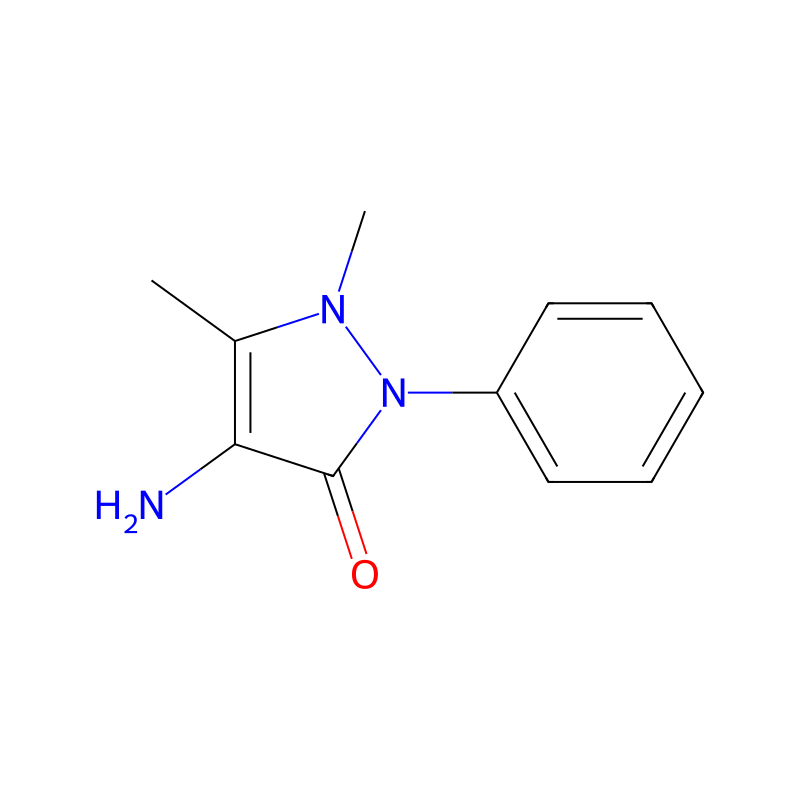
식별자 및 물리적 특성
| CAS No. | 83-07-8 |
|---|---|
| 분자식 | C11H13N3O |
| 평균 분자량 | 203.24 g/mol |
| 단동위원소 질량 | 203.10586204 g/mol |
| SMILES | Cc1c(N)c(=O)n(-c2ccccc2)n1C |
| InChIKey | RLFWWDJHLFCNIJ-UHFFFAOYSA-N |
| PubChem CID | 2151 |
| ChEMBL | CHEMBL1165011 |
| ChEBI | CHEBI:59026 |
| EC No. | 201-452-3 |
| DTXSID | DTXSID8048860 |
| 현지명 | 4-아미노안티피린 |
화학 및 물리적 성질
| XLogP | 0.1 |
|---|---|
| 극성 표면적 | 49.6 |
| 수소 결합 공여자 수 | 1 |
| 수소 결합 수용자 수 | 3 |
| 회전 가능 결합 수 | 1 |
| 무거운 원자 수 | 15 |
| 형식 전하 | 0 |
| 복잡도 | 305 |
| 의약품 | Pharmaceuticals -> Metabolite of Metamizole |
| Animal Drugs | Pharmaceuticals -> Animal Drugs -> Approved in Taiwan |
| Endocrine Disruptors | Potential endocrine disrupting compound |
| Collision Cross Section | 151.49 Ų [M+K]+ [CCS Type: TWMethod: calibrated with polyalanine and drug standards]142.6 Ų [M+H]+ [CCS Type: TW142.48 Ų [M+H]+ |
| 녹는점 | 105-110 °C(lit.) |
| 끓는 점 | 340 C |
| 밀도 | 0.8 |
| 굴절률 | 1.4930 (estimate) |
| 저장 조건 | Keep in dark place,Inert atmosphere,Room temperature |
| 용해도 | H2O: 0.1 g/mL, 투명 |
| pKa(산도 계수) | pK1: 4.94(+1) (25°C) |
| 물리적 상태 | 분말 또는 결정 |
| 색상 | 노란색에서 황갈색 |
| pH | 7.1 (100g/l, H2O, 20℃)(slurry) |
| 냄새 | 냄새 없는 |
| 용해도 | ca. 500g/L(20℃) |
| Merck | 14,591 |
| BRN | 181635 |
| 안정성 | 안정적인. 빛에 민감할 수 있습니다. |
| InChI | 1S/C11H13N3O/c1-8-10(12)11(15)14(13(8)2)9-6-4-3-5-7-9/h3-7H,12H2,1-2H3 |
| InChIKey | RLFWWDJHLFCNIJ-UHFFFAOYSA-N |
| SMILES | CN1N(c2ccccc2)C(=O)C(N)=C1C |
| LogP(분배 계수) | -0.257 (est) |
| NIST | Aminoantipyrene(83-07-8) |
| EPA | 4-Aminoantipyrene (83-07-8) |
화학적 성질
It is an amber to pale yellow crystalline powder. It is soluble in water, benzene, and ethanol, and only slightly soluble in diethyl ether.
안전 및 규제
| GHS 분류 | This chemical does not meet GHS hazard criteria for 1% (1 of 105) of reports.WarningH302 (99%): Harmful if swallowed [Warning Acute toxicity, oral]P261, P264, P264+P265, P270, P271, P280, P301+P317, P302+P352, P304+P340, P305+P351+P338, P319, P321, P330, P332+P317, P337+P317, P362+P364, P403+P233, P405, and P501 (click each P-code to see the statement)Aggregated GHS information provided per 105 reports by companies from 13 notifications to the ECHA C&L Inventory. Each notification may be associated with multiple companies. |
|---|---|
| 규제 정보 | 4-Amino-2,3-dimethyl-1-phenyl-3-pyrazolin-5-one: Does not have an individual approval but may be used under an appropriate group standard |
| 기타 안전 정보 | IMAP assessments - 3H-Pyrazol-3-one, 4-amino-1,2-dihydro-1,5-dimethyl-2-phenyl-: Environment tier I assessment |
| Hazard Classes and Categories | Acute Tox. 4 (99%) |
| 수질 위해 등급(WGK) | 3 |
| TSCA 등재 상태 | TSCA listed |
| RTECS 번호 | CD2480000 |
| 독성 | LD50 orally in Rabbit: 1700 mg/kg |
| 관세 코드 | 29331190 |
| 위험 문구(R) | 22-36/37/38-20/21/22 |
| 위험 표시 | Xn |
| 안전 문구(S) | 26-36-36/37/39 |
| 기존화학 물질 | KE-01297 |
| F 고인화성물질 | 8-9-23 |
| 위험 참고 사항 | Harmful |
| 위험 등급 | Acute Tox. 4 Oral |
| 저장 분류 | 11 - Combustible Solids |
용도
용도
4-Aminoantipyrine is a metabolite of aminopyrine, having both analgesic and anti-inflammatory properties. It readily forms metal complexes due to its amino nitrogen, a strong coordination site.4-aminoantipyrine forms Schiff bases when treated with aldehydes/ketones, which are used in chemosensing applications.Coupling Reagent for Trinder's reagent in colorimetric hydrogen peroxide detectionassays.Forms highly stable dyes by coupling with Trinder's reagent in presence of Peroxidase and H2O2. Therefore suitable for use in test strip and solution diagnostics.
일반 설명
4-Aminoantipyrine forms heterocyclic Schiff bases, by reaction with various aldehydes and oximes. These Schiff bases form stable complexes with transition metals.
제조 및 합성 방법
제조 방법
synthesis of 4-aminoantipyrine: Antipyrine is nitrosated by sodium nitrite, reduced by ammonium bisulfite and ammonium sulfite, hydrolyzed by sulfuric acid, and finally neutralized with liquid ammonia to obtain 4-aminoantipyrine.