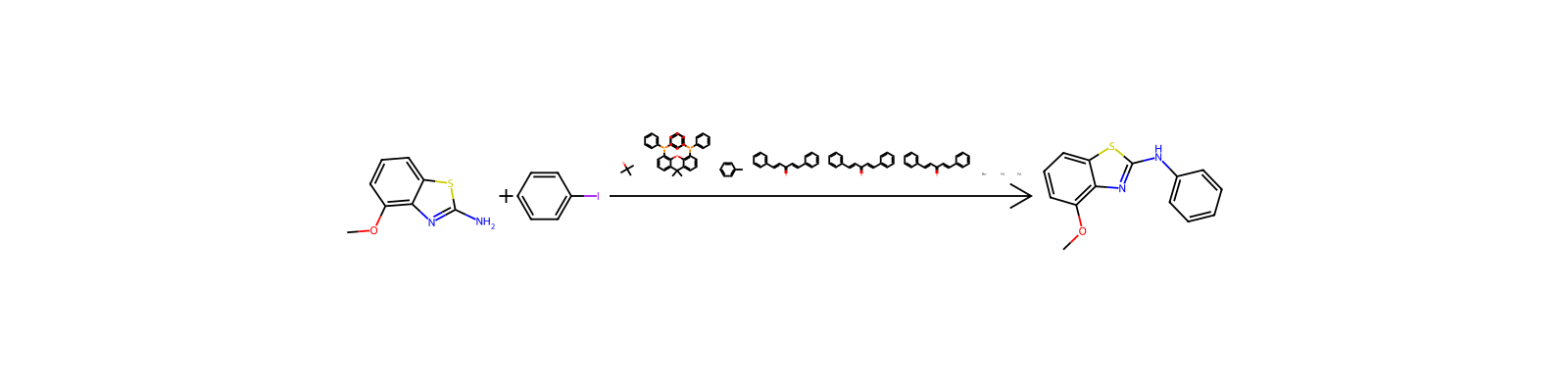
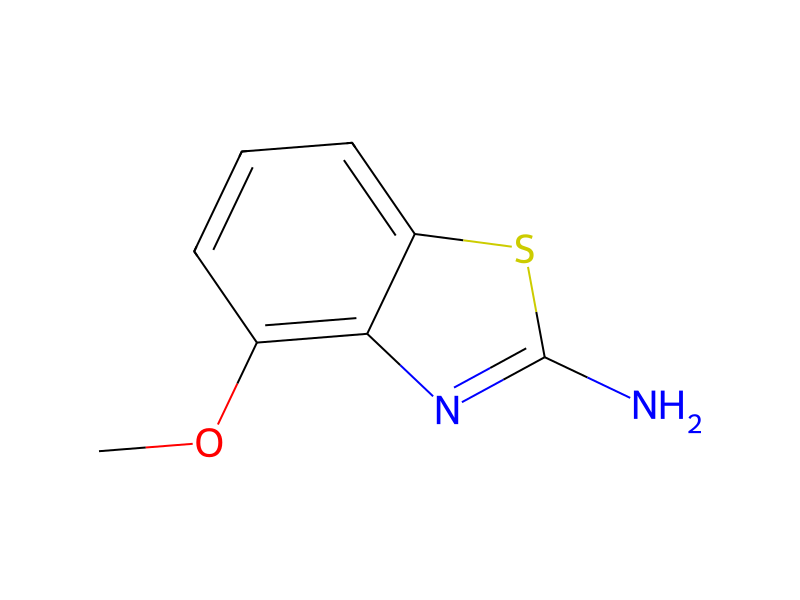
기본 정보
- 표준 SMILES
COc1cccc2sc(N)nc12- InChIKey
YEBCRAVYUWNFQT-UHFFFAOYSA-N- 분자식
- C8H8N2OS
- 평균 분자량
- 180.23 g/mol
- 단동위원소 질량
- 180.03573406
이름 및 식별자
- 우선 이름
- 4-Methoxy-2-aminobenzothiazole
- IUPAC
- 4-methoxy-1,3-benzothiazol-2-amine
- 현지명
- 4-메톡시-2-아미노벤조티아졸
- 영어명
- 4-Methoxy-2-aminobenzothiazole
- 분자식
- C8H8N2OS
- 분자량
- 180.23
이름 및 동의어
2-AMINO-4-METHOXYBENZOTHIAZOLE5464-79-94-Methoxy-2-aminobenzothiazole2-Benzothiazolamine, 4-methoxy-Benzothiazole, 2-amino-4-methoxy-4-Methoxybenzothiazol-2-ylamineDTXSID4024484EINECS 226-763-1NSC 287407E3D8644F2BRN 0141363NSC-28740
이름 더 보기
4-메톡시-2-아미노벤조티아졸4-methoxybenzo[d]thiazol-2-amine4-METHOXY-1,3-BENZOTHIAZOL-2-AMINE15144-A2AKOS BBS-00007984TIMTEC-BB SBB0002204-Methoxybenzothiazol-2-amine2-amino-4-methoxy-benzothiazol
(4-METHOXYBENZOTHIAZOL-2-YL)AMINEDTXCID2044844-27-00-05446 (Beilstein Handbook Reference)4-METHOXY-2-BENZOTHIAZOLAMINEAMINO-4-METHOXYBENZOTHIAZOLE, 2-BENZOTHIAZOLE, 1-AMINO-3-METHOXY-RefChem:5245302-Benzothiazolamine, 4-methoxy-(9CI)
데이터베이스 식별자
- CAS
5464-79-9- PubChem CID
- 21622
- DTXSID
DTXSID4024484- ChEMBL
CHEMBL1487454- UNII
- 7E3D8644F2
- EC Number
- 226-763-1
- Nikkaji
- J41.961C
물성
구조 계산 물성
- XLogP
- 2
- 극성 표면적
- 76.4 Ų
- 수소 결합 공여자 수
- 1
- 수소 결합 수용자 수
- 4
- 회전 가능 결합 수
- 1
- 무거운 원자 수
- 12
- 형식 전하
- 0
- 복잡도
- 167
실험 및 물리화학적 성질
Solubilityless than 1 mg/mL at 67.1 °F (NTP, 1992)
Melting Point307 to 311 °F (NTP, 1992)
Physical Description2-amino-4-methoxybenzothiazole is a beige chunky solid. (NTP, 1992)
Kovats Retention Index1892
물리화학적 성질
- 녹는점
- 153 · 153-155 °C (lit.)
- 끓는 점
- 240 °C · 240°C (rough estimate)
- 밀도
- 1.2425 · 1.2425 (rough estimate)
- 굴절률
- 1.569 · 1.5690 (estimate)
- 저장 조건
- Keep in dark place,Inert atmosphere,Room temperature
- 물리적 상태
- 결정성 분말
- 산도 계수 (pKa)
- 4.09 · 4.09±0.10(Predicted)
- 색상
- 베이지색
- 수용성
- 19.5 · 19.5&C에서 <0.1g/100mL
- BRN
- 141363 · 141363
- InChI
- InChI=1S/C8H8N2OS/c1-11-5-3-2-4-6-7(5)10-8(9)12-6/h2-4H,1H3,(H2,9,10)
- InChIKey
- YEBCRAVYUWNFQT-UHFFFAOYSA-N
- SMILES
- S1C2=CC=CC(OC)=C2N=C1N
- EPA
- 2 · 2-Amino-4-methoxybenzothiazole (5464-79-9)
화학적 성질
Beige crystalline powder
안전 및 규제
GHS 분류
GHS Classification
Warning
H302 (100%): Harmful if swallowed [Warning Acute toxicity, oral];H312 (89.1%): Harmful in contact with skin [Warning Acute toxicity, dermal];H332 (89.1%): Harmful if inhaled [Warning Acute toxicity, inhalation]
P261, P264, P270, P271, P280, P301+P317, P302+P352, P304+P340, P317, P321, P330, P362+P364, and P501 (click each P-code to see the statement)
Aggregated GHS information provided per 46 reports by companies from 4 notifications to the ECHA C&L Inventory. Each notification may be associated with multiple companies.;Information may vary between notifications depending on impurities, additives, and other factors. The percentage value in parenthesis indicates the notified classification ratio from companies that provide hazard codes. Only hazard codes with percentage values above 10% are shown. For more detailed information, please visit ECHA C&L website.
유해성 정보
Fire HazardsFlash point data for this chemical are not available. It is probably combustible. (NTP, 1992)
Health HazardsACUTE/CHRONIC HAZARDS: When heated to decomposition this compound emits very toxic fumes of NOx and SOx. (NTP, 1992)
Reactive GroupAmines, Phosphines, and Pyridines;Sulfides, Organic
Reactivity Profile
An amine, organosulfide. Organosulfides are incompatible with acids, diazo and azo compounds, halocarbons, isocyanates, aldehydes, alkali metals, nitrides, hydrides, and other strong reducing agents. Reactions with these materials generate heat and in many cases hydrogen gas. Many of these compounds may liberate hydrogen sulfide upon decomposition or reaction with an acid. Amines are chemical bases. They neutralize acids to form salts plus water. These acid-base reactions are exothermic. The amount of heat that is evolved per mole of amine in a neutralization is largely independent of the strength of the amine as a base. Amines may be incompatible with isocyanates, halogenated organics, peroxides, phenols (acidic), epoxides, anhydrides, and acid halides. Flammable gaseous hydrogen is generated by amines in combination with strong reducing agents, such as hydrides.
Air and Water ReactionsInsoluble in water.
Hazard Classes and CategoriesAcute Tox. 4 (100%);Acute Tox. 4 (89.1%);Acute Tox. 4 (89.1%)
안전 및 보호
Fire FightingFires involving this material can be controlled with a dry chemical, carbon dioxide or Halon extinguisher. (NTP, 1992)
First Aid
EYES: First check the victim for contact lenses and remove if present. Flush victim's eyes with water or normal saline solution for 20 to 30 minutes while simultaneously calling a hospital or poison control center. Do not put any ointments, oils, or medication in the victim's eyes without specific instructions from a physician. IMMEDIATELY transport the victim after flushing eyes to a hospital even if no symptoms (such as redness or irritation) develop.;SKIN: IMMEDIATELY flood affected skin with water while removing and isolating all contaminated clothing. Gently wash all affected skin areas thoroughly with soap and water. If symptoms such as redness or irritation develop, IMMEDIATELY call a physician and be prepared to transport the victim to a hospital for treatment.;INHALATION: IMMEDIATELY leave the contaminated area; take deep breaths of fresh air. If symptoms (such as wheezing, coughing, shortness of breath, or burning in the mouth, throat, or chest) develop, call a physician and be prepared to transport the victim to a hospital. Provide proper respiratory protection to rescuers entering an unknown atmosphere. Whenever possible, Self-Contained Breathing Apparatus (SCBA) should be used; if not available, use a level of protection greater than or equal to that advised under Protective Clothing.;INGESTION: DO NOT INDUCE VOMITING. If the victim is conscious and not convulsing, give 1 or 2 glasses of water to dilute the chemical and IMMEDIATELY call a hospital or poison control center. Be prepared to transport the victim to a hospital if advised by a physician. If the victim is convulsing or unconscious, do not give anything by mouth, ensure that the victim's airway is open and lay the victim on his/her side with the head lower than the body. DO NOT INDUCE VOMITING. IMMEDIATELY transport the victim to a hospital. (NTP, 1992)
Nonfire Spill Response
SMALL SPILLS AND LEAKAGE: Should a spill occur while you are handling this chemical, FIRST REMOVE ALL SOURCES OF IGNITION, then you should dampen the solid spill material with 60-70% ethanol and transfer the dampened material to a suitable container. Use absorbent paper dampened with 60-70% ethanol to pick up any remaining material. Seal the absorbent paper, and any of your clothes, which may be contaminated, in a vapor-tight plastic bag for eventual disposal. Solvent wash all contaminated surfaces with 60-70% ethanol followed by washing with a soap and water solution. Do not reenter the contaminated area until the Safety Officer (or other responsible person) has verified that the area has been properly cleaned.;STORAGE PRECAUTIONS: You should store this material under ambient temperatures. (NTP, 1992)
Personal Protective Equipment (PPE)
RECOMMENDED RESPIRATOR: Where the neat test chemical is weighed and diluted, wear a NIOSH-approved half face respirator equipped with an organic vapor/acid gas cartridge (specific for organic vapors, HCl, acid gas and SO2) with a dust/mist filter. (NTP, 1992)
안전 데이터
- wgk
- 3
- rtecs
- DL2000000
- HS 번호
- 29342000
- risk_code
- 20/21/22
- hazard_code
- Xn,Xi
- safety_code
- 36
- 위험 참고 사항
- Harmful
- Hazard Classifications
- Acute Tox. 4 DermalAcute Tox. 4 InhalationAcute Tox. 4 Oral
- 스토리지 클래스
- 11 - Combustible Solids
화학 및 산업
응용 분야
일반 설명Beige chunky solid.
상·하류 제품 정보
상류 원료
하류 제품
공급사50 곳
梯希爱(上海)化成工业发展有限公司021-67121386 · [email protected]
上海阿拉丁生化科技股份有限公司400-6206333 13167063860 · [email protected]
毕佳索(上海毕得医药科技股份有限公司)400-6005915 · [email protected]
上海麦克林生化科技股份有限公司021-50706066 15221275939 · [email protected]
成都彼样生物科技有限公司18108052721 · [email protected]
上海毕得医药科技股份有限公司400-1647117 13681763483 · [email protected]
爱斯特(成都)生物制药股份有限公司+86-28-85122536 85324413 · [email protected]
Dayang Chem (Hangzhou) Co.,Ltd.+86-0571-88938639 17705817739 · [email protected]
阿法埃莎(中国)化学有限公司400-6106006 · [email protected]
安耐吉化学&3A(安徽泽升科技股份有限公司)400-0056266 · [email protected]
上海瀚鸿科技股份有限公司021-54306202 13764082696 · [email protected]
上海相辉医药科技有限公司13761987713 · [email protected]
上海景颜化工科技有限公司13817811078 · [email protected]
Pure Chemistry Scientific Inc.001-857-928-2050 or 1-888-588-9418 · [email protected]
上海隆盛化工有限公司58099637 13585536065 · [email protected]
河南利恩化工产品有限公司0371-63357898 15378766539 · [email protected]
杭州东帆化学有限公司86-0571-85151182
云南西力生物技术股份有限公司0871-65217109 · [email protected]
苏州施亚生物科技有限公司86(512)5235 8471 17715136450 · [email protected]
天津希恩思生化科技有限公司400 638 7771 · [email protected]
常州市辰悦化工科技有限公司+86-0519-85500896 · [email protected]
北京泰亚杰科技有限公司021-33690831-8001 13552411790;18616022633 · [email protected]
济南千叶医药技术有限公司0531-81313138 13066006660 · [email protected]
赛默飞世尔科技(中国)有限公司800-810-5118 · [email protected]
上海健超生物科技有限公司150-2103-5486 18017383231 · [email protected]
TCI AMERICA800-4238616 · [email protected]
TOKYO CHEMICAL INDUSTRY CO., LTD.03-36680489 · [email protected]
TCI Europe320-37350700 · [email protected]
Shanghai Witofly Chemical Co.,Ltd[email protected]
越林试剂021-62960152 · [email protected]
南京杜莱生物技术有限公司025-84699383-8003;025-846993838003-8003 18013301590 · [email protected]
上海喀露蓝科技有限公司18149758185 18149758185 · [email protected]
上海毕得医药科技股份有限公司400-164-7117 18317119277 · [email protected]
Labnetwork lnc.+86-27-50766799 +86-18062016861 · [email protected]
成都零六生物科技有限公司400-1166-196 13458535857 · [email protected]
上海卓因生物科技有限公司021-61317773 · [email protected]
上海御略医药科技有限公司021-60345187 13671753212 · [email protected]
杭州杰恒化工有限公司0571-87396432 · [email protected]
上海永叶生物科技有限公司86-021-61559134 15921386130 · [email protected]
南京多隆生物科技有限公司18905173768 · [email protected]
上海洽凡生化科技有限公司+86-021-61654350 · [email protected]
江苏艾康生物医药研发有限公司025-66028182 17714375163 · [email protected]
陕西缔都医药化工有限公司029-81024372 17792795018 · [email protected]
上海皓骏医药科技有限公司021-34621078 13120882795 · [email protected]
湖北巨胜科技有限公司027-59599241 18871490274 · [email protected]
Sigma-Aldrich西格玛奥德里奇(上海)贸易有限公司021-61415566 800-8193336 · [email protected]
成都赛诺宁科技有限公司28-87999436 02887999436 · [email protected]
上海皓之翔生物科技有限公司(原上海拓青化工有限公司)526763801 13301653310 · [email protected]
上海威芬奇医药科技有限公司13817485796 · [email protected]
诺尔凯立科技有限公司86-(0)21-31261262 373522135 · [email protected]
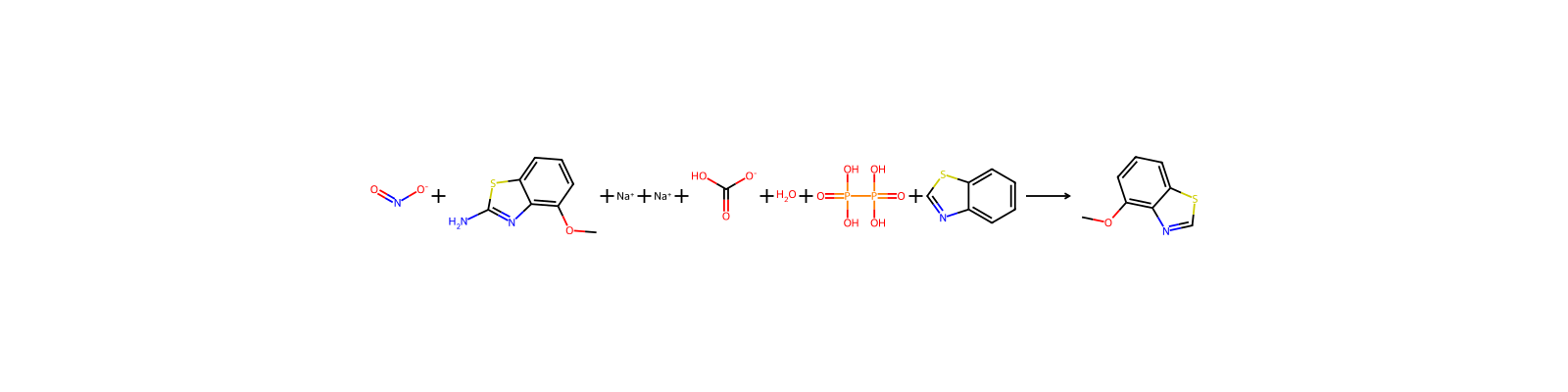
관련 반응
56건




연결된 노트
불러오는 중…