
HRID 903839반응물로
2-Chloro-p-phenylenediamine sulfate
데이터를 보충하는 중입니다. 잠시 후 페이지를 새로 고치면 최신 내용을 볼 수 있습니다
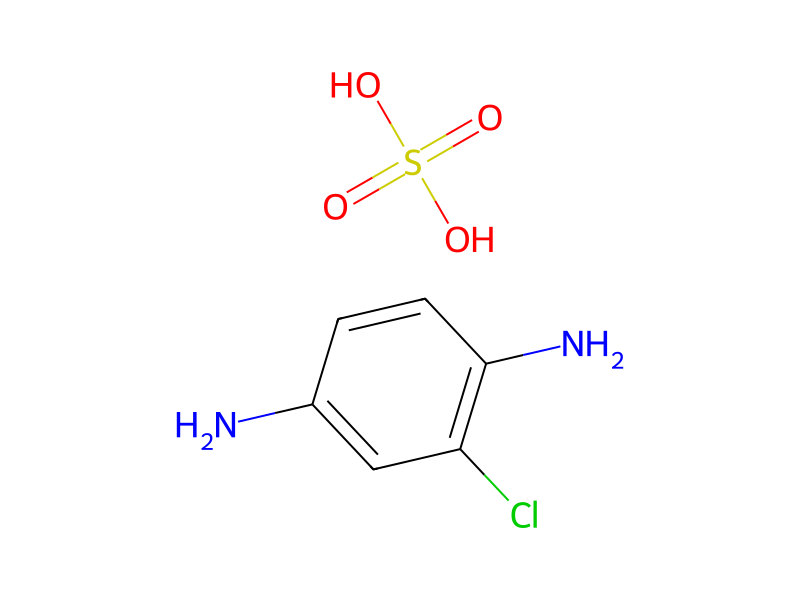
61702-44-1Nc1ccc(N)c(Cl)c1.O=S(=O)(O)OGQFGHCRXPLROOF-UHFFFAOYSA-N2-chloro-p-phenylenediamine sulfate appears as light gray or lavender powder. (NTP, 1992)
Cosmetic ingredients (2-Chloro-p-Phenylenediamine Sulfate) -> CIR (Cosmetic Ingredient Review)
Hair dyeing
안전 정보는 참고용이며, 공급업체의 물질안전보건자료(SDS), 관련 법규 및 전문가 평가를 대체하지 않습니다.
Danger
H301 (12.2%): Toxic if swallowed [Danger Acute toxicity, oral]
P261, P262, P264, P264+P265, P270, P271, P272, P280, P301+P316, P302+P352, P304+P340, P305+P351+P338, P316, P317, P319, P321, P330, P332+P317, P333+P317, P337+P317, P361+P364, P362+P364, P403+P233, P405, and P501 (click each P-code to see the statement)
Aggregated GHS information provided per 49 reports by companies from 7 notifications to the ECHA C&L Inventory. Each notification may be associated with multiple companies.
Danger
H301 (21.4%): Toxic if swallowed [Danger Acute toxicity, oral]
Chemical: 1,4-Benzenediamine, 2-chloro-, sulfate
REACH registered substance: 2-chlorobenzene-1,4-diammonium sulphate (EC: 228-291-1)
1,4-Benzenediamine, 2-chloro-, sulfate: Does not have an individual approval but may be used as a component in a product covered by a group standard. It is not approved for use as a chemical in its own right.
용도2-Chloro-p-phenylenediamine monosulfate (2-Chloro-1,4-diaminobenzene monosulfate) may be used in chemical synthesis studies.
일반 설명Light gray or lavender powder.
정의ChEBI: An arylammonium sulfate salt obtained by combining 2-chloro-1,4-phenylenediamine with one molar equivalent of sulfuric acid.

61702-44-1、6219-71-2DTXSID0020284CHEMBL1391326CHEBI:76597White to off-white powder
Final Report on the safety assessment of 2-chloro-p-phenylenediamine and 2-chloro-p-phenylenediamine sulfate. J Am Coll Toxicol 11(4) 521-30 (1992).
EVIDENCE IS GIVEN SUPPORTING TESTING OF THE CLASS OF COMPOUNDS PHENYLENEDIAMINES FOR THEIR TOXIC EFFECTS ON HUMAN HEALTH AND THE ENVIRONMENT. THE RESULTS OF TOXICITY TESTING OF 22 COMPOUNDS ARE TABULATED AS ARE THE EFFECTS FOR WHICH TESTING IS BEING CONSIDERED FOR 13 COMPOUNDS, AND THE USES OR POTENTIAL USES OF 47 PHENYLENEDIAMINES.[UNITED STATES EPA; PHENYLENEDIAMINES; RESPONSE TO INTERAGENCY TESTING COMMITTEE; FED REGIST 47(5) 973 (1982)]
An acidic salt of an amine. Materials in this group are generally soluble in water. The resulting solutions contain moderate concentrations of hydrogen ions and have pH's of less than 7.0. They react as acids to neutralize bases. These neutralizations generate heat, but less or far less than is generated by neutralization of inorganic acids, inorganic oxoacids, and carboxylic acid. They usually do not react as either oxidizing agents or reducing agents but such behavior is not impossible. Many of these compounds catalyze organic reactions.
Acute Tox. 3 (12.2%)
Acute Tox. 3 (21.4%)
Acute toxicity (ingestion) - category 4
EYES: First check the victim for contact lenses and remove if present. Flush victim's eyes with water or normal saline solution for 20 to 30 minutes while simultaneously calling a hospital or poison control center. Do not put any ointments, oils, or medication in the victim's eyes without specific instructions from a physician. IMMEDIATELY transport the victim after flushing eyes to a hospital even if no symptoms (such as redness or irritation) develop.
SMALL SPILLS AND LEAKAGE: If you spill this chemical, you should dampen the solid spill material with water, then transfer the dampened material to a suitable container. Use absorbent paper dampened with water to pick up any remaining material. Seal your contaminated clothing and the absorbent paper in a vapor-tight plastic bag for eventual disposal. Wash all contaminated surfaces with a soap and water solution. Do not reenter the contaminated area until the Safety Officer (or other responsible person) has verified that the area has been properly cleaned.
RECOMMENDED RESPIRATOR: Where the neat test chemical is weighed and diluted, wear a NIOSH-approved half face respirator equipped with an organic vapor/acid gas cartridge (specific for organic vapors, HCl, acid gas and SO2) with a dust/mist filter. (NTP, 1992)
The following link will take the user to the National Toxicology Program (NTP) Test Agent Search Results page, which tabulates all of the "Standard Toxicology & Carcinogenesis Studies", "Developmental Studies", and "Genetic Toxicity Studies" performed with this chemical. Clicking on the "Testing Status" link will take the user to the status (i.e., in review, in progress, in preparation, on test, completed, etc.) and results of all the studies that the NTP has done on this chemical. /2-Chloro-p-phenylenediamine sulfate (1:1)/ [http://ntp-apps.niehs.nih.gov/ntp_tox/index.cfm?fuseaction=ntpsearch.searchresults&searchterm=61702-44-1]
2-Chloro-p-phenylenediamine sulfate
TR-113: Bioassay of 2-Chloro-p-phenylenediamine Sulfate for Possible Carcinogenicity (CASRN 61702-44-1) (1978 )
04/26/78
No Evidence
No Evidence
No Evidence
A BIOASSAY FOR POSSIBLE CARCINOGENICITY OF 2-CHLORO-P-PHENYLENEDIAMINE SULFATE WAS CONDUCTED USING RATS AND MICE. THE COMPOUND WAS ADMINISTERED IN THE FEED, AT EITHER OF 2 CONCENTRATIONS, TO GROUPS OF MALE AND FEMALE ANIMALS OF EACH SPECIES. THE DIETARY CONCENTRATIONS USED WERE 0.3 AND 0.15% FOR THE HIGH AND LOW DOSE RATS, RESPECTIVELY, AND 0.6 AND 0.3% FOR THE HIGH AND LOW DOSE MICE, RESPECTIVELY. COMPOUND ADMINISTRATION WAS FOR 105-107 WEEKS IN RATS, 87 WEEKS IN HIGH DOSE MICE, AND 104-105 WEEKS IN LOW DOSE MICE. THERE WAS INSUFFICIENT EVIDENCE THAT DIETARY ADMINISTRATION WAS CARCINOGENIC TO RATS OR MICE.