Huagongshe화공사 화학 정보 인쇄 보고서 · 연구 참고용
벤조산,2-아미노-,디아조화,4-아미노-5-히드록시-2,7-나프탈렌디술폰산,디아조화3,3'-디메틸[1,1'-비페닐]-4,4'-디아민과결합및5,5'-[옥시비스[(5-히드록시-3,1-페닐렌)옥시]]비스[1,3-벤젠디올],나트륨염
안트라닐산 · o-아미노벤조익애씨드 · 바이타민L1 · 안트라닐릭애씨드 · 2-AMINOBENZOIC ACID · O-AMINOBENZOIC ACID · 2-aa · Anthranilic acid (VitaMin L1)
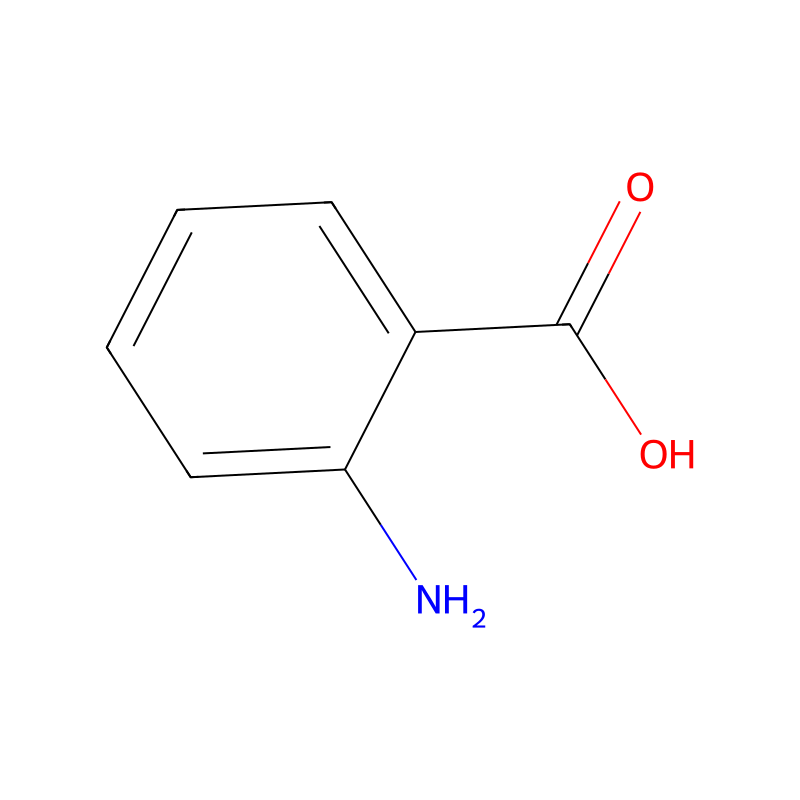
식별자 및 물리적 특성
| CAS No. | 118-92-3 |
|---|---|
| 분자식 | C7H7NO2 |
| 평균 분자량 | 137.14 g/mol |
| 단동위원소 질량 | 137.04767846 g/mol |
| SMILES | Nc1ccccc1C(=O)O |
| InChIKey | RWZYAGGXGHYGMB-UHFFFAOYSA-N |
| PubChem CID | 227 |
| ChEMBL | CHEMBL14173 |
| ChEBI | CHEBI:30754 |
| EC No. | 204-287-5 |
| DTXSID | DTXSID8020094 |
| 현지명 | 안트라닐산 |
화학 및 물리적 성질
| XLogP | 1.2 |
|---|---|
| 극성 표면적 | 63.3 |
| 수소 결합 공여자 수 | 2 |
| 수소 결합 수용자 수 | 3 |
| 회전 가능 결합 수 | 1 |
| 무거운 원자 수 | 10 |
| 형식 전하 | 0 |
| 복잡도 | 136 |
| 물질 분류 | Nitrogen Compounds -> Aminobenzoic AcidsDye |
| 의약품 | Pharmaceuticals -> Listed in ZINC15Pharmaceuticals -> Synthetic Cannabinoids or Psychoactive Compounds |
| LogP(분배 계수) | log Kow = 1.210.99-1.3 |
| 맛 | Sweetish taste |
| 밀도 | 1.412 (NTP, 1992) - Denser than waterwill sink1.412 at 20 °C1.4 g/cm³Relative density of the vapour/air-mixture at 20 °C (air = 1): 1.01.412 @ 20°C |
| Color/Form | White to pale yellow, crystalline powderLeaves from alcoholNEEDLE-LIKE CRYSTALS |
| 용해도 | less than 0.1 mg/mL at 68 °F (NTP, 1992)Freely soluble in alcohol, etherSoluble in ethanol, ethyl ether, slightly soluble in trifluoroacetic acid, benzene, very soluble in chloroform, pyridineIn water, 3.5X10+3 mg/L at 25 °C3.5 mg/mLSolubility in water, g/100ml at 20 °C: 0.35 (poor)에탄올: 투명하거나 약간 흐릿할 수 있음 |
| 인화점 | 340 °F (NTP, 1992)150 °C150 °C /from table/150°C |
| 끓는 점 | Sublimes (NTP, 1992)251.96°C (rough estimate) |
| Decomposition | 200 °C |
| 녹는점 | 291 to 295 °F (NTP, 1992)144-146 °C146.5 °C146-148 °C144-148 °C(lit.) |
| 증기 밀도 | 4.7 (calculated) (NTP, 1992) - Heavier than airwill sink (Relative to Air)Relative vapor density (air = 1): 4.74.7 (vs air) |
| 증기압 | 0.1Pa at 52.6℃ |
| 굴절률 | 1.5323 (estimate) |
| 저장 조건 | Store at 0°C |
| pKa(산도 계수) | 2.108(at 25℃) |
| 물리적 상태 | 가루 |
| 색상 | 흰색에서 연한 노란색 결정 |
| 용해도 | 5.7 g/L (25 ºC) |
| Merck | 14,422 |
| BRN | 471803 |
| 헨리 상수 | 2.6×10⁵ mol/(m3Pa) at 25℃, HSDB (2015) |
| 안정성 | 안정적인. 강한 산화제와 호환되지 않습니다. |
| 주요 응용 | 차량 하부 반사 방지 코팅, 반도체 소자, 잉크, 염색약, 화장품, 만성 염증성 질환 치료, 우울증 치료 |
| 화장품 원료 기능 | 피부 컨디셔닝 - 기타 |
| InChI | 1S/C7H7NO2/c8-6-4-2-1-3-5(6)7(9)10/h1-4H,8H2,(H,9,10) |
| InChIKey | RWZYAGGXGHYGMB-UHFFFAOYSA-N |
| SMILES | Nc1c(cccc1)C(=O)O |
| LogP(분배 계수) | 0.99 at 23℃ and pH3.7 |
| NIST | Anthranilic acid(118-92-3) |
| EPA | Anthranilic acid (118-92-3) |
화학적 성질
White to off white crystalline powder
안전 및 규제
| GHS 분류 | This chemical does not meet GHS hazard criteria for 0.3% (1 of 321) of reports.DangerH318 (49.5%): Causes serious eye damage [Danger Serious eye damage/eye irritation]P264+P265, P280, P305+P351+P338, P305+P354+P338, P317, and P337+P317 (click each P-code to see the statement)Aggregated GHS information provided per 321 reports by companies from 9 notifications to the ECHA C&L Inventory. Each notification may be associated with multiple companies. |
|---|---|
| 규제 정보 | Chemical: Benzoic acid, 2-amino-List I Chemical: A chemical specified by regulation that, in addition to legitimate uses, is used in manufacturing a controlled substance in violation of the Act and is important to the manufacture of a controlled substance. (21 eCFR 1310.02)Status: Active Update: 27-10-2021 https://echa.europa.eu/registration-dossier/-/registered-dossier/10130Anthranilic acid: Does not have an individual approval but may be used under an appropriate group standard |
| 기타 안전 정보 | IMAP assessments - Anthranilic acid and its calcium salt: Human health tier II assessment |
| 화재 위험 | This chemical is combustible. (NTP, 1992)Combustible. Gives off irritating or toxic fumes (or gases) in a fire. Finely dispersed particles form explosive mixtures in air. |
| 화재 가능성 | Combustible. /from table/ |
| 건강 유해성 | SYMPTOMS: Symptoms of exposure to this compound may include nausea, vomiting, acidosis, rash, fever, methemoglobinemia and possibly hepatitis. Other symptoms of exposure include allergic reaction and cyanosis (bluing of skin). Skin contact may cause irritation, itching and dermatitis. It may also cause pruritus. Eye contact may cause irritation. Exposure may cause respiratory irritation, mucous membrane irritation, conjunctivitis and liver inflammation. |
| 유해성 요약 | Emergency treatment: methemoglobinemia[HSDB] Causes somnolence and ataxia in lethal-dose feeding studies of rats[RTECS] An eye irritant[ICSC] May cause irritation, methemoglobinemia, and liver injury[CAMEO] An irritant[MSDSonline] |
| FDA 요건 | The following chemical has been specifically designated by the Administrator of the Drug Enforcement Administration as subject to the provisions of this part and parts 1309 and 1313 of this chapter. Anthranilic acid, its esters and its salts are List 1 chemicalsDEA Code: 8530. |
| 반응성 그룹 | Acids, Carboxylic |
| Special Reports | DHEW/NCIBioassay of o-Anthranilic Acid for Possible Carcinogenicity (1978) Technical Rpt Series No. 36 DHEW Pub No. (NIH) 78-836 |
| Reactivity Profile | ANTHRANILIC ACID is incompatible with strong oxidizers. (NTP, 1992) |
| 대기 기준 | This action promulgates standards of performance for equipment leaks of Volatile Organic Compounds (VOC) in the Synthetic Organic Chemical Manufacturing Industry (SOCMI). The intended effect of these standards is to require all newly constructed, modified, and reconstructed SOCMI process units to use the best demonstrated system of continuous emission reduction for equipment leaks of VOC, considering costs, non air quality health and environmental impact and energy requirements. Anthranilic acid is produced, as an intermediate or a final product, by process units covered under this subpart. |
| Chemical Dangers | On combustion, forms nitrogen oxides. The solution in water is a weak acid. Reacts with oxidants. This generates fire hazard. |
| 소화 | Fires involving this material can be controlled with a dry chemical, carbon dioxide or Halon extinguisher. A water spray may also be used. (NTP, 1992)Use powder, water spray, foam, carbon dioxide. |
| 응급 조치 | Fresh air, rest.Rinse and then wash skin with water and soap.First rinse with plenty of water for several minutes (remove contact lenses if easily possible), then refer for medical attention.Rinse mouth. Give one or two glasses of water to drink. Seek medical attention if you feel unwell. |
| 응급 처치 | EYES: First check the victim for contact lenses and remove if present. Flush victim's eyes with water or normal saline solution for 20 to 30 minutes while simultaneously calling a hospital or poison control center. Do not put any ointments, oils, or medication in the victim's eyes without specific instructions from a physician. IMMEDIATELY transport the victim after flushing eyes to a hospital even if no symptoms (such as redness or irritation) develop. |
| 안전 보관 | Separated from oxidants. |
| 소화 절차 | Powder, water spray, foam, carbon dioxide. /from table/ |
| 보관 조건 | Separated from strong oxidants. /from table/ |
| 정리 방법 | Remove all ignition sources. Sweep spilled substance into covered containersif appropriate, moisten first to prevent dusting, then remove to safe place. Do NOT let this chemical enter the environment. |
| 비화재 누출 대응 | SMALL SPILLS AND LEAKAGE: Should a spill occur while you are handling this chemical, FIRST REMOVE ALL SOURCES OF IGNITION, then you should dampen the solid spill material with 60-70% ethanol and transfer the dampened material to a suitable container. Use absorbent paper dampened with 60-70% ethanol to pick up any remaining material. Seal the absorbent paper, and any of your clothes, which may be contaminated, in a vapor-tight plastic bag for eventual disposal. Solvent wash all contaminated surfaces with 60-70% ethanol followed by washing with a soap and water solution. Do not reenter the contaminated area until the Safety Officer (or other responsible person) has verified that the area has been properly cleaned. |
| 처리 방법 | SRP: The most favorable course of action is to use an alternative chemical product with less inherent propensity for occupational exposure or environmental contamination. Recycle any unused portion of the material for its approved use or return it to the manufacturer or supplier. Ultimate disposal of the chemical must consider: the material's impact on air qualitypotential migration in soil or watereffects on animal, aquatic, and plant lifeand conformance with environmental and public health regulations. |
| 누출 처리 | Personal protection: particulate filter respirator adapted to the airborne concentration of the substance. Sweep spilled substance into covered containers. If appropriate, moisten first to prevent dusting. Then store and dispose of according to local regulations. Do NOT let this chemical enter the environment. |
| Preventive Measures | Local exhaust or breathing protection. Protective gloves. Safety goggles, or eye protection in combination with breathing protection if powder. Do not eat, drink, or smoke during work. /from table/SRP: The scientific literature for the use of contact lenses in industry is conflicting. The benefit or detrimental effects of wearing contact lenses depend not only upon the substance, but also on factors including the form of the substance, characteristics and duration of the exposure, the uses of other eye protection equipment, and the hygiene of the lenses. However, there may be individual substances whose irritating or corrosive properties are such that the wearing of contact lenses would be harmful to the eye. In those specific cases, contact lenses should not be worn. In any event, the usual eye protection equipment should be worn even when contact lenses are in place. |
| Eye Prevention | Wear safety spectacles. |
| Treatment | Kidney dialysis is usually needed to relieve the symptoms of uremic syndrome until normal kidney function can be restored. |
| 건강 영향 | Chronic exposure to uremic toxins can lead to a number of conditions including renal damage, chronic kidney disease and cardiovascular disease. |
| 생태독성 수치 | LC50 Leuciscus idus (freshwater fishIde) 215-1000 mg/L for 1 hr /conditions of bioassay not specified/LC50 Leuciscus idus (Freshwater fish, Ide) 100-215 mg/L for 96 hr /conditions of bioassay not specified/ |
| 환경 거동 | TERRESTRIAL FATE: Based on a classification scheme(1), an estimated Koc value of 110(SRC), determined from a log Kow of 1.21(2) and a regression-derived equation(3), indicates that anthranilic acid is expected to have high mobility in soil(SRC). The pKa of anthranilic acid is 2.14(4), indicating that this compound will primarily exist in anion form in the environment and anions generally do not adsorb more strongly to soils containing organic carbon and clay than their neutral counterparts(5). Volatilization of anthranilic acid from moist soil surfaces is not expected to be an important fate process(SRC) given an estimated Henry's Law constant of 3.8X10⁻¹¹ atm-cu m/mole(SRC), using a fragment constant estimation method(6). Anthranilic acid is not expected to volatilize from dry soil surfaces(SRC) based upon an estimated vapor pressure of 2.8X10⁻⁴ mm Hg(SRC), determined from a fragment constant method(7). Anthranilic acid (10 ppm) degraded 100% in 2 days using a 1% suspension of Niagara silt loam at 25 °C(8).AQUATIC FATE: Based on a classification scheme(1), an estimated Koc value of 110(SRC), determined from a log Kow of 1.21(2) and a regression-derived equation(3), indicates that anthranilic acid is not expected to adsorb to suspended solids and sediment(SRC). Volatilization from water surfaces is not expected(3) based upon an estimated Henry's Law constant of 3.8X10⁻¹¹ atm-cu m/mole(SRC), developed using a fragment constant estimation method(4). According to a classification scheme(5), an estimated BCF of 3(SRC), from its log Kow(2) and a regression-derived equation(6), suggests the potential for bioconcentration in aquatic organisms is low(SRC). Anthranilic acid was shown to degrade rapidly in a variety of aqueous aerobic and anaerobic screening test(7-16). Anthranilic acid photodegrades rapidly in natural seawater(17). Anthranilic acid is shown to have a maximum absorption at 337 nm(18) and therefore may be susceptible to direct photolysis by sunlight(SRC).ATMOSPHERIC FATE: According to a model of gas/particle partitioning of semivolatile organic compounds in the atmosphere(1), anthranilic acid, which has an estimated vapor pressure of 2.8X10⁻⁴ mm Hg at 25 °C(SRC), determined from a fragment constant method(2), is expected to exist solely as a vapor in the ambient atmosphere. Vapor-phase anthranilic acid is degraded in the atmosphere by reaction with photochemically-produced hydroxyl radicals(SRC)the half-life for this reaction in air is estimated to be 10 hours(SRC), calculated from its rate constant of 4.0X10⁻¹¹ cu cm/molecule-sec at 25 °C(SRC) that was derived using a structure estimation method(3). |
| 유해 작용 | Occupational hepatotoxin - Secondary hepatotoxins: the potential for toxic effect in the occupational setting is based on cases of poisoning by human ingestion or animal experimentation. |
| 노출 경로 | The substance can be absorbed into the body by ingestion.Endogenous, Ingestion, Dermal (contact) |
| 독성 요약 | Uremic toxins such as anthranilic acid are actively transported into the kidneys via organic ion transporters (especially OAT3). Increased levels of uremic toxins can stimulate the production of reactive oxygen species. This seems to be mediated by the direct binding or inhibition by uremic toxins of the enzyme NADPH oxidase (especially NOX4 which is abundant in the kidneys and heart) (A7868). Reactive oxygen species can induce several different DNA methyltransferases (DNMTs) which are involved in the silencing of a protein known as KLOTHO. KLOTHO has been identified as having important roles in anti-aging, mineral metabolism, and vitamin D metabolism. A number of studies have indicated that KLOTHO mRNA and protein levels are reduced during acute or chronic kidney diseases in response to high local levels of reactive oxygen species (A7869). |
| Signs and Symptoms | Redness. Pain.As a uremic toxin, this compound can cause uremic syndrome. Uremic syndrome may affect any part of the body and can cause nausea, vomiting, loss of appetite, and weight loss. It can also cause changes in mental status, such as confusion, reduced awareness, agitation, psychosis, seizures, and coma. Abnormal bleeding, such as bleeding spontaneously or profusely from a very minor injury can also occur. Heart problems, such as an irregular heartbeat, inflammation in the sac that surrounds the heart (pericarditis), and increased pressure on the heart can be seen in patients with uremic syndrome. Shortness of breath from fluid buildup in the space between the lungs and the chest wall (pleural effusion) can also be present. |
| Ongoing Test Status | The following link will take the user to the National Toxicology Program (NTP) Test Agent Search Results page, which tabulates all of the "Standard Toxicology & Carcinogenesis Studies", "Developmental Studies", and "Genetic Toxicity Studies" performed with this chemical. Clicking on the "Testing Status" link will take the user to the status (i.e., in review, in progress, in preparation, on test, completed, etc.) and results of all the studies that the NTP has done on this chemical. [http://ntp-apps.niehs.nih.gov/ntp_tox/index.cfm?fuseaction=ntpsearch.searchresults&searchterm=118-92-3] |
| Effluent Concentrations | Anthranilic acid was detected in ammunition plant wastewater in Stadtallendorf, Germany(1). |
| ICSC Environmental Data | The substance is harmful to aquatic organisms. This substance may be hazardous to the environment. Special attention should be given to birds. |
| Soil Adsorption/Mobility | The Koc of anthranilic acid is estimated as 110(SRC), using a log Kow of 1.21(1) and a regression-derived equation(2). According to a classification scheme(3), this estimated Koc value suggests that anthranilic acid is expected to have high mobility in soil. The pKa of anthranilic acid is 2.14(4), indicating that this compound will primarily exist in anion form in the environment and anions generally do not adsorb more strongly to soils containing organic carbon and clay than their neutral counterparts(5). |
| 수질 위해 등급(WGK) | 2 |
| TSCA 등재 상태 | TSCA listed |
| RTECS 번호 | CB2450000 |
| 관세 코드 | 29224300 |
| 위험 문구(R) | 36-37-36/37/38 |
| 위험 표시 | Xi |
| 안전 문구(S) | 26-36-39 |
| 기존화학 물질 | KE-01198 |
| 자연 발화 온도 | >530°C |
| 위험 등급 | Eye Dam. 1 |
| 저장 분류 | 11 - Combustible Solids |
| 유해 물질 데이터 | 118-92-3(Hazardous Substances Data) |
용도
용도
Anthranilic acid can be used in organic synthesis to generate the benzyne intermediate. It is used as an intermediate for production of dyes, pigments, and saccharin. It and its esters are used in preparing perfumes to imitate jasmine and orange, pharmaceuticals and UV-absorber as well as corrosion inhibitors for metals and mold inhibitors in soya sauce.
일반 설명
Odorless white to pale-yellow or tan crystalline powder with a sweetish taste.