
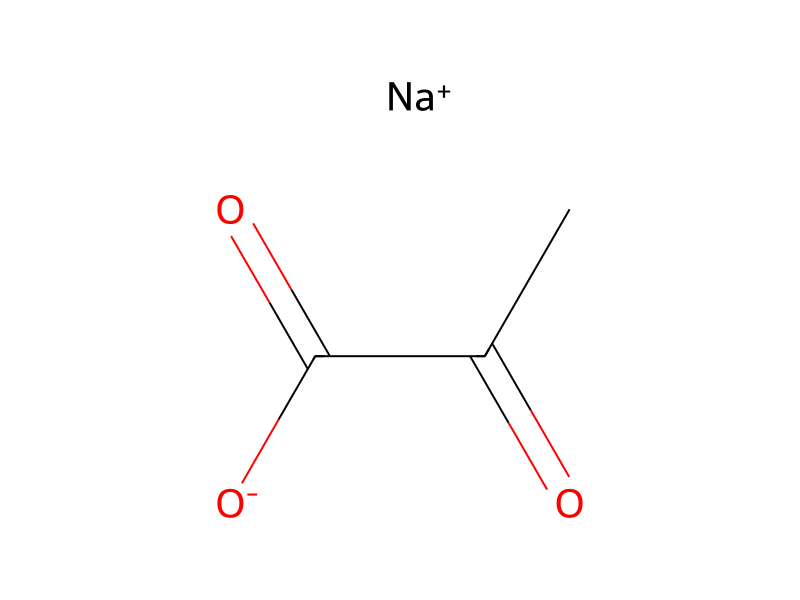
기본 정보
- CAS
113-24-6- 표준 SMILES
CC(=O)C(=O)[O-].[Na+]- InChIKey
DAEPDZWVDSPTHF-UHFFFAOYSA-M- 분자식
- C3H3NaO3
- 평균 분자량
- 110.04 g/mol
- 단동위원소 질량
- 109.99798824
개요
Sodium pyruvate is an organic sodium salt. It contains a pyruvate.
이름 및 식별자
- 우선 이름
- Sodium pyruvate
- IUPAC
- sodium 2-oxopropanoate
- 현지명
- 피루브 산, 나트륨 염
- 영어명
- Sodium pyruvate
- 분자식
- C3H5NaO3
- 분자량
- 112.06
이름 및 동의어
SODIUM PYRUVATE113-24-6Pyruvic acid, sodium saltPropanoic acid, 2-oxo-, sodium saltNatrum pyruvicumDTXSID6040614NatriumpyruvatPOD38AIF08SODIUM PYRUVATE [MART.]SODIUM PYRUVATE [WHO-DD]Propanoic acid, 2-oxo-, sodium salt (1:1)EINECS 204-024-4
이름 더 보기
피루브산,나트륨염피루브산,나트륨염소듐파이루베이트PYRUVATEPYRUVIC ACID SODIUM SALTSODIUM 2-OXOPROPANOATEpyruvic acid sodiumSodiuM pyruvat2-KETOPROPIONIC ACID SODIUM SALTPYR NAp.A.,100gbinrongsuannaSodium pyruate
NATRUM PYRUVICUM [HPUS]DTXCID4020614CHEBI:50144SODIUM PYRUVATE (MART.)RefChem:887848SODIUM PYRUVATE [INCI]Propanoic acid, 2oxo, sodium salt204-024-4
데이터베이스 식별자
- CAS
113-24-6- PubChem CID
- 23662274
- DTXSID
DTXSID6040614
물성
구조 계산 물성
- 극성 표면적
- 57.2 Ų
- 수소 결합 공여자 수
- 0
- 수소 결합 수용자 수
- 3
- 회전 가능 결합 수
- 1
- 무거운 원자 수
- 7
- 형식 전하
- 0
- 복잡도
- 88.2
실험 및 물리화학적 성질
Chemical ClassesBiological Agents -> Other Biomolecules
Melting Point300 °C
Physical Description
Liquid; CBI; Dry Powder
White to pale yellow powder; [Alfa Aesar MSDS]
물리화학적 성질
- 녹는점
- 300 °C · >300 °C (lit.)
- 끓는 점
- 300 ℃ · >300℃
- 밀도
- 1 · 1,267g/cm
- 증기압
- 0 Pa · 0Pa at 20℃
- 굴절률
- 1 · 1,426-1,43
- 저장 조건
- 2 · 2-8°C
- 용해도
- 2 O: · H2O: 100 mg/mL
- 물리적 상태
- 액체
- 색상
- 흰색에서 연한 노란색
- 수소이온지수(pH)
- pH(100g/l, 25℃) : 4.0~8.0
- 생물학적 소스
- synthetic (organic)
- 수용성
- 물에 용해됩니다.
- BRN
- 3568341 · 3568341
- 안정성
- 안정적인. 강한 산화제와 호환되지 않습니다.
안전 및 규제
GHS 분류
GHS Classification
This chemical does not meet GHS hazard criteria for 29.7% (70 of 236) of reports.
Warning
H317 (69.9%): May cause an allergic skin reaction [Warning Sensitization, Skin]
P261, P264+P265, P272, P280, P302+P352, P305+P351+P338, P321, P333+P317, P337+P317, P362+P364, and P501 (click each P-code to see the statement)
Aggregated GHS information provided per 236 reports by companies from 5 notifications to the ECHA C&L Inventory. Each notification may be associated with multiple companies.
유해성 정보
Regulatory Information
Chemical: Propanoic acid, 2-oxo-, sodium salt
Propanoic acid, 2-oxo-, sodium salt (1:1) is listed on the EPA's Chemical Data Reporting (CDR) system. Manufacturers and importers of Propanoic acid, 2-oxo-, sodium salt (1:1) are required to report information about their production and use of this chemical to the EPA under the Toxic Substances Control Act (TSCA). (40 eCFR Part 711)
Status: Active Update: 03-06-2022 https://echa.europa.eu/registration-dossier/-/registered-dossier/24266
Sodium pyruvate: Does not have an individual approval but may be used under an appropriate group standard
Hazards SummaryMay cause irritation; [Alfa Aesar MSDS]
Hazard Classes and CategoriesSkin Sens. 1 (69.9%)
안전 및 보호
Protective Action Criteria (PAC)
12 [mg/m3]
130 [mg/m3]
790 [mg/m3]
안전 데이터
- wgk
- 3
- tsca
- TSCA listed
화학 및 산업
용도 및 제조
UsesIntermediate in carbohydrate, protein, and fat metabolism; [ChemIDplus] Can be added to cell and tissue cultures as an energy source and antioxidant; [REPROTOX]
U.S. Production2023: 50,000 - <75,000 lb
Consumer UsesLaboratory chemicals
Industry UsesNot Known or Reasonably Ascertainable
General Manufacturing Information
All Other Basic Organic Chemical Manufacturing
Propanoic acid, 2-oxo-, sodium salt (1:1): ACTIVE
응용 분야
개요Sodium pyruvate is the sodium salt of pyruvate. It is frequently supplemented to the cell culture medium to act as a source of energy since it is a key intermediate during the production of the high-energy ATP molecules inside cells. For example, it can be used as a carbon source for bacteria. It may also protect cell against hydrogen peroxide, an oxidant to scavenger oxygen radicals. It is an important metabolic intermediate in many essential metabolic pathways such as carbohydrate metabolism. For example, it is converted into acetyl coenzyme A and enters into the TCA cycle (Kreb’s cycle) in organisms. It is also involved in the amino acid metabolism in organisms.
용도Sodium pyruvate is used in cell culture media as an additional source of energy. It acts as an antioxidant and finds protective effects against oxygen radicals. It serves as an intermediate in many metabolic pathways such as sugar metabolism. It is converted into acetyl coenzyme A and enters the trichloroacetic acid cycle. In addition, it is involved with amino acid metabolism and initiates the Kreb's cycle. It plays an important role as a free radical scavenger.
일반 설명Sodium pyruvate (SP) is a simplest keto-acid. It crystallizes as very thin plates and belongs to the monoclinic system. Its utility in Knoevenagel condensation carried out in an aqueous medium has been examined. The standard molar enthalpy of formation and molar enthalpy of dissolution of SP at infinite dilution have been obtained. Its efficacy in treating mitochondrial DNA depletion syndromes has been investigated.
관련 반응
41건


화합물 노트
불러오는 중…