홈MCP워크벤치Skills
홈워크벤치알림마이페이지
llms.txt · MCP 가이드개인정보처리방침 · 이용약관 · 지원v1.8.0
  1. 홈
  2. /화합물

실란

Silane

HCID 23953
새 노트새 반응견적 요청하기
인쇄 미리보기
기본 정보개요이름 및 식별자물성안전 및 규제화학 및 산업관련 반응화합물 노트
부분 구조 검색유사 구조 찾기

기본 정보

CAS
50808-20-3
표준 SMILES
[SiH4]
InChIKey
BLRPTPMANUNPDV-UHFFFAOYSA-N
분자식
H4Si
평균 분자량
32.117 g/mol
단동위원소 질량
32.00822666

개요

Silane is a colorless, flammable and poisonous gas, with a strong repulsive odor. It is easily ignited in air, reacts with oxidizing agents, is very toxic by inhalation, and is a strong irritant to skin, eyes and mucous membranes. Silane is lighter than air. Under prolonged exposure to fire or heat the containers may rupture violently and rocket. It is used in the production of amorphous silicon.

이름 및 식별자

우선 이름
Silane
IUPAC
silane
현지명
실란
영어명
Silicon tetrahydride
분자식
H4Si
분자량
32.12

이름 및 동의어

SILANESilicaneMonosilaneSilicon tetrahydrideCHEBI:29389RefChem:6217DTXCID3031107232-263-45J076063R17803-62-5DTXSID6052534Flots 100SCO
이름 더 보기
실란실레인The silaneflots100scotetrahydrureSilicomethane
Silicon hydrideSiH4SilantetrahydridosiliconH4SiSilicon hydride (SiH4)SCHEMBL3294[SiH4]

데이터베이스 식별자

CAS
50808-20-3、7803-62-5
PubChem CID
23953
DTXSID
DTXSID6052534
ChEBI
CHEBI:29389
UNII
5J076063R1
EC Number
232-263-4

물성

구조 계산 물성

극성 표면적
0 Ų
수소 결합 공여자 수
0
수소 결합 수용자 수
0
회전 가능 결합 수
0
무거운 원자 수
1
형식 전하
0
복잡도
0

실험 및 물리화학적 성질

Chemical Classes · 2건

Toxic Gases & Vapors -> Hydrides

Flammable agents - 4th degree

SpringerMaterials PropertiesGibbs energy
Odor · 2건

Repulsive odor

Characteristic odor

Density · 3건

0.68 at -185 °C (liquid)

0.68 @ 185°C

1.11(relative gas density)

Color/FormColorless gas
Solubility · 4건

Decomposes (NIOSH, 2024)

Slowly decomp in water; practically insol in alc, ether, benzene, chloroform, silicochloroform and silicon tetrachloride; decomp in potassium hydoxide solns.

Solubility in water: slow reaction

Decomposes

Flash PointNA (Gas)
Boiling Point · 6건

-169 °F at 760 mmHg (NIOSH, 2024)

-112 °C

-112 °C

-169 °F

-112 °C @760 [mm Hg]

-169 °F

Decomposition · 3건

When heated to decomposition it burns or explodes.

The silanes decomp at elevated temp to liberate hydrogen and deposit a high purity silicon, which leads to some of the principal uses of silanes. /Silanes/

안전 및 규제

안전 정보는 참고용이며, 공급업체의 물질안전보건자료(SDS), 관련 법규 및 전문가 평가를 대체하지 않습니다.

GHS 분류

GHS Classification · 6건

This chemical does not meet GHS hazard criteria for 3.3% (5 of 151) of reports.

Danger

H220 (96.7%): Extremely flammable gas [Danger Flammable gases]

P203, P210, P222, P280, P377, P381, P403, and P410+P403 (click each P-code to see the statement)

Aggregated GHS information provided per 151 reports by companies from 6 notifications to the ECHA C&L Inventory. Each notification may be associated with multiple companies.

Danger

유해성 정보

Regulatory Information · 5건

Chemical: Silane

Silane is listed on the EPA's Chemical Data Reporting (CDR) system. Manufacturers and importers of Silane are required to report information about their production and use of this chemical to the EPA under the Toxic Substances Control Act (TSCA). (40 eCFR Part 711)

REACH registered substance: Silane (EC: 232-263-4)

Silane: HSNO Approval: HSR001012 Approved with controls

The New Jersey Worker and Community Right to Know Act requires public and private employers to provide information about hazardous substances at their workplaces. (N.J.S.A. 34:5A-1 et. seq.)

DOT LabelFlammable Gas
Fire Hazards · 3건

Excerpt from ERG Guide 116 [Gases - Flammable (Unstable)]:

· EXTREMELY FLAMMABLE.

Extremely flammable. Gas/air mixtures are explosive.

Fire Potential · 4건

Silicone hydride will ignite in air by slightly raising the temp or lowering the pressure.

... /Silane/ is mildly endothermic ... Pure material is said not to ignite in air unless the temp be incr or the pressure reduced. Presence of other hydrides as impurities causes ignition always to occur on contact. However, 99.95% pure material, even at concn down to 1% in hydrogen and/or nitrogen, ignites in contact with air unless emerging at very high gas velocity, when mixtures with up to 10% silane content may not ignite. Silane from a cylinder at 24 bar contained inside a ventilated cabinet inadvertently flowed back to the low pressure side of a nitrogen cylinder regulator outside the cabinet. When the regulator failed, the leaking silane ignited and burned outside the cabinet, preventing access to the main silane valve, and the leak reignited after extinguishing the fire. The system has been redesigned to eliminate the problems.

화학 및 산업

약리 정보

Absorption, Distribution and ExcretionThe substance can be absorbed into the body by inhalation.

용도 및 제조

Uses · 5건

Used as a source of silicon for semiconductors in the microelectronics industry; [ACGIH]

Semiconductor Manufacturing [Category: Industry]

Source of hyperpure silicon for semiconductors.

Doping agent for solid-state devices, production of amorphous silicon.

Silane is used largely as a raw material to form other silicon-containing compounds, but it also serves as a source of silicon for deposition of epitaxial layers.

ImpuritiesImpurities: Phosphorous trihydride, arsenic trihydride & boron hydride /in gaseous silane/.
U.S. Production · 3건

2023: 5,000,000 - <10,000,000 lb

(1982) > 9.07X10+6 g /est/

Production volumes for non-confidential chemicals reported under the Inventory Update Rule. [Table#5900]

Consumer UsesSemiconductor and photovoltaic agent
Industry UsesSemiconductor and photovoltaic agent
Methods of Manufacturing · 3건

Prepared from aluminum silicide and hydrochloric acid or by electrolysis of an aqueous solution of sodium, ammonium, manganese, or ferrous chloride using an aluminum-silicon alloy as the positive pole; ... from magnesium silicide and HCl; ... from zinc silicide and acid; ... from lithium silicide and acid; ... from magnesium silicide and ammonium bromide or chloride in liquid ammonia; ... from lithium aluminum hydride in ether and silicon tetrachloride; ... from silica gel, aluminum oxide and hydrogen; ... from silicon tetrachloride and sodium aluminum hydride.

Silane is produced by combining an ether solution of silicon tetrachloride with an ether solution of lithium aluminum hydride.

관련 반응

101건
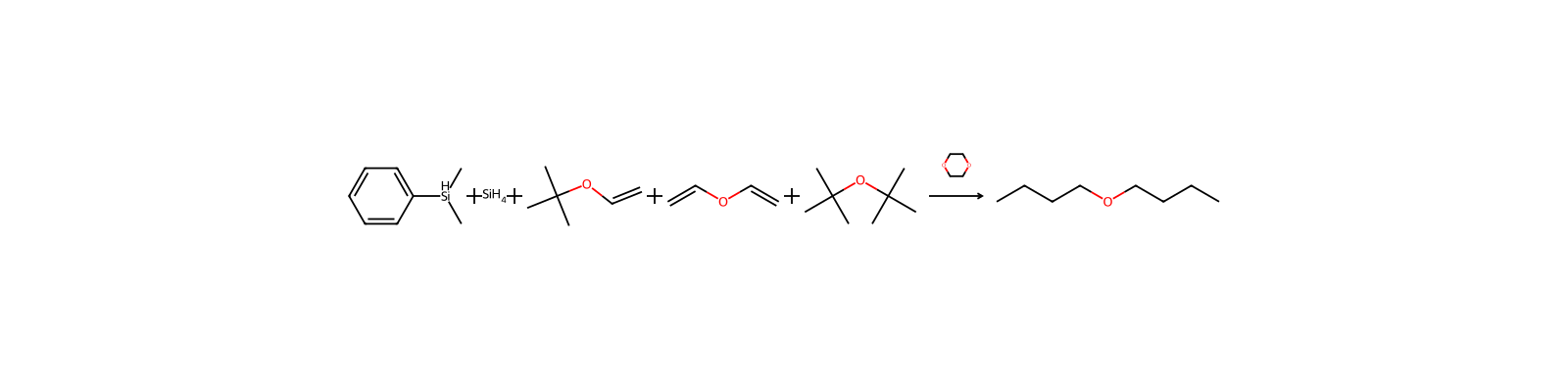
반응 기록 만들기
HRID 9702 반응식
HRID 9702반응물로uspto-grants-2006_08
HRID 31361 반응식
HRID 31361반응물로uspto-grants-2008_09
HRID 36463 반응식
HRID 36463반응물로uspto-grants-1995_05
HRID 108257 반응식
HRID 108257반응물로Training data from https://doi.org/10.1039/C8SC04228D (2/10)
HRID 125998 반응식
HRID 125998반응물로Training data from https://doi.org/10.1039/C8SC04228D (2/10)
HRID 141947 반응식
HRID 141947반응물로Training data from https://doi.org/10.1039/C8SC04228D (9/10)
HRID 151497 반응식
HRID 151497반응물로Training data from https://doi.org/10.1039/C8SC04228D (9/10)
HRID 213917 반응식
HRID 213917반응물로Training data from https://doi.org/10.1039/C8SC04228D (6/10)
1 / 13 페이지

화합물 노트

불러오는 중…

이 페이지에서기본 정보개요이름 및 식별자물성안전 및 규제화학 및 산업관련 반응화합물 노트
더보기
새 노트새 반응견적 요청하기

... Decomposes at 752 °F (400 °C) with release of silicon fumes and hydrogen.

Melting Point · 6건

-301 °F (NIOSH, 2024)

-185 °C

-185 °C

-301 °F

-185 °C

-301 °F

Vapor Density · 3건

1.11 (NIOSH, 2024) - Heavier than air; will sink (Relative to Air)

Relative vapor density (air = 1): 1.3

1.11

Vapor Pressure · 3건

greater than 1 atm (NIOSH, 2024)

>1 atm

>1 atm

물리화학적 성질

녹는점
-185 °C · -185 °C
끓는 점
-112 °C · -112 °C
밀도
1.114 g/mL · 1.114 g/mL at 25 °C(lit.)
증기 밀도
1.1 · 1.1 (vs air)
증기압
100 kPa · 100kPa at 20℃
용해도
2 O; · reacts with H2O; insoluble in ethanol,benzene
물리적 상태
무색 가스
Specific Gravity
0.68 · 0.680
색상
colorless gas; flammable
냄새
역겨운 냄새
수용성
2 O에 · H2O에 의해 분해됨; 불용성알코올, 벤젠[HAW93]
비열
1.33 J/ · Cp(gas): 1.33 J/(g·K), at 25℃
Merck
13 · 13,8562
EPA
Silane (7803-62-5)
화학적 성질 · 1건

Silicon tetrahydride is a highly toxic gas with a repulsive odor. It is spontaneously flammable in air. Trichlorosilane has an acrid odor, fumes in air and supports combustion. It is a lachrymator and is moisture sensitive. Octamethyl tetrasilane is moisture sensitive.

Pyrophoric. Flammable gas. Low ignition energy ...

Extremely flammable ... /Silane/ decomposes on heating or on burning producing silicon and hydrogen, causing fire and explosion hazard ...

Health Hazards · 2건

Excerpt from ERG Guide 116 [Gases - Flammable (Unstable)]:

· Vapors may cause dizziness or asphyxiation without warning, especially when in closed or confined areas.

Hazards Summary · 1건

Silicon tetrahydride may ignite spontaneously in air. Toxicology data is extremely limited. The TLV is based on the subacute effects in rodents at 1000 ppm. Silane has low acute toxicity in inhalation animal experiments. The estimated LC50 is between 5,000 and 10,000 ppm for 4-hour exposures. [ACGIH] Explosions, fire, and asphyxiation in confined spaces are the most important hazards of silane. [Sullivan, p. 962] A skin, eye, and respiratory tract irritant; Evaporating liquid can cause frostbite; [ICSC]

DOT ID and Guide · 2건

2203 116

2203 116

Reactive GroupNitrides, Phosphides, Carbides, and Silicides
UN ClassificationUN Hazard Class: 2.1
Special Reports · 2건

Health Council of the Netherlands: Committee on Updating of Occupational Exposure Limits. Silane; Health-based Reassessment of Administrative Occupational Exposure Limits. The Hague: Health Council of the Netherlands, 2000; 2000/15OSH/014.

Moskowitz PD et al; p.97-113 in Hazard Assessment and Control Technology in Semiconductor Manufacture (1989)

Reactivity AlertsHighly Flammable
OSHA StandardsVacated 1989 OSHA PEL TWA 5 ppm (7 mg/cu m) is still enforced in some states.

안전 및 보호

Fire Fighting · 2건

Excerpt from ERG Guide 116 [Gases - Flammable (Unstable)]:

Shut off supply; if not possible and no risk to surroundings, let the fire burn itself out. In other cases extinguish with powder, carbon dioxide. Combat fire from a sheltered position.

First Aid Measures · 3건

Fresh air, rest. Refer for medical attention.

ON FROSTBITE: rinse with plenty of water, do NOT remove clothes. Rinse skin with plenty of water or shower.

First rinse with plenty of water for several minutes (remove contact lenses if easily possible), then refer for medical attention.

Accidental Release Measures · 2건

· CALL 911. Then call emergency response telephone number on shipping paper. If shipping paper not available or no answer, refer to appropriate telephone number listed on the inside back cover.

· ELIMINATE all ignition sources (no smoking, flares, sparks or flames) from immediate area.

First Aid · 3건

Excerpt from NIOSH Pocket Guide for Silicon tetrahydride:

General First Aid:

(General first aid procedures)

Safe StorageFireproof.
Firefighting Hazards · 2건

... React slowly with water ... A harmful concentration of this gas in the air will be reached very quickly on loss of containment.

Closed containers may rupture violently when heated.

Exposure Control and Personal Protection· Wear positive pressure self-contained breathing apparatus (SCBA).
Fire Fighting Procedures · 4건

Use fine spray or fog to control fire by preventing its spread and absorbing some of its heat. Stop flow of gas before extinguishing fire. Use water spray to keep fire-exposed containers cool. Do not use halocarbons. Explosive decomposition may occur under fore conditions. Fight fire from protected location or maximum possible distance. Approach fore from upwind to avoid hazardous vapors and toxic decomposition products.

If material on fire or involved in fire: Do not extinguish fire unless flow can be stopped. Do not apply water to point of leak in tank car or container. Use water in flooding quantities as fog. Cool all affected containers with flooding quantities of water. Apply water from as far a distance as possible. Use "alcohol" foam, dry chemical or carbon dioxide.

Evacuation: If fire becomes uncontrollable or container is exposed to direct flame - consider evacuation of one-third (1/3) mile radius.

Shut off supply; if not possible and no risk to surroundings, let the fire burn itself out; in other cases extinguish with powder, carbon dioxide.

Storage Conditions · 2건

Fireproof.

Store in a cool, dry, well ventilated location. Separate from alkalies, oxidizing materials, halogens, and air. Outside or detached storage is preferred.

Cleanup Methods · 2건

Evacuate danger area! Consult an expert! Ventilation. Remove gas with fine water spray (extra personal protection: self-contained breathing apparatus).

Stop or control the leak, if this can be done without undue risk. Use water spray to cool and disperse vapors and protect personnel. Releases may ignite spontaneously.

Nonfire Spill ResponseExcerpt from ERG Guide 116 [Gases - Flammable (Unstable)]:
Disposal Methods · 1건

SRP: The most favorable course of action is to use an alternative chemical product with less inherent propensity for occupational exposure or environmental contamination. Recycle any unused portion of the material for its approved use or return it to the manufacturer or supplier. Ultimate disposal of the chemical must consider: the material's impact on air quality; potential migration in soil or water; effects on animal, aquatic, and plant life; and conformance with environmental and public health regulations.

독성 정보

Target OrgansEyes, skin, respiratory system, central nervous system
Adverse EffectsOther Poison - Simple Asphyxiant
Exposure Routes · 2건

The substance can be absorbed into the body by inhalation.

inhalation

Signs and Symptoms · 4건

Cough. Headache. Nausea. Sore throat.

Redness. ON CONTACT WITH LIQUID: FROSTBITE.

Redness. Pain.

irritation eyes, skin, mucous membrane; nausea, headache

Human Toxicity Excerpts/SIGNS AND SYMPTOMS/ ACUTE ... SYMPTOMS: Inhalation--Cough. Headache. Nausea. Sore throat ; Skin--Redness. ON CONTACT WITH LIQUID: FROSTBITE; Eyes--Redness. Pain.
Non-Human Toxicity Excerpts · 5건

/LABORATORY ANIMALS: Acute Exposure/ In mice, 4 out of 10 animals died following exposure to 9,600 ppm (approx 13,345 mg/cu m) for 4 hours.[Health Council of the Netherlands: Committee on Updating of Occupational Exposure Limits. Silane; Health-based Reassessment of Administrative Occupational Exposure Limits. p.014-5. The Hague: Health Council of the Netherlands, 2000; 2000/15OSH/014.]

/LABORATORY ANIMALS: Acute Exposure/ Rats exposed at 126 ppm for 1 hr were apparently unaffected.[American Conference of Governmental Industrial Hygienists. Documentation of the TLV's and BEI's with Other World Wide Occupational Exposure Values. CD-ROM Cincinnati, OH 45240-1634 2005., p. 1]

/LABORATORY ANIMALS: Acute Exposure/ ... Male ICR mice (n=10/group) were exposed to approximately 1,000 ppm (approx. 1,390 mg/cu m) of silane for 1 hour or 2, 4, or 8 hours. After sacrifice 3 days postexposure, the organs were examined grossly, and histologically (all exposed and non-exposed mice: nasal cavity, lung, liver, kidney, spleen, thymus, bone marrow, and testis; some of the mice: cornea, trachea, thyroid, salivary glands, and oesophagus). Biochemical and hematological parameters examined included alkaline phosphatase, aspartate and alanine aminotransferase, cholinesterase, blood urea nitrogen, sodium, potassium, red blood cell count, and total and differential white blood cell counts. Neither mortality nor exposure-related changes in any of the organs were observed. Biochemical or hematological parameters affected included an increase in red blood cell counts in mice exposed for 8 hours, an increase in blood urea nitrogen in mice exposed for 1 hour and a decrease in the 8-hour exposure group, and a decreased white blood cell count after 1-hour exposure.[Health Council of the Netherlands: Committee on Updating of Occupational Exposure Limits. Silane; Health-based Reassessment of Administrative Occupational Exposure Limits. p.014-5. The Hague: Health Council of the Netherlands, 2000; 2000/15OSH/014.]

/LABORATORY ANIMALS: Acute Exposure/ When male ICR mice were exposed to 2,500, 5,000, 7,500, or 10,000 ppm (approx 3,475, 6,950, 10,425, 13,900 mg/cu m) for 30 minutes, 1 hour, or 4 hours, only in the animals exposed to 10,000 ppm for 4 hours, mortality (ie, 9/12; all within 24 hr) was observed. At autopsy of these animals, increased relative kidney weights, renal tubular necrosis, splenic atrophy, appearance of macrophages with debris of degenerated cells in bone marrow and thymus, and inflammatory changes of the nasal mucosa was seen. In the groups exposed for 30 minutes or 1 hour and sacrificed at week 2, mainly effects on the kidneys were found (tubular interstitial nephrosis in 6/8 and 7/8 animals, respectively). Following exposure to 7,500 ppm (only 30-min exposure), tubular nephrosis was seen in 4/8 animals. The 1- and 4-hour exposures to 5,000 ppm caused tubular interstitial nephritis in 1/8 and 2/8 animals sacrificed at week 2, respectively, and acute renal tubular necrosis in 0/4 and 1/4 animals sacrificed after 2 days, respectively. Concerning the 2,500 ppm groups, the only effect observed was acute renal tubular necrosis in 1/4 animals exposed for 4 hours.[Health Council of the Netherlands: Committee on Updating of Occupational Exposure Limits. Silane; Health-based Reassessment of Administrative Occupational Exposure Limits. p.014-5. The Hague: Health Council of the Netherlands, 2000; 2000/15OSH/014.]

For more Non-Human Toxicity Excerpts (Complete) data for SILANE (6 total), please visit the HSDB record page.

Antidote and Emergency Treatment · 3건

Basic treatment: Establish a patent airway (oropharyngeal or nasopharyngeal airway, if needed). Suction if necessary. Watch for signs of respiratory insufficiency and assist ventilations if necessary. Administer oxygen by nonrebreather mask at 10 to 15 L/min. Monitor for pulmonary edema and treat if necessary ... . Anticipate seizures and treat if necessary ... . Monitor for shock and treat if necessary ... . For eye contamination, flush eyes immediately with water. Irrigate each eye continuously with 0.9% saline (NS) during transport ... . Do not use emetics. For ingestion, rinse mouth and administer 5 ml/kg up to 200 ml of water for dilution if the patient can swallow, has a strong gag reflex, and does not drool. Administer activated charcoal (refer to ingestion protocol in Section Three ... . Cover skin burns with sterile dressings after decontamination ... . /Silane, Chlorosilane, and Related Compounds/

Advanced treatment: Consider orotracheal or nasotracheal intubation for airway control in the patient who is unconscious, has severe pulmonary edema, or is in severe respiratory distress. Early intubation at the first sign of upper airway obstruction may be necessary. Positive-pressure ventilation techniques with a bag-valve-mask device may be beneficial. Consider drug therapy for pulmonary edema ... . Monitor cardiac rhythm and treat arrhythmias if necessary ... . Start IV administration of D5W /SRP: "To keep open", minimal flow rate/. Use 0.9% saline (NS) or lactated Ringer's (LR) if signs of hypovolemia are present. For hypotension with signs of hypovolemia, administer fluid cautiously. Consider vasopressors if patient is hypotensive with a normal fluid volume. Watch for signs of fluid overload ... . Treat seizures with diazepam or lorazepam ... . Use proparacaine hydrochloride to assist eye irrigation ... . /Silane, Chlorosilane, and related compounds/

... ON FROSTBITE: rinse with plenty of water, do NOT remove clothes. Rinse skin with plenty of water or shower ... /For EYES:/ First rinse with plenty of water for several minutes (remove contact lenses if easily possible), then take to a doctor.

Toxicity DataLC50 (rat) = 9,600 ppm/4h
Non-Human Toxicity Values · 3건

LC50 Rat inhalation 4000 ppm/4 hr

LD50 Rabbit subcutaneous 3540 mg/kg

LC50 Rat inhalation 9600 ppm/4 hr

규제 정보

DHS Chemicals of Interest (COI) · 4건

Silane

1

10000

Flammable chemical that can be released at a facility.

안전 데이터

OEB
B
OEL
TWA: 5 ppm (7 mg/m3)
wgk
1
tsca
TSCA listed
rtecs
VV1400000
ridadr
UN 2203
risk_code
12-17-20
hazard_code
F+,Xn
safety_code
9-16-33-36/37/39
위험 등급
2.1
기존화학 물질
KE-30951
DOT ClassificationII
2.1 (Flammable gas)
유해 물질 데이터
7803-62-5(Hazardous Substances Data)
사고대비 물질 필터링
87

At pressures of > MPa (400 atm), in the presence of aluminum & aluminum halides, silica can be converted to silane in high yields by reaction with hydrogen.

Formulations/PreparationsThe composition of the silane mixture is 40 wt% silicone tetrahydride, 30 wt% silicon hydride, 15 wt% trisilane, & 15 wt% higher silanes.
General Manufacturing Information · 3건

Computer and Electronic Product Manufacturing

Silane: ACTIVE

The parent silane cmpd is reported to have little application in industry; however, many of the derivatives have wide use.

응용 분야 · 3건

개요Silane is a colorless, spontaneously flammable (pyrophoric) gas. It has a choking odor and may form explosive mixtures with air. Silane will react violently with heavy metal halides and free halogens other than hydrogen chloride.

용도Source of hyperpure silicon for semiconductors.

일반 설명Silicon tetrahydride is a colorless, flammable and poisonous gas, with a strong repulsive odor. Silicon tetrahydride is easily ignited in air, reacts with oxidizing agents, is very toxic by inhalation, and is a strong irritant to skin, eyes and mucous membranes. Silicon tetrahydride is lighter than air. Under prolonged exposure to fire or heat the containers may rupture violently and rocket. Silicon tetrahydride is used in the production of amorphous silicon.

상·하류 제품 정보

상류 원료

실리콘 분염화 암모늄마그네슘

하류 제품

bacterical adhesive라미부딘ENPROSTILsilica gel for photo catalysisTeicoplanin A2EAM resin adhesive modified with diisocyanate for orthodontias1-((비스(4-플루오로페닐)메틸실릴)메틸)-1H-1,2,4-트리아졸CEFTRIAXONEmedicinal adhesive SDG

추가 설명

정의ChEBI: The simplest silane, consisting of a single silicon atom carrying four hydrogens.