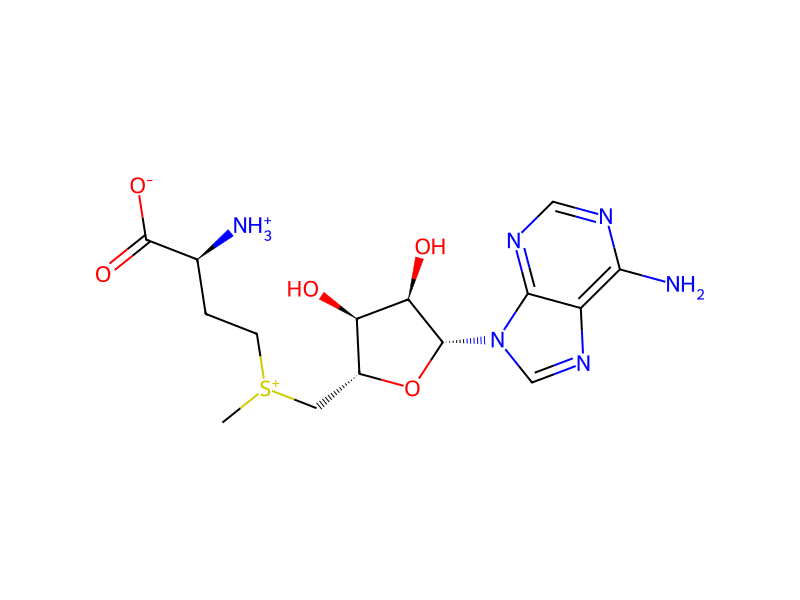
기본 정보
- CAS
29908-03-0- 표준 SMILES
C[S+](CC[C@H]([NH3+])C(=O)[O-])C[C@H]1O[C@@H](n2cnc3c(N)ncnc32)[C@H](O)[C@@H]1O- InChIKey
MEFKEPWMEQBLKI-AIRLBKTGSA-O- 분자식
- C15H23N6O5S+
- 평균 분자량
- 399.4 g/mol
- 단동위원소 질량
- 399.14506403
개요
S-adenosyl-L-methionine zwitterion is a zwitterionic tautomer of S-adenosyl-L-methionine arising from shift of the proton from the carboxy group to the amino group. It has a role as a cofactor. It is an organic cation and a sulfonium compound. It is a tautomer of a S-adenosyl-L-methionine.
이름 및 식별자
- 우선 이름
- Ademetionine
- IUPAC
- (2S)-4-[[(2S,3S,4R,5R)-5-(6-aminopurin-9-yl)-3,4-dihydroxyoxolan-2-yl]methyl-methylsulfonio]-2-azaniumylbutanoate
- 영어명
- S-adenosylmethionine
- 분자식
- C15H23N6O5S
- 분자량
- 400.45
이름 및 동의어
S-adenosyl-L-methionineAdemetionineadenosylmethionine139517-02-5(R)-S-adenosyl-L-methionine(S)-S-adenosyl-L-methionine(R,S)-AdoMet(S,S)-AdoMet2-S-adenosyl-L-methionine16-DENYPRASTERONEACETATESAM(R,S)-AdoMet zwitterion
이름 더 보기
13CH3-SAMMethionine,activeS-ADENOSYLMETHIONINEAdenosine Impurity 39S-(5'-Adenosyl)methionineMEFKEPWMEQBLKI-AIRLBKTGSA-OS-adenosylmethionine USP/EP/BPAdemetionine 1,4-Butanedisulfonate Impurity 18 MonomerGalactose Impurity 1 (Galactose EP Impurity A)(Lactose)S-Adenosyl-L-methionine sulfate p-toluene sulfonate salt
(S,S)-AdoMet zwitterionCHEBI:59789CHEBI:142093CHEBI:142094S-adenosyl-L-methionine zwitterion(R)-S-adenosyl-L-methionine zwitterion(S)-S-adenosyl-L-methionine zwitterion(R,S)-S-adenosyl-L-methionine zwitterion
데이터베이스 식별자
- CAS
물성
구조 계산 물성
- XLogP
- -2.8
- 극성 표면적
- 188 Ų
- 수소 결합 공여자 수
- 4
- 수소 결합 수용자 수
- 9
- 회전 가능 결합 수
- 6
- 무거운 원자 수
- 27
- 형식 전하
- 1
- 복잡도
- 527
실험 및 물리화학적 성질
LogP-5.3
Boiling Point78 °C
Physical DescriptionSolid
물리화학적 성질
- InChIKey
- QOWKLNSTGYYNGX-MDHPBGAINA-N
- SMILES
- C(O)(=O)[C@H](CCS(C[C@H]1O[C@@H](N2C3=C(C(=NC=N3)N)N=C2)[C@H](O)[C@@H]1O)C)N |&1:3,8,10,21,23,r|
안전 및 규제
안전 정보는 참고용이며, 공급업체의 물질안전보건자료(SDS), 관련 법규 및 전문가 평가를 대체하지 않습니다.
안전 데이터
- 신호 어
- Warning
- 유해·위험 문구
- 암호 유해·위험 문구 위험 등급 범주 신호 어 그림 문자 P- 코드 H302
화학 및 산업
약리 정보
ATC CodeA - Alimentary tract and metabolism
Pharmacodynamics
S-adenosylmethionine is an intermediate metabolite of methionine. Its involvement in methylation assists in cellular growth and repair, maintains the phospho-bilipid layer in cell membranes. It also helps in the maintenance of the action of several hormones and neurotransmitters that affect mood. Highest concentration are found in the brain and the liver.
Mechanism of Action
S-Adenosylmethionine (SAMe) is a natural substance present in the cells of the body. It is a direct metabolite of the essential amino acid L-methionine. SAMe plays a crucial biochemical role in the body by donating a one-carbon methyl group in a process called transmethylation. SAMe, formed from the reaction of L-methionine and adenosine triphosphate catalyzed by the enzyme S-adenosylmethionine synthetase, is the methyl-group donor in the biosynthesis of both DNA and RNA nucleic acids, phospholipids, proteins, epinephrine, melatonin, creatine and other molecules.
Metabolism/Metabolites
Significant first-pass metabolism in the liver. Approximately 50% of S-Adenosylmethionine (SAMe) is metabolized in the liver. SAMe is metabolized to S-adenosylhomocysteine, which is then metabolized to homocysteine. Homocysteine can either be metabolized to cystathionine and then cysteine or to methionine. The cofactor in the metabolism of homocysteine to cysteine is vitamin B6. Cofactors for the metabolism of homocysteine to methionine are folic acid, vitamin B12 and betaine.
Absorption, Distribution and ExcretionS-Adenosylmethionine is absorbed from the small intestine following oral intake. As absorption is affected by food, it is best to take on an empty stomach. Bioavailability is low following oral intake.
Tissue LocationsEpidermis
Cellular LocationsEndoplasmic reticulum
Metabolite Pathways
관련 반응
0건
현재 필터 조건에 해당하는 반응 기록이 없습니다.
화합물 노트
불러오는 중…