
Buspirone
데이터를 보충하는 중입니다. 잠시 후 페이지를 새로 고치면 최신 내용을 볼 수 있습니다
기본 정보
- CAS
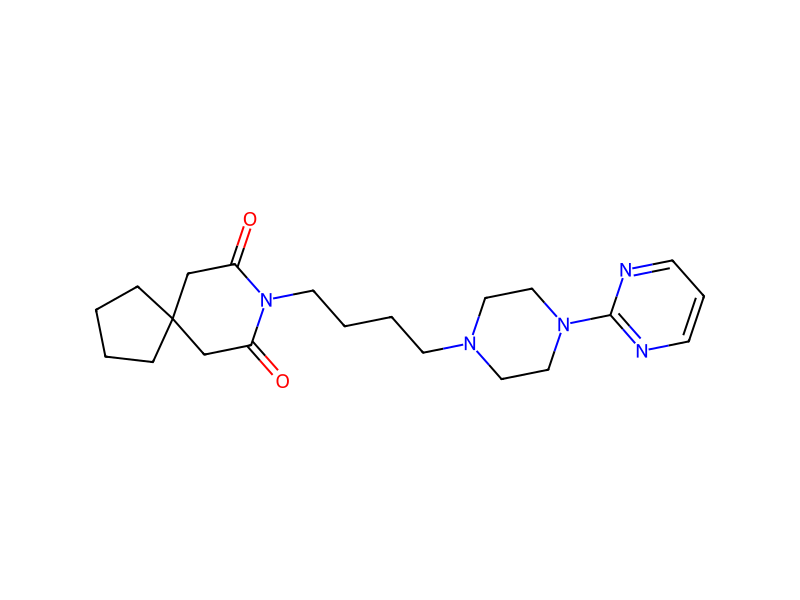
36505-84-7- 표준 SMILES
O=C1CC2(CCCC2)CC(=O)N1CCCCN1CCN(c2ncccn2)CC1- InChIKey
QWCRAEMEVRGPNT-UHFFFAOYSA-N- 분자식
- C21H31N5O2
- 평균 분자량
- 385.5 g/mol
- 단동위원소 질량
- 385.24777523
개요
Buspirone is an azaspiro compound that is 8-azaspiro[4.5]decane-7,9-dione substituted at the nitrogen atom by a 4-(piperazin-1-yl)butyl group which in turn is substituted by a pyrimidin-2-yl group at the N4 position. It has a role as an anxiolytic drug, a sedative, a serotonergic agonist and an EC 3.4.21.26 (prolyl oligopeptidase) inhibitor. It is an azaspiro compound, an organic heteropolycyclic compound, a member of pyrimidines, a N-alkylpiperazine, a N-arylpiperazine and a member of piperidones. It is a conjugate base of a buspirone(1+).
이름 및 식별자
- 우선 이름
- Buspirone
- IUPAC
- 8-[4-(4-pyrimidin-2-ylpiperazin-1-yl)butyl]-8-azaspiro[4.5]decane-7,9-dione
- 영어명
- Buspirone
- 분자식
- C21H31N5O2
- 분자량
- 385.5
이름 및 동의어
buspirone36505-84-7BuspironaAnsialBuspironumGen-BuspironeBespar8-(4-(4-(2-Pyrimidinyl)-1-piperizinyl)butyl)-8-azaspiro(4,5)decane-7,9-dione8-[4-(4-pyrimidin-2-ylpiperazin-1-yl)butyl]-8-azaspiro[4.5]decane-7,9-dioneDTXSID2022707TK65WKS8HL8-(4-(4-(Pyrimidin-2-yl)piperazin-1-yl)butyl)-8-azaspiro[4.5]decane-7,9-dione
이름 더 보기
BUSPIRONE HCLbuspar8-[4-[4-(2-PYRIMIDINYL)-1-PIPERAZINYL]BUTYL]-8-AZASPIRO[4,5]DECANE-7,9-DIONEBuspisalBuspimenNard:TmvinBUPROPIONHCLBUSPIRONE,USPAnsiced:Axoren
8-{4-[4-(pyrimidin-2-yl)piperazin-1-yl]butyl}-8-azaspiro[4.5]decane-7,9-dioneBCI-0248-Azaspiro[4.5]decane-7,9-dione, 8-[4-[4-(2-pyrimidinyl)-1-piperazinyl]butyl]-CHEBI:3223DTXCID4027078-Azaspiro(4,5)decane-7,9-dione, 8-(4-(4-(2-pyrimidinyl)piperizinyl)butyl)-8-Azaspiro(4.5)decane-7,9-dione, 8-(4-(4-(2-pyrimidinyl)-1-piperazinyl)butyl)-ratio Buspirone
물성
구조 계산 물성보충 중
- XLogP
- 2.6
- 극성 표면적
- 69.6 Ų
- 수소 결합 공여자 수
- 0
- 수소 결합 수용자 수
- 6
- 회전 가능 결합 수
- 6
- 무거운 원자 수
- 28
- 형식 전하
- 0
- 복잡도
- 529
실험 및 물리화학적 성질
Drugs
Pharmaceuticals -> Listed in ZINC15
Pharmaceuticals
LogP
2.3
2.3
Solubility5.88e-01 g/L
Human Drugs
Breast Feeding; Lactation; Milk, Human; Anti-Anxiety Agents; Serotonin Agonists
Pharmaceuticals
Melting Point
201.5-202.5
201.5 - 202.5 °C
Physical DescriptionSolid
Ionization Efficiency
Positive
4.334729774
2.7
Thermo LTQ
Electrospray ionization
formic acid (5.3nM)
Dissociation Constants7.6
Collision Cross Section
196.8 Ų [M]+ [CCS Type: DT; Buffer gas: N2; Ionization: APCI+; Dataset: TOXCAST; Source Identifier: DTXSID2022707]
195.97 Ų [M+H]+ [CCS Type: TW; Method: calibrated with polyalanine and drug standards]
안전 및 규제
안전 정보는 참고용이며, 공급업체의 물질안전보건자료(SDS), 관련 법규 및 전문가 평가를 대체하지 않습니다.
GHS 분류
GHS Classification
Danger
H301 (100%): Toxic if swallowed [Danger Acute toxicity, oral]
P264, P270, P301+P316, P321, P330, P405, and P501 (click each P-code to see the statement)
Aggregated GHS information provided per 4 reports by companies from 1 notifications to the ECHA C&L Inventory.
유해성 정보
Regulatory InformationStatus: Active Update: 01-09-2020 https://echa.europa.eu/registration-dossier/-/registered-dossier/31319
Hazard Classes and CategoriesAcute Tox. 3 (100%)
독성 정보
Treatment
General symptomatic and supportive measures should be used along with immediate gastric lavage. Respiration, pulse, and blood pressure should be monitored as in all cases of drug overdosage. No specific antidote is known to buspirone, and dialyzability of buspirone has not been determined. (L1712)
Hepatotoxicity
Buspirone has been associated with infrequent serum aminotransferase elevations, but has not been linked to instances of clinically apparent liver injury in the published literature. Indeed, buspirone is often used as a control, noncytotoxic agent in assessment of other psychotropic drugs in vitro and in vivo. Buspirone is, nevertheless, metabolized in the liver by the P450 system (CYP 3A4) and has the potential of causing drug-drug interactions.
Adverse EffectsDizziness is a common side effect that occurs in over 10% of patients.
Exposure RoutesOral.
Rapidly absorbed in man. Bioavailability is low and variable (approximately 5%) due to extensive first pass metabolism.
화학 및 산업
약리 정보
ATC Code
N - Nervous system
QN - Nervous system
Protein BindingBased on the findings of an _in vitro_ protein binding study, approximately 86% of buspirone is bound to plasma proteins. It is mainly bound to serum albumin and alpha-1-acid glycoprotein.
Pharmacodynamics
The clinical effect of buspirone in alleviating the symptoms of generalized anxiety disorders typically takes 2 to 4 weeks to achieve. The delayed onset of action of buspirone suggests that the therapeutic effectiveness in generalized anxiety may involved more than its molecular mechanism of action at the 5-HT<sub>1A</sub> receptors, or buspirone may induce adaptations of 5-HT<sub>1A</sub> receptors. Buspirone was not shown to alter the psychomotor or cognitive function in healthy volunteers, and the risk of developing sedation is relatively low compared to other anxiolytics, such as benzodiazepines. Unlike benzodiazepines and barbiturates used in anxiety disorders, buspirone is not associated with a risk for developing physical dependence or withdrawal, or any significant interaction with central nervous system depressants such as ethanol. This is due to the lack of effects on GABA receptors. Buspirone also does not exhibit any anticonvulsant or muscle-relaxing properties, but may interfere with arousal reactions due to its inhibitory action on the aactivity of noradrenergic locus coerulus neurons. Despite its clinical effectiveness in generalized anxiety, buspirone demonstrated limited clinical effectiveness on panic disorders, severe anxiety, phobias, and obsessive compulsive disorders. The clinical effectiveness of the long-term use of buspirone, for more than 3 to 4 weeks, has not demonstrated in controlled trials but there were no observable significant adverse events in patients receiving buspirone for a year in a study of long-term use.
Mechanism of Action
The therapeutic action of buspirone in generalized anxiety disorders is thought to be mainly derived from its interaction with two major 5-HT<sub>1A</sub> receptor subtypes that are involved in the brain's anxiety and fear circuitry to enhance the serotonergic activity in these brain areas. Buspirone acts as a full agonist at presynaptic 5-HT<sub>1A</sub> receptors, or 5-HT<sub>1A</sub> autoreceptors, expressed at dorsal raphe while acting as a partial agonist at the postsynaptic 5-HT<sub>1A</sub> receptors expressed on hippocampus and cortex. 5-HT<sub>1A</sub> receptors function as inhibitory autoreceptors by being expressed on the soma or dendrites of serotonergic neurons or mediate postsynaptic actions of 5-HT by being highly expressed on the corticolimbic circuits. They are inhibitory G-protein coupled receptors that couple to Gi/Go proteins. When activated, presynaptic 5-HT<sub>1A</sub> autoreceptors causes neuron hyperpolarization and reduces the firing rate of the serotonergic neuron, thereby decreasing extracellular 5-HT levels in the neuron's projection areas. Activated postsynaptic 5-HT<sub>1A</sub> receptors promote hyperpolarization to released 5-HT on pyramidal neurons. The anxiolytic action of buspirone is mainly thought to arise from the interaction at presynaptic 5-HT<sub>1A</sub> autoreceptors. Acting as a potent agonist in these receptors, buspirone initially causes activation of these autoreceptors and inhibition of 5-HT release. It is proposed that buspirone induces desensitization of somatodendritic autoreceptors over time, which may explain the delayed onset of action of the drug. Desensitization of the autoreceptors ultimately results in heightened excitation of serotonergic neurons and enhanced 5-HT release. Buspirone also displays a weak affinity for serotonin 5HT2 receptors and acts as a weak antagonist on dopamine D2 autoreceptors, although there is not much evidence that the action at these receptors contribute to the anxiolytic effect of buspirone. It acts as an antagonist at presynaptic dopamine D3 and D4 receptors and may bind to alpha-1 adrenergic receptors as a partial agonist.
관련 반응
21건






화합물 노트
불러오는 중…