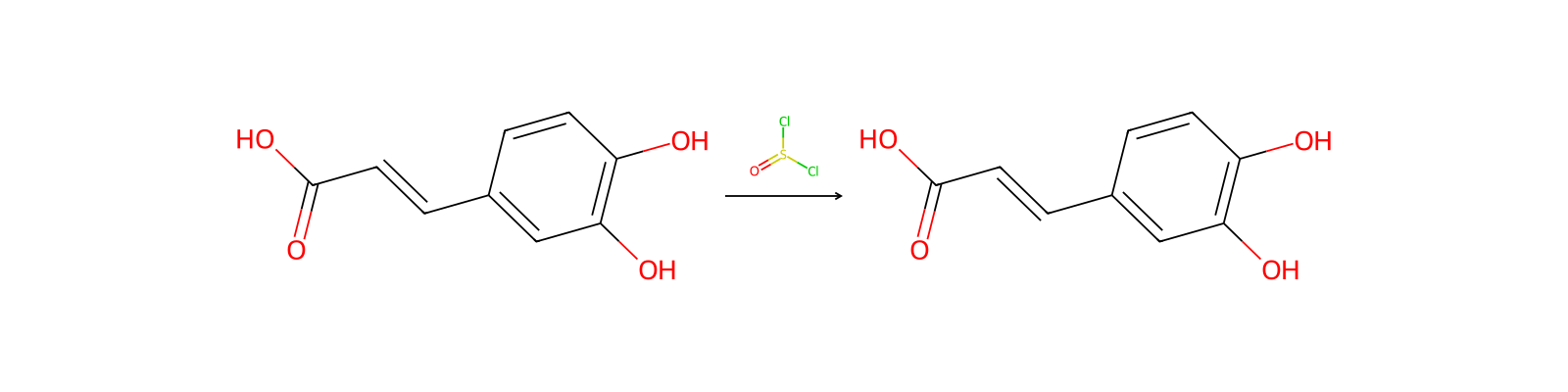
HRID 25331반응물로
3-(3,4-Dihydroxyphenyl)Prop-2-Enoic Acid

331-39-5O=C(O)C=Cc1ccc(O)c(O)c1QAIPRVGONGVQAS-UHFFFAOYSA-NQAIPRVGONGVQAS-UHFFFAOYSA-N has been reported in Salvia miltiorrhiza, Acanthospermum australe, and other organisms with data available.
331-39-5DTXSID5020231CHEMBL3181904안전 정보는 참고용이며, 공급업체의 물질안전보건자료(SDS), 관련 법규 및 전문가 평가를 대체하지 않습니다.
개요Caffeic acid is abundant in the whole plant of Solidago decurrens Lour. (Yi Zhi Huang Hua), fruit of Crataegus pinnatifida Bge. var. major N.E.Br. (Shan Li Hong), Salix myrtillacea Anderss. (Po Liu), rhizome of Cimicifuga foetida L., rhizome of Polypodiaceae Polypodium vulgare L. (Ou Ya Shui Long Gu), peel of Rutaceae Citrus limonum (Ning Meng), the whole plant of Polygonaceae Polygonum aviculare L. (Pian Xu), root of Valeriana officinalis L. (Xie Cao), the whole plant of Thymus mongolicus Ronn (She Xiang), leaves of Eucommia ulmoides (Du Zhong), and other herbal plants. It is a kind of polyhydroxy styrene acid, with the general chemical properties of phenolic acid. It is easily oxidized for the reason of the unsaturated double bonds, particularly unstable in alkaline solutionCaffeic acid has both cis and trans isomers, and the two isomers of caffeic acid have a mutual transformation in plants, which may regulate some important physiological process. Caffeic acid exists in plants in the main form of complexes; free state accounts for a few proportion.
용도Caffeic Acid is a constituent of plants, probably occurs in plants only in conjugated forms. Caffeic acid is found in all plants because it is a key intermediate in the biosynthesis of lignin, one of the principal sources of biomass. Caffeic acid is one of the main natural phenols in argan oi.
일반 설명Yellow prisms or plates (from chloroform or ligroin) or pale yellow granules. Alkaline solutions turn from yellow to orange.
Light yellow to greenish-yellow powder


