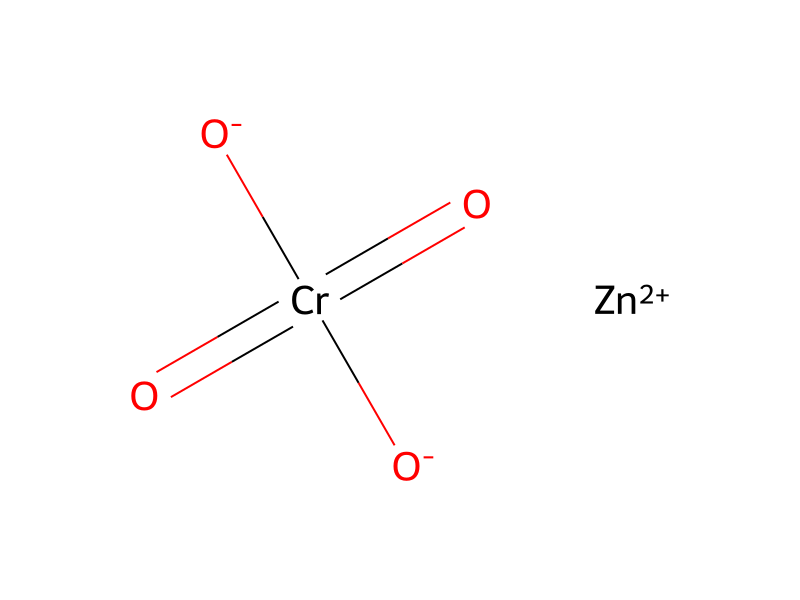
기본 정보
- CAS
13530-65-9- 표준 SMILES
[O]=[Cr](=[O])([O-])[O-].[Zn+2]- InChIKey
NDKWCCLKSWNDBG-UHFFFAOYSA-N- 분자식
- ZnCrO4
- 평균 분자량
- 181.4 g/mol
- 단동위원소 질량
- 179.849305
개요
Zinc chromate is an odorless yellow solid. Sinks in water. (USCG, 1999)
이름 및 식별자
- 우선 이름
- Zinc Chromate
- IUPAC
- zinc dioxido(dioxo)chromium
- 현지명
- C.I. 색소 황색 36
- 영어명
- C.I. Pigment Yellow 36
- 분자식
- CrO4Zn
- 분자량
- 181.3837
이름 및 동의어
이름 더 보기
데이터베이스 식별자
- CAS
13530-65-9、37300-23-5- PubChem CID
- 26089
- DTXSID
DTXSID7047485- UNII
- 05F2837HUF
- EC Number
- 236-878-9、609-398-6
물성
구조 계산 물성
- 극성 표면적
- 80.3 Ų
- 수소 결합 공여자 수
- 0
- 수소 결합 수용자 수
- 4
- 회전 가능 결합 수
- 0
- 무거운 원자 수
- 6
- 형식 전하
- 0
- 복잡도
- 62.2
실험 및 물리화학적 성질
Chemical Classes
Metals -> Chromium Compounds, Inorganic
Carcinogens
Carcinogens
Density
3.43 at 68 °F (USCG, 1999) - Denser than water; will sink
3.40 g/cu cm
3.4 g/cm³
3.4 @25 °C
Color/Form
Yellow prisms
Lemon yellow powder
Solubility
Sparingly soluble in water
3.08 g/100 g water
Soluble in acid, liquid ammonia; insoluble in acetone
Dissolves readily in acids
Solubility in water: none
Melting Point
316 °C
316 °C
316 °C
Physical Description
Zinc chromate is an odorless yellow solid. Sinks in water. (USCG, 1999)
Liquid; Other Solid
Lemon-yellow solid; Insoluble in water; [ACGIH]
YELLOW CRYSTALLINE POWDER.
Other Experimental Properties
Solid yellow, molecular wt: 307.6 /Zinc chromate heptahydrate/
Strong oxidizing agent
Corrosive because of its oxidizing potency /chromate salts/
물리화학적 성질
- EPA
- 36 · C.I. Pigment Yellow 36 (37300-23-5)
안전 및 규제
GHS 분류
GHS Classification
This chemical does not meet GHS hazard criteria for 3.6% (5 of 140) of reports.
Danger
H302 (96.4%): Harmful if swallowed [Warning Acute toxicity, oral]
P203, P261, P264, P270, P272, P273, P280, P301+P317, P302+P352, P318, P321, P330, P333+P317, P362+P364, P391, P405, and P501 (click each P-code to see the statement)
Aggregated GHS information provided per 140 reports by companies from 3 notifications to the ECHA C&L Inventory. Each notification may be associated with multiple companies.
This chemical does not meet GHS hazard criteria for 6.2% (5 of 80) of reports.
유해성 정보
Regulatory Information
Chemical: Chromic acid (H2CrO4), zinc salt (1:1)
Chemical: C.I. Pigment Yellow 36
Chromic acid (H2CrO4), zinc salt (1:1) is listed on the EPA's Chemical Data Reporting (CDR) system. Manufacturers and importers of Chromic acid (H2CrO4), zinc salt (1:1) are required to report information about their production and use of this chemical to the EPA under the Toxic Substances Control Act (TSCA). (40 eCFR Part 711)
R - indicates a substance that is the subject of a TSCA section 6 risk management rule.
Zinc chromate: HSNO Approval: HSR003960 Approved with controls
C.I. Pigment Yellow 36: Does not have an individual approval but may be used under an appropriate group standard
Other Safety Information
IMAP assessments - Chromates and dichromates (insoluble): Human health tier II assessment
IMAP assessments - Chromates and dichromates (insoluble): Human health tier II assessment
Fire Hazards
Excerpt from ERG Guide 151 [Substances - Toxic (Non-Combustible)]:
Not combustible. Gives off irritating or toxic fumes (or gases) in a fire. Risk of explosion on contact with reducing agents or organic materials.
Hazards Summary
Occupational exposure can cause skin ulcers, lung irritation, and lung cancer. [HSDB] Kidney injury has been reported in workers exposed to hexavalent chromium compounds; [ACGIH] Inhalation may cause irritation; Asthma and skin sensitization are potential adverse effects; [ICSC] Excess risk for lung cancer has been clearly established in facilities where zinc chromate was produced. [IARC] See Chromium and linked occupational diseases.
Special Reports
USEPA; Ambient Water Quality Criteria Doc: Zinc (1980) EPA 400/5-80-079
USEPA; Ambient Water Quality Criteria Doc: Zinc (1987) EPA 440/5-87-003
RCRA Requirements
D007; A solid waste containing chromium may or may not become characterized as a hazardous waste when subjected to the Toxicity Characteristic Leaching Procedure listed in 40 CFR 261.24, and if so characterized, must be managed as a hazardous waste. /Chromium/
안전 및 보호
Fire Fighting
Excerpt from ERG Guide 151 [Substances - Toxic (Non-Combustible)]:
In case of fire in the surroundings, use appropriate extinguishing media.
First Aid Measures
Fresh air, rest.
Remove contaminated clothes. Rinse and then wash skin with water and soap.
First rinse with plenty of water for several minutes (remove contact lenses if easily possible), then refer for medical attention.
Rinse mouth.
Exposure Control and Personal Protection
TIH (Toxic Inhalation Hazard) - Term used to describe gases and volatile liquids that are toxic when inhaled. Some are TIH materials themselves, e.g., chlorine, and some release TIH gases when spilled in water, e.g., chlorosilanes. [ERG 2016].
Fire Fighting Procedures
Nonflammable. Use agent suitable for surrounding fire.
From a secure, explosion-proof location, use water spray to cool exposed containers, If cooling streams are ineffective (venting sound increases in volume and pitch, tank discolors, or shows any signs of deforming), withdraw immediately to a secure position.
The only respirators recommended for firefighting are self-contained breathing apparatuses that have full face-pieces and are operated in a pressure-demand or other positive-pressure mode.
SMALL FIRE: Dry chemical, CO2 or water spray.
For more Fire Fighting Procedures (Complete) data for ZINC CHROMATE (7 total), please visit the HSDB record page.
Storage Conditions
Store in a secure poison location. Store in tightly closed containers in a cool, well-ventilated area away from reducing agents. Where possible, automatically transfer material from other storage containers to process containers. A regulated, marked area should be established where this chemical is handled, used, or stored in compliance with OSHA Standard 1910.1045.
PRECAUTIONS FOR "CARCINOGENS": Storage site should be as close as practical to lab in which carcinogens are to be used, so that only small quantities required for ... expt need to be carried. Carcinogens should be kept in only one section of cupboard, an explosion-proof refrigerator or freezer (depending on chemicophysical properties ...) that bears appropriate label. An inventory ... should be kept, showing quantity of carcinogen & date it was acquired ... Facilities for dispensing ... should be contiguous to storage area. /Chemical Carcinogens/
Cleanup Methods
Evacuate persons not wearing protective equipment from area of spill or leak until cleanup is complete. Remove all ignition sources. Collect powdered material in the most convenient and safe manner and deposit in sealed containers. Ventilate area after cleanup is complete. It may be necessary to contain and dispose of this chemical as a hazardous waste. If material or contaminated runoff enters waterways, notify downstream users of potentially contaminated waters.
As an immediate precautionary measure, isolate spill or leak area in all directions for at least 50 meters (150 feet) for liquids and at least 25 meters (75 feet) for solids. SPILL: Increase, in the downwind direction, as necessary, the isolation distance shown above.
Cr(VI) cmpd in waste sludge are completely removed by redn by carbon at 600 °C. /Chromium VI/
Persons not wearing protective equipment and clothing should be restricted from areas of spills until cleanup has been completed. If chromic acid or chromates are spilled, the following steps should be taken: 1. Ventilate area of spill. 2. Collect spilled material in the most convenient and safe manner and deposit in sealed containers for reclamation or for disposal in a secured sanitary landfill. Liquid containing chromic acid or chromates should be absorbed in vermiculite, dry sand, earth, or a similar material. /Chromic acid and chromates/
PRECAUTIONS FOR "CARCINOGENS": A high-efficiency particulate arrestor (HEPA) or charcoal filters can be used to minimize amt of carcinogen in exhausted air ventilated safety cabinets, lab hoods, glove boxes or animal rooms ... Filter housing that is designed so that used filters can be transferred into plastic bag without contaminating maintenance staff is avail commercially. Filters should be placed in plastic bags immediately after removal ... The plastic bag should be sealed immediately ... The sealed bag should be labelled properly ... Waste liquids ... should be placed or collected in proper containers for disposal. The lid should be secured & the bottles properly labelled. Once filled, bottles should be placed in plastic bag, so that outer surface ... is not contaminated ... The plastic bag should also be sealed & labelled. ... Broken glassware ... should be decontaminated by solvent extraction, by chemical destruction, or in specially designed incinerators. /Chemical Carcinogens/
Disposal Methods
Generators of waste (equal to or greater than 100 kg/mo) containing this contaminant, EPA hazardous waste number D007, must conform with USEPA regulations in storage, transportation, treatment and disposal of waste. /Chromium/
SRP: Wastewater from contaminant suppression, cleaning of protective clothing/equipment, or contaminated sites should be contained and evaluated for subject chemical or decomposition product concentrations. Concentrations shall be lower than applicable environmental discharge or disposal criteria. Alternatively, pretreatment and/or discharge to a permitted wastewater treatment facility is acceptable only after review by the governing authority and assurance that "pass through" violations will not occur. Due consideration shall be given to remediation worker exposure (inhalation, dermal and ingestion) as well as fate during treatment, transfer and disposal. If it is not practicable to manage the chemical in this fashion, it must be evaluated in accordance with EPA 40 CFR Part 261, specifically Subpart B, in order to determine the appropriate local, state and federal requirements for disposal.
The following wastewater treatment technology has been investigated for chromium: Concentration process: Biological Treatment. /Chromium/
The following wastewater treatment technology has been investigated for chromium: Concentration process: Chemical Precipitation. /Chromium/
For more Disposal Methods (Complete) data for ZINC CHROMATE (14 total), please visit the HSDB record page.
Spillage Disposal
Personal protection: particulate filter respirator adapted to the airborne concentration of the substance. Do NOT let this chemical enter the environment. Do NOT absorb in saw-dust or other combustible absorbents. Vacuum spilled material with specialist equipment. If appropriate, moisten first to prevent dusting. Carefully collect remainder. Then store and dispose of according to local regulations.
Preventive Measures
SRP: Contaminated protective clothing should be segregated in a manner such that there is no direct personal contact by personnel who handle, dispose, or clean the clothing. The completeness of the cleaning procedures should be considered before the decontaminated protective clothing is returned for reuse by the workers. Contaminated clothing should not be taken home at the end of shift, but should remain at employee's place of work for cleaning.
SRP: Local exhaust ventilation should be applied wherever there is an incidence of point source emissions or dispersion of regulated contaminants in the work area. Ventilation control of the contaminant as close to its point of generation is both the most economical and safest method to minimize personnel exposure to airborne contaminants. Ensure that the local ventilation moves the contaminant away from the worker.
Workers whose clothing may have become contaminated should change into uncontaminated clothing before leaving the work premises. /Chromic acid and cromates/
Work clothing that becomes wet or significantly contaminated should be removed and replaced. /Chromic acid and cromates; Chromium(II) compounds (as Cr); Chromium(III) compounds/
For more Preventive Measures (Complete) data for ZINC CHROMATE (14 total), please visit the HSDB record page.
독성 정보
Health Effects
Chronic exposure to zinc causes anemia, atazia, lethargy, and decreases the level of good cholesterol in the body. It is also believed to cause pancreatic and reproductive damage. Hexavalent chromium is a known carcinogen. Chronic inhalation especially has been linked to lung cancer. Hexavalent chromium has also been know to cause reproductive and developmental defects. (A12, L49)
Exposure Routes
The substance can be absorbed into the body by inhalation of dust and by ingestion.
Inhalation (L49) ; oral (L49) ; dermal (L49)
Toxicity Summary
IDENTIFICATION AND USE: Zinc chromate is a lemon-yellow powder. Zinc chromates are employed primarily in priming paints used for metals, for which they provide resistance against corrosion. HUMAN EXPOSURE AND TOXICITY: Development of dermatitis from exposure to zinc chromate has been reported, but such instances are rare. An outbreak of hand dermatitis was reported amongst employees working on a new assembly line of an electronics factory. Twenty-four out of 41 employees had signs of irritant contact dermatitis. The fingertips and the dorsal parts of the hands were especially affected. In 1975, five manufacturers of chromate pigment (including zinc chromate) in Japan were examined in a study of the carcinogenicity of chromates. None of the results showed statistically significant differences that would suggest an excess risk for malignant neoplasms, particularly lung cancer, among workers engaged in the manufacture of chromate pigment in Japan. However, several other studies of workers exposed to chromium compounds have suggested an increased incidence of respiratory cancers. Lead and zinc chromates were among the chromium compounds implicated. A study was done in a pigment plant in Newark, New Jersey, USA, which utilized both of these compounds. Observed deaths from each cause were compared with expected deaths. A statistically significant relative risk of 1.6 for lung cancer was found. An increased incidence of lung cancer was also evident. A small cohort of Norwegian male workers were studied from a company which produced zinc chromate paint. They found 3 cases of bronchial carcinoma (in workers aged 41, 51, and 59) where only 0.079 was expected for the total period of observation. The three cases had six to nine years of exposure to zinc chromate dust levels of approximately 0.5 to 1.5 mg Cr/cu m. Two of the three carcinomas were found in smokers. There was also one case of nasal cancer in a man with a total of 3 months of exposure. In a study of zinc chromate spray painters and electroplaters at two large aircraft maintenance facilities, the relative excess for respiratory cancer among spray painters (21 observed vs 11.4 expected) was statistically significant. The ability of chronic exposure to zinc chromate to induce numerical chromosome instability was tested in human lung fibroblasts. The study found no increase in aneuploidy after a 24 hr exposure to zinc chromate, but with more chronic exposures, zinc chromate induced concentration- and time-dependent increases in aneuploidy in the form of hypodiploidy, hyperdiploidy, and tetraploidy. Zinc chromate also induced centrosome amplification in a concentration- and time-dependent manner in both interphase and mitotic cells after chronic exposure, producing cells with centriolar defects. Furthermore, chronic exposure to zinc chromate induced concentration- and time-dependent increases in spindle assembly checkpoint bypass with increases in centromere spreading, premature centromere division, and premature anaphase. All together, these data indicate that zinc chromate can induce chromosome instability after prolonged exposures. In human brochial cells zinc chromate was more clastogenic than all other chromium compounds. ANIMAL STUDIES: Six intratracheal injections of zinc chromate were given at 6 week intervals to 62 mice, which were observed until their death. No pulmonary carcinomas were found; pulmonary adenomas occurred in 31/62 exposed, in 7/18 untreated control and in 0/2 zinc carbonate-treated control animals. Pulmonary adenomas occurred in 1 of 21 guinea pigs that were given 6 intratracheal instillations of zinc chromate, no pulmonary adenomas occurred in controls. Chromium containing materials were examined for carcinogenic activity in a two-year study using an intrabronchial pellet implantation system whereby pellets loaded with test material were surgically implanted into the lower left bronchus of rats. Zinc chromate resulted in bronchial carcinomas in 5/100 rats tested. A further zinc chromate group produced bronchial carcinomas in 3/100, which was not statistically significant. Zinc chromate induced forward mutations to 8-azaguanine resistance in Chinese hamster V79/4 cells. Deaths in cattle believed to have had access to zinc chromate paste have been recorded in New Zealand. A daily dose of 30-40 mg/kg body weight produced severe chronic poisoning in young calves within one month. The acute lethal dose for adult cattle is about 20 times this amount. The outstanding clinical feature of the condition produced was profuse scouring, leading in chronic cases to severe dehydration and a low terminal blood pressure. Changes in the alimentary tract were the most marked post mortem finding. In acute poisoning, there was severe congestion and inflammation throughout the intestines and sloughing of the gastric mucous membranes. In chronic poisoning, congestion and inflammation were present only in the stomach (the rumen and abomasum in particular) showing severe ulceration and near perforation.
Anaemia results from the excessive absorption of zinc suppressing copper and iron absorption, most likely through competitive binding of intestinal mucosal cells. Unbalanced levels of copper and zinc binding to Cu,Zn-superoxide dismutase has been linked to amyotrophic lateral sclerosis (ALS). Stomach acid dissolves metallic zinc to give corrosive zinc chloride, which can cause damage to the stomach lining. Metal fume fever is thought to be an immune response to inhaled zinc. Hexavalent chromium's carcinogenic effects are caused by its metabolites, pentavalent and trivalent chromium. The DNA damage may be caused by hydroxyl radicals produced during reoxidation of pentavalent chromium by hydrogen peroxide molecules present in the cell. Trivalent chromium may also form complexes with peptides, proteins, and DNA, resulting in DNA-protein crosslinks, DNA strand breaks, DNA-DNA interstrand crosslinks, chromium-DNA adducts, chromosomal aberrations and alterations in cellular signaling pathways. It has been shown to induce carcinogenesis by overstimulating cellular regulatory pathways and increasing peroxide levels by activating certain mitogen-activated protein kinases. It can also cause transcriptional repression by cross-linking histone deacetylase 1-DNA methyltransferase 1 complexes to CYP1A1 promoter chromatin, inhibiting histone modification. Chromium may increase its own toxicity by modifying metal regulatory transcription factor 1, causing the inhibition of zinc-induced metallothionein transcription. (A12, L16, A34, A35, A36, L48, L49, A49)
Signs and Symptoms
Cough. See Effects of long-term or repeated exposure.
Redness.
Redness.
See Effects of long-term or repeated exposure.
Ingestion of large doses of zinc causes stomach cramps, nausea, and vomiting. Acute inhalation of large amounts of zinc causes metal fume fever, which is characterized by chills, fever, headache, weakness, dryness of the nose and throat, chest pain, and coughing. Dermal contact with zinc results in skin irritation. Breathing hexavalent chromium can cause irritation to the lining of the nose, nose ulcers, runny nose, and breathing problems, such as asthma, cough, shortness of breath, or wheezing. Ingestion of hexavalent chromium causes irritation and ulcers in the stomach and small intestine, as well as anemia. Skin contact can cause skin ulcers. (L16, L49)
Medical Surveillance
PRECAUTIONS FOR "CARCINOGENS": Whenever medical surveillance is indicated, in particular when exposure to a carcinogen has occurred, ad hoc decisions should be taken concerning ... /cytogenetic and/or other/ tests that might become useful or mandatory. /Chemical Carcinogens/
TSCA Test Submissions
Zinc chromate KSH/SM (CAS # not specified) was tested for carcinogenicity in Porton Wistar rats (52 females/48 males) exposed for up to 2 years to 2 mg of the test compound in stainless steel mesh pellets surgically implanted in the left inferior bronchiolus. Control rats (25-50/sex/treatment group) received a similar treatment with 2 mg of cholesterol (negative control) or 2 mg of 20-methylcholanthrene (positive control) or calcium chromate (positive control). Treatment with the test compound had no adverse effects with respect to mortality rate, body weights, or incidences of non-lung tumors. The incidence of bronchial carcinomas was increased in treated rats (3%), as compared to the negative control group (0%). The authors concluded that the test compound elicited a weak, but detectable, carcinogenic effect in rats. Both groups of positive control rats had an increased incidence (25-46%) of bronchial carcinomas.
Human Toxicity Excerpts
/SIGNS AND SYMPTOMS/ Development of dermatitis from exposure to zinc chromate and sulfate has been reported, but such instances are rare.
/CASE REPORTS/ An outbreak of hand dermatitis is reported amongst employees working on a new assembly line of an electronics factory. Twenty-four out of 41 employees had signs of irritant contact dermatitis. The fingertips and the dorsal parts of the hands were especially affected. Mechanical factors in combination with zinc-chromium compounds from galvanized steel seemed to be responsible for the dermatitis and the dry skin. The use of an emollient solved the problem. /Zinc chromium compounds/
/EPIDEMIOLOGY STUDIES/ In 1975, five manufacturers of chromate pigment in Japan were examined in a study of the carcinogenicity of chromates. These companies were producing lead chromate, zinc chromate, molybdate orange and/or strontium chromate. The current study covers a cohort of 666 workers involved in the manufacture of chromate pigment for at least 1 year between 1950 and 1975. The workers were followed up for 15-40 years, until 1989. Many previous reports have found an excess lung cancer risk among workers involved in the manufacture of chromate pigments and chromate chemicals. In the current study, subjects were classified on the basis of years worked, years of observation, characteristics of company, type of work engaged in for the longest period of time, and involvement in the manufacture of zinc chromate. Mortality was compared with that of all Japanese males by means of the person-year method. The route of exposure was primarily inhalation through the respiratory system. None of the results showed statistically significant differences that would suggest an excess risk for malignant neoplasms, particularly lung cancer, among workers engaged in the manufacture of chromate pigment in Japan.
/EPIDEMIOLOGY STUDIES/ Epidemiologic studies on chromate workers are considered with special reference to the valency of chromium compounds, carcinogenic potency, and water solubility. It is assumed that all hexavalent chromium compounds are carcinogenic to humans when inhaled but that there is no evidence that trivalent compounds are carcinogenic. It is suggested that zinc chromate is a highly potent carcinogen and also that calcium chromate may be carcinogenic. There are indications that chromates of low water solubility may be less potent carcinogens than compounds of greater solubility. Evidence is also presented for possible interactions with smoking and other factors involved in work-related cancers.
For more Human Toxicity Excerpts (Complete) data for ZINC CHROMATE (23 total), please visit the HSDB record page.
규제 정보
RCRA Requirements
D007; A solid waste containing chromium may or may not become characterized as a hazardous waste when subjected to the Toxicity Characteristic Leaching Procedure listed in 40 CFR 261.24, and if so characterized, must be managed as a hazardous waste. /Chromium/
Atmospheric Standards
... Substances for which a Federal Register notice has been published that included consideration of the serious health effects, including cancer, from ambient air exposure to the substance. Chromium is included on this list. /Chromium/
Listed as a hazardous air pollutant (HAP) generally known or suspected to cause serious health problems. The Clean Air Act, as amended in 1990, directs EPA to set standards requiring major sources to sharply reduce routine emissions of toxic pollutants. EPA is required to establish and phase in specific performance based standards for all air emission sources that emit one or more of the listed pollutants. Chromium compounds is included on this list. /Chromium compounds/
Clean Water Act Requirements
Toxic pollutant designated pursuant to section 307(a)(1) of the Federal Water Pollution Control Act and is subject to effluent limitations. /Zinc and compounds/
Toxic pollutant designated pursuant to section 307(a)(1) of the Federal Water Pollution Control Act and is subject to effluent limitations. /Chromium and compounds/
State Drinking Water Guidelines
(AZ) ARIZONA 5000 ug/L /Zinc/
(MN) MINNESOTA 2000 ug/L /Zinc/
(ME) MAINE 35 ug/L /Cr VI)
Federal Drinking Water Guidelines
Maximum contaminant level goal for inorganic contaminants: Contaminant: Chromium; MCLG 0.1 mg/L. /Chromium/
EPA 5000 ug/L /Zinc/
EPA 100 ug/L /Chromium/
안전 데이터
- tsca
- TSCA listed
- ridadr
- 3288
- 포장분류
- II
- 위험 등급
- 6.1(a)
- 함량 및 규제정보
- 물질구분: 유독물질; 혼합물(제품)함량정보: 크롬산 염류 및 이를 0.1% 이상 함유한 혼합물. 다만 크롬산납을 70% 이하 함유한 것은 제외
- 유해화학물질 필터링
- 97-1-271;06-5-10
- 중점관리물질 필터링
- 별표1-189
화학 및 산업
약리 정보
Metabolism/Metabolites
Zinc can enter the body through the lungs, skin, and gastrointestinal tract. Intestinal absorption of zinc is controlled by zinc carrier protein CRIP. Zinc also binds to metallothioneins, which help prevent absorption of excess zinc. Zinc is widely distributed and found in all tissues and tissues fluids, concentrating in the liver, gastrointestinal tract, kidney, skin, lung, brain, heart, and pancreas. In the bloodstream zinc is found bound to carbonic anhydrase in erythrocytes, as well as bound to albumin, _2-macroglobulin, and amino acids in the the plasma. Albumin and amino acid bound zinc can diffuse across tissue membranes. Zinc is excreted in the urine and faeces. Chromium is absorbed from oral, inhalation, or dermal exposure and distributes to nearly all tissues, with the highest concentrations found in kidney and liver. Bone is also a major storage site and may contribute to long-term retention. Hexavalent chromium's similarity to sulfate and chromate allow it to be transported into cells via sulfate transport mechanisms. Inside the cell, hexavalent chromium is reduced first to pentavalent chromium, then to trivalent chromium by many substances including ascorbate, glutathione, and nicotinamide adenine dinucleotide. Chromium is almost entirely excreted with the urine. (A12, L16, L49)
Absorption, Distribution and Excretion
... Chromates(VI) are absorbed /from the gastrointestinal tract/ at a rate of 3-6% in rats. ... Zinc chromate(VI) was absorbed quickly in rats exposed to known atmospheric concentrations (6.3-10.7 mg/cu m, equivalent to 1.3-2.2 mg/cu m chromium) in an inhalation chamber: a 5 fold increase in the blood chromium level was observed after 100 minutes of inhalation exposure, and this level increased at a similar rate during the next 150 minutes. Elimination from blood was slow: the blood chromium level fell by less than 50% during the first 3 days after exposure; and after 18 and 37 days, respectively, 20% and 9% of the initial concentration remained. Excretion occurred mainly via the urine.
Two groups of rats were exposed in the same zinc chromate dust cloud, 1 in open wire cages & the other in fiber glass tubes. The chromium excretion during the following 2.5 days was 8.4 times higher in feces & 5.5 times higher in urine in the animals exposed in cages compared with those exposed in tubes.
(51)Cr-labelled sodium, zinc and lead chromates were studied. Sodium chromate and the less soluble zinc chromate were absorbed by the blood, resulting in increased urinary excretion of chromium. ... The less water soluble the chromate, the higher was its elimination via the feces. Absorbed chromium was retained in the spleen and bone marrow in all three cases, and also in the liver and kidneys in the case of sodium chromate. Chromium levels in blood and urine are not indicative of inhalation exposure to insoluble chromates.
The relative significance of dust ingestion during and after short-term inhalation exposure to a zinc chromate aerosol has been studied. Two groups of rats were exposed in the same dust cloud, one in open wire cages and the other in fiber glass tubes. The chromium excretion during the following 2 1/2 days was 8.4 times higher in feces and 5.5 times higher in urine in the animals exposed in cages, compared with those exposed in tubes.
Studies on absorption and excretion of chromium in the rat exposed to known atmospheric concentrations of zinc chromate in an inhalation chamber and the influence of diurnal variations in physical activity have been carried out. Chromium analyses were performed on samples of blood, urine and feces using a method for determining chromium in small samples of biological material based on flameless atomic absorption spectrometry. Zinc chromate is absorbed quickly during exposure and excreted mainly via urine. An accumulation of chromium in blood was observed, followed by a slow elimination. It is suggested that chromium from zinc chromate enters the blood in the hexavalent state.
용도 및 제조
Uses
Zinc chromates are used primarily in priming paints to prevent corrosion. They are also used as pigments. [ACGIH]
Painting (Pigments, Binders, and Biocides) [Category: Paint]
... Zinc chromates are employed primarily in priming paints used for metals, for which they provide resistance against corrosion. /Zinc chromates/
Pigments
Zinc chromate is used as a corrosion resisting agent and as the pigment Zinc Yellow or Yellow 36. (L60)
U.S. Production
2023: <50,000 lb
Non-confidential 2012 Chemical Data Reporting (CDR) information on the production and use of chemicals manufactured or imported into the United States. Chemical: Chromic acid (H2CrO4), zinc salt (1:1). National Production Volume: 55,027 lb/yr.
Formulations/Preparations
Zinc chromate is available commercially in the USA only in the form of basic zinc chromate. A typical analysis of basic zinc chromates is ZnO, 71.0% by weight; CrO3, 17.0%; combined water, 10.0%; moisture, 1.5%; and total water-soluble salts, 0.2%.
Micronized grades, pigment grade
General Manufacturing Information
All Other Basic Inorganic Chemical Manufacturing
Chromic acid (H2CrO4), zinc salt (1:1): ACTIVE
C.I. Pigment Yellow 36: ACTIVE
The term 'zinc chromate' is a generic term for a series of commercial products with three kinds of molecular structure: (i) 'zinc chromate' type (like ZnCr04); (ii) 'basic zinc chromate' type (like zinc tetrahydroxychromate (ZnCr04.4Zn(OH)2); and (iii) '(basic) zinc potassium chromate' type (like 3ZnCr04.Zn(OH)2.K2Cr04' 2H20). Several different commercial 'zinc chromates' are also referred to as 'zinc yellow'.
공급사9 곳
관련 반응
현재 필터 조건에 해당하는 반응 기록이 없습니다.
화합물 노트
불러오는 중…