
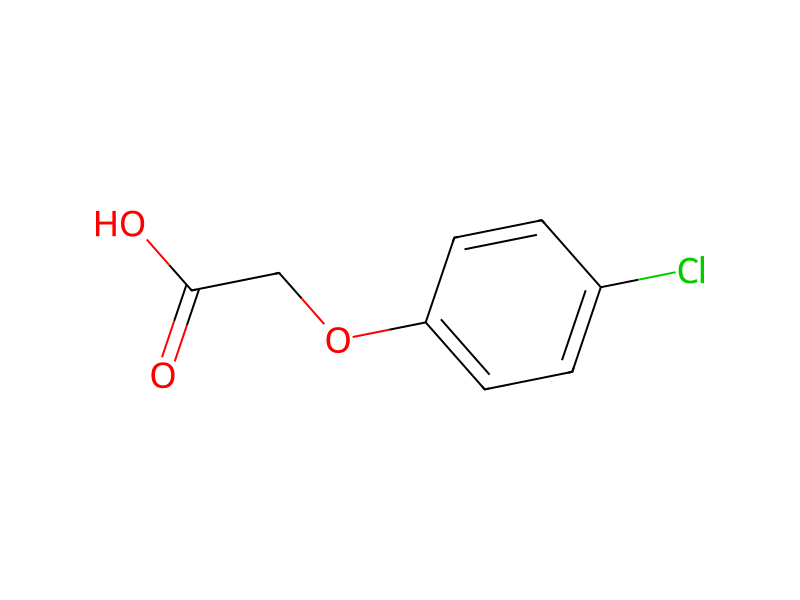
기본 정보
- 표준 SMILES
O=C(O)COc1ccc(Cl)cc1- InChIKey
SODPIMGUZLOIPE-UHFFFAOYSA-N- 분자식
- C8H7ClO3
- 평균 분자량
- 186.59 g/mol
- 단동위원소 질량
- 186.00837176
개요
(4-chlorophenoxy)acetic acid is a chlorophenoxyacetic acid that is phenoxyacetic acid carrying a chloro substituent at position 4. It has a role as a phenoxy herbicide. It is a chlorophenoxyacetic acid and a member of monochlorobenzenes. It is a conjugate acid of a (4-chlorophenoxy)acetate.
이름 및 식별자
- 우선 이름
- (4-Chlorophenoxy)acetic acid
- IUPAC
- 2-(4-chlorophenoxy)acetic acid
- 현지명
- 4-클로로페녹시아세트산
- 영어명
- 4-Chlorophenoxyacetic acid
- 분자식
- C8H7ClO3
- 분자량
- 186.59
이름 및 동의어
4-CHLOROPHENOXYACETIC ACID122-88-3(4-Chlorophenoxy)acetic acidSure-SetAcetic acid, (4-chlorophenoxy)-Tomato Fixp-Chlorophenoxyacetic acidTomato hold(p-Chlorophenoxy)acetic acid4CPAAcetic acid, (p-chlorophenoxy)-Parachlorophenoxyacetic acid
이름 더 보기
4-클로로펜옥시아세트산4-클로로페녹시아세트산4-클로로펜옥시아세트산4-CPAIUPAC4-CPCPAbi124CPAensc8769nsc-8769
BI 12NSC 8769TOMATONEDTXSID90342824EMM3U5P3KCHEBI:1808DTXCID7014282NSC-9213
데이터베이스 식별자
- CAS
122-88-3- PubChem CID
- 26229
- DTXSID
DTXSID9034282- ChEMBL
CHEMBL178018- ChEBI
CHEBI:1808- UNII
- 4EMM3U5P3K
- EC Number
- 204-581-3
- Nikkaji
- J2.495C
물성
구조 계산 물성
- XLogP
- 2.2
- 극성 표면적
- 46.5 Ų
- 수소 결합 공여자 수
- 1
- 수소 결합 수용자 수
- 3
- 회전 가능 결합 수
- 3
- 무거운 원자 수
- 12
- 형식 전하
- 0
- 복잡도
- 152
실험 및 물리화학적 성질
SpringerMaterials PropertiesCrystal structure
Pesticides
Plant Growth Regulators
Active substance -> EU Pesticides database: Not approved
Pesticides -> Herbicides, Chlorophenoxy
LogPlog Kow = 2.25
Color/FormPrisms or needles from water
SolubilityIn water, 957 mg/L at 25 °C
Endocrine DisruptorsPotential endocrine disrupting compound
DecompositionWhen heated to decomposition it emits toxic fumes of /hydrogen chloride/.
Melting Point156.5 °C
Odor ThresholdOdorless
Vapor Pressure0.000318 [mmHg]
Physical DescriptionOdorless solid; [HSDB] White or off-white powder; [MSDSonline]
Stability/Shelf LifeIt is stable at elevated temperatures (54 °C) and on exposure to metals, but degrades (30% loss in 24 hours) on exposure to sunlight.
물리화학적 성질
- 녹는점
- 157 · 157-159 °C
- 끓는 점
- 266.91 °C · 266.91°C (rough estimate)
- 밀도
- 1.3245 · 1.3245 (rough estimate)
- 굴절률
- 1.525 · 1.5250 (estimate)
- 저장 조건
- Sealed in dry,Room Temperature
- 용해도
- 957 mg/l · 957mg/l
- 물리적 상태
- 수정 같은
- 산도 계수 (pKa)
- 1 · pK1: 3.10 (25°C)
- 색상
- 흰색~밝은 베이지
- 수용성
- 848 mg/L · 848mg/L(25℃)
- BRN
- 1211804 · 1211804
- Henry's Law Constant
- 1 · 1.0×105 mol/(m3Pa) at 25℃, Ebert et al. (2023)
- 주요 응용
- 농업환경
- InChI
- 1S/C8H7ClO3/c9-6-1-3-7(4-2-6)12-5-8(10)11/h1-4H,5H2,(H,10,11)
- InChIKey
- SODPIMGUZLOIPE-UHFFFAOYSA-N
- SMILES
- OC(=O)COc1ccc(Cl)cc1
- LogP
- 2.25 · 2.250
- NIST
- 4 · 4-Chlorophenoxyacetic acid(122-88-3)
- EPA
- 4 · 4-Chlorophenoxyacetic acid (122-88-3)
화학적 성질
white to light beige powder
안전 및 규제
GHS 분류
GHS Classification
Warning
H302: Harmful if swallowed [Warning Acute toxicity, oral]
P264, P270, P301+P317, P330, and P501 (click each P-code to see the statement)
Warning
H302 (100%): Harmful if swallowed [Warning Acute toxicity, oral]
P264, P270, P301+P317, P330, and P501 (click each P-code to see the statement)
유해성 정보
Regulatory Information
4-Chlorophenoxyacetic acid is listed in the dataset of EPA Human Health Benchmarks for Pesticides under the Safe Drinking Water Act (40 eCFR 141)
2002/2076
Acetic acid, (4-chlorophenoxy)-: Does not have an individual approval but may be used as a component in a product covered by a group standard. It is not approved for use as a chemical in its own right.
Other Safety InformationIMAP assessments - Acetic acid, (4-chlorophenoxy)-: Environment tier I assessment
Hazards Summary
Caused severe eye irritation but no skin irritation in studies with rabbits; Effects in high-dose 13 week feeding studies with rats include decrease in weight gain and increased incidence of slight hepatic lymphohistiocytic infiltrates and slight individual hepatocellular necrosis in males (NOEL = 2000 ppm, LOEL = 8000 ppm); [HSDB] Chlorophenoxy herbicides are possibly carcinogenic to humans (Group 2B); [IARC] See 2,4D.
Special Reports
USEPA/Office of Pesticide Programs; Reregistration Eligibility Decision Document - 4-Chlorophenoxy-acetic Acid (4-CPA), EPA 738-R-97-001 (March 1997). The RED summarizes the risk assessment conclusions and outlines any risk reduction measures necessary for the pesticide to continue to be registered in the U.S.[Available from, as of June 21, 2006: http://www.epa.gov/pesticides/reregistration/status.htm]
BOVEY RW; PHYSIOLOGICAL EFFECTS OF PHENOXY HERBICIDES IN HIGHER PLANTS. IN: THE SCIENCE OF 2,4,5-T AND ASSOCIATED HERBICIDES, (JOHN WILEY & SONS: NY) CHAPTER 7: 217-38 (1980). RESEARCH ON THE PHYSIOLOGY AND MODE-OF-ACTION OF PHENOXY HERBICIDES INCLUDING 4-CPA ARE REVIEWED.
FIFRA Requirements
A tolerance is established for combined residues of the plant regulator p-chlorophenoxyacetic acid and its metabolite p-chlorophenol in or on the following food commodity: tomato.
A tolerance is established for combined residues of the plant regulator p-chlorophenoxyacetic acid and its metabolite p-chlorophenol to inhibit embryonic root development in or on the following food commodity: bean, mung, sprouts.
Based on the reviews of the generic data for the active ingredient 4-CPA, the Agency has sufficient information on the health effects of 4-CPA and on its potential 14 for causing adverse effects in fish and wildlife and the environment. The Agency has determined that 4-CPA products, labeled and used as specified in this Reregistration Eligibility Decision, will not pose unreasonable risks or adverse effects to humans or the environment. Therefore, the Agency concludes that products containing 4-CPA for the mung bean use are eligible for reregistration. ... The Agency has determined that the mung bean use of 4-CPA is eligible for reregistration.
As the federal pesticide law FIFRA directs, EPA is conducting a comprehensive review of older pesticides to consider their health and environmental effects and make decisions about their future use. Under this pesticide reregistration program, EPA examines health and safety data for pesticide active ingredients initially registered before November 1, 1984, and determines whether they are eligible for reregistration. In addition, all pesticides must meet the new safety standard of the Food Quality Protection Act of 1996. Pesticides for which EPA had not issued Registration Standards prior to the effective date of FIFRA, as amended in 1988, were divided into three lists based upon their potential for human exposure and other factors, with List B containing pesticides of greater concern and List D pesticides of less concern. 4-Chlorophenoxyacetic acid is found on List B. Case No: 2115; Pesticide type: herbicide; Case Status: RED Approved 03/95; OPP has made a decision that some/all uses of the pesticide are eligible for reregistration, as reflected in a Reregistration Eligibility Decision (RED) document.; Active ingredient (AI): 4-Chlorophenoxyacetic acid; Data Call-in (DCI) Date(s): 06/05/91, 05/20/94; AI Status: OPP has completed a Reregistration Eligibility Decision (RED) document for the case/AI.
Hazard Classes and Categories
Acute Tox. 4 (100%)
Acute toxicity - category 4
Acute toxicity (Oral) - Category 4
Acute Tox. 4 *
안전 및 보호
Cleanup MethodsIf material is released or spilled, flush with water ... .
Disposal Methods
SRP: The most favorable course of action is to use an alternative chemical product with less inherent propensity for occupational exposure or environmental contamination. Recycle any unused portion of the material for its approved use or return it to the manufacturer or supplier. Ultimate disposal of the chemical must consider: the material's impact on air quality; potential migration in soil or water; effects on animal, aquatic, and plant life; and conformance with environmental and public health regulations.
Preventive MeasuresIndividuals with chronic skin disease or known hypersensitivity to /chlorophenoxy herbicides/ should either avoid using them or take strict precautions to avoid contact (respirator, gloves, etc.). /Chlorophenoxy compounds/
Allowable Tolerances
A tolerance is established for combined residues of the plant regulator p-chlorophenoxyacetic acid and its metabolite p-chlorophenol in or on the following food commodity: tomato, 0.05 ppm.
A tolerance is established for combined residues of the plant regulator p-chlorophenoxyacetic acid and its metabolite p-chlorophenol to inhibit embryonic root development in or on the following food commodity: bean, mung, sprouts, 2 ppm.
Personal Protective Equipment (PPE)If material is released or spilled, flush with water, wear all purpose canister mask, rubber vinyl-coated gloves, face shield for eye protection.
독성 정보
Ecotoxicity Values
LC50 Lepomis macrochirus (Bluegill) >180 ppm/96 hr; static /diethanolamine salt; 2% AI formulated product/
LD50 Salmo trutta (Sea trout) 147 mg/L/24 hr /Conditions of bioassay not specified/
Environmental Fate
TERRESTRIAL FATE: Based on a classification scheme(1), an estimated Koc value of 18(SRC), determined from a structure estimation method(2), indicates that 4-chlorophenoxyacetic acid is expected to have very high mobility in soil(SRC). Furthermore, the pKa of 4-chlorophenoxyacetic acid is 3.56(3), indicating it will exist primarily as an anion under environmental conditions and anions generally possess greater mobility in soils than neutral compounds(4). Volatilization from moist soil surfaces will not be an important environmental fate process since anions do not volatilize(SRC). 4-Chlorophenoxyacetic acid is not expected to volatilize from dry soil surfaces(SRC), based upon an estimated vapor pressure of 3.2X10⁻⁴ mm Hg at 25 °C(SRC), determined from a fragment constant method(5). The half-life of 4-chlorophenoxyacetic acid in a clay loam soil under field conditions was 20 days(6).
AQUATIC FATE: Based on a classification scheme(1), an estimated Koc value of 18(SRC), determined from a structure estimation method(2), indicates that 4-chlorophenoxyacetic acid is not expected to adsorb to suspended solids and sediment(SRC). The pKa of 4-chlorophenoxyacetic acid is 3.56(3), indicating it will exist primarily as an anion under environmental conditions. Volatilization from water surfaces is not an important environmental fate process since anions do not volatilize(SRC). According to a classification scheme(4), an estimated BCF of 3(SRC), from a log Kow of 2.25(5) and a regression-derived equation(6), suggests the potential for bioconcentration in aquatic organisms is low(SRC). Biodegradation studies using soil(7), and sewage inocula(8), suggest that biodegradation in water may occur. 4-Chlorophenoxyacetic acid exposed to natural sunlight for 24 hours was degraded 30%, suggesting that photolysis in sunlit surface waters may be important(9).
ATMOSPHERIC FATE: According to a model of gas/particle partitioning of semivolatile organic compounds in the atmosphere(1), 4-chlorophenoxyacetic acid, which has an estimated vapor pressure of 3.2X10⁻⁴ mm Hg at 25 °C(2), is expected to exist solely in the vapor-phase in the ambient atmosphere. Vapor-phase 4-chlorophenoxyacetic acid is degraded in the atmosphere by reaction with photochemically-produced hydroxyl radicals(SRC); the half-life for this reaction in air is estimated to be 35 hours(SRC), calculated from its rate constant of 1.1X10⁻¹¹ cu cm/molecule-sec at 25 °C(SRC) that was derived using a structure estimation method(3). 4-Chlorophenoxyacetic acid was degraded 30% upon exposure to natural sunlight over the course of 24 hours, suggesting photodegradation is an important environmental fate process(4).
Adverse EffectsOccupational hepatotoxin - Secondary hepatotoxins: the potential for toxic effect in the occupational setting is based on cases of poisoning by human ingestion or animal experimentation.
Soil Adsorption/Mobility
The Rf value for 4-chlorophenoxyacetic acid ranged from 0.74 at pH 4.0 to 0.93 at pH 7 using a Rothansted silty clay loam(1). At pH 7.8-7.9, 4-chlorophenoxyacetic acid was found not to be significantly adsorbed to clay(2). Sorption of 4-chlorophenoxy acetic acid to clay is pH dependent and increases with decreasing ionization(3). Using a structure estimation method based on molecular connectivity indices(4), the Koc for 4-chlorophenoxy acetic acid can be estimated to be 18(SRC). According to a classification scheme(5), this estimated Koc value suggests that 4-chlorophenoxy acetic acid is expected to have very high mobility in soil(SRC). In addition, the pKa of 4-chlorophenoxy acetic acid is 3.56(6), indicating that this compound will primarily exist as an anion in the environment, and anions generally possess high mobility in soil(7).
Artificial Pollution Sources
4-Chlorophenoxyacetic acid's production may result in its release to the environment through various waste streams; it's use as a plant growth regulator and as an aid in setting fruit(1) will result in its direct release to the environment(SRC).
Environmental Biodegradation
AEROBIC: The time required for 80% breakdown of 4-chlorophenoxyacetic acid in soil was 12.1 days in fresh soil and 2.5 days in adapted soil(1). The number of days for complete removal in Honeoye and Dunkirk soils was 94 and 11 days, respectively(2). 4-Chlorophenoxyacetic acid had a 31% theoretical biological oxygen demand in a 5 day test using an acclimated mixed microbial culture(3). A pilot plant sewage treatment plant provided 32-58% removal using an activated sludge inocula, residence time not provided(4). 4-Chlorophenoxyacetic acid degraded in mixed soil and sewage inocula(5).
HALF-LIFE OF P-CHLOROPHENOXYACETIC ACID (CPA) IN CLAY LOAM UNDER FIELD CONDITIONS WAS 20 DAYS AND UNDER LAB CONDITIONS 27.4 DAYS.
4-Chlorophenoxyacetic acid was found to be degraded by pure cultures of Achromobacter sp, Alcaligenenes sp, Flavobacterium oeregrinum, and Pseudomonas sp(1-3) forming 2-hydroxy-4-chlorophenoxyacetic acid, 4-chlorocatechol, 4-chloromuconic acid, chloro-alpha-carboxymethylene butenolide, and chloro-beta-keto adipic acid(4-6). .
ANAEROBIC: 4-Chlorophenoxyacetic acid underwent complete removal using an an anaerobic digester sludge in 8 days, initial concentration not provided(1).
Environmental Bioconcentration
An estimated BCF of 3 was calculated for 4-chlorophenoxyacetic acid(SRC), using a log Kow of 2.25(1) and a regression-derived equation(2). According to a classification scheme(3), this BCF suggests the potential for bioconcentration in aquatic organisms is low(SRC).
Volatilization from Water/Soil
The pKa of 4-chlorophenoxyacetic acid is 3.56(1), indicating that this compound will exist predominantly as an anion under environmental conditions. Volatilization will not occur from water and moist soils since anions do not volatilize(SRC). 4-Chlorophenoxyacetic acid is not expected to volatilize from dry soil surfaces(SRC), based upon an estimated vapor pressure of 3.2X10⁻⁴ mm Hg at 25 °C(SRC), determined from a fragment constant estimation method(2).
Non-Human Toxicity Excerpts
/LABORATORY ANIMALS: Acute Exposure/ In rabbits, 4-CPA was a severe eye irritant. 4-CPA was non-irritating in a primary dermal irritation study with rabbits. No sensitization occurred in a dermal sensitization study with guinea pigs.[USEPA/Office of Pesticide Programs; Reregistration Eligibility Decision Document - 4-Chlorophenoxy-acetic Acid (4-CPA). EPA 738-R-97-001 March 1997. Available from, as of April 20, 2006: http://www.epa.gov/pesticides/reregistration/status.htm]
/LABORATORY ANIMALS: Acute Exposure/ In an acute oral toxicity study in rats, ...clinical signs of toxicity were staggered gait, hypoactivity, and absent pain reflex.[USEPA/Office of Pesticide Programs; Reregistration Eligibility Decision Document - 4-Chlorophenoxy-acetic Acid (4-CPA). EPA 738-R-97-001 March 1997. Available from, as of April 20, 2006: http://www.epa.gov/pesticides/reregistration/status.htm]
/LABORATORY ANIMALS: Subchronic or Prechronic Exposure/ In a 13-week oral toxicity study, 4-CPA was given to Crl:CD BR VAF/Plus rats at doses of 0, 100, 2000, or 8000 ppm in the diet (0, 6.6, 132, or 517 mg/kg/day for males; 0, 8.0, 153, or 626 mg/kg/day for females). The NOEL was 2000 ppm. The LOEL was 8000 ppm, based on decreased body weight gain in both sexes, decreased food consumption in females, increased urine volume in females, and increased incidence of slight hepatic lymphohistiocytic infiltrates and slight individual hepatocellular necrosis in males.[USEPA/Office of Pesticide Programs; Reregistration Eligibility Decision Document - 4-Chlorophenoxy-acetic Acid (4-CPA). EPA 738-R-97-001 March 1997. Available from, as of April 20, 2006: http://www.epa.gov/pesticides/reregistration/status.htm]
/LABORATORY ANIMALS: Subchronic or Prechronic Exposure/ 4-CPA was given to beagle dogs for 13 weeks in the diet at 0, 20, 100, or 500 ppm (0, 0.8, 3.3, or 18.6 mg/kg/day for males; 0, 0.8, 4.0, or 17.4 mg/kg/day for females). The NOEL was 500 ppm. The only effect found was decreased body weight gain and food consumption during the first four weeks at the highest dose, which may have been related to palatability.[USEPA/Office of Pesticide Programs; Reregistration Eligibility Decision Document - 4-Chlorophenoxy-acetic Acid (4-CPA). EPA 738-R-97-001 March 1997. Available from, as of April 20, 2006: http://www.epa.gov/pesticides/reregistration/status.htm]
For more Non-Human Toxicity Excerpts (Complete) data for 4-CHLOROPHENOXYACETIC ACID (11 total), please visit the HSDB record page.
Environmental Abiotic Degradation
The rate constant for the vapor phase reaction of 4-chlorophenoxyacetic acid with photochemically produced hydroxyl radicals has been estimated to be 1.1X10⁻¹¹ cu cm/molecule-sec at 25 °C(SRC) using a structure estimation method(1). This corresponds to an atmospheric half-life of about 35 hours at an atmospheric concn of 5X10+5 hydroxyl radicals per cu cm(1). 4-Chlorophenoxyacetic acid was stable to hydrolysis (half-life > 30 days) at pH 5, 7, and 9(2). 4-Chlorophenoxyacetic acid was degraded 30% upon exposure to natural sunlight over the course of 24 hours(2).
The sunlight photolysis of 4-chlorophenoxyacetic acid in natural waters was found to produce catechol and phenol by either the reaction with solvated electrons or hydroxyl radicals formed via the sensitization of naturally occurring substances(1). Which ever process is operating, the isolation of the formate ester of phenol as a photolysis intermediate indicates a free radical rather then ionic (hydrolytic) pathway(2). Laboratory irradiation of 4-chlorophenoxyacetic acid in ethanol using a mercury vapor lamp produced phenol, 2-coumaranone, and phenoxyacetic acid(3).
Under sunlight or UV (300-450 nm) 4-CPA in aqueous solutions decomposed mainly to p-chlorophenol, phenol, hydroquinone, p-chlorophenyl formate, phenoxyacetic acid, p-hydroxyphenoxacetic acid and humic acids. In the presence of cyanide ions, irradiation of 4-CPA produced p-chlorobenzonitrile.
Probable Routes of Human Exposure
Occupational exposure to 4-chlorophenoxyacetic acid may occur by inhalation or dermal contact during its production or application as a plant growth regulator(SRC). Products containing 4-chlorophenoxyacetic acid are intended primarily for commercial use and are not likely to be used at residential sites; therefore, exposure to the general population is expected to be low(1).
Environmental Water ConcentrationsDRINKING WATER: 4-Chlorophenoxyacetic acid was qualitatively detected in treated drinking water supplies in the U.K.(1).
규제 정보
FIFRA Requirements
A tolerance is established for combined residues of the plant regulator p-chlorophenoxyacetic acid and its metabolite p-chlorophenol in or on the following food commodity: tomato.
A tolerance is established for combined residues of the plant regulator p-chlorophenoxyacetic acid and its metabolite p-chlorophenol to inhibit embryonic root development in or on the following food commodity: bean, mung, sprouts.
Based on the reviews of the generic data for the active ingredient 4-CPA, the Agency has sufficient information on the health effects of 4-CPA and on its potential 14 for causing adverse effects in fish and wildlife and the environment. The Agency has determined that 4-CPA products, labeled and used as specified in this Reregistration Eligibility Decision, will not pose unreasonable risks or adverse effects to humans or the environment. Therefore, the Agency concludes that products containing 4-CPA for the mung bean use are eligible for reregistration. ... The Agency has determined that the mung bean use of 4-CPA is eligible for reregistration.
As the federal pesticide law FIFRA directs, EPA is conducting a comprehensive review of older pesticides to consider their health and environmental effects and make decisions about their future use. Under this pesticide reregistration program, EPA examines health and safety data for pesticide active ingredients initially registered before November 1, 1984, and determines whether they are eligible for reregistration. In addition, all pesticides must meet the new safety standard of the Food Quality Protection Act of 1996. Pesticides for which EPA had not issued Registration Standards prior to the effective date of FIFRA, as amended in 1988, were divided into three lists based upon their potential for human exposure and other factors, with List B containing pesticides of greater concern and List D pesticides of less concern. 4-Chlorophenoxyacetic acid is found on List B. Case No: 2115; Pesticide type: herbicide; Case Status: RED Approved 03/95; OPP has made a decision that some/all uses of the pesticide are eligible for reregistration, as reflected in a Reregistration Eligibility Decision (RED) document.; Active ingredient (AI): 4-Chlorophenoxyacetic acid; Data Call-in (DCI) Date(s): 06/05/91, 05/20/94; AI Status: OPP has completed a Reregistration Eligibility Decision (RED) document for the case/AI.
안전 데이터
- wgk
- 1
- tsca
- TSCA listed
- rtecs
- AG0175000
- ridadr
- 2811
- 독성
- LD50 oral in rat: 850mg/kg
- HS 번호
- 29189090
- risk_code
- 22-R22
- hazard_code
- Xn,Xi
- safety_code
- 22-24/25
- 위험 등급
- IRRITANT
- 기존화학 물질
- KE-05807
- F 고인화성물질
- 21
- Hazard Classifications
- Acute Tox. 4 Oral
- 스토리지 클래스
- 11 - Combustible Solids
- 유해 물질 데이터
- 122-88-3(Hazardous Substances Data)
화학 및 산업
약리 정보
Metabolism/Metabolites
Soil microorganisms metabolize the herbicide p-chlorophenoxyacetic acid into 2-hydroxy-4-chlorophenoxyacetic acid, and Aspergillus niger converts phenoxyacetic acid into the o- and p-hydroxy derivatives.
A pseudomonas, capable of utilizing 4-CPA as a sole carbon source, was isolated from soil. The following compounds were identified in culture extracts: 4-chloro-2-hydroxyphenoxyacetate, 4-chlorocatechol, beta-chloromuconate, gamma-carboxyethylene-delta-alpha-beta-butenolide. It was found that beta-chloromuconolactone was unstable in aqueous solution and hydrolyzed easily to the corresponding beta-hydroxy analog.
Yields p-chlorophenol in arthrobacter. /from table/
Microbial degradation of various pesticides by aquatic and soil microorganisms was studied. Arthrobacter species metabolized 4-chlorophenoxyacetic acid to 4-chloro-3-hydroxyphenyl acetic acid.
For more Metabolism/Metabolites (Complete) data for 4-CHLOROPHENOXYACETIC ACID (6 total), please visit the HSDB record page.
Absorption, Distribution and Excretion
Translocation and metabolism of (14)C-labeled phenoxyacetic acid in soybeans were evaluated following applications at 3 different sites, primary leaf, cotyledon, and epicotyl. 4-chlorophenoxyacetic acid was phloem-mobile compound 63.4% of the parent acid remained after 2 days. The factor which accounted for the difference between phloem transport of (14)C phenoxyacetic acid and the hormone-type compound is binding to receptor protein. (14)C phenoxyacetic acid appears to be more phloem mobile because it is not inactivated at the source, in the transport path, or at the sinks either by rapid and extensive in vivo degradation or by binding to plant growth regulator receptor proteins.
The differential renal excretion of phenoxyacetic acid, 2-chlorophenoxyacetic acid, 4-chlorophenoxyacetic acid, and herbicides 2,4-D and 2,4,5-T was measured in chickens by the method of Sperber (1948 and 1954). Doses of approximately 50 and 100 mumol of either test compound were infused during 3 min into a leg vein and the amounts excreted by the 2 kidneys determined during consecutive 15-min periods. At the lower dose level the mean apparent tubular excretion fractions (EF) of the compounds, expressed as per cent of the dose, where 16.5, 22.9, 12.8, 11.3 and 4.2, respectively. All the values except that for 2,4,5-T are sufficiently high to be indicative of tubular excretion. On increasing the dose, the EF values decreased, thus suggesting the involvement of a saturable mechanism. The test compounds depressed the excretion of phenol red, the effect being most marked with 2,4,5-T.
Tritiated chlorphenesin carbamate was quickly absorbed by the dog, with peak blood levels appearing 2-3 hr after injection. One of the urinary metabolites was p-chlorophenoxyacetic acid.
용도 및 제조
Uses
Used as a specialized plant growth regulator to improve fruit set in tomatoes, berries, and other fruit; May also be used to replace pollination; [HSDB] Used to regulate root growth of mung beans in seed germination; [Reference #1]
Registration cancelled for use on tomatoes in 1994; [Reference #1]
Farming (Pesticides) [Category: Industry]
For 4-chlorophenoxyacetic acid (USEPA/OPP Pesticide Code: 19401) ACTIVE products with label matches. /SRP: Registered for use in the U.S. but approved pesticide uses may change periodically and so federal, state and local authorities must be consulted for currently approved uses./
... Specific plant growth regulator to improve fruit set in tomatoes; it can also replace pollination.
ImpuritiesReagent grade p-chlorophenoxyacetic acid was found to contain 2,4-D as an impurity (1.0%) as well as traces of 2,4-dichlorophenols.
Formulations/Preparations
Marks 4-CPA, Tomato Fix concentrate, Tomato Hold, Tomatotone
Technical grade contains 4-chloro-o-cresol (<34%).
Aerosol, liquid, tablet.
... Aerosol spray in either a 2 or 0.005% solution.
General Manufacturing Information
Acetic acid, 2-(4-chlorophenoxy)-: ACTIVE
SPRAY APPLICATION OF 4-CHLOROPHENOXYACETIC ACID (2 AND 4 PPM) TO GRAPES INCREASED BERRY SET SIGNIFICANTLY OVER CONTROLS. BERRY SET INCREASED WITH INCREASE IN 4-CHLOROPHENOXYACETIC ACID CONCN. BERRY DROP WAS ALSO SIGNIFICANTLY REDUCED, AND WITH INCREASED AUXIN CONCN CORRESPONDING DECREASE IN BERRY DROP WAS OBSERVED. PANICLE DRYING WAS SEVERE IN THIS CULTIVAR WHICH WAS EFFECTIVELY REDUCED BY AUXIN APPLICATION.
THE EFFECT OF P-CHLOROPHENOXYACETIC ACID ON THE GROWTH, FLOWERING AND YIELD ON THE BITTER GOURD WAS STUDIED. 4-CHLOROPHENOXYACETIC ACID AT 100 PPM MARKEDLY IMPROVED PLANT GROWTH.
WHEN 1-3 PPM 4-CHLOROPHENOXYACETIC ACID WERE SPRAYED ON FOLIAGE AT THE STAGE OF THE 2ND NET FORMATION OF MUSKMELON FRUITS, FRUIT WT INCR BY 104-115% WITH GOOD NET FORMATION.
4-CHLOROPHENOXYACETIC ACID INHIBITS ABSCISSION OF STEM PARTS (BUTTONS) FROM FRUIT OF LEMON (CITRUS LIMON) STORED IN CONTROLLED ETHYLENE (ABOUT 5 PPM) ATMOSPHERE. FRESHLY PICKED LEMONS WERE DIPPED IN AQ SOLN CONTAINING 500 PPM TRITON X-100 AND THE ABOVE CMPD, AND WERE STORED FOR 13 DAYS AND ANALYZED FOR BUTTON ABSCISSION.
For more General Manufacturing Information (Complete) data for 4-CHLOROPHENOXYACETIC ACID (7 total), please visit the HSDB record page.
응용 분야
용도1. 꽃과 과일의 이탈을 막고, 콩 뿌리를 억제하고, 과일 세트를 촉진하고, 씨없는 과일의 형성을 유도하는 데 사용됩니다. 2. 숙성과 과일 thin기에도 사용됩니다. 3. 0.1 % 인산 칼륨과 병용하면 효과적입니다.
용도2-(4-Chlorophenoxy)acetic Acid is used in the synthesis of a new class of hypoxia-inducible factor-1 inhibitors.
일반 설명4-Chlorophenoxyacetic acid is a herbicide. Degradation of 4-chlorophenoxyacetic acid in aqueous medium by advanced electrochemical oxidation processes, using an undivided cell containing a Pt anode has been reported.
상·하류 제품 정보
상류 원료
하류 제품
공급사50 곳
国药集团化学试剂有限公司86-21-63210123 · [email protected]
上海阿拉丁生化科技股份有限公司400-6206333 13167063860 · [email protected]
爱斯特(成都)生物制药股份有限公司+86-28-85122536 85324413 · [email protected]
上海如吉生物科技发展有限公司+86-21-65211385-8001 36031160 · [email protected]
科瑞迪化学400-821-5857 021-64326257 · [email protected]
上海迈瑞尔生化科技有限公司4006356688 18621169109 · [email protected]
北京华威锐科化工有限公司0757-86329057 18934348241 · [email protected]
阿法埃莎(中国)化学有限公司400-6106006 · [email protected]
安耐吉化学&3A(安徽泽升科技股份有限公司)400-0056266 · [email protected]
上海瀚鸿科技股份有限公司021-54306202 13764082696 · [email protected]
上海景颜化工科技有限公司13817811078 · [email protected]
嘉兴市艾森化工有限公司0573-85285100 18627885956 · [email protected]
上海泰坦科技股份有限公司400-6009262 15618770481 · [email protected]
孝感深远化工有限公司15527621225; 15527621225 · [email protected]
Beckmann-Kenko GmbH+49 4241 9308 88 · [email protected]
山东西亚化学有限公司13355009207 13355009207 · [email protected]
玛雅试剂+86 (573) 82222445 (0)18006601000 452520369 · [email protected]
四川库利南科技有限公司400-1166-196 18981987031 · [email protected]
天津希恩思生化科技有限公司400 638 7771 · [email protected]
斯百全化学(上海)有限公司021-021-021-67601398-809-809-809 15221380277 · [email protected]
上海源叶生物科技有限公司13636370518 · [email protected]
艾科试剂4008-755-333 18080918076 · [email protected]
上海思域化工科技有限公司86-21-34053660 · [email protected]
赛默飞世尔科技(中国)有限公司800-810-5118 · [email protected]
江苏艾康生物医药研发有限公司025-66113011 13913916777 · [email protected]
TCI AMERICA800-4238616 · [email protected]
TOKYO CHEMICAL INDUSTRY CO., LTD.03-36680489 · [email protected]
TCI Europe320-37350700 · [email protected]
上海贤鼎生物科技有限公司4009209199 · [email protected]
深圳振强药物研发有限公司0755-66853366 13670046396 · [email protected]
上海偕腾生物科技有限公司+86-021-58975553 · [email protected]
南京杜莱生物技术有限公司025-84699383-8003;025-846993838003-8003 18013301590 · [email protected]
苏州爱玛特生物科技有限公司0512-56316828 4008675858 · [email protected]
上海将来实业股份有限公司021-61552785 · [email protected]
日照力德士化工有限公司010-51268198 · [email protected]
美岚实业(上海)有限公司021-58958189 · [email protected]
上海爱蝶实业有限公司021-58957966 18930537195 · [email protected]
广拓化学(上海)有限公司021-60899189-8001 18918189673 · [email protected]
北京福源坊科技有限公司010-57903446 15869909019 · [email protected]
上海创赛科技有限公司400-6087598 15021221957 · [email protected]
上海御略医药科技有限公司021-60345187 13671753212 · [email protected]
上海德榜化工有限公司021-61531158 · [email protected]
上海麦克林生化科技股份有限公司15221275939 15221275939 · [email protected]
杭州杰恒化工有限公司0571-87396432 · [email protected]
南京恰风和医药科技有限公司025-57018978 18251899859 · [email protected]
上海孚一生物科技有限公司+86 (21) 61124340
成都润泽本土化工有限公司13096311329 028-88469284 616445927 · [email protected]
湖北巨胜科技有限公司027-59599241 18871490274 · [email protected]
池州凯隆进出口贸易有限公司[email protected]
Sigma-Aldrich西格玛奥德里奇(上海)贸易有限公司021-61415566 800-8193336 · [email protected]
추가 설명
정의ChEBI: A chlorophenoxyacetic acid that is phenoxyacetic acid carrying a chloro substituent at position 4.
관련 반응
72건


연결된 노트
불러오는 중…