
다이소듐 4,4’-비스(4-아닐리노-6-몰폴리노-1,3,5-트라이아진-2-일)아미노)스틸벤-2,2’-디설포네이트
4,4'-bis(2-morpholino-4-anilino-s-triazinyl-6-amino)stilbene-2,2'-disulfonic acid disodium salt
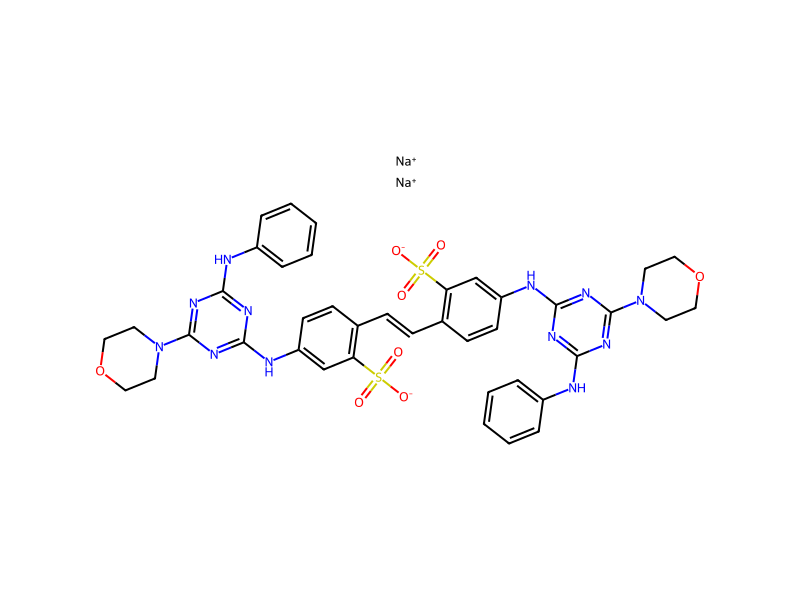
기본 정보
- CAS
16090-02-1- 표준 SMILES
O=S(=O)([O-])c1cc(Nc2nc(Nc3ccccc3)nc(N3CCOCC3)n2)ccc1C=Cc1ccc(Nc2nc(Nc3ccccc3)nc(N3CCOCC3)n2)cc1S(=O)(=O)[O-].[Na+].[Na+]- InChIKey
VUJGKADZTYCLIL-UHFFFAOYSA-L- 분자식
- C40H38N12O8S2. 2Na
- 평균 분자량
- 924.9 g/mol
- 단동위원소 질량
- 924.21723713
이름 및 식별자
- 우선 이름
- 4,4'-bis(2-morpholino-4-anilino-s-triazinyl-6-amino)stilbene-2,2'-disulfonic acid disodium salt
- IUPAC
- disodium;5-[(4-anilino-6-morpholin-4-yl-1,3,5-triazin-2-yl)amino]-2-[2-[4-[(4-anilino-6-morpholin-4-yl-1,3,5-triazin-2-yl)amino]-2-sulfonatophenyl]ethenyl]benzenesulfonate
- 현지명
- 다이소듐 4,4’-비스(4-아닐리노-6-몰폴리노-1,3,5-트라이아진-2-일)아미노)스틸벤-2,2’-디설포네이트
- 영어명
- Fluorescent brightener 71
- 분자식
- C40H38N12Na2O8S2
- 분자량
- 924.91486
이름 및 동의어
DTXSID00277774,4'-Bis(2-morpholino-4-anilino-s-triazinyl-6-amino)stilbene-2,2'-disulfonic acid disodium saltRefChem:198465DTXCID00103111516090-02-1Fluorescent brightener 71 Solution in Water, 100ug/mLSCHEMBL1079927SCHEMBL29349737AKOS030241901MSK000269-100Wdisodium 4,4'-bis(4-anilino-6-morpholino-s-triazin-2-ylamino)-2,2'-stilbenedisulfonatedisodium;5-[(4-anilino-6-morpholin-4-yl-1,3,5-triazin-2-yl)amino]-2-[2-[4-[(4-anilino-6-morpholin-4-yl-1,3,5-triazin-2-yl)amino]-2-sulfonatophenyl]ethenyl]benzenesulfonate
이름 더 보기
다이소듐4,4’-비스(4-아닐리노-6-몰폴리노-1,3,5-트라이아진-2-일)아미노)스틸벤-2,2’-디설포네이트형광증백제FWA-1다이소듐4,4’-비스(4-아닐리노-6-몰폴리노-1,3,5-트라이아진-2-일)아미노)스틸벤-2,2’-디설포네이트2,2'-(1,2-에텐다이일)비스[5-[[4-(4-모폴린일)-6-(페닐아미노)-1,3,5-트라이아진-2-일]아미노]벤젠설폰산, 다이소듐 염2,2'-스틸벤다이설폰산, 4,4'-비스((4-아닐리노-6-모폴리노-S-트라이아진-2-일)아미노)-, 다이소듐 염2,2'-스틸벤다이설폰산, 4,4'-비스[(4-아닐리노-6-모폴리노-s-트라이아진-2-일)아미노]-, 다이소듐 염4,4'-비스(2-모폴리노-4-아닐리노-s-트라이아진일-6-아미노)스틸벤-2,2'-다이설폰산, 다이소듐 염4,4'-비스[(2-아닐리노-4-모폴리노-1,3,5-트라이아진-6-일)아미노]-2,2'-스틸벤다이설폰산, 다이소듐 염4,4'-비스[(6-아닐리노-4-모폴리노-1,3,5-트라이아진-2-일)아미노]-2,2'-다이설포스틸벤, 다이소듐 염4,4'-비스[4''-아닐리노-6''-모폴리노트라이아진일-2''-아미노]스틸벤-2,2'-다이설폰산, 다이소듐 염C.I. 형광증백제 260다이소듐 4,4'-비스[(4-아닐리노-6-모폴리노-1,3,5-트라이아진-2-일)아미노]스틸벤-2,2'-다이설포네이트벤젠설폰산, 2,2'-(1,2-에텐다이일)비스(5-((4-(4-모폴린일)-6-(페닐아미노)-1,3,5-트라이아진-2-일)아미노)-, 다이소듐벤젠설폰산, 2,2'-(1,2-에텐다이일)비스[5[[4-(4-모폴린일)-6-(페닐아미노)-1,3,5-트라이아진-2-일]아미노], 다이소듐 염벤젠설폰산, 2,2'-(1,2-에텐디일)비스[5-[[4-(4-모르폴리닐)-6-(페닐아미노)-1,3,5-트리아진-2-일]아미노]-, 이나트륨형광증백제 71형광증백제 FWA-1MBBH 766BELOTEXKDUvitex SDGMikephor TBJADEADD CXTBelofor KD 2Heliofor 3BCHeliofor BDCKayaphor MASLeukopur PAM
NS000772025-[(4-anilino-6-morpholin-4-yl-1,3,5-triazin-2-yl)amino]-2-[(Z)-2-[4-[(4-anilino-6-morpholin-4-yl-1,3,5-triazin-2-yl)amino]-2-sulfophenyl]ethenyl]benzenesulfonic acidDisodium 2,2'-(ethene-1,2-diyl)bis(5-{[4-anilino-6-(morpholin-4-yl)-1,3,5-triazin-2-yl]amino}benzene-1-sulfonate)disodium 4,4'-bis[(4-anilino-6-morpholino-1,3,5-triazin-2-yl)amino]-stilbene-2,2'-disulfonate
데이터베이스 식별자
- CAS
16090-02-1- PubChem CID
- 27677
- DTXSID
DTXSID0027777- EC Number
- 240-245-2
물성
구조 계산 물성
- 극성 표면적
- 282 Ų
- 수소 결합 공여자 수
- 4
- 수소 결합 수용자 수
- 20
- 회전 가능 결합 수
- 12
- 무거운 원자 수
- 64
- 형식 전하
- 0
- 복잡도
- 1,490
실험 및 물리화학적 성질
Chemical ClassesDyes -> Carbocyanine Dyes
LogP-1.5
Solubility
In water, 5 mg/l at 25 °C.
Solubility in water, g/100ml: 0.18 (slightly soluble)
Flash Pointnot available
Decomposition
When heated to decomposition it emits toxic vapaors of nitrous oxides and /hydrogen chloride/.
300 °C
Melting Point>270 °C
Food Contact SubstancesFCS -> FDA Inventory of Effective Food Contact Substance (FCS) Notifications
Physical Description
Dry Powder; Large Crystals
White solid; [ICSC] Off-white odorless granules or powder; [MSDSonline] Commercial form may also be aqueous slurry; [eChemPortal: SIDSUNEP]
WHITE POWDER OR GRANULES
Dissociation Constantslog Kow = 1.48
Autoignition Temperature>500 °C
물리화학적 성질
- 녹는점
- 270 °C · >270 °C
- 밀도
- 0.417 · 0.417-1.54[at 20℃]
- 증기압
- 0 · 0-0Pa at 25℃
- 저장 조건
- Refrigerator
- 용해도
- DMSO(약간 용해됨), 메탄올(매우 소량, 가열)
- 물리적 상태
- 고체
- 색상
- 옅은 노랑
- 수용성
- 1.223 · 1.223-1.9g/L at 20-25℃
- LogP
- -1.58 · -1.58-1.186 at 25℃
- EPA
- 2 · Benzenesulfonic acid, 2,2'-(1,2-ethenediyl)bis[5-[[4-(4-morpholinyl)-6-(phenylamino)-1,3,5-triazin-2-yl]amino]-, sodium salt (1:2) (16090-02-1)
화학적 성질
Pale Yellow Solid
안전 및 규제
안전 정보는 참고용이며, 공급업체의 물질안전보건자료(SDS), 관련 법규 및 전문가 평가를 대체하지 않습니다.
GHS 분류
GHS Classification
This chemical does not meet GHS hazard criteria for 62.1% (231 of 372) of all reports.
H412 (37.4%): Harmful to aquatic life with long lasting effects [Hazardous to the aquatic environment, long-term hazard]
P273, and P501 (click each P-code to see the statement)
Aggregated GHS information provided per 372 reports by companies from 6 notifications to the ECHA C&L Inventory.
Warning
H320: Causes eye irritation [Warning Serious eye damage/eye irritation]
유해성 정보
Regulatory Information
Chemical: Benzenesulfonic acid, 2,2â²-(1,2-ethenediyl)bis[5-[[4-(4-morpholinyl)-6-(phenylamino)-1,3,5-triazin-2-yl]amino]-, sodium salt (1:2)
Benzenesulfonic acid, 2,2'-(1,2-ethenediyl)bis[5-[[4-(4-morpholinyl)-6-(phenylamino)-1,3,5-triazin-2-yl]amino]-, sodium salt (1:2) is listed on the EPA's Chemical Data Reporting (CDR) system. Manufacturers and importers of Benzenesulfonic acid, 2,2'-(1,2-ethenediyl)bis[5-[[4-(4-morpholinyl)-6-(phenylamino)-1,3,5-triazin-2-yl]amino]-, sodium salt (1:2) are required to report information about their production and use of this chemical to the EPA under the Toxic Substances Control Act (TSCA). (40 eCFR Part 711)
REACH registered substance: Disodium 4,4'-bis[(4-anilino-6-morpholino-1,3,5-triazin-2-yl)amino]stilbene-2,2'-disulphonate (EC: 240-245-2)
C.I. Fluorescent brightener 260: Does not have an individual approval but may be used under an appropriate group standard
Other Safety InformationIMAP assessments - Benzenesulfonic acid, 2,2'-(1,2-ethenediyl)bis[5-[[4-(4-morpholinyl)-6-(phenylamino)-1,3,5-triazin-2-yl]amino]-, disodium salt: Human health tier I assessment
Fire HazardsNot combustible. Gives off irritating or toxic fumes (or gases) in a fire.
Hazards Summary
A mild eye irritant; [ICSC] Two year oral studies of rats and dogs produced no notable adverse effects; [HSDB] A stilbene type brightener; A mild skin and eye irritant, based on animal studies; Almost totally eliminated in the feces of rats within 48 hours; [eChemPortal: SIDSUNEP] May cause eye irritation; [MSDSonline]
EPA Safer ChemicalChemical: FWA-1
Chemical DangersDecomposes on heating and on burning. This produces toxic and corrosive gases including nitrogen oxides and sulfur oxides.
Hazard Classes and Categories
Aquatic Chronic 3 (37.4%)
Serious eye damage/eye irritation - Category 2B
Serious eye damage/eye irritation - Category 2B
안전 및 보호
Fire FightingIn case of fire in the surroundings, use appropriate extinguishing media.
First Aid Measures
Fresh air, rest. Fresh air, rest.
Rinse and then wash skin with water and soap.
Rinse with plenty of water for several minutes (remove contact lenses if easily possible).
Rinse mouth.
Disposal Methods
SRP: At the time of review, criteria for land treatment or burial (sanitary landfill) disposal practices are subject to significant revision. Prior to implementing land disposal of waste residue (including waste sludge), consult with environmental regulatory agencies for guidance on acceptable disposal practices.
Spillage Disposal
Personal protection: protective gloves and particulate filter respirator adapted to the airborne concentration of the substance. Do NOT let this chemical enter the environment. Sweep spilled substance into covered containers. If appropriate, moisten first to prevent dusting. Carefully collect remainder. Then store and dispose of according to local regulations.
Eye PreventionWear safety goggles.
Inhalation RiskA nuisance-causing concentration of airborne particles can be reached quickly when dispersed, especially if powdered.
Skin PreventionProtective gloves.
Exposure PreventionPREVENT DISPERSION OF DUST!
Ingestion PreventionDo not eat, drink, or smoke during work.
Inhalation PreventionUse local exhaust. Use breathing protection.
Effects of Short Term ExposureThe substance is mildly irritating to the eyes.
독성 정보
Environmental Fate
TERRESTRIAL FATE: Based on a recommended regression classification scheme(1), an estimated Koc value of 1800 (SRC), determined from a measured water solubility of 5 mg/l(2) and a recommended regression-derived equation(3), indicates that C.I. Fluorescent Brightener will have low mobility in soil(SRC). In one experiment, clean water was percolated through sludge containing fluorescent whitening agents. After 68 days the total amount leached from the original 216 mg C.I. Fluorescent Brightener 260 in 20 kg sludge was only 0.02%(6). As C.I. Fluorescent Brightener 3 is an ionic compound at environmental pHs, volatilization of this compound will not be important from moist soil surfaces(4,SRC). Based on limited data, C.I. Fluorescent Brightener 260 is expected to be resistant to aerobic biodegradation(SRC); C.I. Fluorescent Brightener 260 was not biodegraded in a standard 5 day BOD test(5).
AQUATIC FATE: Based on a recommended classification scheme(1), an estimated Koc value of 1800(SRC), determined from a measured water solubility(3) and a recommended regression-derived equation(2), indicates that C.I. Fluorescent Brightener 260 may adsorb to suspended solids and sediment in water(SRC). However, due to the ionic nature of C.I. Fluorescent Brightener, the retention of the brightener by ion-exchange processes(4,SRC), particularly on clay surfaces, and adsorption at mineral surfaces such as geothite(5,SRC), may lead to increased adsorption on some sediment and particulate surfaces(SRC). As C.I. Fluorescent Brightener 260 is an ionic compound, volatilization from water surfaces is not expected(4,SRC). According to a classification scheme(6), a BCF range of 1.4 to 28 in carp(3) suggests that bioconcentration in aquatic organisms is low(SRC). Based on limited data, C.I. Fluorescent Brightener 260 is expected to be resistant to aerobic biodegradation in water(SRC); C.I. Fluorescent Brightener 260 was not biodegraded in a standard 5 day BOD test(7). In a river die-away test at which carbon dioxide production was measured in solutions of maximum 1000 ppb over a period of 35 days, no biodegradability was found(7).
ATMOSPHERIC FATE: The ionic state of C.I. Fluorescent Brightener 260 makes this compound essentially non-volatile(1,SRC), therefore this compound will only exist in the particulate phase in the ambient atmosphere. Particulate-phase C.I. Fluorescent Brightener 260 may be physically removed from the air by wet and dry deposition(SRC).
Signs and SymptomsRedness.
Effluent ConcentrationsSamples of 35 US rivers in 1974 showed concentration of fluorescent whitening agents up to 0.6 ppb upstream of a sewage treatment plant. Downstream concentrations were never above 40 ppb for C.I. Fluorescent Brightener 260(1).
ICSC Environmental DataThe substance is harmful to aquatic organisms.
Soil Adsorption/Mobility
The Koc of C.I. Fluorescent Brightener 260 is estimated as approximately 1800(SRC), using a water solubility of 5 mg/l(1) and a regression-derived equation(2,SRC). According to a classification scheme(3), this estimated Koc value suggests that C.I. Fluorescent Brightener 260 is expected to have low mobility in soil(SRC). Due to the ionic nature of the brightener, the retention of C.I. Fluorescent Brightener 260 by ion-exchange processes(4,SRC), particularly on clay surfaces and adsorption at mineral surfaces such as geothite(5,SRC), may slow down or prevent leaching(SRC). In one experiment, clean water was percolated through sludge containing fluorescent whitening agents. After 68 days the total amount leached from the original 216 mg C.I. Fluorescent Brightener 260 in 20 kg sludge was only 0.02%(6).
Artificial Pollution SourcesC.I. Fluorescent Brightener 260's production and use in laundry detergents(1) may result in its release to the environment through various waste streams(SRC).
Environmental Biodegradation
Laboratory experiments showed that fluorescent whitening agents used in detergents are not readily biodegradable. Tests which used the oxygen consumption over 5 days as a measure of the ability of fluorescent agents to serve a substrate for bacterial growth gave no evidence of biodegradation; C.I. Fluorescent Brightener 260 had a BOD5 of zero. In a river die-away test at which carbon dioxide production was measured in solutions of maximum 1000 ppb over a period of 35 days, no biodegradability was found(1).
Sediment/Soil Concentrations
Fluorescent whitening agents are strongly adsorbed to soil. In one experiment, clean water was percolated through sludge containing fluorescent whitening agents. After 68 days the total amount leached from the original 216 mg C.I. Fluorescent Brightener 260 in 20 kg sludge was only 0.02%. The sludge had been exposed to natural weather and non-agricultural conditions(1).
Environmental BioconcentrationA bioconcentration factor range of 1.4 to 28 in carp was determined for C.I. Fluorescent Brightener 260(1). According to a classification scheme(2), this BCF suggests the potential for bioconcentration in aquatic organisms is low(SRC).
Volatilization from Water/SoilSince C.I. Fluorescent Brightener 260 is an ionic compound, volatilization from water and moist soil surfaces is not expected to be an important fate process(1,SRC).
Non-Human Toxicity Excerpts
FBA-260 GIVEN @ 40-1000 PPM IN DIET, HAD NO EFFECT ON REPRODUCTIVE PERFORMANCE OF RATS THROUGH 3 SUCCESSIVE 2-LITTER GENERATIONS.
NO SIGNIFICANT ADVERSE EFFECTS WHEN TINOPAL AMS WAS FED FOR 2 YR TO RATS @ LEVELS OF 40, 200 OR 1000 PPM & FED TO DOGS @ LEVELS OF 2000 PPM FOR 2 YR.
FBA-260 SHOWED NO MUTAGENICITY IN DOMINANT LETHAL TESTS WHEN GIVEN @ 5000 MG/KG, ORALLY, TO MICE.
SKIN TUMORS WERE PRODUCED IN HAIRLESS MICE AFTER SEVERAL MONTHS DAILY EXPOSURE TO UV, VISIBLE & IR IRRADIATION. PRETREATMENT WITH TINOPAL AMS DID NOT PRODUCE PHOTOTOXICITY OR ENHANCE PHOTOCARCINOGENESIS.
For more Non-Human Toxicity Excerpts (Complete) data for C.I. FLUORESCENT BRIGHTENER 260 (11 total), please visit the HSDB record page.
Environmental Abiotic Degradation
C.I. Fluorescent Brightener 260 is not expected to undergo hydrolysis in the environment due to the lack of hydrolyzable functional groups(1). Fluorescent whitening agents, which includes C.I. Fluorescent Brightener 260, have an UV absorption maximum between 340 to 360 nm in water and transform UV energy almost quantitatively into blue fluorescent light(2).
안전 데이터
- tsca
- TSCA listed
- 기존화학 물질
- KE-07695
- 유해 물질 데이터
- 16090-02-1(Hazardous Substances Data)
화학 및 산업
약리 정보
Biological Half-LifeORAL DOSES OF 5 MG/KG (14)C-TINOPAL AMS TO RATS HAD RAPID & COMPLETE EXCRETION & RADIOACTIVITY T/2 OF 7-13 HR.
Absorption, Distribution and Excretion
INTUBATION IN RATS SHOWED LITTLE ABSORPTION FROM INTESTINAL TRACT. EXCRETED RAPIDLY IN FECES. PARENTERAL ADMIN TO RATS, RAPIDLY EXCRETED IN FECES; SMALL AMT IN TISSUES & ORGANS. ABSORPTION BY SKIN: SLIGHT.
ORAL DOSES OF 5 MG/KG (14)C-TINOPAL AMS TO RATS HAD RAPID & COMPLETE EXCRETION. MOST EXCRETION WAS VIA FECES. NO RADIOACTIVITY WAS FOUND IN BLOOD, LIVER, KIDNEY, BRAIN, MUSCLE OR FAT 96 HR AFTER DOSING.
용도 및 제조
Uses
Used as a dye for cotton fibers, soaps, and detergents; [HSDB] Used mostly (greater than 90%) in household detergents; Also used in paper and textile industries; [eChemPortal: SIDSUNEP]
Pulp and Paper Processing [Category: Industry]
DYE FOR COTTON FIBERS, SOAPS & DETERGENTS
IN HEAVY DUTY DETERGENT, TO WHITEN FABRICS; PLASTICS; FIBERS, COATINGS, WAXES... /TINOPAL/
U.S. Production
2023: 1,000,000 - <2,500,000 lb
(1977) NOT PRODUCED COMMERCIALLY IN US
(1979) NOT PRODUCED COMMERCIALLY IN US
Consumer UsesDye
Industry UsesDye
Household ProductsInformation on 53 consumer products that contain Tinopal DMS in the following categories is provided:
Use Classification
EPA Safer Chemical Functional Use Classes -> Colorants
Safer Chemical Classes -> Green circle - The chemical has been verified to be of low concern
General Manufacturing Information
All Other Chemical Product and Preparation Manufacturing
Benzenesulfonic acid, 2,2'-(1,2-ethenediyl)bis[5-[[4-(4-morpholinyl)-6-(phenylamino)-1,3,5-triazin-2-yl]amino]-, sodium salt (1:2): ACTIVE
"TINOPAL" /IS/ TRADEMARK FOR GROUP OF OPTICAL BRIGHTENERS, WHICH ABSORB UV LIGHT IN NEAR VISIBLE RANGE & RE-EMIT THE ENERGY AS VISIBLE LIGHT. /TINOPAL/
응용 분야
용도(Fluorescent brightener 71)Fluorescent (optical) brighteners are known for their characteristics of protecting baculoviruses against deactivation by UV light and enhancing the activity of these agents as microbial insecticides on hosts and semipermissive hosts. Fluorescent brighteners improve the bioinsecticidal activity of Anticarsia gemmatalis nucleopolyhedrovirus.
관련 반응
1건
화합물 노트
불러오는 중…