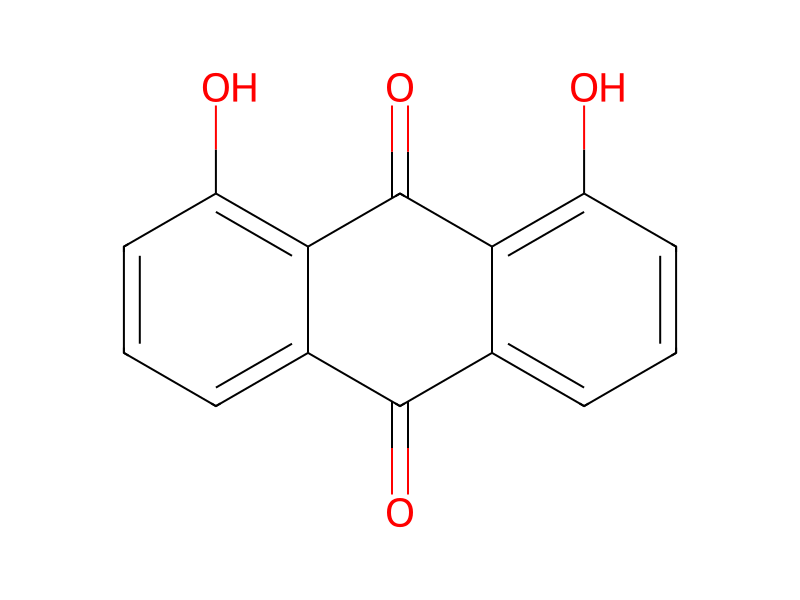
1,8-Dihydroxyanthraquinone
117-10-2O=C1c2cccc(O)c2C(=O)c2c(O)cccc21QBPFLULOKWLNNW-UHFFFAOYSA-NDantron (Chrysazin; 1,8-Dihydroxyanthraquinone) can cause cancer according to The World Health Organization's International Agency for Research on Cancer (IARC).
117-10-2DTXSID9020328CHEMBL53418CHEBI:3682Red or red-yellow needles or leaves (from alcohol)
Orange needles from alcohol
Orange powder or reddish-brown needles
less than 1 mg/mL at 64 °F (NTP, 1992)
Insoluble in water; slightly soluble in ethanol, diethyl ether; soluble in acetone, acetic acid, alkali
Almost insoluble in water (6.5X10⁻⁶ mols/L at 25 °C), in alcohol (1:2000). Moderately soluble in ether (1:500), in chloroform; soluble in 10 parts hot glacial acetic acid. Very slightly soluble in aqueous solutions of alkali hydroxides: about 0.8 g dissolves in 100 ml 0.5N NaOH.
Sublimes (NTP, 1992)
Sublimes
안전 정보는 참고용이며, 공급업체의 물질안전보건자료(SDS), 관련 법규 및 전문가 평가를 대체하지 않습니다.
Warning
H351 (96%): Suspected of causing cancer [Warning Carcinogenicity]
P203, P280, P318, P405, and P501 (click each P-code to see the statement)
Aggregated GHS information provided per 50 reports by companies from 5 notifications to the ECHA C&L Inventory.
Warning
H351: Suspected of causing cancer [Warning Carcinogenicity]
Chemical: 9,10-Anthracenedione, 1,8-dihydroxy-
Hazard Traits - Carcinogenicity
1,8-Dihydroxyanthraquinone: Does not have an individual approval but may be used under an appropriate group standard
The New Jersey Worker and Community Right to Know Act requires public and private employers to provide information about hazardous substances at their workplaces. (N.J.S.A. 34:5A-1 et. seq.)
SYMPTOMS: Symptoms of exposure to this compound may include abdominal cramps, skin rash and prolonged diarrhea. It colors the urine pink or red. It also colors the peri-anal skin pink or red. Other adverse effects, which are uncommon, include excessive bowel activity (griping, nausea and vomiting), peri-anal irritation, weakness, dizziness, palpitations and sweating. There has been reported a suspected allergic reaction with facial swelling, redness and discomfort. Leukopenia and liver damage have also been reported. There has been one case of grayish-blue discoloration of the skin. Prolonged use may cause discoloration (staining) of mucosa of the large intestine. Large doses may produce nephritis. Enteritis may also occur from large doses. Frequent or prolonged use may result in dependence. Superficial sloughing of discolored skin may occur in incontinent persons or children wearing napkins.
A - Alimentary tract and metabolism
QA - Alimentary tract and metabolism
The mechanism of metal-mediated DNA damage by carcinogenic danthron (1,8-dihydroxyanthraquinone) and anthraquinone was investigated by the DNA sequencing technique using 32P-labeled human DNA fragments obtained from the human c-Ha-ras-1 protooncogene and the p53 tumor suppressor gene. Danthron caused DNA damage particularly at guanines in the 5'-GG-3', 5'-GGGG-3', 5'-GGGGG-3' sequences (damaged bases are underlined) in the presence of Cu(II), cytochrome P450 reductase and the NADPH-generating system. The DNA damage was inhibited by catalase and bathocuproine, suggesting the involvement of H2O2 and Cu(I). The formation of 8-oxo-7,8-dihydro-2'-deoxyguanosine increased with increasing concentration of danthron. On the other hand, carcinogenic anthraquinone induced less oxidative DNA damage than danthron. Electron spin resonance study showed that the semiquinone radical could be produced by P450 reductase plus NADPH-mediated reduction of danthron, while little signal was observed with anthraquinone. These results suggest that danthron is much more likely to be reduced by P450 reductase and generate reactive oxygen species through the redox cycle, leading to more extensive Cu(II)-mediated DNA damage than anthraquinone. In the case of anthraquinone, its hydroxylated metabolites with similar reactivity to danthron may participate in DNA damage in vivo. /It was concluded/ that oxidative DNA damage by danthron and anthraquinone seems to be relevant for the expression of their carcinogenicity.
... All three tested anthraquinones, emodin, aloe-emodin, and danthron, showed capabilities to inhibit the non-covalent binding of bisbenzimide Hoechst 33342 to isolated DNA and in mouse lymphoma L5178Y cells comparable to the topoisomerase II inhibitor and intercalator m-amsacrine. In a cell-free decatenation assay, emodin exerted a stronger, danthron a similar and aloe-emodin a weaker inhibition of topoisomerase II activity than m-amsacrine. Analysis of the chromosomal extent of DNA damage induced by these anthraquinones was performed in mouse lymphoma L5178Y cells. Anthraquinone-induced mutant cell clones showed similar chromosomal lesions when compared to the topoisomerase II inhibitors etoposide and m-amsacrine, but were different from mutants induced by the DNA alkylator ethyl methanesulfonate. These data support the idea that inhibition of the catalytic activity of topoisomerase II contributes to anthraquinone-induced genotoxicity and mutagenicity.
불러오는 중…
379 °F (NTP, 1992)
193 °C
193 °C
193 °C
8.3 (NTP, 1992) - Heavier than air; will sink (Relative to Air)
8.3 (Air = 1)
Danthron is an orange crystalline powder. Almost odorless and tasteless. (NTP, 1992)
Solid
orange-brown or brown powder
National Toxicology Program. Eleventh Report on Carcinogens (2005). The Report on Carcinogens is an informational scientific and public health document that identifies and discusses substances (including agents, mixtures, or exposure circumstances) that may pose a carcinogenic hazard to human health. Danthron (1,8-Dihydroxyanthraquinone) (117-10-2) is listed as reasonably anticipated to be a human carcinogen.[Available from, as of September 29, 2009: http://ntp.niehs.nih.gov/ntp/roc/eleventh/profiles/s055dant.pdf]
IARC. Danthron (Chrysazin; 1,8-Dihydoxyanthroquinine). In: Monographs on the Evaluation of the Carcinogenic Risk of Chemicals to Man. Geneva: World Health Organization, International Agency for Research on Cancer, Pharmaceutical Drugs Vol 50: 265-75 (1990). IARC Monographs provide critical reviews of data on carcinogenicity for agents to which humans are known to be exposed and on specific exposure situations.[Available from, as of November 19, 2009: http://monographs.iarc.fr/ENG/Monographs/vol50/index.php]
Carc. 2 (96%)
Carcinogenicity - category 1B
Carcinogenicity - Category 2
Carcinogens
PRECAUTIONS FOR "CARCINOGENS": When no regulations exist, the following procedure must be adopted. The carcinogen should be enclosed in a securely sealed, watertight container (primary container), which should be enclosed in a second, unbreakable, leakproof container that will withstand chem attack from the carcinogen (secondary container). The space between primary & secondary container should be filled with absorbent material, which would withstand chem attack from the carcinogen & is sufficient to absorb the entire contents of the primary container in the event of breakage or leakage. Each secondary container should then be enclosed in a strong outer box. The space between the secondary container & the outer box should be filled with an appropriate quantity of shock-absorbent material. Sender should use fastest & most secure form of transport & notify recipient of its departure. If parcel is not received when expected, carrier should be informed so that immediate effort can be made to find it. Traffic schedules should be consulted to avoid ... arrival on weekend or holiday ... /Chemical Carcinogens/
PRECAUTIONS FOR "CARCINOGENS": Procurement ... of unduly large amt ... should be avoided. To avoid spilling, carcinogens should be transported in securely sealed glass bottles or ampoules, which should themselves be placed inside strong screw-cap or snap-top container that will not open when dropped & will resist attack from the carcinogen. Both bottle & the outside container should be appropriately labelled. ... National post offices, railway companies, road haulage companies & airlines have regulations governing transport of hazardous materials. These authorities should be consulted before ... material is shipped. /Chemical Carcinogens/
EYES: First check the victim for contact lenses and remove if present. Flush victim's eyes with water or normal saline solution for 20 to 30 minutes while simultaneously calling a hospital or poison control center. Do not put any ointments, oils, or medication in the victim's eyes without specific instructions from a physician. IMMEDIATELY transport the victim after flushing eyes to a hospital even if no symptoms (such as redness or irritation) develop.
Do not store above 30 °C.
PRECAUTIONS FOR "CARCINOGENS": Storage site should be as close as practical to lab in which carcinogens are to be used, so that only small quantities required for ... expt need to be carried. Carcinogens should be kept in only one section of cupboard, an explosion-proof refrigerator or freezer (depending on chemicophysical properties ...) that bears appropriate label. An inventory ... should be kept, showing quantity of carcinogen & date it was acquired ... Facilities for dispensing ... should be contiguous to storage area. /Chemical Carcinogens/
PRECAUTIONS FOR "CARCINOGENS": A high-efficiency particulate arrestor (HEPA) or charcoal filters can be used to minimize amt of carcinogen in exhausted air ventilated safety cabinets, lab hoods, glove boxes or animal rooms ... Filter housing that is designed so that used filters can be transferred into plastic bag without contaminating maintenance staff is avail commercially. Filters should be placed in plastic bags immediately after removal ... The plastic bag should be sealed immediately ... The sealed bag should be labelled properly ... Waste liquids ... should be placed or collected in proper containers for disposal. The lid should be secured & the bottles properly labelled. Once filled, bottles should be placed in plastic bag, so that outer surface ... is not contaminated ... The plastic bag should also be sealed & labelled. ... Broken glassware ... should be decontaminated by solvent extraction, by chemical destruction, or in specially designed incinerators. /Chemical Carcinogens/
SMALL SPILLS AND LEAKAGE: Should a spill occur while you are handling this chemical, FIRST REMOVE ALL SOURCES OF IGNITION, then you should dampen the solid spill material with 60-70% ethanol and transfer the dampened material to a suitable container. Use absorbent paper dampened with 60-70% ethanol to pick up any remaining material. Seal the absorbent paper, and any of your clothes, which may be contaminated, in a vapor-tight plastic bag for eventual disposal. Solvent wash all contaminated surfaces with 60-70% ethanol followed by washing with a soap and water solution. Do not reenter the contaminated area until the Safety Officer (or other responsible person) has verified that the area has been properly cleaned.
SRP: Criteria for land treatment or burial (sanitary landfill) disposal practices are subject to significant revision. Prior to implementing land disposal of waste residue (including waste sludge), consult with environmental regulatory agencies for guidance on acceptable disposal practices.
SRP: Expired or waste pharmaceuticals shall carefully take into consideration applicable DEA, EPA, and FDA regulations. It is not appropriate to dispose by flushing the pharmaceutical down the toilet or discarding to trash. If possible return the pharmaceutical to the manufacturer for proper disposal being careful to properly label and securely package the material. Alternatively, the waste pharmaceutical shall be labeled, securely packaged and transported by a state licensed medical waste contractor to dispose by burial in a licensed hazardous or toxic waste landfill or incinerator.
PRECAUTIONS FOR "CARCINOGENS": Carcinogens that are alkylating, arylating or acylating agents per se can be destroyed by reaction with appropriate nucleophiles, such as water, hydroxyl ions, ammonia, thiols & thiosulfate. The reactivity of various alkylating agents varies greatly ... & is also influenced by sol of agent in the reaction medium. To facilitate the complete reaction, it is suggested that the agents be dissolved in ethanol or similar solvents. ... No method should be applied ... until it has been thoroughly tested for its effectiveness & safety on material to be inactivated. For example, in case of destruction of alkylating agents, it is possible to detect residual compounds by reaction with 4(4-nitrobenzyl)-pyridine. /Chemical Carcinogens/
PRECAUTIONS FOR "CARCINOGENS": ... Small quantities of ... some carcinogens can be destroyed using chem reactions ... but no general rules can be given. ... As a general technique ... treatment with sodium dichromate in strong sulfuric acid can be used. The time necessary for destruction ... is seldom known ... but 1-2 days is generally considered sufficient when freshly prepd reagent is used. ... Carcinogens that are easily oxidizable can be destroyed with milder oxidative agents, such as saturated soln of potassium permanganate in acetone, which appears to be a suitable agent for destruction of hydrazines or of compounds containing isolated carbon-carbon double bonds. Concn or 50% aqueous sodium hypochlorite can also be used as an oxidizing agent. /Chemical Carcinogens/
For more Disposal Methods (Complete) data for 1,8-Dihydroxyanthraquinone (7 total), please visit the HSDB record page.
SRP: The scientific literature for the use of contact lenses by industrial workers is inconsistent. The benefits or detrimental effects of wearing contact lenses depend not only upon the substance, but also on factors including the form of the substance, characteristics and duration of the exposure, the uses of other eye protection equipment, and the hygiene of the lenses. However, there may be individual substances whose irritating or corrosive properties are such that the wearing of contact lenses would be harmful to the eye. In those specific cases, contact lenses should not be worn. In any event, the usual eye protection equipment should be worn even when contact lenses are in place.
PRECAUTIONS FOR "CARCINOGENS": Doors leading into areas where carcinogens are used ... should be marked distinctively with appropriate labels. Access ... limited to persons involved in expt. ... A prominently displayed notice should give the name of the Scientific Investigator or other person who can advise in an emergency & who can inform others (such as firemen) on the handling of carcinogenic substances. /Chemical Carcinogens/
PRECAUTIONS FOR "CARCINOGENS": Rooms in which obvious contamination has occurred, such as spillage, should be decontaminated by lab personnel engaged in expt. Design of expt should ... avoid contamination of permanent equipment. ... Procedures should ensure that maintenance workers are not exposed to carcinogens. ... Particular care should be taken to avoid contamination of drains or ventilation ducts. In cleaning labs, procedures should be used which do not produce aerosols or dispersal of dust, ie, wet mop or vacuum cleaner equipped with high-efficiency particulate filter on exhaust, which are avail commercially, should be used. Sweeping, brushing & use of dry dusters or mops should be prohibited. Grossly contaminated cleaning materials should not be re-used ... If gowns or towels are contaminated, they should not be sent to laundry, but ... decontaminated or burnt, to avoid any hazard to laundry personnel. /Chemical Carcinogens/
PRECAUTIONS FOR "CARCINOGENS": To eliminate risk that ... contamination in lab could build up during conduct of expt, periodic checks should be carried out on lab atmospheres, surfaces, such as walls, floors & benches, & ... interior of fume hoods & airducts. As well as regular monitoring, check must be carried out after cleaning-up of spillage. Sensitive methods are required when testing lab atmospheres. ... Methods ... should ... where possible, be simple & sensitive. /Chemical Carcinogens/
For more Preventive Measures (Complete) data for 1,8-Dihydroxyanthraquinone (10 total), please visit the HSDB record page.
6.7 [mg/m3]
73 [mg/m3]
440 [mg/m3]
RECOMMENDED RESPIRATOR: Where the neat test chemical is weighed and diluted, wear a NIOSH-approved half face respirator equipped with an organic vapor/acid gas cartridge (specific for organic vapors, HCl, acid gas and SO2) with a dust/mist filter. (NTP, 1992)
PRECAUTIONS FOR "CARCINOGENS": ... Dispensers of liq detergent /should be available./ ... Safety pipettes should be used for all pipetting. ... In animal laboratory, personnel should ... wear protective suits (preferably disposable, one-piece & close-fitting at ankles & wrists), gloves, hair covering & overshoes. ... In chemical laboratory, gloves & gowns should always be worn ... however, gloves should not be assumed to provide full protection. Carefully fitted masks or respirators may be necessary when working with particulates or gases, & disposable plastic aprons might provide addnl protection. ... Gowns ... /should be/ of distinctive color, this is a reminder that they are not to be worn outside the laboratory. /Chemical Carcinogens/
Effective March 28, 1987, danthron containing products may no longer be marketed in the United States. The Food and Drug Administration has advised drug firms manufacturing laxatives containing the drug danthron to immediately discontinue their production and to recall them from retail store shelves. Detention without physical examination is indicated on all (Bulk, Rx and OTC) articles of drug offered for human use that contain danthron.
This final rule declares OTC laxative drug products containing danthron to be new drugs within the meaning of section 201(p) of the Federal Food, Drug, and Cosmetic Act (the act) (21 U.S.C. 321(p)), for which an application or abbreviated application (hereinafter called application) approved under section 505 of the act (21 U.S.C. 355) and 21 CFR part 314 is required for marketing. In the absence of an approved application, products containing these drugs for laxative use also would be misbranded under section 502 of the act (21 U.S.C. 352). The final rule amends part 310 (21 CFR part 310) to include danthron by adding new Sec. 310.545(a)(12)(iv)(B). Because a safety problem has been identified for OTC drug products containing danthron, this final rule is effective on the date of its publication in the Federal Register. Therefore, on or after January 29, 1999, no OTC drug products that are subject to this final rule may be initially introduced or initially delivered for introduction into interstate commerce unless they are the subject of an approved application.
The modifying effects of chrysazin on 1,2-dimethylhydrazine (DMH)-induced colon and liver carcinogenesis were examined in male ICR/CD-1 mice. Starting at 6 weeks of age, mice were divided into four groups, two of which were treated with sc injections of DMH (20 mg/kg body wt) once a week for 12 weeks. A week after the final injection of DMH, one group was kept on the basal diet throughout the study (group I), and the other group was fed the diet containing chrysazin (mixed in basal diet at 0.2% concentration) alone for 42 weeks (group II). The other two groups were injected with normal saline and given the diet containing 0.2% chrysazin for 42 weeks (group III), or the basal diet during the experiment (group IV). The incidence and multiplicity of colon tumors of group II were significantly greater than those of group I (P < 0.05, P < 0.01). The incidence and multiplicity of the hepatocellular neoplasms of group II were larger than those of group I (P < 0.002, P < 0.02 respectively). In group III, colon tumors were not found, though a few liver neoplasms and severe inflammatory lesions of the colon were observed. The activity of ornithine decarboxylase of the colonic mucosa in mice exposed to chrysazin was stronger than that of animals without chrysazin. The results suggest that the promoting effect of chrysazin is probably related to an increase of cell proliferation in the target organ. A synergistic effect of DMH with chrysazin was also observed in liver tumorigenesis.
When danthron was administered in the feed to mice that also received 1,2- dimethylhydrazine, the incidence and multiplicity of adenomas of the colon and liver were significantly increased.
The tumor-promoting activity of the anthraquinone laxative danthron was studied by giving 3 groups of male rats a single subcutaneous injection of the colon tumor-inducing agent 1,2-dimethylhydrazine (DMH). After 1 week, the animals were fed diets containing 0, 600 or 2400 ppm of danthron for 26 weeks. Two other groups of rats were included in the study; one received no treatment while the other was given danthron only. Altogether 9 tumors were observed among animals given DMA with or without danthron. The incidence of colon tumors was higher in animals receiving DMH and danthron than in those given DMH only (5/60 vs. 0/30), but this difference was not statistically significant. The kidneys and lymph nodes of mesocolon were enlarged and showed a yellowish-red and brown discoloration, respectively. The pigment mostly displayed a PAS-positive reaction but contained no lipid as determined by several staining procedures. The available evidence suggests that the pigment is drug-derived.
EC50; Species: Lemna gibba (Inflated duckweed); Conditions: freshwater, renewal, photomodified; Concentration: 500 ug/L for 7 days; Effect: decreased population growth /formulation/
EC50; Species: Lemna gibba (Inflated duckweed); Conditions: freshwater, renewal, simulated solar radiation; Concentration: 2500 ug/L for 7 days; Effect: decreased population growth /formulation/
EC50; Species: Lemna gibba (Inflated duckweed); Conditions: freshwater, renewal, photosynthetically active radiation; Concentration: 3000 ug/L for 7 days; Effect: decreased population growth /formulation/
TERRESTRIAL FATE: Based on a classification scheme(1), an estimated Koc value of 8,600(SRC), determined from a structure estimation method(2), indicates that 1,8-dihydroxyanthraquinone is expected to be immobile in soil(SRC). An estimated pKa value of 1,8-dihydroxyanthraquinone is 8.45(3), indicating that this compound will exist partially in the cation form in the environment and cations generally adsorb more strongly to soils containing organic carbon and clay than their neutral counterparts(4). Volatilization of 1,8-dihydroxyanthraquinone from moist soil surfaces is not expected to be an important fate process(SRC) given an estimated Henry's Law constant of 5.4X10⁻¹¹ atm-cu m/mole(SRC), using a fragment constant estimation method(5). 1,8-Dihydroxyanthraquinone is not expected to volatilize from dry soil surfaces(SRC) based upon an estimated vapor pressure of 8.6X10⁻¹⁰ mm Hg(SRC), determined from a fragment constant method(6). Biodegradation data were not available(SRC, 2009).
AQUATIC FATE: Based on a classification scheme(1), an estimated Koc value of 8,600(SRC), determined from a structure estimation method(2), indicates that 1,8-dihydroxyanthraquinone is expected to adsorb to suspended solids and sediment(SRC). Volatilization from water surfaces is not expected(3) based upon an estimated Henry's Law constant of 5.4X10⁻¹¹ atm-cu m/mole(SRC), developed using a fragment constant estimation method(4). According to a classification scheme(5), an estimated BCF of 50(SRC), from an estimated log Kow of 3.9(6) and a regression-derived equation(7), suggests the potential for bioconcentration in aquatic organisms is moderate(SRC). 1,8-Dihydroxyanthraquinone is not expected to undergo hydrolysis in the environment due to the lack of functional groups that hydrolyze under environmental conditions(3). Biodegradation data were not available(SRC, 2009).
ATMOSPHERIC FATE: According to a model of gas/particle partitioning of semivolatile organic compounds in the atmosphere(1), 1,8-dihydroxyanthraquinone, which has an estimated vapor pressure of 8.6X10⁻¹⁰ mm Hg at 25 °C(SRC), determined from a fragment constant method(2), is expected to exist solely in the particulate phase in the ambient atmosphere. Particulate-phase 1,8-dihydroxyanthraquinone may be removed from the air by wet or dry deposition(SRC). 1,8-Dihydroxyanthraquinone absorbs light at wavelengths >290 nm(3) and therefore may be susceptible to direct photolysis by sunlight(SRC).
/AQUATIC SPECIES/ The study on the acute, sublethal and chronic toxicity of 1,8-dihydroxyanthraquinone to Daphnia magna showed that the 48 hr LC50 was 0.37 mg/L, and the feeding behavior of Daphnia magna was severely affected by the compound. When exposed to 0.2 mg/L of 1,8-dihydroxyanthraquinone for 5 hr, the filtration and ingestion rate of Daphnia magna was inhibited by 97%. Chronic toxicity test results indicated that the reproduction ability decreased dramatically after exposing to sublethal concentration of 1,8-dihydroxyanthraquinone ...
PRECAUTIONS FOR "CARCINOGENS": Whenever medical surveillance is indicated, in particular when exposure to a carcinogen has occurred, ad hoc decisions should be taken concerning ... /cytogenetic and/or other/ tests that might become useful or mandatory. /Chemical Carcinogens/
Using a structure estimation method based on molecular connectivity indices(1), the Koc of 1,8-dihydroxyanthraquinone can be estimated to be 8,600(SRC). According to a classification scheme(2), this estimated Koc value suggests that 1,8-dihydroxyanthraquinone is expected to be immobile in soil. An estimated pKa value of 1,8-dihydroxyanthraquinone is 8.45(3), indicating that this compound will exist partially in the cation form in the environment and cations generally adsorb more strongly to soils containing organic carbon and clay than their neutral counterparts(4).
/1,8-Dihydroxyanthraquinone/ has been isolated from dried leaves and stems of Xyris semifuscata harvested in Madagascar. /1,8-Dihydroxyanthraquinone/ is the basic structure of the aglycones of naturally occurring laxative glycosides, in e.g., Cassia (senna), Aloe, Rheum and Rhamnus (cascara) species. /1,8-Dihydroxyanthraquinone/ has been identified in larvae of the elm-leaf beetle, Pyrrhalta luteola. The presence of a mixture of anthraquinones and anthrones was suggested to be a means of protection from predators, and these compounds appear to be biosynthesized by the insect.
/SIGNS AND SYMPTOMS/ Melanosis coli, a state involving apoptosis and lipofuscin pigment accumulation in macrophages in colonic lamina propria, has been described in persons using anthraquinone laxatives.
/SIGNS AND SYMPTOMS/ An eye irritant.
/CASE REPORTS/ Liver damage was reported in a woman who had used a laxative containing dantron and dioctyl calcium sulfosuccinate for one year. The symptoms disappeared after discontinuation of the medication but reappeared upon resumption; none of the compounds given alone had any effect on the results of hepatic function tests.
/CASE REPORTS/ A woman developed deep discoloration of the skin following ingestion of large amounts of a laxative containing dantron. Such staining was also found in other studies, predominantly in elderly subjects, and was localized to the buttocks and thighs, with minor inflammatory symptoms. Contact of skin with feces or urine containing the drug seems to be a prerequisite for discoloration. Inflammation, when present, may result from reduction of the parent compound in the colon to the diol derivative, which irritates both the gut and skin, while the parent compound does not.
For more Human Toxicity Excerpts (Complete) data for 1,8-Dihydroxyanthraquinone (7 total), please visit the HSDB record page.
Dantron (Chrysazin; 1,8-Dihydroxyanthraquinone)
Group 2B: Possibly carcinogenic to humans
Volume 50: (1990) Pharmaceutical Drugs
1990
1989
An estimated BCF of 50 was calculated in fish for 1,8-dihydroxyanthraquinone(SRC), using an estimated log Kow of 3.9(1) and a regression-derived equation(2). According to a classification scheme(3), this BCF suggests the potential for bioconcentration in aquatic organisms is moderate(SRC).
The Henry's Law constant for 1,8-dihydroxyanthraquinone is estimated as 5.4X10⁻¹¹ atm-cu m/mole(SRC) using a fragment constant estimation method(1). This Henry's Law constant indicates that 1,8-dihydroxyanthraquinone is expected to be essentially nonvolatile from water surfaces(2). 1,8-Dihydroxyanthraquinone is not expected to volatilize from dry soil surfaces(SRC) based upon an estimated vapor pressure of 8.6X10⁻¹⁰ mm Hg(SRC), determined from a fragment constant method(3).
In vitro, rat jejunum and colon transformed dantron into its monoglucuronide and monosulfate, the monoglucuronide being the major metabolite.
Male Wistar rats were given the sodium salt of dantron intravenously at 4.8, 22 or 58 umol/kg (1.2, 5.3 or 14 mg/kg) bw or at 12 umol/kg (28.8 mg/kg) bw by gastric tube. Metabolites identified in the bile and urine following administration by either route included the monosulfate, beta-glucuronide and other unidentified metabolites. /Dantron sodium salt/
Danthron infused intravenously in rats shows a complex dose-dependent pattern of metabolism and excretion. The metabolites, particularly the more polar ones, are in general excreted predominantly in bile, to a lesser extent in urine. ... /This/ paper describes a further study within a bile-derived metabolite group, which proved to be particularly heterogeneous. It contained more than a dozen metabolites, which were conjugates of four different aglycons including the parent danthron...
... Everted sacs of rat jejunum and stripped colon were filled with Krebs-Henseleit solution (K-H) on the serosal (BL) side, and bathed at the mucosal (LU) side with K-H containing either danthron (3-4 nmol/mL) or rhein (10 nmol/mL). After 60 min incubation at 37 degrees C, LU and BL solutions and gut tissue were analysed for parent diphenol and metabolites by reverse-phase high-pressure liquid chromatography. Reference metabolites were isolated and purified from urine and bile of rats infused with danthron or rhein. The studies showed: (1) only small amounts of unchanged drug were present on the contraluminal side; (2) in both tissues, danthron was transformed into its monoglucuronide (G) and monosulfate (S); the ratio G:S was 6-8:1 in jejunum, and even greater in colon; (3) in jejunum, G and S were mainly secreted (LU:BL distribution ratios greater than 10:1); (4) in the colon, however, the main G fraction was absorbed (BL:LU ratios of 3:1), whereas a slight net secretion of S seemed to take place; (5) residuals (%) in gut tissue were small; (6) rhein was more slowly taken up and metabolized, but seemed otherwise to behave as danthron...
Agents that are used to stimulate evacuation of the bowels.
Chemical agents that increase the rate of genetic mutation by interfering with the function of nucleic acids. A clastogen is a specific mutagen that causes breaks in chromosomes.
Following its administration within 24 hr of the induction of labor in 12 women, dantron was found in maternal urine, neonatal urine and amniotic fluide. Most of the drug appeared as a glucuronide in both mothers and babies.
Male Wistar rats were given the sodium salt of dantron intravenously at 4.8, 22 or 58 umol/kg (1.2, 5.3 or 14 mg/kg) bw or at 12 umol/kg (28.8 mg/kg) bw by gastric tube. ... Following intravenous administration, about 80% of the dantron conjugates in bile were excreted after 1 hr; the dose fractions found after 5 hr represented about 20%, 30% and 40% of the low-; intermediate- and high-dose levels, respectively. The corresponding fractions in urine were 16%, 12% and 10%, giving rise to bile:urine excretion ratios of 1.3, 2.7 and 4.0, respectively. Only 30-50% of the dose could be accounted for by conjugates. Earlier studies also showed that after oral administration of dantron only 30-40% of the total dose administered could be recovered in feces and urine, mostly during the first 24 hr. /Dantron sodium salt/
Like other anthraquinone compounds, dantron is partially absorbed from the small intestine.
Rats were infused with danthron (I) at doses of 0.48, 2.2 and 5.8 umol/100 g body weight, or given 12 umol/100 g with gastric tube. TLC of bile and urine demonstrated a number of metabolites, at both administration routes. These included danthron monosulfate (II) and -glucuronide (III), two other phase 2 metabolites which behaved as the corresponding diconjugates, and several phase 1 metabolites (IV) in conjugated form. ... Following infusion, about 80% of the danthron conjugates in bile were excreted after 1 hour; the dose fractions found after 5 hours represented about 20%, 30%, and 40% at the low, intermediate and high dose level, respectively. The corresponding fractions in urine were 16%, 12% and 10%, giving rise to bile:urine excretion ratios of 1.3, 2.7 and 4.0, respectively. This change in excretion pattern was associated with changes in metabolite muster, which involved a decrease in the balance of IV:I conjugates, as well as an increase in III:II ratio. IV was more abundantly present in bile than in urine, and showed a more sustained excretion than the danthron conjugates. By intragastric administration, the cumulated excretion (bile + urine) of I conjugates were only 6%, 8% and 5% of dose, in three consecutive 6 hours' periods (0-6, 6-12 and 12-18 hours after dosing). The bile:urine excretion ratios seemed to decrease with time, as did the III:II ratio...
Important intermediate in the manufacture of alizarin and indanthrene dyestuffs; forms insoluble calcium, barium, and lead lakes. Antioxidant in synthetic lubricants; fungicide.
It is currently used as an antioxidant in synthetic lubricants, in the synthesis of experimental antitumor agents, and as a fungicide for control of powdery mildew ... It is also used, to a lesser extent, as an intermediate in the manufacture of dyes and forms lakes with calcium, barium, and lead.
Therapeutic category: Cathartic /Former use in USA/
Therapeutic category (Vet): Purgative /Former use in USA/
Dantron has been prepared by several processes, including the alkaline hydrolysis of 1,8-dinitroanthraquinone, the caustic fusion of 1,8-anthraquinonedisulfonic acid, the diazotization of 1,8-diaminoanthraquinone followed by hydrolysis of the bisdiazo compound, the acid hydrolysis of 1,8-dimethoxyanthraquinone in glacial acetic acid-sulfuric acid, the alkaline hydrolysis of 1,8-anthraquinonedisulfonic acid using calcium oxide, and the reaction of 1,8-dinitroanthraquinone with sodium formate or potassium formate.
Dantron is available commercially at a purity of 95-99%.
Altan
Antrapurol
Bancon
For more Formulations/Preparations (Complete) data for 1,8-Dihydroxyanthraquinone (37 total), please visit the HSDB record page.
9,10-Anthracenedione, 1,8-dihydroxy-: ACTIVE
Use was discontinued in Canadian, US and UK markets in 1998
In 1987, US manufacturers voluntarily withdrew production of all human drug products containing dantron.
개요Danthron, a natural product, was originally extracted from the roots and rhizome of Polygonaceae plant, also called Da Huang in traditional Chinese herbal medicine. Now it is synthesized in many countries, such as Germany, India, Japan, Poland, the United Kingdom, and the United States. Danthron is reasonably anticipated to be a human carcinogen. Danthron is an anthraquinone that exists at room temperature as a red or orange crystalline powder.It is practically insoluble in water, but soluble in a variety of solvents (acetone, chloroform, diethyl ether, ethanol) and alkaline hydroxide solutions. The stability of danthron is generally good. It is stable under room temperatures and normal pressures.
용도1,8-Dihydroxyanthraquinone can be used:To prepare an inclusion complex with β-cyclodextrin, applicable as a sensor in the estimation of Cu2+ions in an aqueous solution.As a starting material in the synthesis of 1,4,5,8-tetramethoxyanthracene.As an aromatic scavenger in the modification of lignin, which acts as a corrosion inhibitor for steel.
일반 설명Orange crystalline powder. Almost odorless and tasteless.
정의ChEBI: 1,8-Dihydroxyanthraquinone is a dihydroxyanthraquinone that is anthracene-9,10-dione substituted by hydroxy groups at positions 1 and 8. It has a role as an apoptosis inducer and a plant metabolite.