
HRID 229949반응물로
Oxadiazon
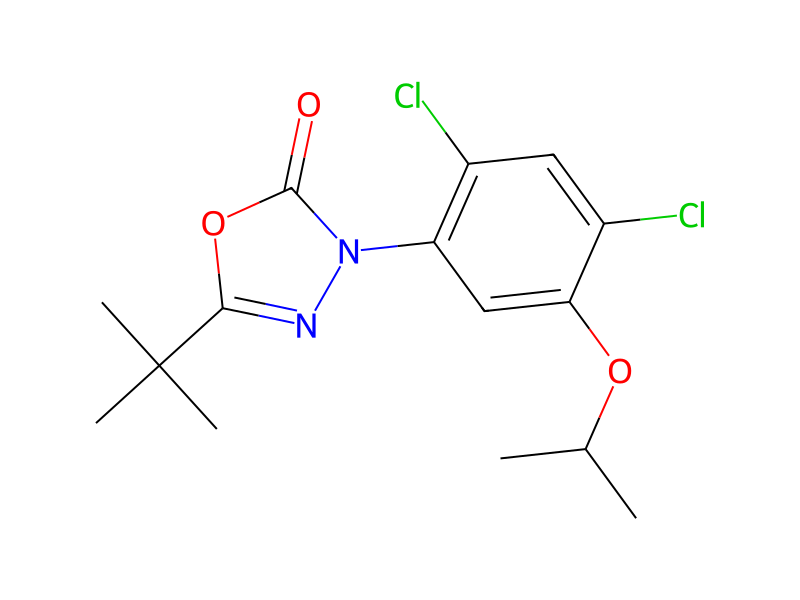
19666-30-9CC(C)Oc1cc(-n2nc(C(C)(C)C)oc2=O)c(Cl)cc1ClCHNUNORXWHYHNE-UHFFFAOYSA-NOxadiazon can cause cancer according to an independent committee of scientific and health experts. It can cause developmental toxicity according to The Environmental Protection Agency (EPA).
Pesticide -> EPA IRIS
Herbicides
Active substance -> EU Pesticides database: Not approved
Pesticides -> Herbicides, Protox-Inhibiting
Herbicides
Pesticide (Oxadiazon) -> USDA PDB
log Kow = 4.80
4.09
White crystals
Colorless crystals
Solubility in methanol, ethanol ca 100, cyclohexane 200, acetone, isophorone, methyl ethyl ketone, carbon tetrachloride ca 600, toluene, benzene, chloroform ca 1000 (all in g/l, 20 °C)
Soluble in solvents
In water, 0.7 mg/l @ 24 °C
안전 정보는 참고용이며, 공급업체의 물질안전보건자료(SDS), 관련 법규 및 전문가 평가를 대체하지 않습니다.
Warning
H400: Very toxic to aquatic life [Warning Hazardous to the aquatic environment, acute hazard]
P273, P391, and P501 (click each P-code to see the statement)
Warning
H400 (100%): Very toxic to aquatic life [Warning Hazardous to the aquatic environment, acute hazard]
P273, P391, and P501 (click each P-code to see the statement)
Hazard Traits - Carcinogenicity; Developmental Toxicity
Commission Regulation (EC) No 1490/2002
Oxadiazon is listed in the dataset of EPA Human Health Benchmarks for Pesticides under the Safe Drinking Water Act (40 eCFR 141)
2008/69/EC, 2010/39/EU, Reg. (EU) 2022/801, Reg. (EU) No 540/2011
REACH registered substance: 3-[2,4-dichloro-5-(1-methylethoxy)phenyl]-5-(1,1-dimethylethyl)-1,3,4-oxadiazol-2(3H)-one (EC: 243-215-7)
Oxadiazon: Does not have an individual approval but may be used under an appropriate group standard
The protox inhibitor herbicides (Fomesafen,Oxadiazon, Lactofen, Sulfentrazone, Carfentrazone-ethyl, Oxyfluorofen and Bifenox) can disrupt porphyrin metabolism; It has been speculated that a transient form of porphyria variegate may occur following a massive exposure or long-term exposure to lower doses. A mild eye irritant; [HSDB] An eye irritant; [eChemPortal: ERMA] An irritant; Targets the liver; [MSDSonline] See Fluthiacet-methyl.
Used as selective pre-emergence herbicide; [Merck Index]
Farming (Pesticides) [Category: Industry]
For Oxadiazon (USEPA/OPP Pesticide Code: 109001) ACTIVE products with label matches. /SRP: Registered for use in the U.S. but approved pesticide uses may change periodically and so federal, state and local authorities must be consulted for currently approved uses./
Herbicide
This is a man-made compound that is used as an herbicide.
Prepn: Brit. Pat 1,110,500 corresp to J. Metivier, R. Boesch, U.S. pat 3,385,862 (both 1968 to Rhone Poulenc).
1,2,4,5-Tetrachlorobenzene + isopropanol + hydrazine + pivaloyl chloride + phosgene (ether formation/amine formation/amide formation/phosgenation)
USEPA/OPP Pesticide Code 109001; Trade Names: Ronstar; RP-17623; G315.
Emulsifiable concentrates, granules, flowable, wettable powder
Tech. is greater than/equal to 94% pure
용도A commonly used herbicide/pesticide.
일반 설명Crystalline solid. Used as an herbicide.





19666-30-9DTXSID3024239CHEMBL1080648CHEBI:817860.00000011 [mmHg]
1.15X10⁻⁷ mm Hg @ 22 °C
Oxydiazon is a crystalline solid. Used as an herbicide.
White odorless solid; [Merck Index]
Pale Yellow Solid
Tolerances are established for combined residues of the herbicide oxadiazon (2-tert-butyl-4-(2,4-dichloro-5-isopropoxyphenyl)delta2-1,3,4-oxadiazolin-5-one) and its metabolites (2-tert-butyl-4-(2,4-dichloro-5-hydroxyphenyl)delta2-1,3,4-oxadiazolin-5-one) and 2-carboxyisopropyl-4-(2,4-dichloro-5-isopropoxyphenyl)delta2-1,3,4-oxadiazolin-5 -one) in or on raw agricultural commodities as follows: in milk fat; in the meat, fat, and meat byproducts of cattle, goats, hogs, horses, and sheep.
OXYDIAZON is a diazo compound. Azo, diazo, azido compounds can detonate. This applies in particular to organic azides that have been sensitized by the addition of metal salts or strong acids. Toxic gases are formed by mixing materials of this class with acids, aldehydes, amides, carbamates, cyanides, inorganic fluorides, halogenated organics, isocyanates, ketones, metals, nitrides, peroxides, phenols, epoxides, acyl halides, and strong oxidizing or reducing agents. Flammable gases are formed by mixing materials in this group with alkali metals. Explosive combination can occur with strong oxidizing agents, metal salts, peroxides, and sulfides.
Aquatic Acute 1 (100%)
Hazardous to the aquatic environment (acute) - category 1
Reproductive toxicity - Category 2
Teratogens
Aquatic Acute 1
SRP: At the time of review, criteria for land treatment or burial (sanitary landfill) disposal practices are subject to significant revision. Prior to implementing land disposal of waste residue (including waste sludge), consult with environmental regulatory agencies for guidance on acceptable disposal practices.
SRP: The scientific literature for the use of contact lenses in industry is conflicting. The benefit or detrimental effects of wearing contact lenses depend not only upon the substance, but also on factors including the form of the substance, characteristics and duration of the exposure, the uses of other eye protection equipment, and the hygiene of the lenses. However, there may be individual substances whose irritating or corrosive properties are such that the wearing of contact lenses would be harmful to the eye. In those specific cases, contact lenses should not be worn. In any event, the usual eye protection equipment should be worn even when contact lenses are in place.
Tolerances are established for combined residues of the herbicide oxadiazon (2-tert-butyl-4-(2,4-dichloro-5-isopropoxyphenyl)delta2-1,3,4-oxadiazolin-5-one) and its metabolites (2-tert-butyl-4-(2,4-dichloro-5-hydroxyphenyl)delta2-1,3,4-oxadiazolin-5-one) and 2-carboxyisopropyl-4-(2,4-dichloro-5-isopropoxyphenyl)delta2-1,3,4-oxadiazolin-5 -one) in or on raw agricultural commodities as follows: 0.1 ppm in milk fat (reflecting negligible residues in milk); 0.01 ppm (negligible residue) in the meat, fat, and meat byproducts of cattle, goats, hogs, horses, and sheep.
TERRESTRIAL FATE: Based on a classification scheme(1), reported Koc values ranging from 676 to 3,236(2-4), indicate that oxadiazon is expected to have only low or slight mobility in soil(SRC). In laboratory studies using TLC(5) and column leaching(6) methods, oxadiazon was determined to be immobile in a total of six soils. Volatilization of oxadiazon from moist soil surfaces is not expected to be an important fate process(4). Oxadiazon is not expected to volatilize from dry soil surfaces(SRC) based upon its vapor pressure of 1.15X10⁻⁷ mm Hg(7). Oxadiazon photodegrades on soil in natural sunlight with a half-life of 4.65 days(8). The photodegradation of oxadiazon results in three photoproducts with the loss of chlorine as the dominant process and the participation of hydroxyl(8). Biodegradation in soil is not expected to be an important fate process with a reported half-life of oxadiazon in aerobic soil of 3-6 months(9).
AQUATIC FATE: Based on a classification scheme(1), reported Koc values ranging from 676 to 3,236(2-4) indicate that oxadiazon is expected to adsorb to suspended solids and sediment(SRC). Volatilization from water surfaces is not expected(5) based upon an estimated Henry's Law constant of 7X10⁻⁸ atm-cu m/mole(SRC), estimated based on its vapor pressure, 1.15X10⁻⁷ mm Hg(6), and water solubility, 0.7 mg/l(7). According to a classification scheme(8), BCF values in the range of 24.1 to 708 measured in fish(9,10), suggests bioconcentration in aquatic organisms is low to high(SRC). Oxadiazon (1 ppm) photodegrades in water in natural sunlight with a half-life of 2.65 days(11). The photodegradation of oxadiazon results in three photoproducts with the loss of chlorine as the dominant process and the participation of hydroxyl(11). Oxadiazon is stable to hydrolysis at neutral and acidic pHs, but degrades slowly at pH 9, with a half-life of 38 days(12). Only 7% biodegradation was observed in a river die-away test using water from Ashai River, Japan after 50 days(13), suggesting biodegradation is slow in water.
ATMOSPHERIC FATE: According to a model of gas/particle partitioning of semivolatile organic compounds in the atmosphere(1), oxadiazon, which has a vapor pressure of 1.15X10⁻⁷ mm Hg at 22 °C(2), is expected to exist in both the vapor and particulate phases in the ambient atmosphere. Vapor-phase oxadiazon is degraded in the atmosphere by reaction with photochemically-produced hydroxyl radicals(SRC); the half-life for this reaction in air is estimated to be 16 hours(SRC), calculated from its rate constant of 24.3X10⁻¹² cu cm/molecule-sec at 25 °C(SRC) determined using a structure estimation method(3). Particulate-phase oxadiazon is removed from the air by wet and dry deposition(SRC). There is the potential for the photodegradation of oxadiazon in air based upon its photodegradation in water(4); however, the rate at which this may occur is not known.
In a 1992-1993 FDA monitoring study of oxadiazon residues in pears, the compound was not detected in any of the 710 domestic or 949 imported pear samples tested(1). Oxadiazon was not detected in a monitoring study of 6970 samples (80% domestic, 20 % foreign) of 81 commodities, including 71 pear samples, collected in Texas during 1989-1991(2).
'Oxadiazon is a member of the oxadiazole class of herbicides. While current data are limited, EPA has evidence that compounds within a class may share a common mechanism of toxicity. At this time, the Agency does not have sufficient data concerning common mechanism issues to determine whether or not oxadiazon shares a common mechanism of toxicity with other substances, including other oxadiazoles or other probable human carcinogens.' (L2081)
Oxadiazon
Hematologic
5 x 10 ^-3 mg/kg-day
The Koc of oxadiazon is reported as ranging from 676 to 3236(1-3). According to a classification scheme(4), this estimated Koc value suggests that oxadiazon is expected to have only low or slight mobility in soil. In laboratory studies using TLC(5) and column leaching(6) methods, oxadiazon was determined to be immobile in a total of six soils. In a study of the adsorption of oxadiazon (concn of 0.1-100 ppm) to soil and container (potting) media, 98-99% of the applied oxadiazon was adsorbed at all treatment rates, indicating that adsorption was not dependent on concn(7).
URBAN/SUBURBAN: Oxadiazon was not detected in the air in Kitakyashu City, Japan, an urban area 10 miles from an agricultural area, in samples collected during July 1991 and April 1992 using a single 24-hr sampling at a flow rate of 500 L/min(1).
AEROBIC: Oxadiazon, present at 100 mg/l, reached 16% of its theoretical BOD in two weeks using an activated sludge inoculum at 30 mg/l and a modified Japanese MITI test(1). In an aerobic degradation study using non-acclimated microbes in a mixed inoculum obtained from activated sludge, field soil and river sediment, oxadiazon was observed to be relatively stable to aerobic microbial degradation, with reported half-lives of 100-321 days(2). The half-life of oxadiazon in aerobic soil (loam and fine sandy loam) is reported to be 3-6 months(3). No biodegradation of oxadiazon at a concn of 0.00555 ppm occurred in Lake Kojima, Japan water samples incubated in the dark for 20 days(4). Using Ashai River, Japan water samples incubated at 10 °C, 7% biodegradation was observed after 50 days at a concn of 0.01 ppm(4).
ANAEROBIC: In an anaerobic degradation study using non-acclimated microbes in a mixed inoculum obtained from activated sludge, field soil and river sediment, oxadiazon was observed to be relatively stable to metabolic degradation, with reported half-lives of 107-577 days(1). Therefore, this compound is not expected to biodegrade rapidly in the environment under anaerobic conditions.
SEDIMENT: Oxadiazon was detected in river sediment (organic carbon contents of 0.49-4.05 mg/g) samples collected from the Koise River tributaries in Japan during a rice cultivation period between May and September 1985 at a maximum concn of 10 ug/kg during August(1).
Tolerances are established for combined residues of the herbicide oxadiazon (2-tert-butyl-4-(2,4-dichloro-5-isopropoxyphenyl)delta2-1,3,4-oxadiazolin-5-one) and its metabolites (2-tert-butyl-4-(2,4-dichloro-5-hydroxyphenyl)delta2-1,3,4-oxadiazolin-5-one) and 2-carboxyisopropyl-4-(2,4-dichloro-5-isopropoxyphenyl)delta2-1,3,4-oxadiazolin-5 -one) in or on raw agricultural commodities as follows: in milk fat; in the meat, fat, and meat byproducts of cattle, goats, hogs, horses, and sheep.
1,2,4,5-테트라클로로벤젠+아이소프로판올+하이드라진+피발로일 클로라이드+포스겐(에테르 형성/아민 형성/아마이드 형성/포스겐화)