
갈락토스
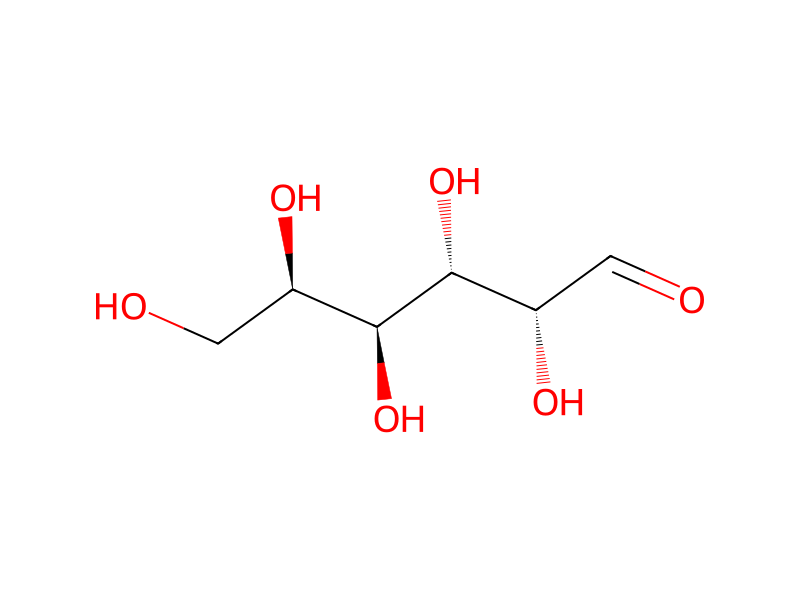
(2R,3S,4S,5R)-2,3,4,5,6-pentahydroxyhexanal
기본 정보
- CAS
26566-61-0- 표준 SMILES
O=C[C@H](O)[C@@H](O)[C@@H](O)[C@H](O)CO- InChIKey
GZCGUPFRVQAUEE-KCDKBNATSA-N- 분자식
- C6H12O6
- 평균 분자량
- 180.16 g/mol
- 단동위원소 질량
- 180.0633881
개요
Aldehydo-D-galactose is a D-galactose and an aldehydo-galactose. It is an enantiomer of an aldehydo-L-galactose.
이름 및 식별자
- 우선 이름
- (2R,3S,4S,5R)-2,3,4,5,6-pentahydroxyhexanal
- IUPAC
- (2R,3S,4S,5R)-2,3,4,5,6-pentahydroxyhexanal
- 현지명
- 갈락토스
- 영어명
- Galactose
- 분자식
- C6H12O6
- 분자량
- 180.16
이름 및 동의어
(2R,3S,4S,5R)-2,3,4,5,6-pentahydroxyhexanalGlyTouCan:G93924TTRefChem:934737G93924TTaldehydo-D-galactosedl-Galactose26566-61-0Lactoglucosealdehydo-D-galacto-hexoseD-aGalactoseD-GalaktoseD-?Galactose
이름 더 보기
갈락토스C01582
Galactose, D-Galactose [USAN]MFCD00151230rel-(2R,3S,4S,5R)-2,3,4,5,6-pentahydroxyhexanalD-Galactose (Standard)GALACTOSE [II]AI3-09083UNII-X2RN3Q8DNE
데이터베이스 식별자
- CAS
26566-61-0、59-23-4- PubChem CID
- 3037556
- ChEMBL
CHEMBL6067641- ChEBI
CHEBI:17118- UNII
- X2RN3Q8DNE
- Nikkaji
- J4.597G
물성
구조 계산 물성
- XLogP
- -2.9
- 극성 표면적
- 118 Ų
- 수소 결합 공여자 수
- 5
- 수소 결합 수용자 수
- 6
- 회전 가능 결합 수
- 5
- 무거운 원자 수
- 12
- 형식 전하
- 0
- 복잡도
- 138
실험 및 물리화학적 성질
SpringerMaterials PropertiesDensity
물리화학적 성질
- 녹는점
- 160 °C · 160 °C
- 끓는 점
- 527.1 · 527.1±50.0 °C(Predicted)
- 밀도
- 1.581 · 1.581±0.06 g/cm3(Predicted)
- 산도 계수 (pKa)
- 12.45 · 12.45±0.20(Predicted)
- EPA
- Galactose (26566-61-0)
안전 및 규제
안전 정보는 참고용이며, 공급업체의 물질안전보건자료(SDS), 관련 법규 및 전문가 평가를 대체하지 않습니다.
안전 데이터
- tsca
- TSCA listed
화학 및 산업
약리 정보
Protein BindingReadily accessible data regarding the protein binding of galactose is not available.
Pharmacodynamics
Galactose is a naturally occurring monosaccharide that forms the disaccharide lactose when combined with glucose (another monosaccharide). Subsequently, when lactose or small amounts of free galactose found in various common dairy products (and other foods) are consumed, the hydrolysis of lactose to glucose and galactose occurs and galactose is itself further metabolized to generate glucose. Such glucose is, of course, ultimately relied upon and used as the primary metabolic fuel for humans in a variety of biological reactions. Conversely, however, the ways in which galactose is commonly used in therapeutic agents generally do not rely upon such pharmacodynamics, even though they ultimately remain the most important ways in which galactose exerts or elicits useful biological actions for the human body.
Mechanism of Action
In the development of typhoid Ty21a live oral vaccine, the use of exogenous galactose is critical. When dealing with Salmonella typhimurium, it has been shown that rough strains with incomplete lipopolysaccharide (LPS) lacking O-specific side chains are much less virulent than smooth strains with complete LPS with O-specific side chains. Salmonella typhimurium gal E mutants used to produce the vaccine are effectively avirulent and highly protective but lack the specific UDP-galactose 4-epimerase enzyme which allows for the normal synthesis of UDP-galactose from UDP-glucose. The consequence of this mutant defect is that the gal E mutants can only generate incomplete LPS without O-specific antigen side chains, which are not capable enough as the complete LPS with O-specific side chains at generating an immunologic response. When exogenous galactose is added to the vaccine medium, however, it allows the mutants to generate UDP-galactose via galactose 1-phosphate. This ultimately allows the mutants to form smooth-type LPS with O-specific side chains. Regardless, the mutant's epimerase defect ultimately results in the accumulation of such intermediary products like galactose 1-phosphate and UDP-galactose, which consequently causes lysis of the mutant cells. The resultant vaccine is subsequently effective enough to elicit an immunologic response while the bacteriolysis prevents the mutant cells from regaining virulence under conditions where smooth type LPS similar to the active parental strain is synthesized. Galactose is also an essential element to the chemical structure of the commonly used laxative solution lactulose. Lactulose itself is a synthetic disaccharide that is made in parts from lactose, galactose, and various other sugars. It is poorly absorbed from the gastrointestinal tract and no enzyme capable of hydrolysis of lactulose is present in human gastrointestinal tissue. Oral doses of lactulose subsequently arrive at the colon largely unchanged. At the colon, lactulose is finally broken down predominantly to lactic acid, and also small amounts of formic and acetic acids by the action of colonic bacteria, which results in an increase in osmotic pressure and slight acidification of the colonic contents. This action consequently causes an increase in stool water content and softens the stool for a laxative effect.
관련 반응
118건




화합물 노트
불러오는 중…