피롤리딘
피롤리딘 · 테트라하이드로피롤 · TETRAHYDROPYRROLE · Pyrrolidin · FEMA 2523 · FEMA 3523 · PRD · Azolidine
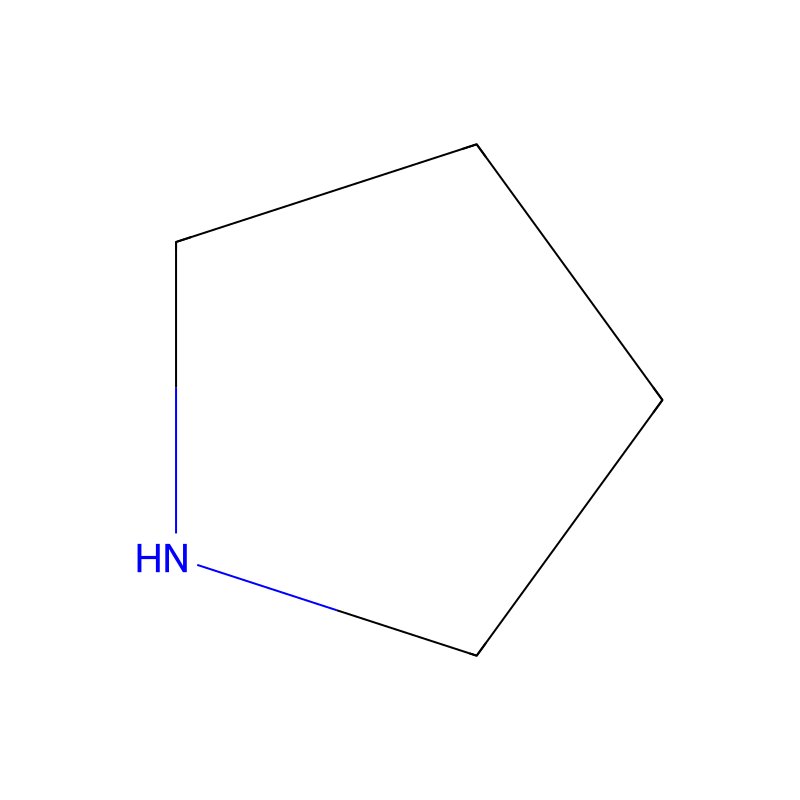
식별자 및 물리적 특성
| CAS No. | 123-75-1 |
|---|---|
| 분자식 | C4H9N |
| 평균 분자량 | 71.12 g/mol |
| 단동위원소 질량 | 71.07349929 g/mol |
| SMILES | C1CCNC1 |
| InChIKey | RWRDLPDLKQPQOW-UHFFFAOYSA-N |
| PubChem CID | 31268 |
| ChEMBL | CHEMBL22830 |
| ChEBI | CHEBI:33135 |
| EC No. | 204-648-7 |
| DTXSID | DTXSID3059559 |
| 현지명 | 피롤리딘 |
화학 및 물리적 성질
| XLogP | 0.5 |
|---|---|
| 극성 표면적 | 12 |
| 수소 결합 공여자 수 | 1 |
| 수소 결합 수용자 수 | 1 |
| 회전 가능 결합 수 | 0 |
| 무거운 원자 수 | 5 |
| 형식 전하 | 0 |
| 복잡도 | 22.8 |
| 물질 분류 | Nitrogen Compounds -> Amines, CyclicFlammable agents - 3rd degree |
| SpringerMaterials Properties | 15N nuclear magnetic resonance spectrum |
| LogP(분배 계수) | log Kow = 0.46 at pH 130.460 |
| 냄새 | Unpleasant, ammoniacal odor프로필렌 글리콜 중 0.10%. 암모니아 동물 계란 아민 |
| 맛 | POWERFUL, AMMONIACAL TASTE |
| 식품 첨가물 | FLAVORING AGENT OR ADJUVANT -> FDA Substance added to food |
| 밀도 | 0.8520 at 22.5 °C/4 °CRelative density (water = 1): 0.850.847-0.8530.8618 @25 °C0.852 g/mL at 25 °C (lit.) |
| 향미제 | EU Flavoring substances |
| Viscosity | 6.1472X10⁻³ Pa.s |
| Color/Form | Colorless to pale yellow liq |
| 용해도 | Soluble in ethanol, ethyl etherslightly soluble in benzene, chloroformIn water, 1.0X10+6 mg/L (miscible) at 20 °C1.00E+06 mg/L @ 20 °C (exp)Solubility in water: miscibleSoluble in water, fatsSoluble (in ethanol)물: 섞일 수 있음 |
| Corrosivity | Corrosive |
| 녹는점 | -63 °C |
| 끓는 점 | 87-88 °C/760 mmHg (lit.) |
| 증기 밀도 | 2.45 (vs air) |
| 증기압 | 128 mm Hg ( 39 °C) |
| 굴절률 | n20/D 1.443(lit.) |
| FEMA | 3523 | PYRROLIDINE |
| 인화점 | 37 °F |
| 저장 조건 | Store below +30°C. |
| 물리적 상태 | 액체 |
| pKa(산도 계수) | 11.27(at 25℃) |
| 색상 | 무색 내지 거의 무색 |
| pH | 12.9 (100g/l, H2O, 20℃) |
| 폭발한계 | 1.6-10.6%(V) |
| 향취 유형 | 암모니아의 |
| 생물학적 소스 | synthetic |
| 용해도 | 알코올, 에테르, 클로로포름, 물과 섞입니다. |
| 비열 | Cp(liquid): 2.2 J/(g·K), at 25℃ |
| Merck | 14,8015 |
| JECFA Number | 1609 |
| BRN | 102395 |
| 헨리 상수 | 4.2×100 mol/(m3Pa) at 25℃, Amoore and Buttery (1978) |
| 유전율 | 8.3000000000000007 |
| 안정성 | 안정적인가연성. 강산, 강산화제와 호환되지 않습니다. |
| InChI | 1S/C4H9N/c1-2-4-5-3-1/h5H,1-4H2 |
| InChIKey | RWRDLPDLKQPQOW-UHFFFAOYSA-N |
| SMILES | C1CCNC1 |
| LogP(분배 계수) | 0.22 at 25℃ |
| 표면장력 | 30.11mN/m at 293.15K |
| NIST | Pyrrolidine(123-75-1) |
| EPA | Pyrrolidine (123-75-1) |
화학적 성질
Pyrrolidine appears as a colorless to pale yellow liquid with an ammonia-like odor. It is infinitely miscible with water and conventional organic solvents such as methanol, acetone, ether, and chloroform. It acts as a lachrymator. Chemically, pyrrolidine behaves like a secondary amine in every respect. For example, it undergoes Leuckart –Wallach and Mannich reactions and is readily converted into an enamine. In the presence of a catalyst, such as platinum at 360°C or rhodium at 650°C, pyrrole is formed. In the presence of a copper catalyst, N-methylpyrrolidone is converted into N-methylpyrrolidine.
안전 및 규제
| GHS 분류 | DangerH225 (22%): Highly Flammable liquid and vapor [Danger Flammable liquids]P210, P233, P240, P241, P242, P243, P260, P261, P264, P264+P265, P270, P271, P280, P301+P317, P301+P330+P331, P302+P361+P354, P303+P361+P353, P304+P340, P305+P354+P338, P316, P317, P321, P330, P363, P370+P378, P403+P235, P405, and P501 (click each P-code to see the statement)Aggregated GHS information provided per 1650 reports by companies from 18 notifications to the ECHA C&L Inventory. Each notification may be associated with multiple companies.H225: Highly Flammable liquid and vapor [Danger Flammable liquids] |
|---|---|
| 규제 정보 | Chemical: PyrrolidineRegulation (EC) No 1831/2003 (amended)Pyrrolidine is listed on the EPA's Chemical Data Reporting (CDR) system. Manufacturers and importers of Pyrrolidine are required to report information about their production and use of this chemical to the EPA under the Toxic Substances Control Act (TSCA). (40 eCFR Part 711)Status: Active Update: 07-10-2020 https://echa.europa.eu/registration-dossier/-/registered-dossier/5444Pyrrolidine: HSNO Approval: HSR001050 Approved with controlsThe New Jersey Worker and Community Right to Know Act requires public and private employers to provide information about hazardous substances at their workplaces. (N.J.S.A. 34:5A-1 et. seq.) |
| 운송 라벨(DOT) | Flammable Liquid Corrosive |
| 화재 위험 | Excerpt from ERG Guide 132 [Flammable Liquids - Corrosive]:· Flammable/combustible material.Highly flammable. Gives off irritating or toxic fumes (or gases) in a fire. Vapour/air mixtures are explosive. |
| 화재 가능성 | Dangerous fire hazard when exposed to heat or flame.Vapor/air mixtures are explosive. |
| 건강 유해성 | Excerpt from ERG Guide 132 [Flammable Liquids - Corrosive]:· May cause toxic effects if inhaled or ingested. |
| 유해성 요약 | Corrosive to skin[Quick CPC] In high-dose animal studies, causes damage to the liver, kidneys, and CNS (seizures)In 6-hour inhalation studies with concentrations of 2600 ppm, no rats died. [HSDB] Corrosive to skin and eyesA respiratory tract irritantMay have effects on the nervous system[ICSC] Safe when used as a flavoring agent in food[JECFA] Causes convulsions in inhalation lethal-concentration studies of mice and oral lethal-dose studies of rats[RTECS] Causes burnsInhalation may cause corrosive injuries to upper respiratory tract and lungsHarmful by ingestion and inhalation[Alfa Aesar MSDS] |
| 운송 번호 및 가이드(DOT) | 1922 132 |
| 반응성 그룹 | Amines, Phosphines, and Pyridines |
| UN 분류 | UN Hazard Class: 3UN Subsidiary Risks: 8UN Pack Group: II |
| Reactivity Alerts | Highly Flammable |
| Reactivity Profile | PYRROLIDINE neutralizes acids in exothermic reactions to form salts plus water. May be incompatible with isocyanates, halogenated organics, peroxides, phenols (acidic), epoxides, anhydrides, and acid halides. May generate hydrogen, a flammable gas, in combination with strong reducing agents such as hydrides. An explosion occurred when a mixture of pyrrolidine, benzaldehyde, and propionic acid was heated in an attempt to form porphyrins. |
| Chemical Dangers | Decomposes on burning. This produces toxic fumes including nitrogen oxides. The substance is a strong base. Reacts violently with oxidants. It reacts violently with acid and is corrosive. |
| 소화 | Excerpt from ERG Guide 132 [Flammable Liquids - Corrosive]:Use foam, powder, carbon dioxide. In case of fire: keep drums, etc., cool by spraying with water. |
| 응급 조치 | Fresh air, rest. Refer for medical attention.Rinse skin with plenty of water or shower. Refer for medical attention .First rinse with plenty of water for several minutes (remove contact lenses if easily possible), then refer for medical attention.Refer for medical attention . |
| 누출 비상 조치 | · CALL 911. Then call emergency response telephone number on shipping paper. If shipping paper not available or no answer, refer to appropriate telephone number listed on the inside back cover.· ELIMINATE all ignition sources (no smoking, flares, sparks or flames) from immediate area. |
| 응급 처치 | Excerpt from ERG Guide 132 [Flammable Liquids - Corrosive]:General First Aid: |
| 안전 보관 | Fireproof. Separated from strong oxidants and acids. Well closed. |
| 노출 관리 및 개인 보호 | · Wear positive pressure self-contained breathing apparatus (SCBA). |
| 소화 절차 | Alcohol foam, carbon dioxide, dry chemicalIf material on fire or involved in fire: Do not extinguish fire unless flow can be stopped. Use water in flooding quantities as fog. Solid streams of water may be ineffective. Cool all affected containers with flooding quantities of water. Apply water from as far a distance as possible. Use "alcohol" foam, dry chemical or carbon dioxide. |
| 보관 조건 | Bundling and sills should be provided to prevent spread of liquid accidentally escaping from storage and process vessels. |
| 정리 방법 | Remove all ignition sources. Collect leaking and spilled liquid in sealable containers as far as possible. Absorb remaining liquid in sand or inert absorbent and remove to safe place. Personal protection: chemical protection suit including self-contained breathing apparatus. |
| 비화재 누출 대응 | Excerpt from ERG Guide 132 [Flammable Liquids - Corrosive]: |
| 처리 방법 | SRP: The most favorable course of action is to use an alternative chemical product with less inherent propensity for occupational exposure or environmental contamination. Recycle any unused portion of the material for its approved use or return it to the manufacturer or supplier. Ultimate disposal of the chemical must consider: the material's impact on air qualitypotential migration in soil or watereffects on animal, aquatic, and plant lifeand conformance with environmental and public health regulations. |
| 누출 처리 | Remove all ignition sources. Collect leaking and spilled liquid in sealable containers as far as possible. Absorb remaining liquid in sand or inert absorbent. Then store and dispose of according to local regulations. Personal protection: chemical protection suit including self-contained breathing apparatus. |
| 상호 작용 | Formation of n-nitrosopyrrolidine in a dog's stomach from Na nitrate & pyrrolidine. N-nitrosopyrrolidine disappeared rapidly from stomach, probably due to absorption. |
| 환경 거동 | TERRESTRIAL FATE: Based on a classification scheme(1), an estimated Koc value of 42(SRC), determined from a log Kow of 0.46(2) and a regression-derived equation(3), indicates that pyrrolidine is expected to have very high mobility in soil(SRC). The pKa of pyrrolidine is 11.31(4), indicating that this compound will primarily exist in the cation form in the environment and cations generally adsorb more strongly to soils containing organic carbon and clay than their neutral counterparts(5). Volatilization of pyrrolidine from moist soil surfaces is not expected to be an important fate process as cations do not volatilize(SRC). Pyrrolidine is expected to volatilize from dry soil surfaces(SRC) based upon a vapor pressure of 62.7 mm Hg(6). Pyrrolidine was found to degrade anaerobically via denitrification in 7-15 days in microbial consortia from freshwater sediments, estuarine sediments and activated sludge(7).AQUATIC FATE: Based on a classification scheme(1), an estimated Koc value of 42(SRC), determined from a log Kow of 0.46(2) and a regression-derived equation(3), indicates that pyrrolidine is not expected to adsorb to suspended solids and sediment(SRC). A pKa of 11.31(4) indicates pyrrolidine will exist almost entirely in the cation form at pH values of 5 to 9 and therefore volatilization from water surfaces is not expected to be an important fate process(5). According to a classification scheme(6), an estimated BCF of 3(SRC), from its log Kow(2) and a regression-derived equation(7), suggests the potential for bioconcentration in aquatic organisms is low(SRC). Pyrrolidine was found to degrade anaerobically via denitrification in 7-15 days in microbial consortia from freshwater sediments, estuarine sediments and activated sludge(8).ATMOSPHERIC FATE: According to a model of gas/particle partitioning of semivolatile organic compounds in the atmosphere(1), pyrrolidine, which has a vapor pressure of 62.7 mm Hg at 25 °C(2), is expected to exist solely as a vapor in the ambient atmosphere. Vapor-phase pyrrolidine is degraded in the atmosphere by reaction with photochemically-produced hydroxyl radicals(SRC)the half-life for this reaction in air is estimated to be 5 hours(SRC), calculated from its rate constant of 7.8X10⁻¹¹ cu cm/molecule-sec at 25 °C(SRC) that was derived using a structure estimation method(3). Pyrrolidine does not contain chromophores that absorb at wavelengths >290 nm(4) and therefore is not expected to be susceptible to direct photolysis by sunlight(SRC). |
| 식품 조사 수치 | Pyrrolidine was detected in 10 g samples of baked ham at 0.013 ppm(1). Pyrrolidine can be found in tilsiter, camembert, limburger, and brown bread cheeses at 19.9 mg/kg, 1 mg/kg, 0.1 mg/kg and 0.3 mg/kg, respectively(2). In coffee, pyrrolidine was detected in coffee extract and freeze dried coffee at 10 mg/kg and 11 mg/kg, respectively(3). |
| 유해 작용 | Neurotoxin - Other CNS neurotoxin |
| 노출 경로 | The substance can be absorbed into the body by inhalation and by ingestion. |
| Plant Concentrations | Pyrrolidine was detected in 10 g samples of spinach and miso at 0.250 ppm and 0.020 ppm, respectively(1). Pyrrolidine can be found in spinach, red radish, and celery at 2.5 mg/kg, 38 mg/kg, and 0.4 mg/kg, respectively(2). It can also be found in maize, apple peels, beans, kale, paprika red and cornichons at 3.5 mg/kg, 1.5 mg/kg, 0.2 mg/kg, 1.6 mg/kg, 0.6 mg/kg, and 0.1 mg/kg, respectively(2). It is also found in barley, hops, and malt at 0.9 mg/kg, 1 mg/kg, and 1.5 mg/kg, respectively(2). |
| Signs and Symptoms | Burning sensation. Convulsions. Cough. Headache. Nausea. Sore throat. Vomiting.Redness. Skin burns. Pain. Blisters.Redness. Pain. Blurred vision. Severe deep burns.Convulsions. Sore throat. Vomiting. See Inhalation. |
| Effluent Concentrations | Pyrrolidine was identified in the primary effluent at a concentration of 14 ug/L from municipal wastewater treatment plants(1). |
| Soil Adsorption/Mobility | The Koc of pyrrolidine is estimated as 42(SRC), using a log Kow of 0.46(1) and a regression-derived equation(2). According to a classification scheme(3), this estimated Koc value suggests that pyrrolidine is expected to have very high mobility in soil. The pKa of pyrrolidine is 11.31(4), indicating that this compound will primarily exist in the cation form in the environment and cations generally adsorb more strongly to soils containing organic carbon and clay than their neutral counterparts(5). |
| Natural Pollution Sources | FOUND IN TOBACCO & CARROT LEAVES. PROBABLE BIOSYNTHESIS FROM ORNITHINE & PUTRESCINE.Pyrrolidine was detected in spinach(1,2) and miso(1). Pyrrolidine was also detected in red radish, celery, maize, apple peels, beans, kale, paprika red, cornichons, barley, hops, and malt(2). |
| Human Toxicity Excerpts | /SIGNS AND SYMPTOMS/ Inhalation: Burning sensation. Convulsions. Cough. Headache. Nausea. Sore throat. Vomiting. Skin: Redness. Skin burns. Pain. Blisters. Eyes: Redness. Pain. Blurred vision. Severe deep burns. Ingestion: Convulsions. Sore throat. Vomiting. (See Inhalation). |
| Fish/Seafood Concentrations | Pyrrolidine was detected in 10 g samples of cod roe at 0.006 ppm(1). |
| 수질 위해 등급(WGK) | 2 |
| TSCA 등재 상태 | TSCA listed |
| RTECS 번호 | UX9650000 |
| 운송 번호(UN) | UN 1922 |
| 독성 | LD50 orally in Rabbit: 433 mg/kg |
| 관세 코드 | 2933 99 80 |
| 위험 문구(R) | 11-22-23-34-35-20/21/22-20/22-R35-R20/21/22-R11 |
| 위험 표시 | F,T,C |
| 안전 문구(S) | 16-26-36/37/39-45-33-S45-S36/37/39-S26-S16 |
| 포장분류 | II |
| 위험 등급 | 3Acute Tox. 4 InhalationAcute Tox. 4 OralEye Dam. 1Flam. Liq. 2Skin Corr. 1A |
| F 고인화성물질 | 34 |
| 자연 발화 온도 | 653 °F |
| 저장 분류 | 3 - Flammable liquids |
| 유해 물질 데이터 | 123-75-1(Hazardous Substances Data) |
| 함량 및 규제정보 | 물질구분: 유독물질혼합물(제품)함량정보: 피롤리딘 및 이를 5% 이상 함유한 혼합물 |
| 유해화학물질 필터링 | 2019-1-898(신규화학물질) |
용도
용도
의약 원료, 유기 합성, 특수 유기 용제로 사용됩니다.
출처
Reported found in beer, bread, wheat bread, salmon caviar, fish, milk, leaves and stalks of celery, Camembert cheese, Limburger cheese, Russian cheeses, tilsit cheese, other cheeses, caviar, raw fatty fish, beer, Finnish whiskey, white wine, red wine, coffee, radish, malt, roasted peanut, sweet corn and roasted barley.
용도
Pyrrolidine is a flammable alkaline liquid that undergoes reactions typical of secondary amines. It is used to prepare pesticides and rubber accelerators and as a chemical intermediate (usually the hydrochloride form) in the pharmaceutical industry. There is relatively limited industrial exposure to this material.
일반 설명
Pyrrolidine is a saturated heterocycliccompound having one nitrogenatom in a five-membered ring. It is a colorless to pale yellow liquid with an ammonia-like odor. It is found in certain plants andthe ring structure is present in manyalkaloids. Flash point 37°F. Density 0.85 g / cm3. Vapors heavier than air. Produces toxic oxides of nitrogen during combustion.
제조 및 합성 방법
제조 방법
Pyrrolidine is formed by reduction of pyrrole. Via overall 5-endo-trig cyclizations of homoallylic tosylamides. Pyrrolidine can be produced from butanediol and ammonia, e.g., over an aluminum thorium oxide catalyst at 300°C or over a nickel catalyst at 200°C and 20 MPa under hydrogenation conditions. It can also be produced from THF and ammonia over aluminum oxide at 275-375°C.