

기본 정보
- 표준 SMILES
NC(N)=O.OO- InChIKey
AQLJVWUFPCUVLO-UHFFFAOYSA-N- 분자식
- CH6N2O3
- 평균 분자량
- 94.07 g/mol
- 단동위원소 질량
- 94.03784206
이름 및 식별자
- 우선 이름
- Carbamide Peroxide
- IUPAC
- hydrogen peroxide;urea
- 현지명
- 과산화 요소
- 영어명
- Urea hydrogen peroxide
- 분자식
- CH6N2O3
- 분자량
- 94.07
이름 및 동의어
CARBAMIDE PEROXIDEUrea hydrogen peroxide124-43-6PercarbamideUrea peroxideUrea dioxideUrea hydroperoxideHydroperitHydroperitePercarbamidHyperolOrtizon
이름 더 보기
과산화요소과산화우레아과산화우레아우레아퍼옥사이드카바아미드퍼옥사이드과산화 우레아요소과산화물UHPUREA HYDROGEN PEROXIDE ADDUCTUREA HYDROGEN PEROXIDE ADDITION COMPOUND
PerhydritThenardolPerhydrol-UreaHydrogen peroxide ureaHydrogen peroxide carbamideMurine Ear DropsDebroxGly-oxide
데이터베이스 식별자
- CAS
124-43-6、14479-85-7- PubChem CID
- 31294
- DTXSID
DTXSID9024726- ChEMBL
CHEMBL3184026- ChEBI
CHEBI:75178- UNII
- 31PZ2VAU81
- EC Number
- 204-701-4
물성
구조 계산 물성
- 극성 표면적
- 110 Ų
- 수소 결합 공여자 수
- 4
- 수소 결합 수용자 수
- 3
- 회전 가능 결합 수
- 0
- 무거운 원자 수
- 6
- 형식 전하
- 0
- 복잡도
- 29
실험 및 물리화학적 성질
Density
0.8 at 68 °F (USCG, 1999) - Less dense than water; will float
0.8 @ 20°C
Solubility
greater than or equal to 100 mg/mL at 68 °F (NTP, 1992)
500
Melting Point
167 to 185 °F (decomposes) (NTP, 1992)
75-85
Physical Description
Urea hydrogen peroxide appears as a solid or paste-like semisolid. Used to make plastics.
White solid; [Merck Index] Solid or paste-like semisolid; [CAMEO] Odorless; [CHRIS] White tablet; [Sigma-Aldrich MSDS]
Autoignition Temperaturegreater than 680 °F (USCG, 1999)
물리화학적 성질
- 녹는점
- 90 · 90-93 °C (lit.)
- 끓는 점
- 175.5 °C · 175.5°C (rough estimate)
- 증기압
- 23.3 mm · 23.3 mm Hg ( 30 °C)
- 굴절률
- 1.4616 · 1.4616 (estimate)
- 저장 조건
- 15 °C · Store at +15°C to +25°C.
- 용해도
- 2 O: · H2O: 0.5 g/mL, 투명하거나 매우 희미하게 흐릿함
- 물리적 상태
- 플레이크 크리스탈
- 색상
- 하얀색
- 수소이온지수(pH)
- 6.3 · 6.3 (H2O, 20℃)
- 수용성
- 500 g/L · 500g/L(20℃)
- Merck
- 14 · 14,1782
- BRN
- 3680414 · 3680414
- 안정성
- 불안정한. 산화제. 충격이나 열에 노출되면 심각한 폭발 위험이 있습니다. 강산화제, 유기물질, 환원제, 미세분말 금속과 혼합할 수 없습니다. 에테르나 프로판온과 함께 폭발성 용액을 형성할 수 있습니다.
- 화장품 원료 기능
- 산화
- InChI
- 1S/CH4N2O.H2O2/c2-1(3)4;1-2/h(H4,2,3,4);1-2H
- InChIKey
- AQLJVWUFPCUVLO-UHFFFAOYSA-N
- SMILES
- OO.NC(N)=O
- LogP
- 0.09 at · 0.09 at 25℃
- EPA
- Carbamide peroxide (124-43-6)
화학적 성질
White crystals or crystalline powder. Decomposed by moisture at temperatures around 40C. Soluble in water, alcohol, and ethylene glycol; solvents such as ether and acetone extract hydrogen peroxide and may form explosive solutions. Active oxygen (min) 16%
안전 및 규제
GHS 분류
GHS Classification
Danger
H272 (94.9%): May intensify fire; oxidizer [Danger Oxidizing liquids; Oxidizing solids];H314 (83.1%): Causes severe skin burns and eye damage [Danger Skin corrosion/irritation];H315 (16.9%): Causes skin irritation [Warning Skin corrosion/irritation];H318 (18.6%): Causes serious eye damage [Danger Serious eye damage/eye irritation]
P210, P220, P260, P264, P264+P265, P280, P301+P330+P331, P302+P352, P302+P361+P354, P304+P340, P305+P354+P338, P316, P317, P321, P332+P317, P362+P364, P363, P370+P378, P405, and P501 (click each P-code to see the statement)
Aggregated GHS information provided per 59 reports by companies from 12 notifications to the ECHA C&L Inventory. Each notification may be associated with multiple companies.;Information may vary between notifications depending on impurities, additives, and other factors. The percentage value in parenthesis indicates the notified classification ratio from companies that provide hazard codes. Only hazard codes with percentage values above 10% are shown. For more detailed information, please visit ECHA C&L website.
유해성 정보
Regulatory Information
Chemical: Urea, compound with hydrogen peroxide (H2O2) (1:1)
Status: Active Update: 25-05-2018 https://echa.europa.eu/registration-dossier/-/registered-dossier/25157
Urea, compd. with hydrogen peroxide (1:1): HSNO Approval: HSR001360 Approved with controls
The New Jersey Worker and Community Right to Know Act requires public and private employers to provide information about hazardous substances at their workplaces. (N.J.S.A. 34:5A-1 et. seq.)
Other Safety InformationIMAP assessments - Urea, compound with hydrogen peroxide (H2O2) (1:1): Human health tier II assessment
DOT LabelOxidizer Corrosive
Fire Hazards
Special Hazards of Combustion Products: Irritating ammonia gas may be formed in fire.;Behavior in Fire: Melts and decomposes, giving off oxygen and ammonia. Increases severity of fire. Containers may explode. (USCG, 1999)
CAUTION: Ammonium nitrate products may explode if involved in fire or contaminated with hydrocarbons (fuels), organic matter, other contaminants or when hot molten and contained. Treat as an explosive (GUIDE 112).;· These substances will accelerate burning when involved in a fire.;· Some may decompose explosively when heated or involved in a fire.;· May explode from heat or contamination.;· Some will react explosively with hydrocarbons (fuels).;· May ignite combustibles (wood, paper, oil, clothing, etc.).;· Containers may explode when heated.;· Runoff may create fire or explosion hazard.
Health Hazards
Inhalation of dust causes irritation of nose from hydrogen peroxide formed when heated. Contact with eyes causes severe damage. Contact with moist skin causes temporary itching or burning sensation. Ingestion causes irritation of mouth and stomach. (USCG, 1999)
· Inhalation, ingestion or contact (skin, eyes) with vapors or substance may cause severe injury, burns or death.;· Fire may produce irritating, corrosive and/or toxic gases.;· Runoff from fire control or dilution water may cause environmental contamination.
Hazards Summary
Decomposed by air into urea, oxygen, and water; [Merck Index] A strong oxidizer that may combust on heating or on contact with organic substances; [CAMEO] Forms hydrogen peroxide solution on contact with water; An irritant that may cause severe eye injury; [CHRIS] Serious explosion hazard from shock or heat; An irritant that may cause corneal damage and skin blistering; [NTP] An oxidizer that may intensify fire; Causes burns; Inhalation may cause corrosive injuries to upper respiratory tract and lungs; [Sigma-Aldrich MSDS] See Hydrogen peroxide.
DOT ID and Guide1511 140
Reactive GroupAmides and Imides;Peroxides, Organic
Reactivity AlertsStrong Oxidizing Agent
Reactivity Profile
UREA HYDROGEN PEROXIDE is an oxidizing agent. Liable to spontaneous combustion when heated or in contact with organic materials. The contents of a screw-capped brown glass bottle spontaneously erupted after four years storage at ambient temperature. [MCA Case History No. 719]. Combustion may release Irritating ammonia gas.
DOT Hazard Classification
Urea hydrogen peroxide
UN1511
Div 5.1 Oxidizer (49 eCFR § 173.127)
Div 5.1 Oxidizer (49 eCFR § 173.127);Class 8 Corrosive material (49 eCFR § 173.136)
PG III: the degree of danger presented by the material is minor;For more information about the packing group assignment, please visit 49 eCFR § 173
Air and Water ReactionsDecomposed by moisture at about 40 °C to yield a solution of hydrogen peroxide (nonhazardous reaction). Water soluble.
안전 및 보호
Fire Fighting
Excerpt from ERG Guide 140 [Oxidizers]:;SMALL FIRE: Use water. Do not use dry chemicals or foams. CO2 or Halon® may provide limited control.;LARGE FIRE: Flood fire area with water from a distance. Do not move cargo or vehicle if cargo has been exposed to heat. If it can be done safely, move undamaged containers away from the area around the fire.;FIRE INVOLVING TANKS, RAIL TANK CARS OR HIGHWAY TANKS: For ammonium nitrate products: Do not fight cargo fire. Withdraw, evacuate and isolate area for at least 1600 meters (1 mile). Treat as an explosive (ERG Guide 112). Do not enter area for 24 hours or until expert advice has been provided. Fight fire from maximum distance or use unmanned master stream devices or monitor nozzles. Cool containers with flooding quantities of water until well after fire is out. ALWAYS stay away from tanks in direct contact with flames. For massive fire, use unmanned master stream devices or monitor nozzles; if this is impossible, withdraw from area and let fire burn. (ERG, 2024)
Accidental Release Measures
· CALL 911. Then call emergency response telephone number on shipping paper. If shipping paper not available or no answer, refer to appropriate telephone number listed on the inside back cover.;· Keep unauthorized personnel away.;· Stay upwind, uphill and/or upstream.;· Ventilate closed spaces before entering, but only if properly trained and equipped.
· Keep combustibles (wood, paper, oil, etc.) away from spilled material.;· Do not touch damaged containers or spilled material unless wearing appropriate protective clothing.;· Stop leak if you can do it without risk.;· Do not get water inside containers.;Small Dry Spill;· With clean shovel, place material into clean, dry container and cover loosely; move containers from spill area.;Small Liquid Spill;· Use a non-combustible material like vermiculite or sand to soak up the product and place into a container for later disposal.;Large Spill;· Dike far ahead of liquid spill for later disposal.
First Aid
EYES: First check the victim for contact lenses and remove if present. Flush victim's eyes with water or normal saline solution for 20 to 30 minutes while simultaneously calling a hospital or poison control center. Do not put any ointments, oils, or medication in the victim's eyes without specific instructions from a physician. IMMEDIATELY transport the victim after flushing eyes to a hospital even if no symptoms (such as redness or irritation) develop.;SKIN: IMMEDIATELY flood affected skin with water while removing and isolating all contaminated clothing. Gently wash all affected skin areas thoroughly with soap and water. If symptoms such as redness or irritation develop, IMMEDIATELY call a physician and be prepared to transport the victim to a hospital for treatment.;INHALATION: IMMEDIATELY leave the contaminated area; take deep breaths of fresh air. If symptoms (such as wheezing, coughing, shortness of breath, or burning in the mouth, throat, or chest) develop, call a physician and be prepared to transport the victim to a hospital. Provide proper respiratory protection to rescuers entering an unknown atmosphere. Whenever possible, Self-Contained Breathing Apparatus (SCBA) should be used; if not available, use a level of protection greater than or equal to that advised under Protective Clothing.;INGESTION: DO NOT INDUCE VOMITING. Corrosive chemicals will destroy the membranes of the mouth, throat, and esophagus and, in addition, have a high risk of being aspirated into the victim's lungs during vomiting which increases the medical problems. If the victim is conscious and not convulsing, give 1 or 2 glasses of water to dilute the chemical and IMMEDIATELY call a hospital or poison control center. IMMEDIATELY transport the victim to a hospital. If the victim is convulsing or unconscious, do not give anything by mouth, ensure that the victim's airway is open and lay the victim on his/her side with the head lower than the body. DO NOT INDUCE VOMITING. Transport the victim IMMEDIATELY to a hospital. (NTP, 1992)
General First Aid:;· Call 911 or emergency medical service.;· Ensure that medical personnel are aware of the material(s) involved, take precautions to protect themselves and avoid contamination.;· Move victim to fresh air if it can be done safely.;· Administer oxygen if breathing is difficult.;· If victim is not breathing:;-- DO NOT perform mouth-to-mouth resuscitation; the victim may have ingested or inhaled the substance.;-- If equipped and pulse detected, wash face and mouth, then give artificial respiration using a proper respiratory medical device (bag-valve mask, pocket mask equipped with a one-way valve or other device).;-- If no pulse detected or no respiratory medical device available, provide continuous compressions. Conduct a pulse check every two minutes or monitor for any signs of spontaneous respirations.;· Remove and isolate contaminated clothing and shoes.;· For minor skin contact, avoid spreading material on unaffected skin.;· In case of contact with substance, remove immediately by flushing skin or eyes with running water for at least 20 minutes.;· For severe burns, immediate medical attention is required.;· Effects of exposure (inhalation, ingestion, or skin contact) to substance may be delayed.;· Keep victim calm and warm.;· Keep victim under observation.;· For further assistance, contact your local Poison Control Center.;· Note: Basic Life Support (BLS) and Advanced Life Support (ALS) should be done by trained professionals.;Specific First Aid:;· Contaminated clothing may be a fire risk when dry.
Exposure Control and Personal Protection
· Wear positive pressure self-contained breathing apparatus (SCBA).;· Wear chemical protective clothing that is specifically recommended by the manufacturer when there is NO RISK OF FIRE.;· Structural firefighters' protective clothing provides thermal protection but only limited chemical protection.
Nonfire Spill Response
Excerpt from ERG Guide 140 [Oxidizers]:;Keep combustibles (wood, paper, oil, etc.) away from spilled material. Do not touch damaged containers or spilled material unless wearing appropriate protective clothing. Stop leak if you can do it without risk. Do not get water inside containers.;SMALL DRY SPILL: With clean shovel, place material into clean, dry container and cover loosely; move containers from spill area.;SMALL LIQUID SPILL: Use a non-combustible material like vermiculite or sand to soak up the product and place into a container for later disposal.;LARGE SPILL: Dike far ahead of liquid spill for later disposal. (ERG, 2024)
Isolation and Evacuation
Excerpt from ERG Guide 140 [Oxidizers]:;IMMEDIATE PRECAUTIONARY MEASURE: Isolate spill or leak area in all directions for at least 50 meters (150 feet) for liquids and at least 25 meters (75 feet) for solids.;LARGE SPILL: Consider initial downwind evacuation for at least 100 meters (330 feet).;FIRE: If tank, rail tank car or highway tank is involved in a fire, ISOLATE for 800 meters (1/2 mile) in all directions; also, consider initial evacuation for 800 meters (1/2 mile) in all directions. If ammonium nitrate products are in a tank, rail car or truck and involved in a fire, ISOLATE for 1600 meters (1 mile) in all directions; also, initiate evacuation including emergency responders for 1600 meters (1 mile) in all directions. (ERG, 2024)
Immediate precautionary measure;· Isolate spill or leak area in all directions for at least 50 meters (150 feet) for liquids and at least 25 meters (75 feet) for solids.;Large Spill;· Consider initial downwind evacuation for at least 100 meters (330 feet).;Fire;· If tank, rail tank car or highway tank is involved in a fire, ISOLATE for 800 meters (1/2 mile) in all directions; also, consider initial evacuation for 800 meters (1/2 mile) in all directions.;· If ammonium nitrate products are in a tank, rail car or truck and involved in a fire, ISOLATE for 1600 meters (1 mile) in all directions; also, initiate evacuation including emergency responders for 1600 meters (1 mile) in all directions.
Protective Action Criteria (PAC)
1.2 [mg/m3]
13 [mg/m3]
79 [mg/m3]
Personal Protective Equipment (PPE)Rubber gloves and protective goggles (USCG, 1999)
Emergency Response Planning Guidelines
Small Fire;· Use water. Do not use dry chemicals or foams. CO2 or Halon® may provide limited control.;Large Fire;· Flood fire area with water from a distance.;· Do not move cargo or vehicle if cargo has been exposed to heat.;· If it can be done safely, move undamaged containers away from the area around the fire.;Fire Involving Tanks, Rail Tank Cars or Highway Tanks;· For ammonium nitrate products: Do not fight cargo fire. Withdraw, evacuate and isolate area for at least 1600 meters (1 mile). Treat as an explosive (GUIDE 112). Do not enter area for 24 hours or until expert advice has been provided.;· Fight fire from maximum distance or use unmanned master stream devices or monitor nozzles.;· Cool containers with flooding quantities of water until well after fire is out.;· ALWAYS stay away from tanks in direct contact with flames.;· For massive fire, use unmanned master stream devices or monitor nozzles; if this is impossible, withdraw from area and let fire burn.
독성 정보
Adverse EffectsDermatotoxin - Skin burns.;Toxic Pneumonitis - Inflammation of the lungs induced by inhalation of metal fumes or toxic gases and vapors.
Effects During Pregnancy and Lactation
◉ Summary of Use during Lactation;Carbamide (urea) peroxide has not been studied during breastfeeding. It is unlikely that carbamide peroxide found in ear drops or teeth whiteners is absorbed into the bloodstream. However, if any carbamide peroxide were absorbed, it would be broken down to urea and hydrogen peroxide, both of which are found normally in human milk. If carbamide peroxide is used by the mother according to directions, it is not a reason to discontinue breastfeeding and no special precautions are required.;◉ Effects in Breastfed Infants;Relevant published information was not found as of the revision date.;◉ Effects on Lactation and Breastmilk;Relevant published information was not found as of the revision date.
규제 정보
Regulatory Information
Chemical: Urea, compound with hydrogen peroxide (H2O2) (1:1)
Status: Active Update: 25-05-2018 https://echa.europa.eu/registration-dossier/-/registered-dossier/25157
Urea, compd. with hydrogen peroxide (1:1): HSNO Approval: HSR001360 Approved with controls
The New Jersey Worker and Community Right to Know Act requires public and private employers to provide information about hazardous substances at their workplaces. (N.J.S.A. 34:5A-1 et. seq.)
안전 데이터
- wgk
- 2
- tsca
- TSCA listed
- ridadr
- UN 1511
- 독성
- LD50 orally in Rabbit: > 2000 mg/kg
- HS 번호
- 28470000
- risk_code
- 8-34-36/37/38
- hazard_code
- Xi,C,O
- safety_code
- 26-36-45-36/37/39-17
- 포장분류
- III
- 위험 등급
- 5.1
- 기존화학 물질
- KE-35147
- F 고인화성물질
- 21
- Hazard Classifications
- Eye Dam. 1Ox. Sol. 3Skin Irrit. 2
- 스토리지 클래스
- 5.1B - Oxidizing hazardous materials
- 함량 및 규제정보
- 물질구분: 유독물질; 혼합물(제품)함량정보: 과산화 우레아 및 이를 17% 이상 함유한 혼합물
- 유해화학물질 필터링
- 97-1-3
화학 및 산업
약리 정보
Protein BindingNo established pharmacokinetic data.
Pharmacodynamics
Carbamide peroxide releases hydrogen peroxide and free radicals upon contact with water or outer surfaces of ear and tooth. Hydrogen peroxide exerts cerumenolytic, enamel-bleaching and antiseptic actions. _In vitro_, the chemical stability of ceramics against bleaching agents was observed after treatment with 15% carbamide peroxide for 56 h, 16% carbamide peroxide for 126 h, 10% or 15% carbamide peroxide and 38% hydrogen peroxide for 30 minutes or 45 minutes, respectively. According to _in vitro_ studies, high (37%) or low (10 or 16%) concentrated carbamide peroxide agents were similarly effective as oral bleaching agents. Treatment with carbamide peroxide may lead to demineralization which involves decreased mineral content of enamel calcium, phosphate, and fluoride, and alteration of the chemical, structural, and mechanical properties. Carbamide peroxide may affect the organic components of the enamel and lead to increased susceptibility to erosion, fracture stability or decreased abrasion resistance of the treated area.
Mechanism of Action
Carbamide peroxide release hydrogen peroxide upon contact with teeth, which is a strong oxidizing and bleaching agent. It also release free radicals such as H+ or H3O+. Hydrogen peroxide also acts as an antiseptic, especially in sites with relative anaerobiosis. Following otic administration, carbamide peroxide complex releases hydrogen peroxide that breaks up the hardened wax. The hydrogen peroxide component, which further breaks down into water, is also a cerumenolytic that hydrates the desquamated sheets of corneocytes, which are the major constituent of cerumen plugs. The glycerol and urea facilitates softening of the cerumen, either with or without syringing. Both hydrogen peroxide and urea mildly induce keratolysis with disintegration of the ear wax to help reduce the keratin-load in the ear debris and allow other active components to reach the skin under the debris.
Biological Half-LifeNo established pharmacokinetic data.
Metabolism/MetabolitesNo established pharmacokinetic data.
MeSH Pharmacological Classification
Substances used on humans and other animals that destroy harmful microorganisms or inhibit their activity. They are distinguished from DISINFECTANTS, which are used on inanimate objects.
Chemicals that are used to oxidize pigments in TEETH and thus effect whitening.
Absorption, Distribution and Excretion
Upon treatment into the external auditory canal or the dental cavity, exposure to carbamide peroxide is limited to the intimate contact with the treated area without any systemic absorption.
No established pharmacokinetic data.
No established pharmacokinetic data.
No established pharmacokinetic data.
용도 및 제조
Uses
Used as an antiseptic, cerumenolytic, and dental bleach; [Merck Index] Used to make plastics; [CAMEO] Used for hair bleaching, oxidation of permanent waves, and hair relaxing; [ExPub: EC: SCCP] Used to develop blueprints and for the modification of starches; [NTP]
Using Disinfectants or Biocides [Category: Clean];Dressing Hair [Category: Other]
Household ProductsInformation on 1 consumer products that contain Urea Peroxide in the following categories is provided:;• Landscaping/Yard
Use ClassificationCosmetics -> Oxidising
General Manufacturing InformationUrea, compd. with hydrogen peroxide (H2O2) (1:1): ACTIVE
응용 분야
용도Urea hydrogen peroxide is an antiseptic, disinfectant and bleaching agent used in pharmaceuticals and cosmetics respectively. It is used in the whitening of teeth and relieves minor inflammation of gums, oral mucosal surfaces and lips. It finds application in the preparation of plastics, blue print development and starch modification. In addition to this, it is used as a source of hydrogen peroxide easily handled in the laboratory.
일반 설명A solid or paste-like semisolid. Used to make plastics.
상·하류 제품 정보
상류 원료
하류 제품
추가 설명
정의ChEBI: A mixture obtained by combining equimolar amounts of hydrogen peroxide and urea.
관련 반응
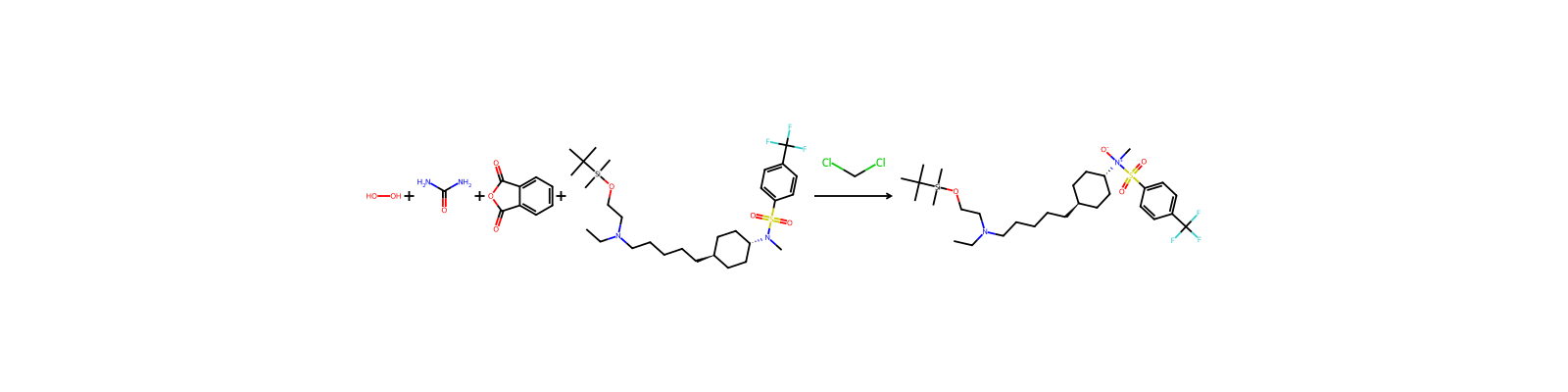
152건




연결된 노트
불러오는 중…