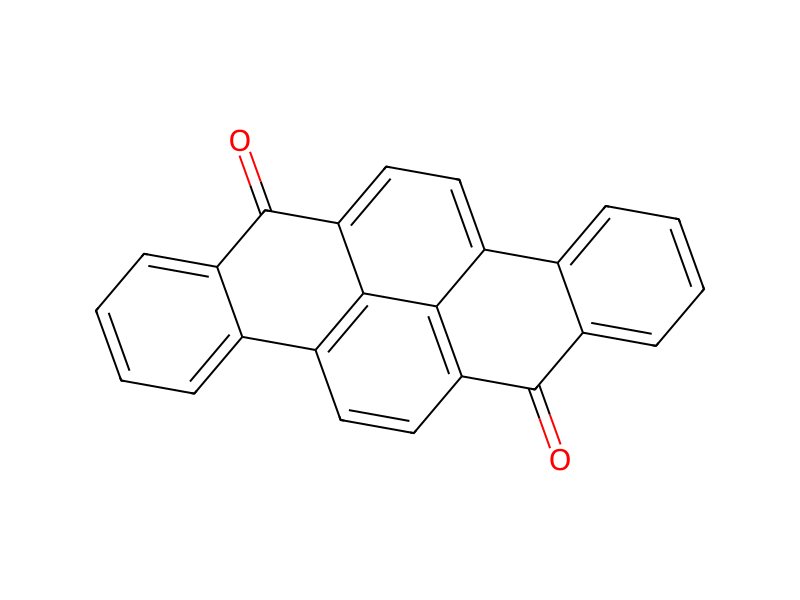
기본 정보
- 표준 SMILES
O=C1c2ccccc2-c2ccc3c4c(ccc1c24)-c1ccccc1C3=O- InChIKey
ZTWQZJLUUZHJGS-UHFFFAOYSA-N- 분자식
- C24H12O2
- 평균 분자량
- 332.3 g/mol
- 단동위원소 질량
- 332.08372962
개요
C.i. vat yellow 4 is a viscous orange liquid. Used for coloring of cotton, wool and cellulose acetate.
이름 및 식별자
- 우선 이름
- Dibenzo(b,def)chrysene-7,14-dione
- IUPAC
- hexacyclo[10.10.2.02,7.09,23.013,18.020,24]tetracosa-1(23),2,4,6,9,11,13,15,17,20(24),21-undecaene-8,19-dione
- 현지명
- VAT 옐로우 4
- 영어명
- Vat Yellow 4
- 분자식
- C24H12O2
- 분자량
- 332.35
이름 및 동의어
이름 더 보기
데이터베이스 식별자
- CAS
128-66-5- PubChem CID
- 31412
- DTXSID
DTXSID6021454- ChEBI
CHEBI:82548- UNII
- 8XO6A4G496
- EC Number
- 204-903-2
- Nikkaji
- J5.411I
물성
구조 계산 물성
- XLogP
- 5.4
- 극성 표면적
- 34.1 Ų
- 수소 결합 공여자 수
- 0
- 수소 결합 수용자 수
- 2
- 회전 가능 결합 수
- 0
- 무거운 원자 수
- 26
- 형식 전하
- 0
- 복잡도
- 570
실험 및 물리화학적 성질
Flash Point
greater than 200 °F (NTP, 1992)
Flash Point > 93 °C
Physical Description
C.i. vat yellow 4 is a viscous orange liquid. Used for coloring of cotton, wool and cellulose acetate.
Orange liquid; [CAMEO]
물리화학적 성질
- 녹는점
- 385 °C · 385 °C
- 끓는 점
- 429.48 °C · 429.48°C (rough estimate)
- 밀도
- 1.1459 · 1.1459 (rough estimate)
- 굴절률
- 1.4891 · 1.4891 (estimate)
- 안정성
- 안정적인. 타기 쉬운. 강한 산화제와 호환되지 않습니다.
- EPA
- 4 · C.I. Vat Yellow 4 (128-66-5)
화학적 성질
viscous orange liquid
안전 및 규제
GHS 분류
유해성 정보
Special Reports
REVIEW OF INHALATION (TOTAL-BODY-EXPOSURE) STUDIES OF COLORED CHEM SMOKES. ACUTE TOXICITIES, TIME TO DEATHS, & GROSS SIGNS COMPARED. TOXICOLOGICAL EVALUATION OF DYES IN SMOKE MIXT INCL. ONE OF THE DYES USED IN CHEM SMOKES IS DIBENZO(B,DEF)CHRYSENE-7,14-DIONE.[OWENS EJ, WARD DM; USNTIS AD/A REP ISS NO 003827/3GA 72 PP (1974)]
DHEW/NCI; Bioassay of C.I. Vat Yellow 4 for Possible Carcinogenicity (1979) Technical Rpt Series No. 134 DHEW Pub No. (NIH) 79-1389
안전 및 보호
First Aid
EYES: First check the victim for contact lenses and remove if present. Flush victim's eyes with water or normal saline solution for 20 to 30 minutes while simultaneously calling a hospital or poison control center. Do not put any ointments, oils, or medication in the victim's eyes without specific instructions from a physician. IMMEDIATELY transport the victim after flushing eyes to a hospital even if no symptoms (such as redness or irritation) develop.
Nonfire Spill Response
SMALL SPILLS AND LEAKAGE: If you should spill this chemical, use absorbent paper to pick up all liquid spill material. Seal the absorbent paper, as well as any of your clothing which may be contaminated, in a vapor-tight plastic bag for eventual disposal. Wash any surfaces you may have contaminated with a soap and water solution. Do not reenter the contaminated area until the Safety Officer (or other responsible person) has verified that the area has been properly cleaned.
Personal Protective Equipment (PPE)
RECOMMENDED RESPIRATOR: Where the neat test chemical is weighed and diluted, wear a NIOSH-approved half face respirator equipped with a combination filter cartridge, i.e. organic vapor/acid gas/HEPA (specific for organic vapors, HCl, acid gas, SO2 and a high efficiency particulate filter). (NTP, 1992)
독성 정보
Ongoing Test Status
The following link will take the user to the National Toxicology Program (NTP) Test Agent Search Results page, which tabulates all of the "Standard Toxicology & Carcinogenesis Studies", "Developmental Studies", and "Genetic Toxicity Studies" performed with this chemical. Clicking on the "Testing Status" link will take the user to the status (i.e., in review, in progress, in preparation, on test, completed, etc.) and results of all the studies that the NTP has done on this chemical. [http://ntp-apps.niehs.nih.gov/ntp_tox/index.cfm?fuseaction=ntpsearch.searchresults&searchterm=128-66-5]
Human Toxicity Excerpts
Most organic azo dyes are potential skin sensitizers, the most important of which are paraphenylenediamine and its analogs. Water soluble azo dyes are more likely to cause clinical sensitization than insoluble dyes. ... In addition to allergic eczematous contact dermatitis, color developing solutions have caused lichen planus like eruptions. /Organic dyes/
Carcinogen Classification
Vat Yellow 4
Group 3: Not classifiable as to its carcinogenicity to humans
Volume 48: (1990) Some Flame Retardants and Textile Chemicals, and Exposures in the Textile Manufacturing Industry
1990
1989
C.I. Vat yellow 4
Non-Human Toxicity Excerpts
Vat yellow 4 (C.I. 59100) was tested for mutagenicity in the Salmonella/microsome preincubation assay using a protocol approved by the National Toxicology Program. Vat yellow 4 was tested over a wide range of doses (0, 100, 333, 1000, 3333, and 10,000 ug/plate) in four Salmonella typhimurium strains (TA98, TA100, TA1535, and TA1537) in the presence and absence of Aroclor-induced rat or hamster liver S9. Vat yellow 4 was negative in these tests and the highest ineffective dose level tested in any Salmonella tester strain was 10,000 ug/plate.
Despite their widespread use and potential for significant human exposure, genotoxicity data on anthraquinones and other dyes are limited. In this study, 16 anthraquinones and one azo dye (Solvent Red 1) were selected for testing using the thymidine locus and micronucleus (MN) analysis in L5178Y/TK(+ or -)-3.7.2C mouse lymphoma cells. Six of the dyes were from the same lot used in the NTP rodent bioassay. The dyes used were all production lots and thus varied in their purity. Disperse Blue 7, 2-aminoanthraquinone; 1-amino-2-methylanthraquinone, Disperse Blue 3 and Disperse Red 11 were genotoxic (inducing 1814 mutants/10(6) survivors, 369 MN/1000 cells at 13% survival; 397 mutants/10(6) survivors, 196 MN/1000 cells at 21% survival; 178 mutants/10(6) survivors, 119 MN/1000 cells at 51% survival; 264 mutants/10(6) survivors, 109 MN/1000 cells at 15% survival, respectively). Reactive Blue 19 was weakly mutagenic (inducing 144 mutants/10(6) survivors, but only 8 MN/1000 cells at 13% survival). Vat Yellow 4 and Solvent Red 1, with exogenous activation, were also mutagenic (inducing 300 mutants/10(6) survivors, 18 MN/1000 cells at 57% survival, and 100 mutants/10(6) survivors and 16 MN/1000 cells at 22% survival, respectively). With activation 1-nitro-2-methylanthraquinone was judged to give an equivocal mutagenicity response. The maximum test concentration was limited for some compounds by their solubility. Those chemicals that did not induce mutation or cytotoxicity at the limits of solubility were classified separately. Compounds which were not evaluated without exogenous activation because of insolubility but were evaluated with activation include 1-nitro-2-methylanthraquinone, Solvent Red 1 and Vat Yellow 4.
Evidence for Carcinogenicity
Evaluation: There is limited evidence for the carcinogenicity of Vat Yellow 4 in experimental animals. No data were available from studies in humans on the carcinogenicity of Vat Yellow 4. Overall evaluation: Vat Yellow 4 is not classifiable as to its carcinogenicity to humans (Group 3).
National Toxicology Program Studies
FISCHER 344 RATS OF EACH SEX ADMIN FORMULATED PRODUCT CONTAINING CI VAT YELLOW 4 IN DIET FOR 104 WK OR 106 WK @ 3500 OR 7000 PPM. TUMOR INCIDENCE WAS NOT HIGHER THAN THAT OF CONTROLS.
B6C3F1 MICE ADMIN FORMULATED PRODUCT CONTAINING CI VAT YELLOW 4 IN DIET FOR 104 WK OR 106 WK, (25,000 OR 50,000 PPM FOR MALES & 12,500 OR 25,000 PPM FOR FEMALES). IT WAS CARCINOGENIC FOR MALES, BUT NOT FEMALES, INDUCING LYMPHOMAS.
안전 데이터
- tsca
- TSCA listed
- 기존화학 물질
- KE-08867
- 유해 물질 데이터
- 128-66-5(Hazardous Substances Data)
화학 및 산업
용도 및 제조
Uses
Used as a dye for cotton, silk, wool, and paper; [HSDB]
Pulp and Paper Processing [Category: Industry]
DYE FOR COTTON, SILK, WOOL & PAPER, FOR PRINTING COTTON
U.S. Imports
(1977) 3.88X10+6 G (PRINCPL CUSTMS DISTS)
(1979) 3.50X10+6 G (PRINCPL CUSTMS DISTS)
U.S. Production
(1978) PROBABLY GREATER THAN 2.27X10+6 G
(1979) PROBABLY GREATER THAN 2.27X10+6 G
응용 분야
용도Vat Yellow 4 is a commercial dye used in textiles. Polyaromatic hydrocarbon with potential carcinogenic activity.Environmental toxin on US EPA Toxic Release Inventory list (TRI) list.
일반 설명Viscous orange liquid. Used for coloring of cotton, wool and cellulose acetate.
제조 방법
(a) 3-Benzoylbenzanthroneand Aluminium chloride and antioxidant for the closed-loop response; (b) 1,5-Dibenzoyl-2-naphthaenein Aluminium chloride and sodium chloride were under existing closed-loop response.
상·하류 제품 정보
상류 원료
하류 제품
공급사19 곳
관련 반응
현재 필터 조건에 해당하는 반응 기록이 없습니다.
연결된 노트
불러오는 중…