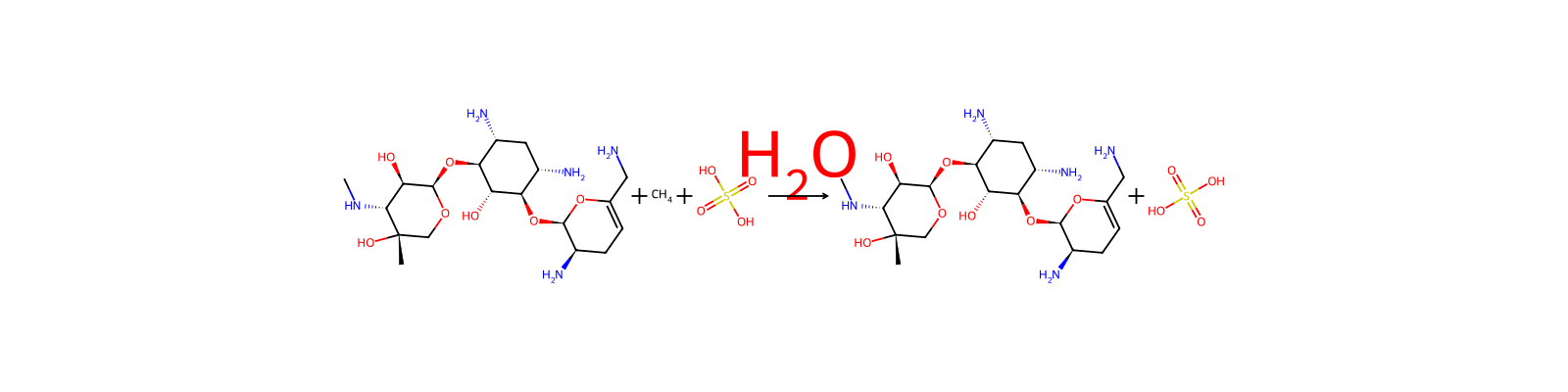
HRID 1415073반응물로

32385-11-8CN[C@@H]1[C@@H](O)[C@@H](O[C@@H]2[C@@H](O)[C@H](O[C@H]3OC(CN)=CC[C@H]3N)[C@@H](N)C[C@H]2N)OC[C@]1(C)OURWAJWIAIPFPJE-YFMIWBNJSA-NSisomycin is an amino cyclitol glycoside, an aminoglycoside antibiotic, a beta-L-arabinoside and a monosaccharide derivative.
32385-11-8CHEMBL221886CHEBI:9169Pharmaceuticals -> Antibiotics
Pharmaceuticals -> Listed in ZINC15
Off-White Solid
안전 정보는 참고용이며, 공급업체의 물질안전보건자료(SDS), 관련 법규 및 전문가 평가를 대체하지 않습니다.
Danger
H312 (100%): Harmful in contact with skin [Warning Acute toxicity, dermal]
P203, P261, P271, P280, P302+P352, P304+P340, P317, P318, P321, P362+P364, P405, and P501 (click each P-code to see the statement)
Aggregated GHS information provided per 2 reports by companies from 1 notifications to the ECHA C&L Inventory. Each notification may be associated with multiple companies.
J - Antiinfectives for systemic use
QJ - Antiinfectives for systemic use
Compounds which inhibit the synthesis of proteins. They are usually ANTI-BACTERIAL AGENTS or toxins. Mechanism of the action of inhibition includes the interruption of peptide-chain elongation, the blocking the A site of ribosomes, the misreading of the genetic code or the prevention of the attachment of oligosaccharide side chains to glycoproteins.
Substances that inhibit the growth or reproduction of BACTERIA.
개요Sisomicin was found in the culture broth of Micromonospora inyoensis by Schering-Plough Co. in 1970, following the discovery of gentamicin by the same research group. The structure and activity of sisomicin are very similar to those of gentamicin C1a, the major component of the gentamicin complex. Sisomicin shows stronger bacterial activity and lower renal and ototoxicity than gentamicin C1a .
용도Sisomicin is an Antibacterial. Gentamicin-like aminoglycoside antibiotic; has broad spectrum antibiotic activity.
일반 설명This aminoglycoside antibiotic is produced by Micromonospora inyoensis. Sisomicin is very similar to gentamicin in its antimicrobial spectrum and all other properties. It is as active as gentamicin against all Enterobacteriaceae . Against Pseudomonas aeruginosa, sisomicin is more active than gentamicin, but not as active as tobramycin. There is almost complete cross-resistance between gentamicin and sisomicin with most Gram-negative bacilli. The reason for this is that sisomicin, like gentamicin, is affected by at least eight of the plasmid-coded modifying enzymes, which can be produced by Gram-negative bacilli). On the other hand, sisomicin is active against some organisms which resist gentamicin by nonenzymatic mechanisms. Sisomicin does not offer significant advantages over gentamicin. It has had limited clinical trials, and has been available commercially in Europe as a sulfate, but not in the USA, UK, and Australia. The drug dosage of sisomicin (3–6 mg/kg/day), its methods of administration, and pharmacokinetics, are similar to those of gentamicin. The toxicity of these two drugs is also probably about the same. Results of treatment of conditions, such as urinary tract infections or Gramnegative bacillary septicemias, have, in general, been similar to what would be expected from an identical gentamicin regimen.