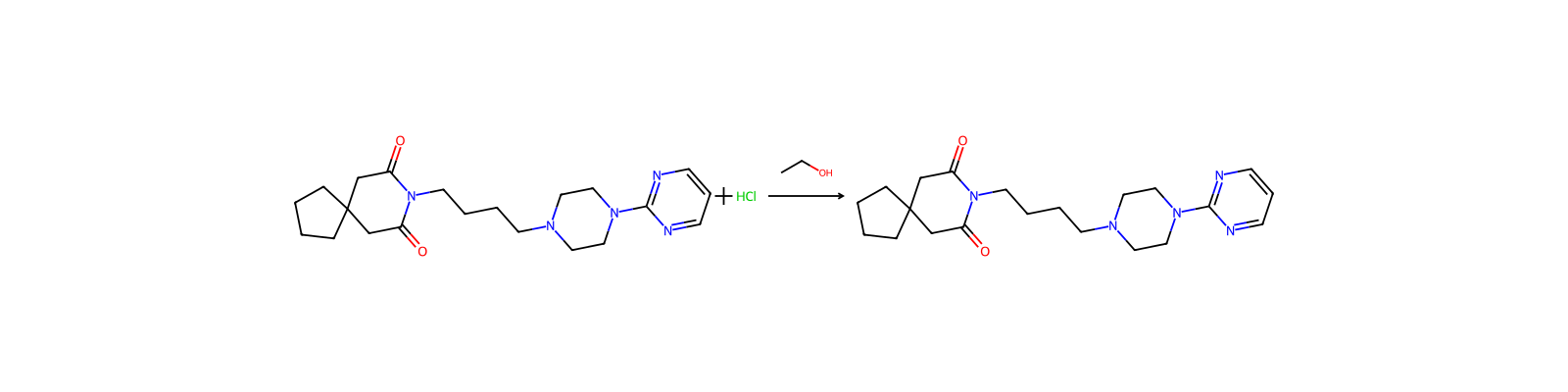

기본 정보
- 표준 SMILES
Cl.O=C1CC2(CCCC2)CC(=O)N1CCCCN1CCN(c2ncccn2)CC1- InChIKey
RICLFGYGYQXUFH-UHFFFAOYSA-N- 분자식
- C21H32ClN5O2
- 평균 분자량
- 422 g/mol
- 단동위원소 질량
- 421.224453
이름 및 식별자
- 우선 이름
- Buspirone Hydrochloride
- IUPAC
- 8-[4-(4-pyrimidin-2-ylpiperazin-1-yl)butyl]-8-azaspiro[4.5]decane-7,9-dione;hydrochloride
- 현지명
- 버스피론 수화염화물
- 영어명
- Buspirone hydrochloride
- 분자식
- C21H32ClN5O2
- 분자량
- 421.96
이름 및 동의어
Buspirone hydrochloride33386-08-2Buspirone HCLSpamilanMJ 9022-1NSC-751138NSC-759571207LT9J9OCAPD405MJ-9022-1APD-405N-(4-(4-(2-Pyrimidinyl)-1-piperazinyl)butyl)-1,1-cyclopentanediacetamide monohydrochloride
이름 더 보기
버스피론수화염화물버스피론수화염화물(BUSPIRONEHYDROCHLORIDE)NarolbesparaxorentravinAnsialcensparlucelanAnsicedbuspinol
CHEBI:3224DTXSID10371938-[4-(4-pyrimidin-2-ylpiperazin-1-yl)butyl]-8-azaspiro[4.5]decane-7,9-dione hydrochloride8-Azaspiro[4.5]decane-7,9-dione, 8-[4-[4-(2-pyrimidinyl)-1-piperazinyl]butyl]-, monohydrochloride8-(4-(4-pyrimidin-2-ylpiperazin-1-yl)butyl)-8-azaspiro(4.5)decane-7,9-dione hydrochlorideN-[4-[4-(2-Pyrimidinyl)-1-piperazinyl]butyl]-1,1-cyclopentanediacetamide monohydrochloride8-Azaspiro(4.5)decane-7,9-dione, 8-(4-(4-(2-pyrimidinyl)-1-piperazinyl)butyl)-, monohydrochlorideHydrochloride, Buspirone
데이터베이스 식별자
- CAS
33386-08-2- PubChem CID
- 36431
- DTXSID
DTXSID1037193- ChEMBL
CHEMBL1200399- ChEBI
CHEBI:3224- UNII
- 207LT9J9OC
- EC Number
- 251-489-4
물성
구조 계산 물성
- 극성 표면적
- 69.6 Ų
- 수소 결합 공여자 수
- 1
- 수소 결합 수용자 수
- 6
- 회전 가능 결합 수
- 6
- 무거운 원자 수
- 29
- 형식 전하
- 0
- 복잡도
- 529
실험 및 물리화학적 성질
Collision Cross Section197.7 Ų [M+H]+ [CCS Type: TW; Method: calibrated with polyalanine and drug standards]
물리화학적 성질
- 녹는점
- 201.5 · 201.5-202.50C
- 인화점
- 9 ℃ · 9℃
- 저장 조건
- 2 · 2-8°C
- 용해도
- 물과 메탄올에 잘 녹고 아세톤에는 거의 녹지 않습니다.
- 물리적 상태
- Solid
- 색상
- White to off-white
- 수용성
- 메탄올(50mg/ml), 물(일부), DMSO(100mM)에 용해됩니다.
- 주요 응용
- 제약
- InChI
- InChI=1S/C21H31N5O2.ClH/c27-18-16-21(6-1-2-7-21)17-19(28)26(18)11-4-3-10-24-12-14-25(15-13-24)20-22-8-5-9-23-20;/h5,8-9H,1-4,6-7,10-17H2;1H
- InChIKey
- RICLFGYGYQXUFH-UHFFFAOYSA-N
- SMILES
- C12(CCCC1)CC(N(CCCCN1CCN(C3=NC=CC=N3)CC1)C(=O)C2)=O.Cl
화학적 성질
White Solid
안전 및 규제
GHS 분류
GHS Classification
Danger
H301 (100%): Toxic if swallowed [Danger Acute toxicity, oral]
P264, P270, P301+P316, P321, P330, P405, and P501 (click each P-code to see the statement)
Aggregated GHS information provided per 47 reports by companies from 4 notifications to the ECHA C&L Inventory.;Information may vary between notifications depending on impurities, additives, and other factors. The percentage value in parenthesis indicates the notified classification ratio from companies that provide hazard codes. Only hazard codes with percentage values above 10% are shown. For more detailed information, please visit ECHA C&L website.
유해성 정보
Regulatory InformationBuspirone hydrochloride: Does not have an individual approval but may be used under an appropriate group standard
Hazard Classes and CategoriesAcute Tox. 3 (100%)
독성 정보
Treatment
General symptomatic and supportive measures should be used along with immediate gastric lavage. Respiration, pulse, and blood pressure should be monitored as in all cases of drug overdosage. No specific antidote is known to buspirone, and dialyzability of buspirone has not been determined. (L1712)
Exposure RoutesOral.
Rapidly absorbed in man. Bioavailability is low and variable (approximately 5%) due to extensive first pass metabolism.
Toxicity Summary
Buspirone binds to 5-HT type 1A serotonin receptors on presynaptic neurons in the dorsal raphe and on postsynaptic neurons in the hippocampus, thus inhibiting the firing rate of 5-HT-containing neurons in the dorsal raphe. Buspirone also binds at dopamine type 2 (DA2) receptors, blocking presynaptic dopamine receptors. Buspirone increases firing in the locus ceruleus, an area of brain where norepinephrine cell bodies are found in high concentration. The net result of buspirone actions is that serotonergic activity is suppressed while noradrenergic and dopaminergic cell firing is enhanced.
Signs and SymptomsSymptoms of overdose include dizziness, drowsiness, nausea or vomiting, severe stomach upset, and unusually small pupils.
Carcinogen ClassificationNo indication of carcinogenicity to humans (not listed by IARC).
Drug Induced Liver Injury
Drug Induced Liver Injury Rank (DILIrank 2.0)
Buspirone hydrochloride
Ambiguous-DILI-concern
3
Adverse reactions
DOI:10.1016/j.drudis.2016.02.015
Toxicity DataLD50: 136 mg/kg (Oral, rat)
규제 정보
Regulatory InformationBuspirone hydrochloride: Does not have an individual approval but may be used under an appropriate group standard
안전 데이터
- wgk
- 3
- rtecs
- CL9915000
- ridadr
- UN 2811 6.1/PG 3
- 독성
- LD50 i.p. in rats: 136 mg/kg (Allen)
- HS 번호
- 29335995
- risk_code
- 25-36/37/38-20/21/22-39/23/24/25-23/24/25-11
- hazard_code
- T,Xn,F
- safety_code
- 45-36-26-36/37-16
- 위험 등급
- 6.1
- 기존화학 물질
- KE-29964
- Hazard Classifications
- Acute Tox. 3 Oral
- 스토리지 클래스
- 6.1C - Combustible acute toxic Cat.3toxic compounds or compounds which causing chronic effects
화학 및 산업
약리 정보
Metabolism/Metabolites
Metabolized hepatically, primarily by oxidation by cytochrome P450 3A4 producing several hydroxylated derivatives and a pharmacologically active metabolite, 1-pyrimidinylpiperazine (1-PP) Route of Elimination: In a single-dose study using 14C-labeled buspirone, 29% to 63% of the dose was excreted in the urine within 24 hours, primarily as metabolites; fecal excretion accounted for 18% to 38% of the dose. Half Life: 2-3 hours (although the action of a single dose is much longer than the short halflife indicates).
MeSH Pharmacological Classification
Agents that alleviate ANXIETY, tension, and ANXIETY DISORDERS, promote sedation, and have a calming effect without affecting clarity of consciousness or neurologic conditions. ADRENERGIC BETA-ANTAGONISTS are commonly used in the symptomatic treatment of anxiety but are not included here.
Endogenous compounds and drugs that bind to and activate SEROTONIN RECEPTORS. Many serotonin receptor agonists are used as ANTIDEPRESSANTS; ANXIOLYTICS; and in the treatment of MIGRAINE DISORDERS.
용도 및 제조
UsesFor the management of anxiety disorders or the short-term relief of the symptoms of anxiety, and also as an augmention of SSRI-treatment against depression.
응용 분야
개요Buspirone hydrochloride is an anxiolytic agent indicated for the management of anxiety disorders with or without accompanying depression. In contrast to the benzodiazepines, buspirone does not interact with alcohol, and lacks sedative, anticonvulsant, and muscle relaxant effects, and abuse potential.
용도Non-benzodiazepine anxiolitic; 5-hydroxytryptamine (5-HT1) receptor agonist.
일반 설명Pharmaceutical secondary standards for application in quality control provide pharma laboratories and manufacturers with a convenient and cost-effective alternative to the preparation of in-house working standards
상·하류 제품 정보
상류 원료
공급사50 곳
天津始加生物医药科技有限公司15022261580 · [email protected]
湖南韵邦生物科技股份有限公司85561037 15386497078 · [email protected]
南通飞宇生物科技有限公司0513-68819626 15152877458 · [email protected]
济南百隆化学有限公司[email protected] · [email protected]
盐城通铭生物科技有限公司15195160625 · [email protected]
深圳市健竹科技有限公司0755-89218110 13480856786
成都彼样生物科技有限公司18108052721 · [email protected]
广州隽沐生物科技股份有限公司020-36607679; 13502246435 · [email protected]
Baoji Guokang Healthchem co.,ltd+8615604608665 15604608665 · [email protected]
重庆康洲智通医药科技有限公司173-08362167 17308362167 · [email protected]
Dayang Chem (Hangzhou) Co.,Ltd.+86-0571-88938639 17705817739 · [email protected]
南京世洲生物科技有限公司025-025-85560043 17301488900 · [email protected]
Hebei Yanxi Chemical Co., Ltd.+86-17531190177 · [email protected]
Hangzhou Verychem Science And Technology Co.Ltd+86-86-57188162785 +8613606544505 · [email protected]
LGM Pharma1-(800)-881-8210 · [email protected]
湖北辰心化工有限公司18696113233 · [email protected]
武汉易泰科技有限公司上海分公司18930552037 · [email protected]
太原市瑞和丰科贸有限公司+86 351 7031519 · [email protected]
广州市亿邦医药科技有限公司+86 (20) 28996708,29078958,28139708,29076128,28133708,28139728,28139738,28133718,021-31663278,021-31663578,021-60538387
西安泽邦生物科技有限公司[email protected]
Pure Chemistry Scientific Inc.001-857-928-2050 or 1-888-588-9418 · [email protected]
上海泰坦科技股份有限公司400-6009262 15618770481 · [email protected]
山东锐顺药业有限公司+86-0538-8923092 13958575904 · [email protected]
天津狄克特科技有限公司22-58627059 13920586291 · [email protected]
佛山宝诺生物科技有限公司0757-85921206 18520245316 · [email protected]
苏州启航生物科技有限公司18662190603;18151111370 · [email protected]
ChemeGen 中国18818260767 · [email protected]
深圳菲斯生物科技有限公司0755-83725681-603
Wuhan NCE Biomedical Co.,Ltd.4000-027-021 |24 +86-13986109188 | +86-15623472865 | +81-08033611988
深圳振强药物研发有限公司0755-66853366 13670046396 · [email protected]
上海敏寒医药科技有限公司17612188245 · [email protected]
南京世洲生物科技有限公司13675144456 · [email protected]
天津普西唐生物医药科技有限公司010-60605840 · [email protected]
上海麦克林生化科技股份有限公司15221275939 15221275939 · [email protected]
杭州杰恒化工有限公司0571-87396432 · [email protected]
南京恰风和医药科技有限公司025-57018978 18251899859 · [email protected]
广州市慈铭生物科技有限公司020-38082199,29065168,38082986,29878298,29866629,4000192398
陕西缔都医药化工有限公司029-81024372 17792795018 · [email protected]
凯试(上海)科技有限公司021-50135380 · [email protected]
武汉贝乐叶生物医药科技有限公司18086118078 · [email protected]
湖北巨胜科技有限公司027-59599241 18871490274 · [email protected]
池州凯隆进出口贸易有限公司[email protected]
Sigma-Aldrich西格玛奥德里奇(上海)贸易有限公司021-61415566 800-8193336 · [email protected]
南京熙泽医药科技有限公司025-66023220 15250997978 · [email protected]
珠海安哲生物科技有限公司13169972583 · [email protected]
TargetMol中国(陶术生物)021-021-33632979 15002134094 · [email protected]
上海昕凯医药科技有限公司21-619849051-1 18521059765 · [email protected]
上海陶术生物科技股份有限公司+1-781-999-5354; +1-00000000000 · [email protected]
斯派螺(武汉)药物研发有限公司[email protected]
BOC Sciences16314854226; +8616314854226 · [email protected]
추가 설명
정의ChEBI: A hydrochloride salt resulting from the reaction of equimolar amounts of buspirone and hydrogen chloride.
관련 반응
8건


연결된 노트
불러오는 중…