

기본 정보
- 표준 SMILES
CC(C)(C)C(O)C(Oc1ccc(Cl)cc1)n1cncn1- InChIKey
BAZVSMNPJJMILC-UHFFFAOYSA-N- 분자식
- C14H18ClN3O2
- 평균 분자량
- 295.76 g/mol
- 단동위원소 질량
- 295.1087545
이름 및 식별자
- 우선 이름
- Triadimenol
- IUPAC
- 1-(4-chlorophenoxy)-3,3-dimethyl-1-(1,2,4-triazol-1-yl)butan-2-ol
- 영어명
- Triadimenol
- 분자식
- C14H18ClN3O2
- 분자량
- 295.76
이름 및 동의어
TRIADIMENOL55219-65-3BaytanBayfidanSpinnakerTriafolSummitTriapholBaytan 151-(4-chlorophenoxy)-3,3-dimethyl-1-(1,2,4-triazol-1-yl)butan-2-olTridan FungicideBayfrdan EW
이름 더 보기
b-(4-Chlorophenoxy)-a-(1,1-dimethylethyl)-1H-1,2,4-triazole-1-ethanolSAMETuk199TRIADIMkwg0519baytoan
UK 199Baytan TF 3479BVydine1-(4-Chlorophenoxy)-3,3-dimethyl-1-(1H-1,2,4-triazol-1-yl)butan-2-olBAY KWG 0519KWG 0519DTXSID0032493NFR7MRD9NM
데이터베이스 식별자
- CAS
55219-65-3- PubChem CID
- 41368
- DTXSID
DTXSID0032493- ChEMBL
CHEMBL520275- ChEBI
CHEBI:9666- UNII
- NFR7MRD9NM
- EC Number
- 259-537-6
- Nikkaji
- J11.445F
물성
구조 계산 물성
- XLogP
- 3.1
- 극성 표면적
- 60.2 Ų
- 수소 결합 공여자 수
- 1
- 수소 결합 수용자 수
- 4
- 회전 가능 결합 수
- 5
- 무거운 원자 수
- 20
- 형식 전하
- 0
- 복잡도
- 303
실험 및 물리화학적 성질
LogPlog Kow = 2.90
OdorSlight non-specific odor
Density1.22 g/cu cm
Color/FormColorless crystalline solid
Solubility
Soluble in alcohol, ketones
In water, 120 mg/L at 20 °C
DecompositionWhen heated to decomposition it emits toxic vapors of /Nitrogen oxides and Chlorides/.
Melting Point118-130 °C
Vapor Pressure3.1X10-10 mm Hg at 20 °C
Physical DescriptionSolid with a mild non-specific odor; [Merck Index] Formulated as emulsifiable, soluble, and flowable concentrates and wettable powder; [Reference #1]
Kovats Retention Index
2078.6;2087.9;2076;2084;2095;2088;2104;2065.3;2063.1;2064.6;2069.9;2079.6;2062.6;2064;2087.9
2050;2069;2066.7;2061.9;2077.1;2023;2051.8
Collision Cross Section172.08 Ų [M+H]+;177.62 Ų [M+Na]+;178.1 Ų [M+HCOO]-
Other Experimental Properties
Diastereoisomer A(1RS, 2SR) and diastereoisomer B(1RS, 2RS) ratio of A:B is 7:3
Diastereoisomer A: MP = 138.2 °C; VP = 6X10⁻⁴ mPa at 20 °C; SG/Density = 1.237 g/cu cm at 22 °C; Kow (logP) = 3.08 at 25 °C; Henry's Law constant = 3X10⁻⁶ Pa cu m mol-1 at 20 °C; solubility = 62 mg/L in water at 20 °C
Diastereoisomer B: MP = 133.5 °C; VP = 4X10⁻⁴ mPa at 20 °C; SG/Density = 1.299 g/cu cm at 22 °C; Kow (logP) = 3.28 at 25 °C; Henry's Law constant = 4X10⁻⁶ Pa cu m mol-1 at 20 °C; solubility = 33 mg/L in water at 20 °C
물리화학적 성질
- 녹는점
- 112 · 112-117°
- 끓는 점
- 465.4 · 465.4±55.0 °C(Predicted)
- 밀도
- 1.299 · 1.2990 (rough estimate)
- 증기압
- 6 x · A 6 x l0-7 Pa (20 °C); B 4 x l0-7 Pa (20 °C)
- 굴절률
- 1.527 · 1.5270 (estimate)
- 인화점
- 2 °C · 2 °C
- 저장 조건
- 2 · 2-8°C
- 용해도
- DMSO(약간 용해됨), 메탄올(약간 용해됨)
- 수용성
- 62 mg · A 62mg l-1(20°C); B 33mg l-1(20°C)
- 산도 계수 (pKa)
- 13.29 · 13.29±0.20(Predicted)
- 물리적 상태
- Solid
- 색상
- 흰색에서 황백색까지
- Merck
- 13 · 13,9667
- BRN
- 616470 · 616470
- Henry's Law Constant
- 7.6 · 7.6×106 mol/(m3Pa) at 25℃, HSDB (2015)
- InChI
- 1S/C14H18ClN3O2/c1-14(2,3)12(19)13(18-9-16-8-17-18)20-11-6-4-10(15)5-7-11/h4-9,12-13,19H,1-3H3
- InChIKey
- BAZVSMNPJJMILC-UHFFFAOYSA-N
- SMILES
- CC(C)(C)C(O)C(Oc1ccc(Cl)cc1)n2cncn2
- LogP
- 2.9 · 2.900
- NIST
- Triadimenol(55219-65-3)
- EPA
- Triadimenol (55219-65-3)
안전 및 규제
GHS 분류
GHS Classification
Danger
H302: Harmful if swallowed [Warning Acute toxicity, oral];H360: May damage fertility or the unborn child [Danger Reproductive toxicity];H362: May cause harm to breast-fed children [Reproductive toxicity, effects on or via lactation];H411: Toxic to aquatic life with long lasting effects [Hazardous to the aquatic environment, long-term hazard]
P203, P260, P263, P264, P270, P273, P280, P301+P317, P318, P330, P391, P405, and P501 (click each P-code to see the statement)
This chemical does not meet GHS hazard criteria for 0.9% (1 of 114) of reports.
유해성 정보
Regulatory Information
Hazard Traits - Reproductive Toxicity;Authoritative List - EC Annex VI CMRs - Cat. 1B;Report - if used as a fragrance or flavor ingredient
Commission Regulation (EC) No 1490/2002
Triadimenol is listed in the dataset of EPA Human Health Benchmarks for Pesticides under the Safe Drinking Water Act (40 eCFR 141)
2008/125, Reg. (EU) 2022/801, Reg. (EU) No 540/2011
Triadimenol: Does not have an individual approval but may be used under an appropriate group standard
Other Safety Information
IMAP assessments - 1H-1,2,4-Triazole-1-ethanol, .beta.-(4-chlorophenoxy)-.alpha.-(1,1-dimethylethyl)-: Human health tier I assessment;IMAP assessments - 1H-1,2,4-Triazole-1-ethanol, .beta.-(4-chlorophenoxy)-.alpha.-(1,1-dimethylethyl)-: Environment tier I assessment
Hazards Summary
Commercial material is mixture of two diastereoisomers; [Merck Index] Increased liver enzyme activity (ALT and AST) and histopathological liver changes observed in 13-week feeding study of rats at the three highest doses tested (500, 1,500, and 4,500 ppm); A 15-day dermal study of rabbits produced a NOAEL greater than highest tested dose (250 mg/kg/day); Teratogenic effects seen in tadpoles (branchial arches) and cultured rat embryos (cranial nerve and ganglia); No evidence of mutagenicity; [HSDB] Not irritating to skin or eyes of rabbits; Not sensitizing to guinea pig skin; No adverse effects to reproductive performance observed in 2-generation study of rats; No evidence of primary embryotoxic or teratogenic effects in rats or rabbits administered by gavage in the most sensitive stage of gestation; No evidence of carcinogenicity in rats or mice; [IUCLID] Repeated dose studies have shown the liver to be the target organ of toxicity (enlargement with corresponding changes in clinical chemistry); Chronic studies of rats and mice also demonstrated hepatotoxicity; Multigenerational studies produced reduced pup survival during lactation and decreased fertility index in all generations in one study; Acute triadimefon (structurally and metabolically similar fungicide) neurotoxicity studies of rats showed reversible hyperactivity and increased motor and locomotor activity without neuropathological changes; Sub-chronic studies produced consistent effects with no increase in severity observed; Does not possess potential for mutagenicity or carcinogenicity; [EFSA] See Triadimefon.
Special Reports
USEPA/Office of Prevention, Pesticides and Toxic Substances; Reregistration Eligibility Decision Document for Triadimefon and Tolerance Reassessment for Triadimenol EPA 738-R-06-003 (August 2006). The RED summarizes the risk assessment conclusions and outlines any risk reduction measures necessary for the pesticide to continue to be registered in the U.S.[Available from, as of May 27, 2009: http://www.epa.gov/pesticides/reregistration/status.htm]
California Environmental Protection Agency/Department of Pesticide Regulation; Toxicology Data Review Summary for Triadimenol (55219-65-3).[Available from, as of May 13, 2009: http://www.cdpr.ca.gov/docs/risk/toxsums/toxsumlist.htm]
USEPA, Office of Prevention, Pesticides, and Toxic Substances; Revised HED Human Health Risk Assessment for Triadimenol (52219-65-3) (February 2006). EPA Docket No.: EPA-HQ-OPP-2006-0038-0005.
European Chemicals Bureau; IUCLID Dataset, Triadimenol (55219-65-3) (2000 CD-ROM edition).[Available from, as of May 8, 2009: http://esis.jrc.ec.europa.eu/]
FIFRA Requirements
Tolerances are established for the combined residues of the fungicide triadimefon, 1-(4-chlorophenoxy)-3,3-dimethyl-1-(1H -1,2,4-triazol-1-yl)-2-butanone, and triadimenol, beta-(4-chlorophenoxy)-alpha-(1,1-dimethylethyl)-1H -1,2,4-triazole-1-ethanol, expressed as triadimefon, in or on the following food commodities: [Table#7396]
Tolerances with regional registrations, as defined in part 180.1(m), are established for the combined residues of the fungicide triadimefon, 1-(4-chlorophenoxy)-3,3-dimethyl-1-(1H -1,2,4-triazol-1-yl)-2-butanone, and triadimenol, beta-(4-chlorophenoxy)-alpha-(1,1-dimethylethyl)-1H -1,2,4-triazole-1-ethanol, expressed as triadimefon, in or on the following food commodities: [Table#7397]
Triadimenol, a metabolite of triadimefon, is also a registered fungicide. Triadimenol was first registered after 1984 and is not subject to reregistration under the 1988 amendments to FIFRA. Triadimenol is, however, subject to tolerance reassessment under the FFDCA, as amended by FQPA. Based on its evaluation of combined exposures from the uses of triadimefon, triadimenol, and their metabolites, the Agency has determined that the tolerances for triadimefon and triadimenol are considered to be reassessed under FFDCA.
New Active Ingredients ... includes chemicals not previously registered as pesticides, as well as pesticide active ingredients initially registered after November 1, 1984 and that currently have active product registrations. By law, these pesticides must meet new safety standards, such as those described in the Food Quality Protection Act of 1996 and, if new safety standards are met, will be reviewed again on a 15-year cycle. Triadimenol is designated by EPA as a New Pesticide Active Ingredient. Active Ingredient Number: 127201; Type of Pesticide: conventional - fungicide; Use Site: food use, turf, ornamentals; Year: 1989.
Hazard Classes and Categories
Acute Tox. 4 (99.1%);Acute Tox. 4 (34.2%);Repr. 1B (26.3%);Lact. (27.2%);Aquatic Chronic 2 (27.2%);Aquatic Chronic 3 (34.2%)
Acute toxicity - category 4;Reproductive toxicity - category 1B;Reproductive toxicity - effects on or via lactation;Hazardous to the aquatic environment (chronic) - category 2
Repr. 1B;Lact.;Acute Tox. 4;Aquatic Chronic 2
Skin, Eye, and Respiratory IrritationsAn eye irritant, and causes a mild skin dermal irritation.
안전 및 보호
Cleanup Methods
SRP: Wastewater from contaminant suppression, cleaning of protective clothing/equipment, or contaminated sites should be contained and evaluated for subject chemical or decomposition product concentrations. Concentrations shall be lower than applicable environmental discharge or disposal criteria. Alternatively, pretreatment and/or discharge to a POTW is acceptable only after review by the governing authority. Due consideration shall be given to remediation worker exposure (inhalation, dermal and ingestion) as well as fate during treatment, transfer and disposal. If it is not practicable to manage the chemical in this fashion, it must meet Hazardous Material Criteria for disposal.
Disposal Methods
SRP: The most favorable course of action is to use an alternative chemical product with less inherent propensity for occupational exposure or environmental contamination. Recycle any unused portion of the material for its approved use or return it to the manufacturer or supplier. Ultimate disposal of the chemical must consider: the material's impact on air quality; potential migration in soil or water; effects on animal, aquatic, and plant life; and conformance with environmental and public health regulations.
Do not discharge effluent containing this product into lakes, streams, ponds, estuaries, oceans, or other waters unless in accordance with the requirements of a National Pollutant Discharge Elimination System (NPDES) permit and the permitting authority has been notified in writing prior to discharge.
Preventive Measures
SRP: Contaminated protective clothing should be segregated in such a manner so that there is no direct personal contact by personnel who handle, dispose, or clean the clothing. Quality assurance to ascertain the completeness of the cleaning procedures should be implemented before the decontaminated protective clothing is returned for reuse by the workers. Contaminated clothing should not be taken home at end of shift, but should remain at employee's place of work for cleaning.
SRP: The scientific literature for the use of contact lenses in industry is conflicting. The benefit or detrimental effects of wearing contact lenses depend not only upon the substance, but also on factors including the form of the substance, characteristics and duration of the exposure, the uses of other eye protection equipment, and the hygiene of the lenses. However, there may be individual substances whose irritating or corrosive properties are such that the wearing of contact lenses would be harmful to the eye. In those specific cases, contact lenses should not be worn. In any event, the usual eye protection equipment should be worn even when contact lenses are in place.
Discard clothing and other absorbent materials that have been drenched or heavily contaminated with this product's concentrate. Do not reuse them.
Users should wash hands before eating, drinking, chewing gum, using tobacco, or using the toilet.
For more Preventive Measures (Complete) data for Triadimenol (13 total), please visit the HSDB record page.
Allowable Tolerances
Tolerances are established for the combined residues of the fungicide triadimefon, 1-(4-chlorophenoxy)-3,3-dimethyl-1-(1H -1,2,4-triazol-1-yl)-2-butanone, and triadimenol, beta-(4-chlorophenoxy)-alpha-(1,1-dimethylethyl)-1H -1,2,4-triazole-1-ethanol, expressed as triadimefon, in or on the following food commodities: [Table#7394]
Tolerances with regional registrations, as defined in part 180.1(m), are established for the combined residues of the fungicide triadimefon, 1-(4-chlorophenoxy)-3,3-dimethyl-1-(1H -1,2,4-triazol-1-yl)-2-butanone, and triadimenol, beta-(4-chlorophenoxy)-alpha-(1,1-dimethylethyl)-1H -1,2,4-triazole-1-ethanol, expressed as triadimefon, in or on the following food commodities: [Table#7395]
Personal Protective Equipment (PPE)
Water soluble packets when used correctly qualify as a closed mixing/loading system under the Worker Protection Standard for Agricultural Pesticides [40 CFR 170.240(d)(4)]. Mixers and loaders using water soluble packets must: wear the personal protective equipment required on this labeling for mixers and loaders, and be provided, have immediately available, and wear in an emergency, such as a broken package, spill, or equipment breakdown: chemical resistant footwear and a NIOSH-approved respirator equipped with a dust/mist filter with MSHA/NIOSH approval number prefix TC-21C or any N, R, P, or HE filter.
Mixers, loaders, applicators, flaggers, and other handlers must wear long sleeved shirt and long pants, shoes plus socks, and chemical resistant gloves when mixing/loading, when applying using handheld equipment or handheld nozzles, or when handling treated seed (including spreading, drying, raking, bagging, and sewing seed bags).
독성 정보
Interactions
... Doses of 15 and 60 mg/kg /triadimenol/ potentiated the effect of amphetamine while doses of 12 to 48 mg/kg antagonized the reserpin response. Triadimenol also prolonged the hexobartital sleeping time at 15 and 60 mg/kg.
... Rats exposed to 48 mg/kg triadimenol elicited an excitatory effect. A comparison with caffeine (doses of 2.5 and 10 mg/kg) showed that the effect of 2.5 mg/kg caffeine corresponded approximately to that of 12 to 15 mg/kg KWG 0519, in the amphetamine potentiation test 2.5 mg/kg caffeine elicited a similar response as 4 mg/kg KWG 0519, while in the antagonism of ptosis 10 mg/kg caffeine and 12 mg/kg KWG 0519 were comparable. The noeffect dose was 1 mg/kg for caffeine. The findings of this study point to a potential for stimulation of Central Nervous System (CNS).
Ecotoxicity Values
LC50; Species: Anas platyrhynchos (Mallard duck, age 13 days) diet >5000 ppm for 8 days
LC50; Species: Colinus virginianus (Northern bobwhite) diet >2000 ppm for 8 days
LC50; Species: Colinus virginianus (Northern bobwhite, age 16 days) diet >5000 ppm for 8 days
LD50; Species: Serinus canaria (Island canary) oral >1000 mg/kg
For more Ecotoxicity Values (Complete) data for Triadimenol (11 total), please visit the HSDB record page.
Environmental Fate
TERRESTRIAL FATE: Based on a classification scheme(1), Koc values of 211(2) to 992(3) indicate that triadimenol is expected to have moderate to low mobility in soil(SRC). Volatilization of triadimenol from moist soil surfaces is not expected to be an important fate process(SRC) given an estimated Henry's Law constant of 1.3X10⁻¹² atm-cu m/mole(SRC), based upon its vapor pressure, 3.1X10⁻¹⁰ mm Hg(4), and water solubility, 120 mg/L(5). Triadimenol is not expected to volatilize from dry soil surfaces(SRC) based upon a vapor pressure(4). In soil, triadimefon degraded with a half life of 15 days to form triadimenol, which was found to be fairly persistent in accord with other compounds that contain triazole groups(6).
TERRESTRIAL FATE: Numerous field studies indicated the presence of triadimenol following the application of triadimefon. Triadimenol residues in soil have been detected after several years of application. Based on one apple orchard trial, triadimenol can consist of 0.13-0.65 mg/kg in the 0-10 cm layer soil during 5 years. The half-life value for triadimenol was determined to range from 3-months to 500 days and consequently thought of as a persistent compound in soil. Often triadimefon and triadimenol are quantified together; however, crop studies specifically detected triadimenol in apples, grapes, melons, strawberries, tomatoes, and wheat at levels up to 0.52 mg/kg at 42 days. 14-C-Radiolabeling studies of 14-C triadimefon treated crops indicated a triadimenol 14-C recovery of 0-1% from barley, 6-23% from wheat, and 25% from apples(1).
AQUATIC FATE: Based on a classification scheme(1), Koc values of 211(2) to 992(3), indicate that triadimenol is expected to adsorb to suspended solids and sediment(SRC). Volatilization from water surfaces is not expected(4) based upon an estimated Henry's Law constant of 1.3X10⁻¹² atm-cu m/mole(SRC), derived from its vapor pressure, 3.1X10⁻¹⁰ mm Hg(5) and water solubility, 120 mg/L(6). According to a classification scheme(7), an estimated BCF of 21(SRC), from a log Kow(2) and a regression-derived equation(8), suggests the potential for bioconcentration in aquatic organisms is low(SRC). Triadimenol adsorbed on sediments of a pond had a half-life 110-375 days(9).
ATMOSPHERIC FATE: According to a model of gas/particle partitioning of semivolatile organic compounds in the atmosphere(1), triadimenol, which has a vapor pressure of 3.1X10⁻¹⁰ mm Hg at 25 deg(2) is expected to exist solely in the particulate phase in the ambient atmosphere. Particulate-phase triadimenol may be removed from the air by wet or dry deposition(SRC). Triadimenol contains chromophores that absorb at wavelengths >290 nm(3); it undergoes some photodegradation upon solar radiation, at a rate of 2.8X10⁻² umol/sq cm-hr(4).
Adverse EffectsOccupational hepatotoxin - Secondary hepatotoxins: the potential for toxic effect in the occupational setting is based on cases of poisoning by human ingestion or animal experimentation.
Ecotoxicity Excerpts
/AQUATIC SPECIES/ Conazole fungicides are commonly used to prevent fungal growth on turf grass and agricultural crops. As many of these sites are adjacent to coastal waterways and estuaries, there exists the potential for nontarget effects of runoff on marine organisms. This study reports 96 hr EC(50) values for four selected conazole fungicides (triadimefon = 5.98 mg/L; triadimenol = 5.51 mg/L; propiconazole = 2.33 mg/L; hexaconazole = 0.91 mg/L) to the model test alga Dunaliella tertiolecta. We further investigated possible mechanisms of toxicity by examining sublethal effects of exposure on cell morphology, osmoregulatory function, and lipid composition. These mechanistic studies revealed that conazole exposure does not inhibit synthesis of the cell's glycerol osmolyte, but does result in an overall increase in cellular volume and total lipid content. Both fungi and chlorophytes rely on ergosterol to maintain membrane structure and fluidity, and we provide evidence that the sterol-inhibiting conazoles may interfere with ergosterol biosynthesis in the cell membrane of Dunaliella. ...
/AQUATIC SPECIES/ ... A rainbow trout (Oncorhynchus mykiss) microsomal aromatase assay /was optimized/ to measure the effects of 43 substances ... on brain and ovarian aromatase activities in vitro. ... 12 compounds were able to inhibit brain and ovarian aromatase activities in a dose-dependent manner with IC50 values ranging from the low nM to the high uM range depending on the substance: steroidal and non steroidal inhibitors of aromatase (4-hydroxyandrostenedione, androstatrienedione, aminogluthethimide), imidazole fungicides (clotrimazole, imazalil, prochloraz), triazole fungicides (difenoconazole, fenbuconazole, propiconazole, triadimenol), the pyrimidine fungicide fenarimol and methylmercury...
Plant Concentrations
At Kentville, Nova Scotia, Canada, seeds of Lennox winter wheat were treated with triadimenol at the rate of 0.3 g a.i./kg, and planted on September 18. Samples of green foliage were taken November 23 and analyzed for triadimenol on May 7 and June 14 of the following year. Residues of triadimenol at the first, second and third sampling dates averaged 0.05, 0.02 and 0.02 ppm, respectively. In another study, Lennox winter wheat treated with triadimenol at the rate of 0.3 g a.i./kg seed on August 26, was planted on September 4; samples of foliage taken November 16 found 0.03 ppm triadimenol in the foliage(1).
Residues of triadimefon, including triadimenol, have been determined in extensive trials on growing cereal plants, e.g. barley, oat and wheat. The majority of residue is in the converted triadimenol form at day 14(1).
Soil Adsorption/Mobility
In Germany, triadimenol sediment was sampled at depths of 0-15 cm depth from the pond and analyzed; Kf = 8.3, Kd = 7.6, and Koc = 211 were calculated for triadimenol(1). Koc values were estimated for triadimenol using soil samples from various European sites as follows: Sicily, Italy (992, clay), Peloponnesos, Greece (161, silt loam), Wales, U.K. (231, loam), Normandy, France (150, silt), and Schleswig-Holstein, Germany (568, loamy sand)(2). According to a classification scheme(3), these Koc values suggest that triadimenol is expected to have low to moderate mobility in soil.
Human Toxicity Excerpts
/SURVEILLANCE/ ... Of the 46 non-occupational exposures /reported to the Poison Control Center between 1993 and 1998/, 13 occurred in children under six years of age. Of the total 20 cases with medically determined outcome, 11 reported minor medical outcome. Of the total 54 exposures to triadimefon/triadimenol, just four were seen in a health care facility and none required hospitalization. A review of symptoms revealed almost exclusively irritation effects (including rash and erythema) to skin, mouth, throat, and eyes. These effects were reported a total of 24 times with some patients reporting two or more of these symptoms. There were four cases reporting headache and two reported cough. No other significant symptoms were reported.
/SURVEILLANCE/ /According to the California Department of Pesticide Regulation, following exposure to triadmefon/triadimnol/ foliar residues accounted for half of the illnesses and nearly half of the systemic illnesses. Although most of the symptoms appeared to be minor, skin and eye irritation, and rash were among the most common topical symptoms. The most common systemic effects included nausea, headache, sneezing, congestion, difficulty breathing and other allergic-type reactions. There were three reports of vomiting.
/ENDOCRINE MODULATION/ Estrogenic activities of 20 selected pesticides ... were examined by estrogen receptor (ER)-dependent MCF-7 cell proliferation assay. Among them, chlordecone, dicofol, methoxychlor, gamma-HCH, fenarimol, EPN, triadimefon, and triadimenol had estrogenic activities, all of which were suppressed by the addition of pure antiestrogen ICI 182,780. ... The antiestrogenic activity of a compound was examined by estimating its suppressive effect on cell proliferation induced by 30 pM 17beta-estradiol. Strongly suspected antiestrogens were captan and myclobutanil ... . Antiestrogenic activities of nitrofen, fenitrothion, fenarimol and triadimefon were also suggested...
Artificial Pollution Sources
Triadimenol's production may result in its release to the environment through various waste streams; its use as a systemic fungicide(1) will result in its direct release to the environment(SRC). In soil, triadimefon degraded with a half-life of 15 days to form triadimenol(2).
Environmental BiodegradationANAEROBIC: Triadimenol adsorbed on sediments of a pond had a half-life of 110-375 days(1).
Carcinogen ClassificationNo indication of carcinogenicity to humans (not listed by IARC).
Environmental Bioconcentration
An estimated BCF of 21 was calculated for triadimenol (SRC), using its log Kow of 2.90(1) and a regression-derived equation(2). According to a classification scheme(3), this BCF suggests the potential for bioconcentration in aquatic organisms is low(SRC).
규제 정보
Regulatory Information
Hazard Traits - Reproductive Toxicity;Authoritative List - EC Annex VI CMRs - Cat. 1B;Report - if used as a fragrance or flavor ingredient
Commission Regulation (EC) No 1490/2002
Triadimenol is listed in the dataset of EPA Human Health Benchmarks for Pesticides under the Safe Drinking Water Act (40 eCFR 141)
2008/125, Reg. (EU) 2022/801, Reg. (EU) No 540/2011
Triadimenol: Does not have an individual approval but may be used under an appropriate group standard
FIFRA Requirements
Tolerances are established for the combined residues of the fungicide triadimefon, 1-(4-chlorophenoxy)-3,3-dimethyl-1-(1H -1,2,4-triazol-1-yl)-2-butanone, and triadimenol, beta-(4-chlorophenoxy)-alpha-(1,1-dimethylethyl)-1H -1,2,4-triazole-1-ethanol, expressed as triadimefon, in or on the following food commodities: [Table#7396]
Tolerances with regional registrations, as defined in part 180.1(m), are established for the combined residues of the fungicide triadimefon, 1-(4-chlorophenoxy)-3,3-dimethyl-1-(1H -1,2,4-triazol-1-yl)-2-butanone, and triadimenol, beta-(4-chlorophenoxy)-alpha-(1,1-dimethylethyl)-1H -1,2,4-triazole-1-ethanol, expressed as triadimefon, in or on the following food commodities: [Table#7397]
Triadimenol, a metabolite of triadimefon, is also a registered fungicide. Triadimenol was first registered after 1984 and is not subject to reregistration under the 1988 amendments to FIFRA. Triadimenol is, however, subject to tolerance reassessment under the FFDCA, as amended by FQPA. Based on its evaluation of combined exposures from the uses of triadimefon, triadimenol, and their metabolites, the Agency has determined that the tolerances for triadimefon and triadimenol are considered to be reassessed under FFDCA.
New Active Ingredients ... includes chemicals not previously registered as pesticides, as well as pesticide active ingredients initially registered after November 1, 1984 and that currently have active product registrations. By law, these pesticides must meet new safety standards, such as those described in the Food Quality Protection Act of 1996 and, if new safety standards are met, will be reviewed again on a 15-year cycle. Triadimenol is designated by EPA as a New Pesticide Active Ingredient. Active Ingredient Number: 127201; Type of Pesticide: conventional - fungicide; Use Site: food use, turf, ornamentals; Year: 1989.
안전 데이터
- wgk
- 2
- rtecs
- KK2200000
- ridadr
- 2588
- 독성
- LD50 in male, female rats (mg/kg): 1161, 1105 orally; >5000 dermally, 24-hr; LD50 in quail: >10000 mg/kg (Frohberger)
- HS 번호
- 29339900
- risk_code
- 22-52/53-36-20/21/22-11-23-20/22
- hazard_code
- Xn,F,T
- safety_code
- 22-61-36-26-45
- 포장분류
- III
- 위험 등급
- 6.1(b)
- 기존화학 물질
- KE-05809
- Hazard Classifications
- Acute Tox. 4 OralAquatic Chronic 2Lact.Repr. 1B
- 스토리지 클래스
- 6.1C - Combustible acute toxic Cat.3toxic compounds or compounds which causing chronic effects
- 유해 물질 데이터
- 55219-65-3(Hazardous Substances Data)
화학 및 산업
약리 정보
Mechanism of Action
Triazole-derivatives alter the pharyngeal apparatus morphogenesis of rodent embryos cultured in vitro. The hindbrain segmentation and the rhombencephalic neural crest cell (NCCs) migration are altered by Fluconazole exposure in vitro. The aim of the present work is to identify if a common pathogenic pathway is detectable also for other molecules of this class of compounds. 9.5 days post coitum (d.p.c.) old rat embryos were exposed in vitro to the teratogenic concentrations of Flusilazole, Triadimefon and Triadimenol and cultured for 24, 48 or 60 hr. The expression and localization of Hox-b1 and Krox-20 proteins (used as markers for hindbrain segmentation) were evaluated after 24 hr of culture. The localization and distribution of NCC was evaluated after 24, 30 and 48 hr of culture. The morphology of the embryos was analyzed after 48 hr, while the branchial nerve structures were evaluated after 60 hr of culture. Hindbrain segmentation and NCC migration alteration as well as pharyngeal arch and cranial nerve abnormalities were detected after exposure of the tested molecules. A common severe teratogenic intrinsic property for the tested molecules of this chemical class has been found, acting through alteration of the normal hindbrain developmental pattern.
Triazole fungicide pesticides, in general, are believed to exhibit their fungicidal activity through an inhibition of ergosterol biosynthesis, leading to an inhibition of cell wall precursors. /Researchers/ evaluated the potential for 14 triazole fungicides and structurally related compounds ... /Research/ showed that of the chemicals tested, only triadimefon and triadimenol were able to induce hyperactivity /in the CNS/; none of the other triazoles or related compounds tested produced this effect. The author hypothesized that the ether oxygen component of the triadimenol and triadimefon molecules appears to be an important structural requirement for induction of hyperactivity in rats. As such, at this time, although the fungicidal activity of triadimefon and triadimenol may be through the inhibition of sterol synthesis, the primary mode of toxicity in mammals appears to be neurotoxicity mediated through an indirect monoaminergic mechanism that appears to be specific to triadimefon and triadimenol only./Triazole fungicides/
The mode of toxic action for triadimenol involves blocking the re-uptake of dopamine. These pesticides act as indirect dopamine agonists by binding to the dopamine transporter and increasing levels of synaptic dopamine.
Metabolism/Metabolites
... In studies conducted with rat hepatic microsomes, triadimenol was identified as the major metabolite (approximately 80%) of triadimefon metabolism, and reduction of the carbonyl group in triadimefon occurred stereoselectively with preferential formation of the less toxic triadimenol B diastereomer...
Triadimefon, triadimenol, and other triazole fungicides are metabolized in animals and plants to form compounds containing the triazole moiety, including 1,2,4-triazole (free triazole), triazole alanine, and triazole acetic acid, which are also considered in this decision ...
... A lactating goat received [phenyl-(14)C]triadimefon at 86.4 ppm for three consecutive days in feed. Triadimefon was detected at low levels in milk and fat (<5% TRR) but was not detected in kidney, liver, or muscle. The major residue identified was KWG 1342 glucuronide (6-47% TRR). Triadimenol and its conjugates comprised a major portion of the residue in tissues and milk (totals of 9-42% TRR). The remainder of the radioactivity was identified as KWG 1323 glucuronide (19-22% TRR) and KWG 1342 (1-6% TRR) and its sulfate (1-15% TRR in tissues, 43% TRR in milk). /Triadimefon/
... 16 laying hens received [phenyl-(14)C]triadimefon at 28.7 ppm for three consecutive days in feed. Triadimefon was identified in fat and eggs (4-17% TRR) but was not detected in liver or muscle. Triadimenol and its related compounds were the major metabolites identified (totals of 41-49% TRR). The remainder of the radioactivity was identified as KWG 1342 and its related compounds (totals of 10-36% TRR), p-chlorophenol (liver and fat only at 2- 4% TRR), chlorophenoxytriazolyl acetic acid (muscle only at 3% TRR), and KWG 1323 (eggs and fat only at 3-5% TRR). /Triadimefon/
MeSH Pharmacological ClassificationChemicals that kill or inhibit the growth of fungi in agricultural applications, on wood, plastics, or other materials, in swimming pools, etc.
Absorption, Distribution and Excretion
... 16 laying hens received [phenyl-(14)C]triadimefon at 28.7 ppm for three consecutive days in feed. Triadimefon was identified in fat and eggs (4-17% TRR) but was not detected in liver or muscle. Triadimenol and its related compounds were the major metabolites identified (totals of 41-49% TRR). The remainder of the radioactivity was identified as KWG 1342 and its related compounds (totals of 10-36% TRR), p-chlorophenol (liver and fat only at 2- 4% TRR), chlorophenoxytriazolyl acetic acid (muscle only at 3% TRR), and KWG 1323 (eggs and fat only at 3-5% TRR). /Triadimefon/
Single oral doses of 25 mg/kg /triadimenol/ were administered to rats. Label was fairly readily excreted (over 70% in a week). In males, label was distributed 30% in urine and 53% in feces: in females distribution was 40% and 35%, respectively. No activity was found in expired gases. The major identified band in urine and in feces was KWG 0519 acid (formed by oxidation of the isobutyl moiety of triadimenol]. KWG 0519 (two isomers are present) was more abundant in plasma and in liver than the original Bayleton. Prevalence of KWG 0519 isomers was particularly apparent in males.
용도 및 제조
Uses
Used as an agricultural fungicide and seed protectant; [Merck Index] The major metabolite of the triazole fungicide triadimefon; A broad spectrum systemic fungicide used as seed treatment for barley, corn, cotton, oats, rye, sorghum, and wheat; An import tolerance is also set for bananas; [Reference #1] Used as fungicide for table and wine grapes, cereals, and cereal seed treatment in the EU; [EFSA]
Farming (Pesticides) [Category: Industry]
For triadimenol (USEPA/OPP Pesticide Code: 127201) ACTIVE products with label matches. /SRP: Registered for use in the U.S. but approved pesticide uses may change periodically and so federal, state and local authorities must be consulted for currently approved uses./
Used as a seed treatment on: barley, corn, cotton, oats, rye, sorghum, and wheat. There is also an import tolerance on bananas.
Baytan: Seed treatment to control smut and bunt of wheat, loose and covered smut and Typhula blight of barley, powdery mildew, rust, leaf spot and take-all and root and foot rot of wheat and barley; head smut of corn and grain sorghum. Bayfidan: Foliar treatments to control powdery mildew, rust, and Rhynchosporium in cereal. On cotton for protection against Rhizoctonia and Thielaviopsis. Also used on vegetables, ornamentals, coffee, deciduous fruit, grapes, tobacco, bananas, and other crops. Shavit: Seed treatment to control smut, ergot, snow mold, spot blotch, bunt, and Rhynchosporium in cereal; head smut of corn and sorghum; foliar treatment to control rust; powdery mildew in deciduous fruit, grapes, mango, ornamentals and vegetables.
Systemic fungicide registered for use in the United States as a seed treatment for barley, corn, cotton, oats, rye, sorghum, and wheat.
Methods of Manufacturing
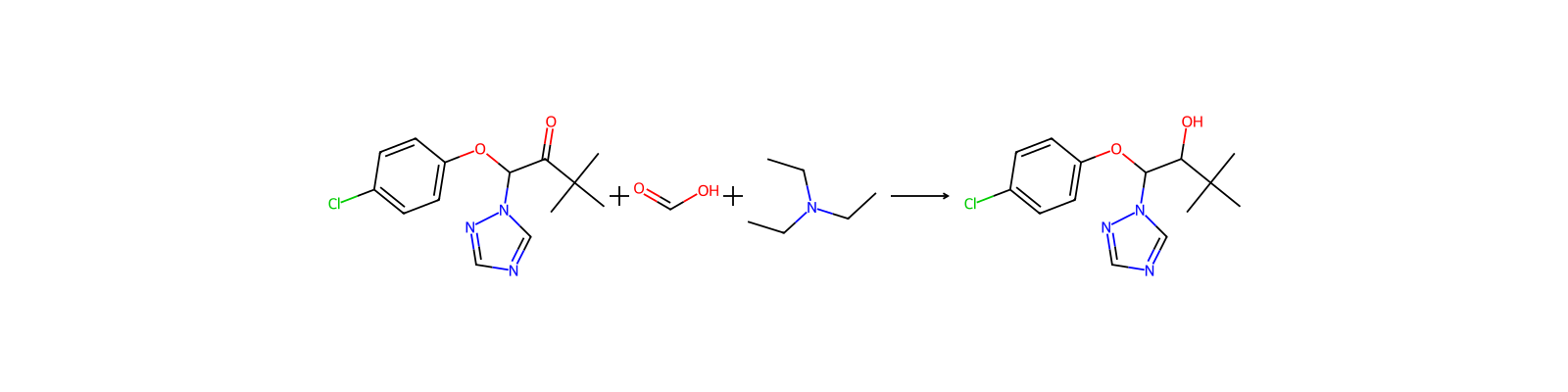
Triadimenol is produced by reduction of triadimefon with aluminum isopropoxide.
Preparation BE 814831; W. Kramer et al., US 3952002 (1974,1976 both to Bayer AG).
Formulations/Preparations
Registered formulations include emulsifiable concentrate (EC) (5% active ingredient), wettable powder (WP)(25% active ingredient), soluble concentrate (SC) (13.33% active ingredient), and flowable concentrate (FlC) (28.3 - 30% active ingredient).
Emulsifiable concentrate, flowable, granule, seed dressing, water dispersible granule, water-oil emulsion, wettable powder.
Baytan Technical; Active ingredient 98.30% Triadimenol
Gustafson RTU-Baytan-Thiram Fungicide; Active ingredients 15.30% Thiram and 5.00% Triadimenol
For more Formulations/Preparations (Complete) data for Triadimenol (7 total), please visit the HSDB record page.
Use Classification
Fungicides, Transformation products
Environmental transformation -> Pesticides (parent, predecessor)
General Manufacturing Information
The WHO Recommended Classification of Pesticides by Hazard identifies Triadimenol (technical grade) as Class III: slightly hazardous; Main Use: Fungicide, for seed treatment.
Commercial product is mixture of 2 diastereoisomers.
응용 분야
개요Triadimenol is a metabolite of triadimefon , a broad-spectrum chiral triazole fungicide, that is formed by reduction of a carbonyl group to the corresponding alcohol. It is teratogenic, inducing cranial nerve and ganglia abnormalities in a rat post-implantation whole embryo culture model when used at concentrations ranging from 12.5 to 125 μM. In vivo, triadimenol induces embryotoxicity in rats and rabbits when administered orally at doses of 100 and 40 mg/kg, respectively. Embryonic exposure to triadimenol (3-3,000 μg/L) induces embryonic mortality as well as decreases fertility and increases the number of female offspring in medaka fish (O. latipes).
용도Triadimenol is used for the control of powdery mildews, rusts and Rhynchosporium in cereals, and also as a seed treatment to control bunt, smut and other cereal diseases. It is also used on vines, hops, coffee, tomatoes, vegetables, fruit, tobacco, sugar cane, ornamentals and other crops, mainly against powdery mildews, rusts and various leaf spot diseases.
상·하류 제품 정보
상류 원료
공급사50 곳
阿诺西(上海)生物技术有限公司400-1107768 15058188853 · [email protected]
上海阿拉丁生化科技股份有限公司400-6206333 13167063860 · [email protected]
山东泰诚生物科技有限公司18769832557 18769832557 · [email protected]
盐城通铭生物科技有限公司15195160625 · [email protected]
上海麦克林生化科技股份有限公司021-50706066 15221275939 · [email protected]
武汉欣扬瑞和化学科技有限公司153-07155313 15307155313 · [email protected]
杭州品高化工有限公司0571-87658025 · [email protected]
Qingdao Trust Agri Chemical Co.,Ltd+86-008615963231493 +86-008613573296305 · [email protected]
河北创海生物科技有限公司+86-86-13131129325 · [email protected]
Dayang Chem (Hangzhou) Co.,Ltd.+86-0571-88938639 17705817739 · [email protected]
河北枫嘉新材料科技有限公司+86-0311-87836622 +86-18712993135 · [email protected]
安耐吉化学&3A(安徽泽升科技有限公司)021-58432009 400-005-6266 · [email protected]
梯希爱(上海)化工贸易有限公司021-61109150 · [email protected]
湖北长耀生物科技有限公司17683887209 17683887209 · [email protected]
上海瀚鸿科技股份有限公司021-54306202 13764082696 · [email protected]
湖北魏氏化学试剂股份有限公司027-59102966 18717199209 · [email protected]
江苏艾康生物医药研发有限公司025-5885952 15955137747 · [email protected]
常州市华阳科技有限公司+8615250961469 · [email protected]
佛山宝诺生物科技有限公司0757-85921206 18520245316 · [email protected]
河北茹麒科技有限公司176-03256889 17603256889 · [email protected]
北京海岸鸿蒙标准物质技术有限责任公司13240431552 · [email protected]
上海毕楷科技有限公司18516304666
宝鸡缔都医药化工有限公司029-81145305 17791533577 · [email protected]
山东西亚化学有限公司13355009207 13355009207 · [email protected]
四川库利南科技有限公司400-1166-196 18981987031 · [email protected]
ZHEJIANG JIUZHOU CHEM CO., LTD+86-0576225566889 +86-13454675544 · [email protected];[email protected];[email protected]
艾科试剂4008-755-333 18080918076 · [email protected]
成都思天德生物科技有限公司028-83243028 19136088901 · [email protected]
南京生利德生物科技有限公司025-57798810 18652991625 · [email protected]
上海将来实业股份有限公司400-0066400 13621662912 · [email protected]
天津普西唐生物医药科技有限公司010-60605840 · [email protected]
杭州杰恒化工有限公司0571-87396432 · [email protected]
湖北宝凌化工科技有限公司13129969326 · [email protected]
湖北巨胜科技有限公司027-59599241 18871490274 · [email protected]
天津阿尔塔科技有限公司022-6537-8550 15522853686 · [email protected]
TargetMol中国(陶术生物)021-021-33632979 15002134094 · [email protected]
南兴化工(江苏)有限公司0512-66387035 18662433356 · [email protected]
上海陶术生物科技股份有限公司+1-781-999-5354; +1-00000000000 · [email protected]
Henan Alfa Chemical Co., Ltd+8618339805032 · [email protected]
常州安奈凯医药科技有限公司+86-0519-8359-8696 · [email protected]
上海谱振生物科技有限公司4001650900 13817534909 · [email protected]
厦门志信化学有限公司+86-5922680277 +86-13806087780 · [email protected]
湖北川合化工有限公司187-7130-7593 18672969259 · [email protected]
艾吉析科技(上海)有限公司17721401538;17717235263 17721401538 · [email protected]
四川普西奥标物科技有限公司13540909846 13882008651 · [email protected]
上海西陇生化科技有限公司021-52907766-8042
上海源叶生物科技有限公司13636370518 · [email protected]
山东西亚化学有限公司4009903999 13395398332 · [email protected]
湖北世腾化工科技有限公司19086915685 18971850150 · [email protected]
西氟试剂+86-531-85906692 · [email protected]
추가 설명
정의ChEBI: A member of the class of triazoles that is 3,3-dimethyl-1-(1,2,4-triazol-1-yl)butane-1,2-diol substituted at position O1 by a 4-chlorophenyl group. A fungicide for cereals, beet and brassicas used to control a range of diseases including powdery mildew, ru ts, bunts and smuts.
관련 반응
8건


연결된 노트
불러오는 중…