
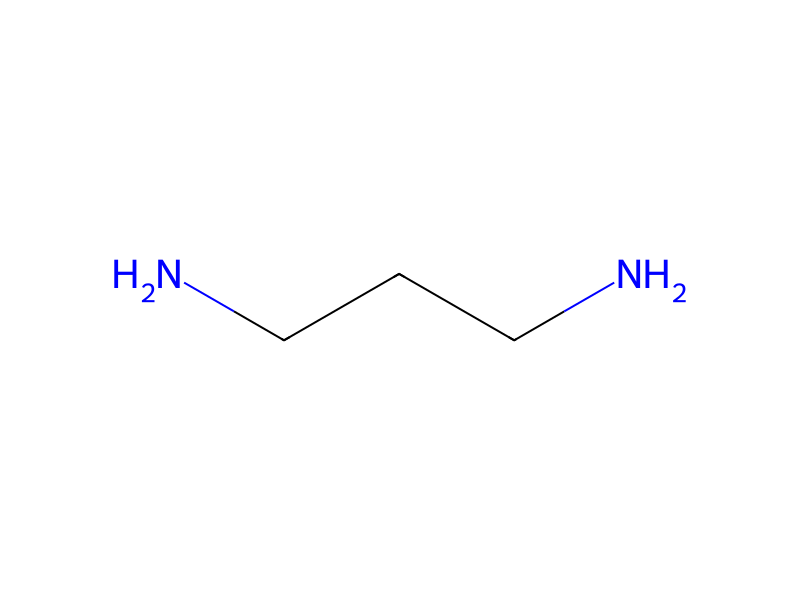
기본 정보
- 표준 SMILES
NCCCN- InChIKey
XFNJVJPLKCPIBV-UHFFFAOYSA-N- 분자식
- C3H10N2
- 평균 분자량
- 74.13 g/mol
- 단동위원소 질량
- 74.08439832
개요
1,3-diaminopropane is a water-white mobile liquid with an odor of amine. (NTP, 1992)
이름 및 식별자
- 우선 이름
- 1,3-Propanediamine
- IUPAC
- propane-1,3-diamine
- 현지명
- 1,3-디아미노프로판
- 영어명
- 1,3-Diaminopropane
- 분자식
- C3H10N2
- 분자량
- 74.12
이름 및 동의어
1,3-diaminopropane1,3-Propanediamine109-76-2Trimethylenediamine1,3-Propylenediamine3-Aminopropylaminealpha,omega-PropanediamineCB3ISL56KG1,3-diaminepropaneNSC-8154DTXSID1021906CHEBI:15725
이름 더 보기
1,3-디아미노프로판1,3-프로판디아민1,3-프로필렌다이아민H2N(CH2)3NH213DAP3-Propanediamine1,3-DiaMinopropane, 99% 1LTFENTAMINE PDAAKOS BBS-000042811,3 Diaminopropan
RefChem:72575DTXCID301906203-702-7611-082-8Propane-1,3-diamineMFCD00008228BRN 0605277AI3-25358
데이터베이스 식별자
- CAS
109-76-2、54018-94-9- PubChem CID
- 428
- DTXSID
DTXSID1021906- ChEMBL
CHEMBL174324- ChEBI
CHEBI:15725- UNII
- CB3ISL56KG
- EC Number
- 203-702-7、611-082-8
- Nikkaji
- J1.969K
물성
구조 계산 물성
- XLogP
- -1.4
- 극성 표면적
- 52 Ų
- 수소 결합 공여자 수
- 2
- 수소 결합 수용자 수
- 2
- 회전 가능 결합 수
- 2
- 무거운 원자 수
- 5
- 형식 전하
- 0
- 복잡도
- 12.4
실험 및 물리화학적 성질
Chemical ClassesNitrogen Compounds -> Amines, Aliphatic
SpringerMaterials Properties15N nuclear magnetic resonance spectrum
LogP
-1.43
-1.43
Density
0.881 at 68 °F (NTP, 1992) - Less dense than water; will float
0.8881 @25 °C
SolubilitySoluble (NTP, 1992)
Flash Point75 °F (NTP, 1992)
Boiling Point
275.9 °F at 738 mmHg (NTP, 1992)
139.80 °C. @ 760.00 mm Hg
Melting Point
10 °F (NTP, 1992)
-12 °C
-12 °C
Vapor Density2.5 (NTP, 1992) - Heavier than air; will sink (Relative to Air)
Vapor Pressure11.5 [mmHg]
Food Contact SubstancesFCS -> FDA Inventory of Food Contact Substances Listed in 21 CFR
Physical Description
1,3-diaminopropane is a water-white mobile liquid with an odor of amine. (NTP, 1992)
Liquid
Colorless to yellow liquid with an amine odor; [CHEMINFO (MSDS)] Colorless liquid with an odor of amines; [CAMEO]
Liquid
물리화학적 성질
- 녹는점
- -12 °C · -12 °C
- 끓는 점
- 140 °C · 140 °C(lit.)
- 밀도
- 0.888 g/mL · 0.888 g/mL at 25 °C(lit.)
- 증기압
- 8 mm · <8 mm Hg ( 20 °C)
- 굴절률
- 20 · n20/D 1.458(lit.)
- 인화점
- 120 °F · 120 °F
- 저장 조건
- 30 °C · Store below +30°C.
- 용해도
- DMSO(약간 용해됨), 메탄올(약간 용해됨)
- 산도 계수 (pKa)
- 10.94 · 10.94(at 10℃)
- 물리적 상태
- 액체
- 색상
- 투명한
- 수소이온지수(pH)
- 12 · >12 (100g/l, H2O, 20℃)
- 폭발한계
- 2.8 · 2.8-15.2%(V)
- 수용성
- 녹는
- BRN
- 605277 · 605277
- Dielectric constant
- 9.6 · 9.6(Ambient)
- 안정성
- 안정적인. 흡습성. 가연성 - 공기와 쉽게 폭발성 혼합물을 형성합니다. 산 무수물, 산 염화물, 산, 강산화제와 호환되지 않습니다.
- InChI
- 1S/C3H10N2/c4-2-1-3-5/h1-5H2
- InChIKey
- XFNJVJPLKCPIBV-UHFFFAOYSA-N
- SMILES
- NCCCN
- LogP
- -1.05 at · -1.05 at 25℃
- NIST
- 1 · 1,3-Propanediamine(109-76-2)
- EPA
- 1 · 1,3-Diaminopropane (109-76-2)
화학적 성질
colourless liquid
안전 및 규제
GHS 분류
GHS Classification
Danger
H226 (99.6%): Flammable liquid and vapor [Warning Flammable liquids]
P210, P233, P240, P241, P242, P243, P260, P261, P262, P264, P264+P265, P270, P271, P272, P280, P284, P301+P317, P301+P330+P331, P302+P352, P302+P361+P354, P303+P361+P353, P304+P340, P305+P354+P338, P316, P317, P321, P330, P333+P317, P342+P316, P361+P364, P362+P364, P363, P370+P378, P403, P403+P235, P405, and P501 (click each P-code to see the statement)
Aggregated GHS information provided per 251 reports by companies from 11 notifications to the ECHA C&L Inventory. Each notification may be associated with multiple companies.
Danger
H225: Highly Flammable liquid and vapor [Danger Flammable liquids]
유해성 정보
Regulatory Information
Chemical: 1,3-Propanediamine
1,3-Propanediamine is listed on the EPA's Chemical Data Reporting (CDR) system. Manufacturers and importers of 1,3-Propanediamine are required to report information about their production and use of this chemical to the EPA under the Toxic Substances Control Act (TSCA). (40 eCFR Part 711)
Status: Active Update: 10-12-2018 https://echa.europa.eu/registration-dossier/-/registered-dossier/11978
1,3-Diaminopropane: Does not have an individual approval but may be used under an appropriate group standard
Other Safety InformationEvaluation - Chemicals that are unlikely to require further regulation to manage risks to environment
DOT LabelCorrosive Flammable Liquid
Fire HazardsThis compound is a flammable liquid. (NTP, 1992)
Health HazardsACUTE/CHRONIC HAZARDS: This compound is a strong irritant to eyes and skin: corrosive HAZARDOUS DECOMPOSITION PRODUCTS. (NTP, 1992)
Hazards Summary
Corrosive to skin; [Quick CPC] Highly irritating or corrosive to skin and eyes; [NTP] Causes burns; Inhalation may cause corrosive injuries to upper respiratory tract and lungs; Harmful by ingestion; Toxic by skin absorption; [Alfa Aesar MSDS]
Reactive GroupAmines, Phosphines, and Pyridines
Reactivity AlertsHighly Flammable
Reactivity Profile1,3-DIAMINOPROPANE is heat sensitive. This compound may react with oxidizing agents. (NTP, 1992)
Air and Water ReactionsHighly flammable. Water soluble.
Hazard Classes and Categories
Flam. Liq. 3 (99.6%)
Flammable liquids - Category 2
안전 및 보호
Fire Fighting
This compound is not very flammable but any fire involving this compound may produce dangerous vapors. You should evacuate the area. All firefighters should wear full-body protective clothing and use self-contained breathing apparatuses. You should extinguish any fires involving this chemical with a dry chemical, carbon dioxide, foam, or halon extinguisher. (NTP, 1992)
First Aid
EYES: First check the victim for contact lenses and remove if present. Flush victim's eyes with water or normal saline solution for 20 to 30 minutes while simultaneously calling a hospital or poison control center. Do not put any ointments, oils, or medication in the victim's eyes without specific instructions from a physician. IMMEDIATELY transport the victim after flushing eyes to a hospital even if no symptoms (such as redness or irritation) develop.
Nonfire Spill Response
SMALL SPILLS AND LEAKAGE: If you should spill this chemical, use absorbent paper to pick up all liquid spill material. Seal the absorbent paper, as well as any of your clothing which may be contaminated, in a vapor-tight plastic bag for eventual disposal. Wash any surfaces you may have contaminated with a soap and water solution. Do not reenter the contaminated area until the Safety Officer (or other responsible person) has verified that the area has been properly cleaned.
Isolation and EvacuationExcerpt from ERG Guide 132 [Flammable Liquids - Corrosive]:
Protective Action Criteria (PAC)
0.93 [mg/m3]
10 [mg/m3]
62 [mg/m3]
Personal Protective Equipment (PPE)MINIMUM PROTECTIVE CLOTHING: If Tyvek-type disposable protective clothing is not worn during handling of this chemical, wear disposable Tyvek-type sleeves taped to your gloves.
독성 정보
Adverse EffectsDermatotoxin - Skin burns.
안전 데이터
- wgk
- 2
- tsca
- TSCA listed
- rtecs
- TX6825000
- ridadr
- UN 2922 8/PG 2
- 독성
- LD50 orally in Rabbit: 700 mg/kg LD50 dermal Rabbit 200 mg/kg
- HS 번호
- 29212900
- risk_code
- 10-22-24-35
- hazard_code
- T,C
- safety_code
- 26-36/37/39-45-25-16
- 포장분류
- III
- 위험 등급
- 3
- 기존화학 물질
- KE-29259
- F 고인화성물질
- 34
- 자연 발화 온도
- 662 °F
- Hazard Classifications
- Acute Tox. 2 DermalAcute Tox. 4 OralEye Dam. 1Flam. Liq. 3Met. Corr. 1Resp. Sens. 1BSkin Corr. 1BSkin Sens. 1B
- 스토리지 클래스
- 3 - Flammable liquids
화학 및 산업
약리 정보
Cellular LocationsCytoplasm
Metabolite Pathwaysbeta-Alanine metabolism
용도 및 제조
UsesUsed as an organic intermediate; [NTP]
U.S. Production2023: <50,000 lb
Industry UsesIntermediate
General Manufacturing Information
All Other Basic Organic Chemical Manufacturing
1,3-Propanediamine: ACTIVE
응용 분야
용도1,3-Diaminopropane is commonly used in the preparation of cholinesterase inhibitors and thrombosis inhibitors. It is also used as a polymer cross linkage agent, polyurethane extender and spray coatings. It is involved in the preparation of agrochemicals and pharmaceutical intermediates. Further, it acts as a building block in the synthesis of heterocyclic compounds, which finds application in textile finishing. In addition to this, it is used as a ligand and form coordination complexes. 1,3-Diaminopropane is also utilized for the production of a chelating agent used in the photo industry and for anticorrosion agents.
일반 설명Water-white mobile liquid with an odor of amine.
제조 방법
생산 방법1,3-Diaminopropane is produced in a twostage continuous process, under a pressure of 10 – 20 MPa. In a first reactor, acrylonitrile reacts with excess ammonia at 70 – 100 ℃ to give 2-aminopropionitrile and bis(cyanoethyl) amine. The mixture of aminonitriles is then hydrogenated in a downstream reactor over a fixed-bed catalyst (cobalt or nickel) at 60 – 120 ℃ to give 1,3-diaminopropane and bis (aminopropyl)amine. The yield of 1,3- diaminopropane can be increased by adding a polar solvent and water or by using a large excess of ammonia.
상·하류 제품 정보
상류 원료
하류 제품
공급사50 곳
国药集团化学试剂有限公司86-21-63210123 · [email protected]
梯希爱(上海)化成工业发展有限公司021-67121386 · [email protected]
上海阿拉丁生化科技股份有限公司400-6206333 13167063860 · [email protected]
南通润丰石油化工有限公司66017690 19952660367 · [email protected]
武汉欣扬瑞和化学科技有限公司153-07155313 15307155313 · [email protected]
爱斯特(成都)生物制药股份有限公司+86-28-85122536 85324413 · [email protected]
Dayang Chem (Hangzhou) Co.,Ltd.+86-0571-88938639 17705817739 · [email protected]
Hebei Yanxi Chemical Co., Ltd.+86-17531190177 · [email protected]
江苏豪隆化工有限公司0513-89083520 13328092525 · [email protected]
Syntechem Co.,Ltd[email protected]
上海迈瑞尔生化科技有限公司4006356688 18621169109 · [email protected]
湖北日升昌新材料科技有限公司13396066230 · [email protected]
阿法埃莎(中国)化学有限公司400-6106006 · [email protected]
安耐吉化学&3A(安徽泽升科技股份有限公司)400-0056266 · [email protected]
上海合勒化学科技有限公司16621266837 · [email protected]
上海沃化化工有限公司021-57681602-802 17302146015 · [email protected]
上海景颜化工科技有限公司13817811078 · [email protected]
嘉兴市艾森化工有限公司0573-85285100 18627885956 · [email protected]
南京蓝白化工有限公司025-85499326 15366059326;13813836665 · [email protected]
山东西亚化学有限公司13355009207 13355009207 · [email protected]
玛雅试剂+86 (573) 82222445 (0)18006601000 452520369 · [email protected]
四川库利南科技有限公司400-1166-196 18981987031 · [email protected]
天津希恩思生化科技有限公司400 638 7771 · [email protected]
斯百全化学(上海)有限公司021-021-021-67601398-809-809-809 15221380277 · [email protected]
艾科试剂4008-755-333 18080918076 · [email protected]
上海思域化工科技有限公司86-21-34053660 · [email protected]
赛默飞世尔科技(中国)有限公司800-810-5118 · [email protected]
北京伊诺凯科技有限公司400-810-7969 010-59572699 · [email protected]
TCI AMERICA800-4238616 · [email protected]
TOKYO CHEMICAL INDUSTRY CO., LTD.03-36680489 · [email protected]
TCI Europe320-37350700 · [email protected]
深圳康特腾科技有限公司86-0755-86635001 · [email protected]
安徽科迪达化工有限公司0554-2106669 · [email protected]
HBCChem, Inc.+1-510-219-6317 · [email protected]
美岚实业(上海)有限公司021-58958189 · [email protected]
上海爱蝶实业有限公司021-58957966 18930537195 · [email protected]
成都零六生物科技有限公司400-1166-196 13458535857 · [email protected]
广拓化学(上海)有限公司021-60899189-8001 18918189673 · [email protected]
雷丁试剂0510-85629785 18013409632 · [email protected]
上海麦克林生化科技股份有限公司15221275939 15221275939 · [email protected]
上海有朋化工有限公司021-69005955 13701776567 · [email protected]
上海凯赛化工有限公司021-33516722 13701817765 · [email protected]
上海彤源化工有限公司021-021-69182866 13701855675 · [email protected]
凯试(上海)科技有限公司021-50135380 · [email protected]
上海蓝润化学有限公司021-69515658 ; 69515628 13701998368 · [email protected]
上海容立化学科技有限公司021-69992220 13701886816 · [email protected]
上海康拓化工有限公司021-69185552 13701777608 · [email protected]
池州凯隆进出口贸易有限公司[email protected]
Sigma-Aldrich西格玛奥德里奇(上海)贸易有限公司021-61415566 800-8193336 · [email protected]
成都瑞欧克科技有限公司028-64353063 · [email protected]
추가 설명
정의ChEBI: 1,3-Diaminopropane is an alkane-alpha,omega-diamine comprising a propane skeleton with amino substituents at positions 1 and 3. It has a role as a reagent, a human metabolite and a mouse metabolite. It is a conjugate base of a trimethylenediaminium.
관련 반응
458건


연결된 노트
불러오는 중…