Sodium borohydride
나트륨붕소수화물 · 나트륨테트라히드로붕산염 · 나트륨히드로붕산염 · 나트륨보로하이드라이드 · 보로수소화나트륨 · 수소화붕소나트륨 · 테트라하이드로붕산나트륨,SBH · 테트라하이드로붕산나트륨
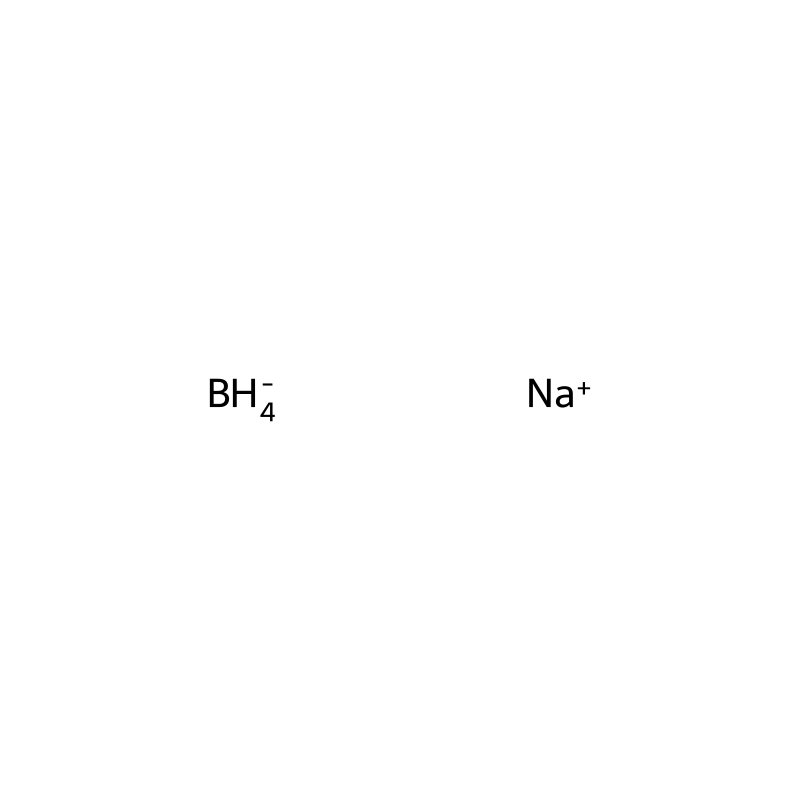
식별자 및 물리적 특성
| CAS No. | 16940-66-2 |
|---|---|
| 분자식 | BH4Na |
| 평균 분자량 | 37.84 g/mol |
| 단동위원소 질량 | 38.0303746 g/mol |
| SMILES | [BH4-].[Na+] |
| InChIKey | YOQDYZUWIQVZSF-UHFFFAOYSA-N |
| PubChem CID | 4311764 |
| ChEBI | CHEBI:50985 |
| EC No. | 241-004-4 |
| DTXSID | DTXSID80893977 |
| 현지명 | 나트륨 붕소수화물 |
화학 및 물리적 성질
| 극성 표면적 | 0 |
|---|---|
| 수소 결합 공여자 수 | 0 |
| 수소 결합 수용자 수 | 1 |
| 회전 가능 결합 수 | 0 |
| 무거운 원자 수 | 2 |
| 형식 전하 | 0 |
| 복잡도 | 2 |
| 밀도 | 1.074 at 68 °F (USCG, 1999) - Denser than waterwill sink1.074 g/cu cm (anhydrous material)1.07 g/cm³1.07 @25 °C1.035 g/mL at 25 °C |
| Color/Form | White to gray-white microcystalline powder or lumpsWhite cubic crystals, hygroscopic |
| 용해도 | Soluble in "Cellosolve" etherSoluble in ammonia, amines, pyridine, dimethyl ether of diethylene glycolinsoluble in other ethers, hydrocarbons, alkyl chloridesSolubility (wt/wt) in liquid ammonia, 104% at 25 °Cin ethylenediamine, 22% at 75 °Cin morpholine, 1.4% at 25 °Cin pyridine, 3.1% at 25 °Cin methanol, 16.4% at 20 °C (reacts)in ethanol, 4.0% at 20 °C (reacts slowly)in tetrahydrofuran, 0.1% at 20 °Cin diglyime, 5.5% at 20 °Cin dimethylformamide, 18.0% at 20 °CSolubility (wt/wt) in water: 55% at 25 °C88.5% at 60 °CSolubility in water, g/100ml at 25 °C: 55메탄올 (약간 용해됨), 물(용해성) |
| Decomposition | When heated to decomposition emits toxic fumes of /sodium oxides/.Solutions are rapidly decomposed by boiling.>250 °C |
| 녹는점 | >400 °C (vacuum) (decomposes)>300 °C (dec.) (lit.) |
| 굴절률 | INDEX OF REFRACTION: 1.542 |
| Physical Description | Sodium borohydride is a white to grayish crystalline powder. It is decomposed by water to form sodium hydroxide, a corrosive material, and hydrogen, a flammable gas. The heat of this reaction may be sufficient to ignite the hydrogen. The material itself is easily ignited and burns vigorously once ignited. It is used to make other chemicals, treat waste water, and for many other uses.Dry PowderLiquidGray to white crystals or powder[HSDB]WHITE CRYSTALLINE POWDER. |
| Stability/Shelf Life | Anhydrous material is stable in dry air to 300 °Cdecomposes slowly at 400 °C and rapidly at 500 °CAqueous solutions are most stable in the presence of small amounts of sodium hydroxide (0.2% for a nearly saturated solution containing 44% sodium borohydride) and can be kept for several days. |
| 자연 발화 온도 | ~220 °C |
| Other Experimental Properties | Hygroscopic, cubic crystals forming a dihydrate, mp 36-37 °Canhydrous material is stable in dry air to 300 °Cdecomposes slowly at 400 °C and rapidly at 500 °CAqueous solutions are most stable in the presence of small amounts of NaOH (0.2% for a nearly saturated solution containing 44% NaBH4) and can be kept for several dayssolutions are rapidly decomposed by boilingStandard enthalpy of formation: -188.6 kJ/mol (crystal)Molar heat capacity 86.8 J/mol K at 25 °C (crystal)Decomposes on heating to constituent elements |
| 끓는 점 | 500°C |
| 증기압 | <1 hPa (25 °C) |
| 인화점 | 158 °F |
| 저장 조건 | Store at RT. |
| 물리적 상태 | 플레이크 크리스탈 |
| 비중 | 1.4 |
| 색상 | 하얀색 |
| pH | 11 (10g/l, H2O, 20℃) |
| 폭발한계 | 3.02%(V) |
| 용해도 | 550g/L(25℃) |
| 비열 | Cp(crystal): 2.29 J/(g·K), at 25℃ |
| Merck | 14,8592 |
| 안정성 | 안정성 안정적이지만 물과 쉽게 반응합니다(반응이 격렬할 수 있음). 물, 산화제, 이산화탄소, 할로겐화수소, 산, 팔라듐, 루테늄 및 기타 금속염, 유리와 혼합되지 않습니다. 가연성 고체. 공기에 민감합니다. |
| 화장품 원료 기능 | 필러항산화제피부 컨디셔닝 |
| InChI | 1S/BH4.Na/h1H4/q-1+1 |
| InChIKey | YOQDYZUWIQVZSF-UHFFFAOYSA-N |
| SMILES | [BH4-].[Na+] |
| NIST | Sodium tetrahydroborate(16940-66-2) |
| EPA | Sodium borohydride (16940-66-2) |
화학적 성질
Sodium Borohydride is a white, odorless powder or pellet. It is used for bleaching wood pulp, as a blowing agent for plastics, and as a reducing agent for aldehydes and ketones.
안전 및 규제
| GHS 분류 | This chemical does not meet GHS hazard criteria for 0.4% (3 of 671) of reports.DangerH260 (86.7%): In contact with water releases flammable gases which may ignite spontaneously [Danger Substances and mixtures which in contact with water, emit flammable gases]H301 (99.6%): Toxic if swallowed [Danger Acute toxicity, oral]H311 (23%): Toxic in contact with skin [Danger Acute toxicity, dermal]H314 (99.6%): Causes severe skin burns and eye damage [Danger Skin corrosion/irritation]H318 (71.4%): Causes serious eye damage [Danger Serious eye damage/eye irritation]H332 (16.7%): Harmful if inhaled [Warning Acute toxicity, inhalation]H360 (43.7%): May damage fertility or the unborn child [Danger Reproductive toxicity]P203, P223, P231+P232, P260, P261, P262, P264, P264+P265, P270, P271, P280, P301+P316, P301+P330+P331, P302+P335+P334, P302+P352, P302+P361+P354, P304+P340, P305+P354+P338, P316, P317, P318, P321, P330, P361+P364, P363, P370+P378, P402+P404, P405, and P501 (click each P-code to see the statement)Aggregated GHS information provided per 671 reports by companies from 41 notifications to the ECHA C&L Inventory. Each notification may be associated with multiple companies.Reported as not meeting GHS hazard criteria per 3 of 671 reports by companies.There are 40 notifications provided by 668 of 671 reports by companies with hazard statement code(s).Information may vary between notifications depending on impurities, additives, and other factors. The percentage value in parenthesis indicates the notified classification ratio from companies that provide hazard codes. Only hazard codes with percentage values above 10% are shown. For more detailed information, please visit ECHA C&L website. |
|---|---|
| 규제 정보 | Chemical: Borate(1-), tetrahydro-, sodiumBorate(1-), tetrahydro-, sodium (1:1) is listed on the EPA's Chemical Data Reporting (CDR) system. Manufacturers and importers of Borate(1-), tetrahydro-, sodium (1:1) are required to report information about their production and use of this chemical to the EPA under the Toxic Substances Control Act (TSCA). (40 eCFR Part 711)Status: Active Update: 10-02-2022 https://echa.europa.eu/registration-dossier/-/registered-dossier/14382Status: Active Update: 20-06-2022 https://echa.europa.eu/registration-dossier/-/registered-dossier/33312Borate(1-), tetrahydro-, sodium: HSNO Approval: HSR001294 Approved with controlsThe New Jersey Worker and Community Right to Know Act requires public and private employers to provide information about hazardous substances at their workplaces. (N.J.S.A. 34:5A-1 et. seq.) |
| 운송 라벨(DOT) | Dangerous When Wet |
| 화재 위험 | Behavior in Fire: Decomposes and produces highly flammable hydrogen gas. (USCG, 1999)· Produce flammable gases on contact with water.· May ignite on contact with water or moist air.· Some react vigorously or explosively on contact with water.· May be ignited by heat, sparks or flames.· May re-ignite after fire is extinguished.· Some are transported in highly flammable liquids.· Runoff may create fire or explosion hazard.Combustible. Risk of fire and explosion on contact with acids, alcohol, oxidizing agents or water. |
| 화재 가능성 | Moderate, when exposed to heat or flame or by chemical reaction with oxidizers.Supports combustion |
| 건강 유해성 | Solid irritates skin. If ingested can form large volume of gas and lead to a gas embolism. (USCG, 1999)· Inhalation or contact with vapors, substance or decomposition products may cause severe injury or death.· May produce corrosive solutions on contact with water.· Fire will produce irritating, corrosive and/or toxic gases.· Runoff from fire control or dilution water may cause environmental contamination. |
| 유해성 요약 | At lethal concentrations, animals have seizures[ChemIDplus] Corrosive to skin, eyes, and respiratory tractInhalation can cause acute pulmonary edema[CHEMINFO MSDS] |
| 운송 번호 및 가이드(DOT) | 1426 138 |
| 반응성 그룹 | Metal Hydrides, Metal Alkyls, Metal Aryls, and Silanes |
| UN 분류 | UN Hazard Class: 4.3UN Pack Group: I |
| Reactivity Alerts | Strong Reducing AgentWater-ReactiveAir-Reactive |
| Reactivity Profile | SODIUM BOROHYDRIDE is a powerful reducing agent. A chemical base. Absorbs moisture readily forming caustic solution. which attacks aluminum and zinc. A violent polymerization of acetaldehyde results from the reactions of acetaldehyde with alkaline materials such as sodium hydroxide. Calcium oxide or sodium hydroxide react with phosphorus pentaoxide extremely violently when initiated by local heating [Mellor 8 Supp.3:406 (1971]. Using potassium hydroxide to dry impure tetrahydrofuran, which contains peroxides, may be hazardous. Explosions have occurred in the past. Sodium hydroxide behaves in a similar way as potassium hydroxide [NSC Newsletter, Chem. Soc. 1967]. Ignition occurs if a mixture of the hydride and sulfuric acid is not cooled. Contact of glycerol and sodium borohydride leads to ignition, other glycols and methanol are exothermic but do not ignite. |
| Chemical Dangers | Decomposes on heating and on contact with acids, powdered metals, water and moisture. This produces flammable/explosive gas (hydrogen - see ICSC 0001). The substance is a strong reducing agent. It reacts violently with oxidants. This generates fire and explosion hazard. |
| 소화 | Excerpt from ERG Guide 138 [Substances - Water-Reactive (Emitting Flammable Gases)]:DO NOT USE WATER OR FOAM.SMALL FIRE: Dry chemical, soda ash, lime or sand.LARGE FIRE: DRY sand, dry chemical, soda ash or lime or withdraw from area and let fire burn. If it can be done safely, move undamaged containers away from the area around the fire.FIRE INVOLVING METALS OR POWDERS (ALUMINUM, LITHIUM, MAGNESIUM, ETC.): Use dry chemical, DRY sand, sodium chloride powder, graphite powder or class D extinguishersin addition, for Lithium you may use Lith-X® powder or copper powder. Also, see ERG Guide 170.FIRE INVOLVING TANKS, RAIL TANK CARS OR HIGHWAY TANKS: Fight fire from maximum distance or use unmanned master stream devices or monitor nozzles. Do not get water inside containers. Cool containers with flooding quantities of water until well after fire is out. Withdraw immediately in case of rising sound from venting safety devices or discoloration of tank. ALWAYS stay away from tanks in direct contact with flames. (ERG, 2024)Use dry sand, dry powder. NO water. NO foam. NO carbon dioxide. |
| 응급 조치 | Fresh air, rest. Refer immediately for medical attention.First rinse with plenty of water for at least 15 minutes, then remove contaminated clothes and rinse again. Refer for medical attention .Rinse with plenty of water for several minutes (remove contact lenses if easily possible). Refer immediately for medical attention.Rinse mouth. Give one or two glasses of water to drink. Do NOT induce vomiting. Refer immediately for medical attention. |
| 누출 비상 조치 | · CALL 911. Then call emergency response telephone number on shipping paper. If shipping paper not available or no answer, refer to appropriate telephone number listed on the inside back cover.· Keep unauthorized personnel away.· Stay upwind, uphill and/or upstream.· Ventilate closed spaces before entering, but only if properly trained and equipped.· ELIMINATE all ignition sources (no smoking, flares, sparks or flames) from immediate area.· Do not touch or walk through spilled material.· Stop leak if you can do it without risk.· Use water spray to reduce vapors or divert vapor cloud drift. Avoid allowing water runoff to contact spilled material.· DO NOT GET WATER on spilled substance or inside containers.Small Spill· Cover with DRY earth, DRY sand or other non-combustible material followed with plastic sheet to minimize spreading or contact with rain.· Dike for later disposaldo not apply water unless directed to do so.Powder Spill· Cover powder spill with plastic sheet or tarp to minimize spreading and keep powder dry.· DO NOT CLEAN-UP OR DISPOSE OF, EXCEPT UNDER SUPERVISION OF A SPECIALIST. |
| 응급 처치 | INGESTION: do NOT induce vomitinggive dilute vinegar, lemon juice, milk, or olive oilcall a doctor.SKIN AND EYES: flood with large amount of water. (USCG, 1999)General First Aid:· Call 911 or emergency medical service.· Ensure that medical personnel are aware of the material(s) involved, take precautions to protect themselves and avoid contamination.· Move victim to fresh air if it can be done safely.· Administer oxygen if breathing is difficult.· If victim is not breathing:-- DO NOT perform mouth-to-mouth resuscitationthe victim may have ingested or inhaled the substance.-- If equipped and pulse detected, wash face and mouth, then give artificial respiration using a proper respiratory medical device (bag-valve mask, pocket mask equipped with a one-way valve or other device).-- If no pulse detected or no respiratory medical device available, provide continuous compressions. Conduct a pulse check every two minutes or monitor for any signs of spontaneous respirations.· Remove and isolate contaminated clothing and shoes.· For minor skin contact, avoid spreading material on unaffected skin.· In case of contact with substance, remove immediately by flushing skin or eyes with running water for at least 20 minutes.· For severe burns, immediate medical attention is required.· Effects of exposure (inhalation, ingestion, or skin contact) to substance may be delayed.· Keep victim calm and warm.· Keep victim under observation.· For further assistance, contact your local Poison Control Center.· Note: Basic Life Support (BLS) and Advanced Life Support (ALS) should be done by trained professionals.Specific First Aid:· In case of contact with substance, wipe from skin immediatelyflush skin or eyes with running water for at least 20 minutes. |
| 안전 보관 | Dry. Well closed. Separated from strong acids, alcohols, powdered metals and water. |
| 노출 관리 및 개인 보호 | · Wear positive pressure self-contained breathing apparatus (SCBA).· Wear chemical protective clothing that is specifically recommended by the manufacturer when there is NO RISK OF FIRE.· Structural firefighters' protective clothing provides thermal protection but only limited chemical protection. |
| 소화 절차 | Fire extinguishing agents: graphite, limestone, soda ash, sodium chloride powdersFire extinguishing agents not to be used: Water, carbon dioxide, or halogenated extinguishing agents.If material on fire or involved in fire: Do not use water. Use graphite, soda ash, powdered sodium chloride, or suitable dry powder. |
| 보관 조건 | Storage temperature: ambient. Venting: sealed containers must be stored in well-ventilated area. |
| 비화재 누출 대응 | Excerpt from ERG Guide 138 [Substances - Water-Reactive (Emitting Flammable Gases)]:ELIMINATE all ignition sources (no smoking, flares, sparks or flames) from immediate area. Do not touch or walk through spilled material. Stop leak if you can do it without risk. Use water spray to reduce vapors or divert vapor cloud drift. Avoid allowing water runoff to contact spilled material. DO NOT GET WATER on spilled substance or inside containers.SMALL SPILL: Cover with DRY earth, DRY sand or other non-combustible material followed with plastic sheet to minimize spreading or contact with rain. Dike for later disposaldo not apply water unless directed to do so.POWDER SPILL: Cover powder spill with plastic sheet or tarp to minimize spreading and keep powder dry. DO NOT CLEAN-UP OR DISPOSE OF, EXCEPT UNDER SUPERVISION OF A SPECIALIST. (ERG, 2024) |
| 처리 방법 | SRP: The most favorable course of action is to use an alternative chemical product with less inherent propensity for occupational exposure or environmental contamination. Recycle any unused portion of the material for its approved use or return it to the manufacturer or supplier. Ultimate disposal of the chemical must consider: the material's impact on air qualitypotential migration in soil or watereffects on animal, aquatic, and plant lifeand conformance with environmental and public health regulations. |
| 누출 처리 | Remove all ignition sources. Personal protection: chemical protection suit and particulate filter respirator adapted to the airborne concentration of the substance. Sweep spilled substance into covered dry, plastic containers. Carefully collect remainder. Then store and dispose of according to local regulations. |
| Preventive Measures | Obvious industrial hygiene recommendations /include/ (1) sodium borohydride is flammable and exothermic in presence of moisture and should be handled with special care to prevent serious burns, and (2) measures should be taken to prevent workers from ocular, cutaneous, or inhalation exposures ...SRP: Contaminated protective clothing should be segregated in such a manner so that there is no direct personal contact by personnel who handle, dispose, or clean the clothing. Quality assurance to ascertain the completeness of the cleaning procedures should be implemented before the decontaminated protective clothing is returned for reuse by the workers. Contaminated clothing should not be taken home at end of shift, but should remain at employee's place of work for cleaning.SRP: The scientific literature for the use of contact lenses in industry is conflicting. The benefit or detrimental effects of wearing contact lenses depend not only upon the substance, but also on factors including the form of the substance, characteristics and duration of the exposure, the uses of other eye protection equipment, and the hygiene of the lenses. However, there may be individual substances whose irritating or corrosive properties are such that the wearing of contact lenses would be harmful to the eye. In those specific cases, contact lenses should not be worn. In any event, the usual eye protection equipment should be worn even when contact lenses are in place.If material not on fire and not involved in fire: Do not use water. Keep sparks, flames, and other sources of ignition away. Keep out of water sources and sewers. Keep material dry. Do not attempt to sweep up dry material.For more Preventive Measures (Complete) data for SODIUM BOROHYDRIDE (8 total), please visit the HSDB record page. |
| 유해 작용 | Neurotoxin - Other CNS neurotoxinDermatotoxin - Skin burns.Toxic Pneumonitis - Inflammation of the lungs induced by inhalation of metal fumes or toxic gases and vapors. |
| 노출 경로 | Serious local effects by all routes of exposure. |
| Signs and Symptoms | Burning sensation. Cough. Sore throat. Laboured breathing. Shortness of breath.Redness. Pain. Skin burns.Redness. Pain. Severe deep burns.Burning sensation in the throat and chest. Abdominal pain. Vomiting. Shock or collapse. |
| Medical Surveillance | No specific considerations are needed for boric acid or borates except for general health and liver and kidney function. /Boric acid and borates/ |
| Non-Human Toxicity Excerpts | /LABORATORY ANIMALS: Acute Exposure/ By dermal application to the moist back of rabbits 6 of 10 died when 400 mg was applied in 2 doses in the same areahowever, when the same application was made in different areas, no deaths resulted. ... Sodium borohydride on dry skin ... produced no signs of irritation./LABORATORY ANIMALS: Acute Exposure/ When instilled into the eye of rabbits, 1 mg sodium borohydride produced irreversible damage ... |
| Environmental Fate/Exposure Summary | Inorganic boron compounds (with the exception of hydroboranes) are expected to be nonvolatile and will exist solely in the particulate phase in the ambient atmosphere. Particulate-phase boron compounds will be removed from the atmosphere by wet and dry deposition. The chemistry of boron is dominated by its tendency to form stable bonds with electronegative atoms, especially oxygen. Reduced boron compounds (halides, hydrides, alkyls and aryls) tend to oxidize and hydrolyze readily, and would be expected to be converted into various boron-oxide compounds in the environment. Inorganic boron compounds are nonvolatile and would not be expected to volatilize from moist or dry soil surfaces. Since the adsorption of boron is expected to be most significant for soils that contain high concentrations of amorphous aluminum and iron oxides and hydroxides, sediments with these characteristics may also strongly adsorb boron compounds. (SRC) |
| Antidote and Emergency Treatment | Maintain an open airway and assist ventilation if nescessary. treat coma, seizures, hypotension, and renal failure if they occur. There is no specific antidote. Administer activated charcoal (although boric acid is not well absorbed). Consider gastric lavage for large ingestions. /Boric acid, Borates, and Boron/Hemodialysis is effective and is indicated after massive ingestions and for supportive care of renal failure. Peritoneal dialysishas not proved effective in enhancing elimination in infants. /Boric acid, Borates, and Boron/In acute poisonings, if a large amount has been ingested and the patient is seen within one hour of exposure, gastrointestinal decontamination should be considered ... .It is important to keep in mind that vomiting and diarrhea are common, and severe poisoning may be associated with seizures. Therefore induction of emesis by syrup of ipecac is probably contraindicated in these exposures. Catharsis is not indicated if diarrhea is present. /Boric acid and Borates/If ingestion of borate has been massive (several grams), or has extended over several days, administer intravenous glucose and electrolyte solutions to sustain urinary excretion of borate. Monitor fluid balance and serum electrolytes (including bicarbonate capacity ) regularly. Monitor cardiac status by ECG. Test the urine for proteins and cells to detect renal injury, and monitor serum concentration of borate. Metabolic acidosis may be treated with sodium bicarbonate. If shock develops, it may be necessary to infuse plasma or whole blood. Administer oxygen continuously. If oliguria (less than 25 to 30 mL urine per hour) occurs, intravenous fluids must be slowed or stopped to avoid overloading the circulation. Such patients should be referred to a center capable of providing intensive care for critically ill patients. /Boric acid and Borates/For more Antidote and Emergency Treatment (Complete) data for SODIUM BOROHYDRIDE (7 total), please visit the HSDB record page. |
| Toxicity Data | LC50 (rat) = 36 mg/m3 |
| Non-Human Toxicity Values | LD50 Rat oral 160 mg/kg bwLD50 Rat ip 18 mg/kg |
| 주 식수 지침 | (CA) CALIFORNIA 1000 ug/L /Boron/(NH) NEW HAMPSHIRE 630 ug/L /Boron/(ME) MAINE 1,400 ug/L /Boron/(MN) MINNESOTA 1,000 ug/L /Boron/(WI) WISCONSIN 960 ug/L /Boron/ |
| 연방 식수 지침 | EPA 600 ug/L /Boron/ |
| 수질 위해 등급(WGK) | 2 |
| TSCA 등재 상태 | TSCA listed |
| RTECS 번호 | ED3325000 |
| 운송 번호(UN) | UN 1426 |
| 독성 | LD50 orally in Rabbit: 160 mg/kg LD50 dermal Rabbit 230 mg/kg |
| 관세 코드 | 28500090 |
| 위험 문구(R) | 60-61-15-34-23/24/25-24/25-35-21/22-51/53-42/43-49-63-62-36/38-43-19-68-50/53 |
| 위험 표시 | F,T,N,C,Xn |
| 안전 문구(S) | 53-43-45-43A-36/37/39-26-22-50-36/37-61 |
| 포장분류 | I |
| 위험 등급 | 4.3Acute Tox. 3 OralEye Dam. 1Repr. 1BSkin Corr. 1BWater-react 1 |
| 기존화학 물질 | KE-31365 |
| F 고인화성물질 | 10-21 |
| 자연 발화 온도 | 220 °C |
| 저장 분류 | 4.3 - Hazardous materials which set free flammable gases upon contact with water |
| 유해 물질 데이터 | 16940-66-2(Hazardous Substances Data) |
용도
용도
주요 용도로는 인쇄 및 염색 산업의 매염제 및 표백 탈지제, 화학 산업의 과산화수소의 대체재, 세제원료로 사용한다.
일반 설명
Sodium borohydride is a white to grayish crystalline powder. Sodium borohydride is decomposed by water to form sodium hydroxide, a corrosive material, and hydrogen, a flammable gas. The heat of this reaction may be sufficient to ignite the hydrogen. The material itself is easily ignited and burns vigorously once ignited. Sodium borohydride is used to make other chemicals, treat waste water, and for many other uses.
제조 및 합성 방법
제조 방법
Sodium borohydride is prepared by reacting sodium hydride with trimethyl borate at about 250°C: 4 NaH + B(OCH3)3 → NaBH3 + 3NaOCH3Also, sodium borohydride can be made by passing diborane, B2H6, through a solution of sodium methylate, NaOCH3 , in methanol: 2B2H6 + 3NaOCH3→ 3NaBH3 + B(OCH3)3Alternatively, diborane may be be passed through a solution of sodium tetramethoxyborohydride at low temperatures: 3 NaB(OCH3)3 + 2B2H6 → 3NaBH3 + 4B(OCH3)3.
생산 방법
Sodium bisulfate is a by-product of sodium sulfate manufacture. One process involves reacting sulfuric acid with sodium nitrate at high temperature to form nitric acid and sodium bisulfate: NaNO3 + H2SO3 → NaHSO4 + HNO3(g)In the above reaction, nitric acid is obtained as vapor. It is purged from the system and collected in water to obtain nitric acid solution of desired concentration. Sodium bisulfate is separated by fractional crystallization.