
HRID 92524반응물로
2-Nitro-4-phenylenediamine
데이터를 보충하는 중입니다. 잠시 후 페이지를 새로 고치면 최신 내용을 볼 수 있습니다
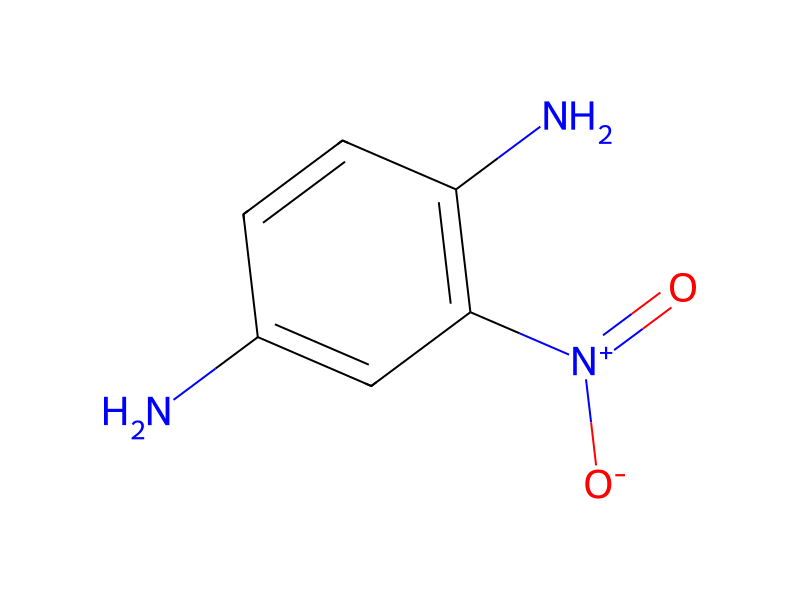
183870-67-9Nc1ccc(N)c([N+](=O)[O-])c1HVHNMNGARPCGGD-UHFFFAOYSA-NAlmost black needles with dark-green luster or black powder. (NTP, 1992)
183870-67-9、5307-14-2DTXSID4020957CHEMBL353971CHEBI:76394Cosmetic ingredients (2-Nitro-p-Phenylenediamine) -> CIR (Cosmetic Ingredient Review)
Hair dyeing
log Kow = 0.53
3.7
0.53
less than 1 mg/mL at 72 °F (NTP, 1992)
Slightly sol in water (0.18% w/w); ethanol, polar organic compounds and benzene; soluble in acetone and diethyl ether
Solubility in water, g/100ml: 0.18
279 °F (NTP, 1992)
140 °C
137 °C
Almost black needles with dark-green luster or black powder. (NTP, 1992)
Almost black needles with dark-green luster or black powder; [CAMEO]
RED-TO-BROWN CRYSTALLINE POWDER.
안전 정보는 참고용이며, 공급업체의 물질안전보건자료(SDS), 관련 법규 및 전문가 평가를 대체하지 않습니다.
This chemical does not meet GHS hazard criteria for 1.3% (1 of 75) of reports.
Warning
H315 (17.3%): Causes skin irritation [Warning Skin corrosion/irritation]
P261, P264, P264+P265, P271, P272, P280, P302+P352, P304+P340, P305+P351+P338, P319, P321, P332+P317, P333+P317, P337+P317, P362+P364, P403+P233, P405, and P501 (click each P-code to see the statement)
Aggregated GHS information provided per 75 reports by companies from 11 notifications to the ECHA C&L Inventory. Each notification may be associated with multiple companies.
Warning
Chemical: 1,4-Benzenediamine, 2-nitro-
REACH registered substance: 2-nitro-p-phenylenediamine (EC: 226-164-5)
2-Nitro-1,4-phenylenediamine: Does not have an individual approval but may be used under an appropriate group standard
Flash point data for this chemical are not available; however, it is probably combustible. (NTP, 1992)
Combustible. Gives off irritating or toxic fumes (or gases) in a fire.
Pairs of male and female rats were intubated or injected intraperitoneally with 0.5 mL of /2-nitro-p-phenylenediamine/ (2NPPD) (14C) in 5 percent Tween 80. ... There were six metabolites and a trace of unchanged 2NPPD in the urine; the metabolites were acetylated 2NPPD, sulfite and/or glucuronide conjugates of 2NPPD and of acetylated 2NPPD, and two conjugates with sulfur-containing amino acids. Similar metabolites were found in the feces.
... In human and rat skin, 2-nitro-p-phenylenediamine (2NPPD) was metabolized to triaminobenzene and N4-acetyl-2NPPD. 2NPPD was also metabolized to a sulfated 2NPPD metabolite in rat skin, but not in human skin. 2NPPD was extensively metabolized in both human and rat skin with ethanol application; metabolism was not as extensive with a semipermanent /hair dye/ formulation application. In rat intestinal tissue, 62% of 2NPPD was metabolized upon absorption to triaminobenzene and N4-acetyl-2NPPD. Differences in the metabolic profiles (proportion of each metabolite formed) were found between the skin and intestinal tissue. These results suggest that 2NPPD is rapidly absorbed and extensively metabolized in both skin and intestinal tissue. The extent of metabolism and the metabolic profile were found to be species-, tissue-, and dosing vehicle-dependent. ...
/In an/ ... experiment conducted with groups of 2 to 3 rats, each rat was treated with 200 uL of 50 % hair colorant base containing 0.025 to 0.48 % /2-nitro-p-phenylenediamine/ (2NPPD) (14C) on 10 sq cm of skin for five minutes. The base was rinsed off, and a 48-hour nonocclusive patch was applied. Skin penetration increased with increasing 2NPPD concentration and was proportional to 2NPPD concentration; it was 0.01 ug/sq cm with 0.025 % 2NPPD and 3.2% with 0.48 % 2NPPD.
Pairs of male and female rats were intubated or injected intraperitoneally with 0.5 mL of /2-nitro-p-phenylenediamine/ (2NPPD) (14C) in 5 percent Tween 80. Expired air was assayed for radioactivity for 24 hours, and urine and feces were assayed. No radioactivity was in expired air. At 3 days, 1 to 2 percent of the applied radioactivity was in the carcass. The rate of excretion was rapid; 85 to 90 percent of the applied radioactivity was recovered in the urine and the feces within 24 hours. Over 3 days, 48 to 68 percent was recovered in the feces and 27 to 41 percent in the urine. There were six metabolites and a trace of unchanged 2NPPD in the urine; the metabolites were acetylated 2NPPD, sulfite and/or glucuronide conjugates of 2NPPD and of acetylated 2NPPD, and two conjugates with sulfur-containing amino acids. Similar metabolites were found in the feces.






Dark red crystal Powder
2-Nitro-p-phenylenediamine. a component of both semipermanent and permanent hair dye formulations, was selected for bioassay by the National Cancer Institute because of the increased incidence of bladder cancer among dye manufacturing industry workers. Aromatic amines are one of several classes of organic chemicals thought to contribute to the increased cancer risk in this industry. The widespread exposure to 2-nitro-p-phenylenediamine among the general population, and the possibility of an increased cancer risk among hairdressers were additional factors in the selection of this compound for testing. A bioassay for the possible carcinogenicity of 2-nitro-p-phenylenediamine was conducted using Fischer 344 rats and B6C3F1 mice. ... Under the conditions of this bioassay, dietary administration of 2-nitro-p-phenylenediamine was carcinogenic to female B6C3F1 mice, causing an increased incidence of hepatocellular neoplasms, primarily hepatocellular adenomas. There was no convincing evidence for the carcinogenicity of the compound in Fischer 344 rats or in male B6C3F1 mice.[DHEW/NCI; Bioassay of 2-Nitro-p-phenylenediamine for Possible Carcinogenicity (1979) Technical Rpt Series No. 169 DHEW Pub No. (NIH) 79-1725]
A safety assessment of 2-nitro-p-phenylenediamine and 4-nitro-o-phenylenediamine was published in 1985 with the conclusion "for those persons not sensitized, the Expert Panel Concludes that 2-nitro-p-phenylenediamine and 4-nitro-o-phenylenediamine are safe as hair dye ingredients at the current concentration of use" ... Studies available since that safety assessment was completed, along with updated information regarding uses and use concentrations, were considered by the CIR Expert Panel. The Panel determined to not reopen this safety assessment.[Cosmetic Ingredient Review; 2-Nitro-p-Phenylenediamine and 4-Nitro-o-Phenylenediamine. JACT 4(3): 161-202, 1985; Re-Review: International Journal of Toxicology. 25(S2), 2006]
Pursuant to section 8(d) of TSCA, EPA promulgated a model Health and Safety Data Reporting Rule. The section 8(d) model rule requires manufacturers, importers, and processors of listed chemical substances and mixtures to submit to EPA copies and lists of unpublished health and safety studies. 1,4-Benzenediamine, 2-nitro- is included on this list. Effective date 4/29/83; Sunset date 4/29/93.
Fires involving this material can be controlled with a dry chemical, carbon dioxide or Halon extinguisher. A water spray may also be used. (NTP, 1992)
Use water spray, powder.
Fresh air, rest.
Remove contaminated clothes. Rinse skin with plenty of water or shower.
First rinse with plenty of water for several minutes (remove contact lenses if easily possible), then refer for medical attention.
Rinse mouth.
EYES: First check the victim for contact lenses and remove if present. Flush victim's eyes with water or normal saline solution for 20 to 30 minutes while simultaneously calling a hospital or poison control center. Do not put any ointments, oils, or medication in the victim's eyes without specific instructions from a physician. IMMEDIATELY transport the victim after flushing eyes to a hospital even if no symptoms (such as redness or irritation) develop.
SMALL SPILLS AND LEAKAGE: If a spill of this chemical occurs, FIRST REMOVE ALL SOURCES OF IGNITION, then you should dampen the solid spill material with acetone and transfer the dampened material to a suitable container. Use absorbent paper dampened with acetone to pick up any remaining material. Seal your contaminated clothing and the absorbent paper in a vapor-tight plastic bag for eventual disposal. Solvent wash all contaminated surfaces with acetone followed by washing with a soap and water solution. Do not reenter the contaminated area until the Safety Officer (or other responsible person) has verified that the area has been properly cleaned.
SRP: The most favorable course of action is to use an alternative chemical product with less inherent propensity for occupational exposure or environmental contamination. Recycle any unused portion of the material for its approved use or return it to the manufacturer or supplier. Ultimate disposal of the chemical must consider: the material's impact on air quality; potential migration in soil or water; effects on animal, aquatic, and plant life; and conformance with environmental and public health regulations.
Personal protection: particulate filter respirator adapted to the airborne concentration of the substance. Sweep spilled substance into covered containers. If appropriate, moisten first to prevent dusting. Do NOT let this chemical enter the environment.
TERRESTRIAL FATE: Based on a classification scheme(1), an estimated Koc value of 46(SRC), determined from a log Kow of 0.53(2) and a regression-derived equation(3), indicates that 2-nitro-p-phenylenediamine is expected to have very high mobility in soil(SRC). However, aromatic amines are expected to bind strongly to humus or organic matter in soils due to the high reactivity of the aromatic amino group(4), suggesting that mobility may be much lower in some soils(SRC). Volatilization of 2-nitro-p-phenylenediamine from moist soil surfaces is not expected to be an important fate process(SRC) given an estimated Henry's Law constant of 5.8X10⁻¹¹ atm-cu m/mole(SRC), using a fragment constant estimation method(5). 2-Nitro-p-phenylenediamine is not expected to volatilize from dry soil surfaces(SRC) based upon an estimated vapor pressure of 5.6X10⁻⁵ mm Hg(SRC), determined from a fragment constant method(6). Information is not available regarding the biodegradation potential of 2-nitro-p-phenylenediamine; however, 80% percent of p-phenylenediamine was removed over 120 hours based on chemical oxygen demand measurements and using an activated sludge inoculum(7).
AQUATIC FATE: Based on a classification scheme(1), an estimated Koc value of 46(SRC), determined from a log Kow of 0.53(2) and a regression-derived equation(3), indicates that 2-nitro-p-phenylenediamine is not expected to adsorb to suspended solids and sediment(SRC). 2-Nitro-p-phenylenediamine may bind strongly to organic matter as aromatic amines are highly reactive with an affinity for organic materials(4). Volatilization from water surfaces is not expected(3) based upon an estimated Henry's Law constant of 5.8X10⁻¹¹ atm-cu m/mole(SRC), developed using a fragment constant estimation method(5). According to a classification scheme(6), an estimated BCF of 3(SRC), from its log Kow(2) and a regression-derived equation(7), suggests the potential for bioconcentration in aquatic organisms is low(SRC). 2-Nitro-p-phenylenediamine absorbs at a wavelength of 441 nm(8) and therefore may be susceptible to direct photolysis by sunlight(SRC). Information is not available regarding the biodegradation potential of 2-nitro-p-phenylenediamine; however, 80% percent of p-phenylenediamine was removed over 120 hours based on chemical oxygen demand measurements and using an activated sludge inoculum(9).
ATMOSPHERIC FATE: According to a model of gas/particle partitioning of semivolatile organic compounds in the atmosphere(1), 2-nitro-p-phenylenediamine, which has an estimated vapor pressure of 5.6X10⁻⁵ mm Hg at 25 °C(SRC), determined from a fragment constant method(2), will exist in both the vapor and particulate phases in the ambient atmosphere. Vapor-phase 2-nitro-p-phenylenediamine is degraded in the atmosphere by reaction with photochemically-produced hydroxyl radicals(SRC); the half-life for this reaction in air is estimated to be 17 hours(SRC), calculated from its rate constant of 2.2X10⁻¹¹ cu cm/molecule-sec at 25 °C(SRC) that was derived using a structure estimation method(3). Particulate-phase 2-nitro-p-phenylenediamine may be removed from the air by wet or dry deposition(SRC). 2-Nitro-p-phenylenediamine absorbs at wavelengths of 441 nm(4) and therefore may be susceptible to direct photolysis by sunlight(SRC).
The following link will take the user to the National Toxicology Program (NTP) Test Agent Search Results page, which tabulates all of the "Standard Toxicology & Carcinogenesis Studies", "Developmental Studies", and "Genetic Toxicity Studies" performed with this chemical. Clicking on the "Testing Status" link will take the user to the status (i.e., in review, in progress, in preparation, on test, completed, etc.) and results of all the studies that the NTP has done on this chemical. [http://ntp-apps.niehs.nih.gov/ntp_tox/index.cfm?fuseaction=ntpsearch.searchresults&searchterm=5307-14-2]
The Koc of 2-nitro-p-phenylenediamine is estimated as 46(SRC), using a log Kow of 0.53(1) and a regression-derived equation(2). According to a classification scheme(3), this estimated Koc value suggests that 2-nitro-p-phenylenediamine is expected to have very high mobility in soil. However, anilines (aromatic amines) are expected to bind strongly to humus or organic matter in soils due to the high reactivity of the aromatic amino group(4), suggesting that mobility may be much lower in some soils(SRC).
/HUMAN EXPOSURE STUDIES/ Thirty-nine hairdressers were patch tested for 24 hours with 2-nitro-p-phenylenediamine (2NPPD). Thirty-two of the hairdressers had no history of allergic contact dermatitis from p-phenylenediamine, and none of these 32 had a positive reaction to 2NPPD. One of seven hairdressers who had experienced strongly positive reactions to p-phenylenediamine was positive for 2NPPD. The researchers suggested that this may have been a cross reaction.
/CASE REPORTS/ A case has been described in the literature in which a dental hygienist developed dermatitis on the skin of her left forearm where it came into frequent contact with the hair of patients. A patch test with p-phenylenediamine mix was negative at 48 and 96 hours, and, with 2% 2-nitro-p-phenylenediamine, was strongly positive at 48 hours.
/GENOTOXICITY/ At 50-100 ug/mL, 2-nitro-p-phenylenediamine induced chromosome & chromatid gaps & breaks in human peripheral blood lymphocytes.
/GENOTOXICITY/ 2-Nitro-p-phenylenediamie... was active in inducing unscheduled DNA synthesis in HELA human cervical cancer cells.
For more Human Toxicity Excerpts (Complete) data for 2-NITRO-P-PHENYLENEDIAMINE (6 total), please visit the HSDB record page.
AEROBIC: Information is not available regarding the biodegradation potential of 2-nitro-p-phenylenediamine; however, 80% percent of p-phenylenediamine was removed over 120 hours based on chemical oxygen demand measurements and using an activated sludge inoculum(1).
Pursuant to section 8(d) of TSCA, EPA promulgated a model Health and Safety Data Reporting Rule. The section 8(d) model rule requires manufacturers, importers, and processors of listed chemical substances and mixtures to submit to EPA copies and lists of unpublished health and safety studies. 1,4-Benzenediamine, 2-nitro- is included on this list. Effective date 4/29/83; Sunset date 4/29/93.
/2-nitro-p-phenylenediamine/ (2NPPD) (14C) was administered intraperitoneally in a dose of 2.6 mg/kg to rats ... and excretion was monitored. Within 24 hours, almost 92 percent of the radioactivity was excreted; 37.4 percent was in the urine and 54.3 percent was in the feces. After 4 days, 96 percent of the radioactivity had been excreted. ...
... In vitro studies /were conducted/ to measure absorption and metabolism of 2-nitro-p-phenylenediamine (2NPPD) in human and fuzzy rat skin and rat jejunal tissue. ... In human skin, the percentages of total applied dose absorbed (receptor fluid + skin) over 24 hr were 9.2 +/- 5.7 (mean +/- SD) and 9.5 +/- 3.2 for ... ethanol and semipermanent /hair dye/ vehicles, respectively, with approximately 3% remaining in skin. In rat skin, the percentages of total applied dose absorbed over 24 hr were 9.3 +/- 1.2 (mean +/- SE), 6.9 +/- 1.2, and 4.2 +/- 0.1 for the ethanol, semipermanent, and permanent formulation vehicles, respectively, with approximately 3% remaining in skin. In rat intestinal tissue, the percentage of total applied dose absorbed over 24 hr was 10.9 +/- 1.2, with approximately 5% remaining in the tissue. ...
CIR ingredient: 2-Nitro-p-Phenylenediamine
Used as a hair dye; [Kanerva, p. 1819]
Dressing Hair [Category: Other]
In dyeing furs brown and reddish brown
Dye intermediate in semi-permanent and permanent hair dye formulations.
AVAIL IN JAPAN WITH MIN PURITY OF 99% & CONTAINS NITROAMINOACETANILIDE ISOMERS AS IMPURITIES.
2-Nitro-p-phenylenediamine is available commercially in purities ranging from 95 to 100%, with 4-amino-3-nitroacetanilide as a possible impurity.
(1976) 3.00X10+5 GRAMS (PRINCPL CUSTMS DISTS)
(1979) 4.53X10+5 GRAMS (PRINCPL CUSTMS DISTS)
FIRST PREPD BY HYDROLYSIS OF 1,4-DIAMINO-5-ACETYL-4-NITROBENZENE... A SIMILAR METHOD IS USED COMMERCIALLY IN JAPAN, WHERE 1,4-DIAMINO-2-NITROBENZENE IS PREPD BY ACETYLATING PARA-PHENYLENEDIAMINE...WITH ACETIC ANHYDRIDE FOLLOWED BY NITRATION & HYDROLYSIS.
...AVAIL IN US AS COMMERCIAL GRADE WITH FOLLOWING TYPICAL SPECIFICATIONS: ASSAY, 97% MIN; MELTING RANGE, 135-138 °C; LOSS ON DRYING, 1.0% MAX; IRON CONTENT, 100 MG/KG MAX; RESIDUE ON IGNITION, 0.3%.
2-Nitro-p-phenylenediamine is available commercially in purities ranging from 95 to 100%, with 4-amino-3-nitroacetanilide as a possible impurity.
2-Nitro-p-phenylenediamine has the following specifications: ash, 0.1% (max); iron, 40 ppm (max); lead, 5 ppm (max); and arsenic, 2ppm(max).
IT HAS BEEN USED IN /HAIR DYES/ DARK-BROWN (@ LEVELS OF 0.1%), MEDIUM-BROWN (0.15%), MEDIUM-RED (2.5%) & ASH-BLOND (0.065%) DYE FORMULATIONS. IT CAN ALSO BE USED IN BLEACH-TONER FORMULATIONS FOR GOLDEN-BLOND (0.008%) & RED-BLOND (0.02%) SHADES.
개요o-Nitro-paraphenylenediamine (ONPD) is a hair dye and a sensitizer in hairdressers.
용도This compound is used in hair and fur dyes.
일반 설명Almost black needles with dark-green luster or black powder.
정의ChEBI: A primary amino compound that is p-phenylenediamine in which one of the hydrogens attached to the benzene ring is replaced by a nitro group. It is a cosmetic hair dye intermediate that is used in permanent hair colouring products (diluted 1:1 ith an oxidising agent prior to application).