
Piperacillin
데이터를 보충하는 중입니다. 잠시 후 페이지를 새로 고치면 최신 내용을 볼 수 있습니다

기본 정보
- CAS
61477-96-1- 표준 SMILES
CCN1CCN(C(=O)N[C@@H](C(=O)N[C@@H]2C(=O)N3[C@@H]2SC(C)(C)[C@@H]3C(=O)O)c2ccccc2)C(=O)C1=O- InChIKey
IVBHGBMCVLDMKU-GXNBUGAJSA-N- 분자식
- C23H27N5O7S
- 평균 분자량
- 517.6 g/mol
- 단동위원소 질량
- 517.1631192
개요
Piperacillin is a penicillin in which the substituent at position 6 of the penam ring is a 2-[(4-ethyl-2,3-dioxopiperazin-1-yl)carboxamido]-2-phenylacetamido group. It has a role as an antibacterial drug. It is a penicillin and a penicillin allergen. It is a conjugate acid of a piperacillin(1-).
이름 및 식별자
- 우선 이름
- Piperacillin
- IUPAC
- (2S,5R,6R)-6-[[(2R)-2-[(4-ethyl-2,3-dioxopiperazine-1-carbonyl)amino]-2-phenylacetyl]amino]-3,3-dimethyl-7-oxo-4-thia-1-azabicyclo[3.2.0]heptane-2-carboxylic acid
- 영어명
- Piperacillin
- 분자식
- C23H27N5O7S
- 분자량
- 517.55
이름 및 동의어
piperacillin61477-96-1Piperacillin anhydrousPiperacillinePiperacilinaPeracinPiperacillinaPiperacillinumPIPCCHEBI:8232Pipercillin(2S,5R,6R)-6-[[(2R)-2-[(4-ethyl-2,3-dioxopiperazine-1-carbonyl)amino]-2-phenylacetyl]amino]-3,3-dimethyl-7-oxo-4-thia-1-azabicyclo[3.2.0]heptane-2-carboxylic acid
이름 더 보기
PIPERACILLIN SODIUMPipracil(2S,5R,6R)-6-[[(2R)-[[(4-Ethyl-2,3-dioxo-1-piperazinyl)carbonyl]amino]phenylacetyl]amino]-3,3-dimethyl-7-oxo-4-Thia-1-azabicyclo[3.2.0]heptane-2-carboxylic acid(2S,5R,6R)-6-((R)-2-(4-ethyl-2,3-dioxopiperazine-1-carboxamido)-2-phenylacetamido)-3,3-dimethyl-7-oxo-4-thia-1-azabicyclo[3.2.0]heptane-2-carboxylic acid hydrate4-Thia-1-azabicyclo[3.2.0]heptane-2-carboxylicacid,6-[[(2R)-2-[[(4-ethyl-2,3-dioxo-1-piperazinyl)carbonyl]aMino]-2-phenylacetyl]aMino]-3,3-diMethyl-7-oxo-,(2S,5R,6R)-C14034Pipraci
(2S,5R,6R)-6-{[(2R)-2-{[(4-ethyl-2,3-dioxopiperazin-1-yl)carbonyl]amino}-2-phenylacetyl]amino}-3,3-dimethyl-7-oxo-4-thia-1-azabicyclo[3.2.0]heptane-2-carboxylic acid9I628532GXDTXSID2023482AB Piperacillin4-Thia-1-azabicyclo(3.2.0)heptane-2-carboxylic acid, 3,3-dimethyl-6-(((((4-ethyl-2,3-dioxo-1-piperazinyl)carbonyl)amino)phenylacetyl)amino)-7-oxo-, (2S-(2-alpha,5-alpha,6-beta(S*)))-4-Thia-1-azabicyclo(3.2.0)heptane-2-carboxylic acid, 6-(((((4-ethyl-2,3-dioxo-1-piperazinyl)carbonyl)amino)phenylacetyl)amino)-3,3-dimethyl-7-oxo-, (2S-(2alpha,5alpha,6beta(S*)))-(2S,5R,6R)-6-[(2R)-2-{[(4-ethyl-2,3-dioxopiperazin-1-yl)carbonyl]amino}-2-phenylacetamido]-3,3-dimethyl-7-oxo-4-thia-1-azabicyclo[3.2.0]heptane-2-carboxylic acid(2S,5R,6R)-6-((R)-2-(4-Ethyl-2,3-dioxo-1-piperazinecarboxamido)-2-phenylacetamido)-3,3-dimethyl-7-oxo-4-thia-1-azabicyclo(3.2.0)heptane-2-carboxylic acid monohydrate
물성
구조 계산 물성보충 중
- XLogP
- 0.5
- 극성 표면적
- 182 Ų
- 수소 결합 공여자 수
- 3
- 수소 결합 수용자 수
- 8
- 회전 가능 결합 수
- 6
- 무거운 원자 수
- 36
- 형식 전하
- 0
- 복잡도
- 982
실험 및 물리화학적 성질
Chemical ClassesOther Uses -> Pharmaceuticals
Drugs
Pharmaceuticals -> Antibiotics
Pharmaceuticals -> Listed in ZINC15
Pharmaceuticals -> Used in Switzerland
Pharmaceuticals -> Antibiotics
LogP0.3
Solubility1.19e-01 g/L
Human DrugsBreast Feeding; Lactation; Milk, Human; Anti-Infective Agents; Antibacterial Agents; Penicillins
Physical Description
White to off-white solid; [Bristol-Myers Squibb]
Solid
Collision Cross Section
227.2 Ų [M+H]+ [CCS Type: TW; Method: calibrated with Waters Major Mix]
222.2 Ų [M+H]+ [CCS Type: TW; Method: calibrated with polyalanine and drug standards]
221.26 Ų [M-H]-
물리화학적 성질
- 녹는점
- 183 · 183-185C (dec.)
- 밀도
- 1.51 · 1.51±0.1 g/cm3(Predicted)
안전 및 규제
안전 정보는 참고용이며, 공급업체의 물질안전보건자료(SDS), 관련 법규 및 전문가 평가를 대체하지 않습니다.
GHS 분류
GHS Classification
Danger
H317 (93.8%): May cause an allergic skin reaction [Warning Sensitization, Skin]
P233, P260, P261, P271, P272, P273, P280, P284, P302+P352, P304+P340, P321, P333+P317, P342+P316, P362+P364, P403, and P501 (click each P-code to see the statement)
Aggregated GHS information provided per 16 reports by companies from 4 notifications to the ECHA C&L Inventory. Each notification may be associated with multiple companies.
유해성 정보
Regulatory InformationStatus: Active Update: 15-06-2020 https://echa.europa.eu/registration-dossier/-/registered-dossier/27459
Other Safety InformationIMAP assessments - 4-Thia-1-azabicyclo[3.2.0]heptane-2-carboxylic acid, 6-[[[[(4-ethyl-2,3-dioxo-1-piperazinyl)carbonyl]amino]phenylacetyl]amino]-3,3-dimethyl-7-oxo-, [2S-[2.alpha.,5.alpha.,6.beta.(S*)]]-: Environment tier I assessment
Hazards SummaryA dermal and respiratory sensitizer; [Bristol-Myers Squibb] Occupational asthma confirmed in a pharmaceutical worker; [Malo] Causes contact urticaria; [Kanerva, p. 219]
Hazard Classes and CategoriesSkin Sens. 1 (93.8%)
독성 정보
Hepatotoxicity
Patients on intravenous piperacillin may have transient and mild-to-moderate serum aminotransferase elevations in up to 12% of patients, but these are of little clinical significance and not more common than with comparative parenteral antibiotics. Hepatic injury was more commonly reported with mezlocillin, a related extended spectrum ureidopenicillin which has been withdrawn from use. Rare instances of idiosyncratic liver injury have been reported in persons receiving piperacillin. The liver injury is typically cholestatic arising within 1 to 6 weeks of starting therapy. The injury can be severe, but is generally self-limited once piperacillin is stopped. The features of the hepatotoxicity resemble those of other penicillins. The cholestatic hepatitis caused by piperacillin and other penicillins can be prolonged and lead to persistent cholestasis (vanishing bile duct syndrome) or persistent elevations in serum alkaline phosphatase suggestive of partial bile duct loss. Most cases of liver injury related to piperacillin are linked to the combination of piperacillin with the beta-lactamase inhibitor tazobactam (Zosyn and generics), which is more commonly used than piperacillin alone.
화학 및 산업
약리 정보
ATC Code
J01CR05
J - Antiinfectives for systemic use
QJ - Antiinfectives for systemic use
Pharmacodynamics
Piperacillin is a penicillin beta-lactam antibiotic used in the treatment of bacterial infections caused by susceptible, usually gram-positive, organisms. The name "penicillin" can either refer to several variants of penicillin available, or to the group of antibiotics derived from the penicillins. Piperacillin has <i>in vitro</i> activity against gram-positive and gram-negative aerobic and anaerobic bacteria. The bactericidal activity of Piperacillin results from the inhibition of cell wall synthesis and is mediated through Piperacillin binding to penicillin binding proteins (PBPs). Piperacillin is stable against hydrolysis by a variety of beta-lactamases, including penicillinases, and cephalosporinases and extended spectrum beta-lactamases.
Mechanism of Action
By binding to specific penicillin-binding proteins (PBPs) located inside the bacterial cell wall, Piperacillin inhibits the third and last stage of bacterial cell wall synthesis. Cell lysis is then mediated by bacterial cell wall autolytic enzymes such as autolysins; it is possible that Piperacillin interferes with an autolysin inhibitor.
Biological Half-Life36-72 minutes
Metabolism/MetabolitesLargely not metabolized.
FDA Pharmacological Classification
9I628532GX
PIPERACILLIN ANHYDROUS
Established Pharmacologic Class [EPC] - Penicillin-class Antibacterial
Chemical Structure [CS] - Penicillins
Piperacillin anhydrous is a Penicillin-class Antibacterial.
MeSH Pharmacological ClassificationSubstances that inhibit the growth or reproduction of BACTERIA.
Absorption, Distribution and Excretion
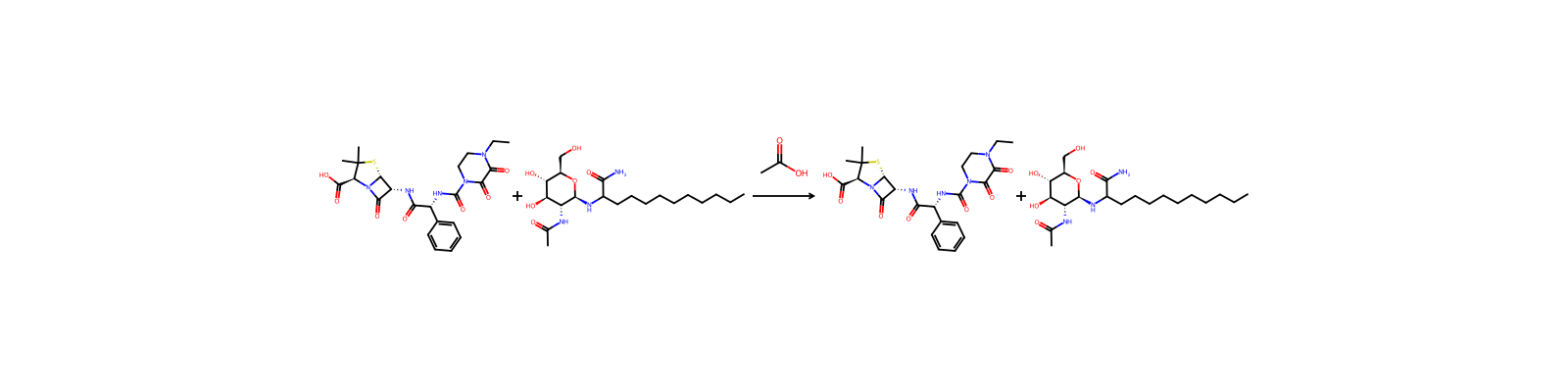
관련 반응
3건

화합물 노트
불러오는 중…