
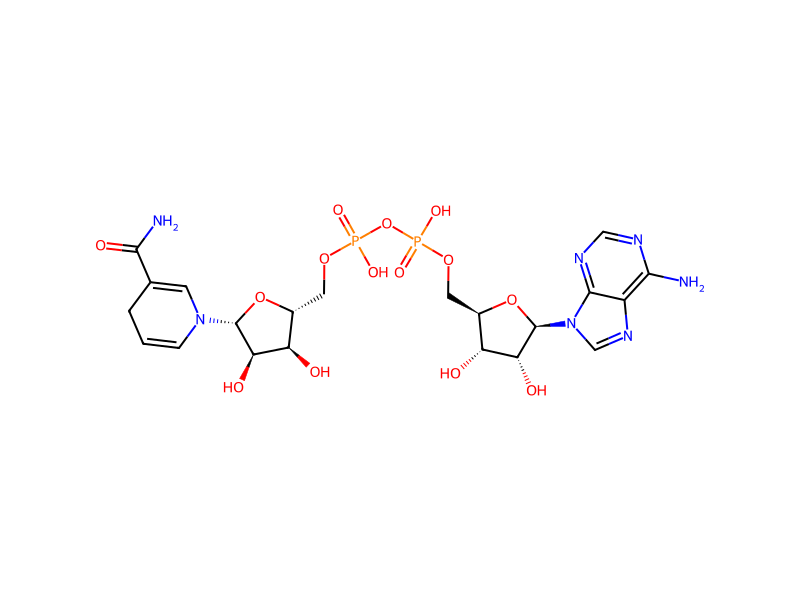
기본 정보
- 표준 SMILES
NC(=O)C1=CN([C@@H]2O[C@H](COP(=O)(O)OP(=O)(O)OC[C@H]3O[C@@H](n4cnc5c(N)ncnc54)[C@H](O)[C@@H]3O)[C@@H](O)[C@H]2O)C=CC1- InChIKey
BOPGDPNILDQYTO-NNYOXOHSSA-N- 분자식
- C21H29N7O14P2
- 평균 분자량
- 665.4 g/mol
- 단동위원소 질량
- 665.12477262
이름 및 식별자
- 우선 이름
- Nadh
- IUPAC
- [[(2R,3S,4R,5R)-5-(6-aminopurin-9-yl)-3,4-dihydroxyoxolan-2-yl]methoxy-hydroxyphosphoryl] [(2R,3S,4R,5R)-5-(3-carbamoyl-4H-pyridin-1-yl)-3,4-dihydroxyoxolan-2-yl]methyl hydrogen phosphate
- 현지명
- 디히드로니코틴아미드-아데닌디뉴클레오티드
- 영어명
- dihydrodiphosphopyridine nucleotide
- 분자식
- C21H29N7O14P2
- 분자량
- 665.44
이름 및 동의어
NADHDPNHbeta-NADH58-68-41,4-Dihydronicotinamide adenine dinucleotideNADH2dihydronicotinamide adenine dinucleotideReduced nicotinamide adenine diphosphateReduced nicotinamide-adenine dinucleotideReduced Nicotinamide Adenine Dinucleotide[[(2R,3S,4R,5R)-5-(6-aminopurin-9-yl)-3,4-dihydroxyoxolan-2-yl]methoxy-hydroxyphosphoryl] [(2R,3S,4R,5R)-5-(3-carbamoyl-4H-pyridin-1-yl)-3,4-dihydroxyoxolan-2-yl]methyl hydrogen phosphate4J24DQ0916
이름 더 보기
디히드로니코틴아미드-아데닌디뉴클레오티드NICOTINAMIDE ADENINE DINUCLEOTIDEdihydrocozymaseReduced formβ-NADH, DPNH, NADHReduced codehydrase ITestosterone 17β-dehydrogenase
Nicotinamide-adenine dinucleotide, reducednicotinamide adenine dinucleotide (reduced)CHEBI:16908DTXSID30889320[({[(2R,3S,4R,5R)-5-(6-amino-9H-purin-9-yl)-3,4-dihydroxyoxolan-2-yl]methoxy}(hydroxy)phosphoryl)oxy]({[(2R,3S,4R,5R)-5-(3-carbamoyl-1,4-dihydropyridin-1-yl)-3,4-dihydroxyoxolan-2-yl]methoxy})phosphinic acidAdenosine 5'-(trihydrogen diphosphate), P'->5'-ester with 1,4-dihydro-1-beta-D-ribofuranosyl-3-pyridinecarboxamideNAD reduced(((((2R,3S,4R,5R)-5-(6-amino-9H-purin-9-yl)-3,4-dihydroxyoxolan-2-yl)methoxy)(hydroxy)phosphoryl)oxy)((((2R,3S,4R,5R)-5-(3-carbamoyl-1,4-dihydropyridin-1-yl)-3,4-dihydroxyoxolan-2-yl)methoxy))phosphinic acid
데이터베이스 식별자
- CAS
58-68-4、606-68-8- PubChem CID
- 439153
- DTXSID
DTXSID30889320- ChEMBL
CHEMBL1234616- ChEBI
CHEBI:16908- UNII
- 4J24DQ0916
- EC Number
- 200-393-0
- Nikkaji
- J213.546I
물성
구조 계산 물성
- XLogP
- -5.7
- 극성 표면적
- 318 Ų
- 수소 결합 공여자 수
- 8
- 수소 결합 수용자 수
- 19
- 회전 가능 결합 수
- 11
- 무거운 원자 수
- 44
- 형식 전하
- 0
- 복잡도
- 1,230
실험 및 물리화학적 성질
LogP-5.1
Melting Point
140.0-142.0 °C
140.0 - 142.0 °C
Physical DescriptionSolid
물리화학적 성질
- 끓는 점
- 1081.8 · 1081.8±75.0 °C(Predicted)
- 밀도
- 2.18 · 2.18±0.1 g/cm3(Predicted)
- 용해도
- 물(약간 용해됨)
- 산도 계수 (pKa)
- 1.13 · 1.13±0.50(Predicted)
- 물리적 상태
- 고체
- 색상
- 흰색에서 황백색까지
- 안정성
- 감광성, 온도 민감성
- InChIKey
- BOPGDPNILDQYTO-NNYOXOHSSA-N
- EPA
- 5 · Adenosine 5'-(trihydrogen diphosphate), P'.fwdarw.5'-ester with 1,4-dihydro-1-.beta.-D-ribofuranosyl-3-pyridinecarboxamide (58-68-4)
안전 및 규제
유해성 정보
Regulatory Information
Chemical: Adenosine 5â²-(trihydrogen diphosphate), Pâ².fwdarw.5â²-ester with 1,4-dihydro-1-.beta.-D-ribofuranosyl-3-pyridinecarboxamide
Adenosine 5'-(trihydrogen diphosphate), P'â5'-ester with 1,4-dihydro-1-.beta.-D-ribofuranosyl-3-pyridinecarboxamide, disodium salt: Does not have an individual approval but may be used under an appropriate group standard
Other Safety InformationEvaluation - Chemicals that are unlikely to require further regulation to manage risks to environment
규제 정보
Regulatory Information
Chemical: Adenosine 5â²-(trihydrogen diphosphate), Pâ².fwdarw.5â²-ester with 1,4-dihydro-1-.beta.-D-ribofuranosyl-3-pyridinecarboxamide
Adenosine 5'-(trihydrogen diphosphate), P'â5'-ester with 1,4-dihydro-1-.beta.-D-ribofuranosyl-3-pyridinecarboxamide, disodium salt: Does not have an individual approval but may be used under an appropriate group standard
안전 데이터
- tsca
- TSCA listed
- 기존화학 물질
- KE-25880
화학 및 산업
약리 정보
Pharmacodynamics
A coenzyme composed of ribosylnicotinamide 5'-diphosphate coupled to adenosine 5'-phosphate by pyrophosphate linkage. It is found widely in nature and is involved in numerous enzymatic reactions in which it serves as an electron carrier by being alternately oxidized (NAD+) and reduced (NADH). The action of supplemental NADH is unclear. Oral NADH supplementation has been used to combat simple fatigue as well as such mysterious and energy-sapping disorders as chronic fatigue syndrome and fibromyalgia. Researchers are also studying the value of NADH supplements for improving mental function in people with Alzheimer's disease, and minimizing physical disability and relieving depression in people with Parkinson's disease. Some healthy individuals also take NADH supplements orally to improve concentration and memory capacity, as well as to increase athletic endurance. However, to date there have been no published studies to indicate that using NADH is in any way effective or safe for these purposes.
Mechanism of Action
NADH is synthesized by the body and thus is not an essential nutrient. It does require the essential nutrient nicotinamide for its synthesis, and its role in energy production is certainly an essential one. In addition to its role in the mitochondrial electron transport chain, NADH is produced in the cytosol. The mitochondrial membrane is impermeable to NADH, and this permeability barrier effectively separates the cytoplasmic from the mitochondrial NADH pools. However, cytoplasmic NADH can be used for biologic energy production. This occurs when the malate-aspartate shuttle introduces reducing equivalents from NADH in the cytosol to the electron transport chain of the mitochondria. This shuttle mainly occurs in the liver and heart.
Absorption, Distribution and ExcretionUnclear how much of an administered dose is absorbed.
Tissue LocationsBladder;Brain;Fibroblasts;Platelet;Skeletal Muscle
Cellular LocationsEndoplasmic reticulum;Mitochondria;Peroxisome
Metabolite Pathways
11-beta-hydroxylase deficiency (CYP11B1);17-alpha-hydroxylase deficiency (CYP17);17-Beta Hydroxysteroid Dehydrogenase III Deficiency;2-aminoadipic 2-oxoadipic aciduria;2-Hydroxyglutric Aciduria (D And L Form);2-ketoglutarate dehydrogenase complex deficiency;2-Methyl-3-Hydroxybutryl CoA Dehydrogenase Deficiency;21-hydroxylase deficiency (CYP21);27-Hydroxylase Deficiency;3-Beta-Hydroxysteroid Dehydrogenase Deficiency;Total 46220 pathways, visit the HMDB page for details
용도 및 제조
General Manufacturing InformationAdenosine 5'-(trihydrogen diphosphate), P'.fwdarw.5'-ester with 1,4-dihydro-1-.beta.-D-ribofuranosyl-3-pyridinecarboxamide: INACTIVE
상·하류 제품 정보
상류 원료
하류 제품
공급사24 곳
weifang runzhong fine chemical co., ltd536-7868377 +8618653686003 · [email protected]
曼顿生物科技(深圳)有限公司+86-75589664337 +86-15112661142 · [email protected]
湖南瑞威尔生物科技有限公司15608648206 13297919155 · [email protected]
北京博奥森生物技术有限公司400-901-9800 18611424007 · [email protected]
上海梅凯科技有限公司021-68689288 15300790979 · [email protected]
PT CHEM GROUP LIMITED+86-85511178; +86-85511178 · [email protected]
杭州六可生物科技有限公司+86-571-86912261 19975279805 · [email protected]
湖北世腾化工科技有限公司18971850150 19086915685 · [email protected]
曼顿生物科技(深圳)有限公司755-89664337 19125366885
成都标样生物科技有限公司028-81700200 13308200041 · [email protected]
湖北世腾化工科技有限公司19086915685 18971850150 · [email protected]
河南天孚化工有限公司+86-0371-55170693 +86-19937530512 · [email protected]
Hebei Chuanghai Biotechnology Co., Ltd+86-15350571055 · [email protected]
河南奥创化工有限公司+86-0371-63689365 +8618638391208 · [email protected]
陕西缔都医药有限责任公司81148925 17391631969 · [email protected]
BOC Sciences+1-631-485-4226 · [email protected]
西安睿斯生物科技有限公司17792397526
SyncoZymes (Shanghai) Co., Ltd.,+86-13681683526(Wechat) · [email protected]
上海楷森生物科技有限公司17558870519 · [email protected]
HANGZHOU LEAP CHEM CO., LTD.+86-571-87711850 +8619957148339 · [email protected]
TargetMol中国(陶术生物)15002134094 · [email protected]
陕西缔都医药化工有限公司+86-29-87569266 +86-17392581500 · [email protected]
上海药领医药科技合伙企业(有限合伙)400-6181121 18616383988 · [email protected]
Guangzhou TongYi biochemistry technology Co.,LTD[email protected]
추가 설명
정의ChEBI: A coenzyme found in all living cells; consists of two nucleotides joined through their 5'-phosphate groups, with one nucleotide containing an adenine base and the other containing nicotinamide.
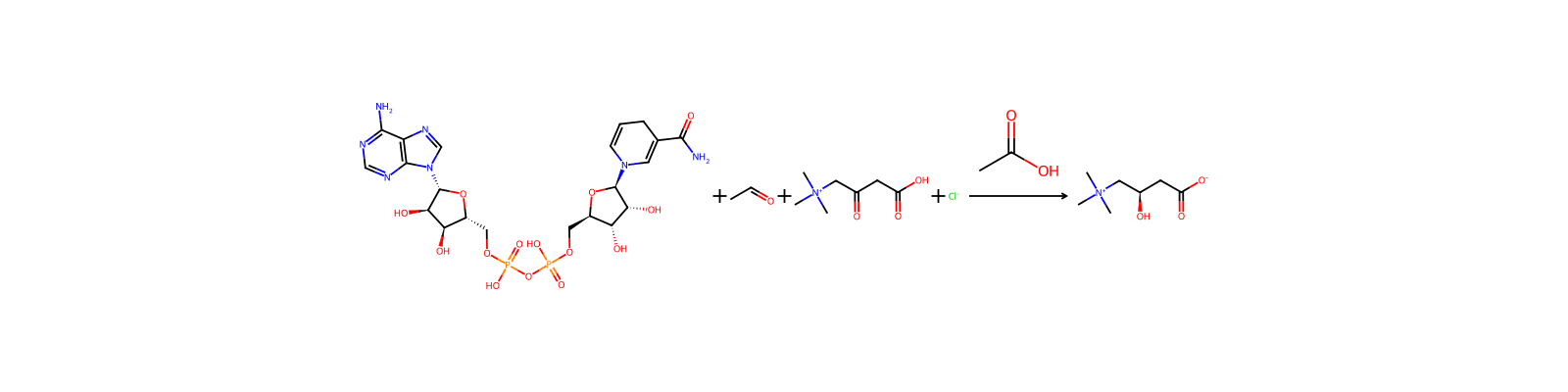
관련 반응
141건





연결된 노트
불러오는 중…