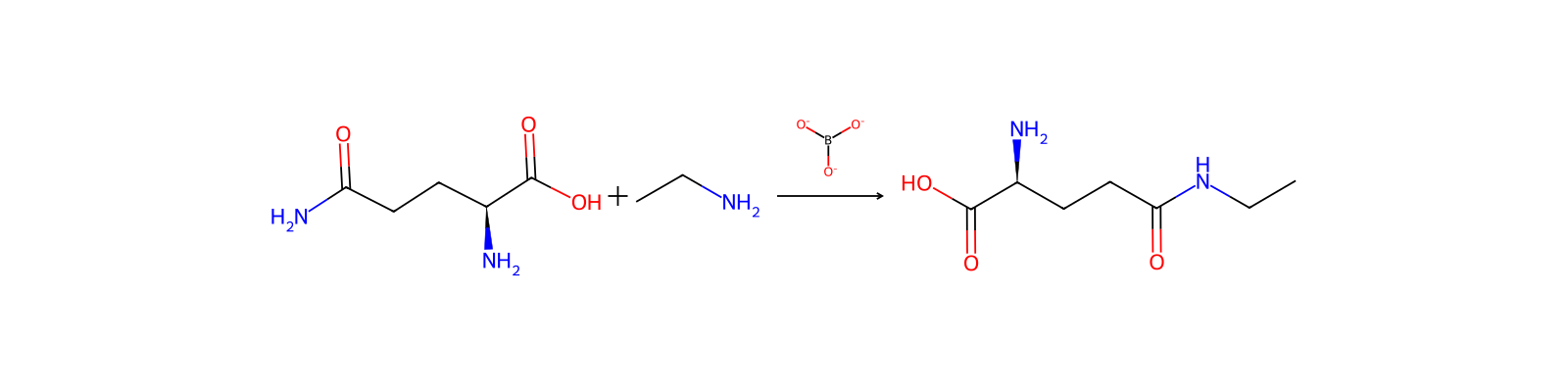
HRID 10366생성물로
L-Theanine

3081-61-6CCNC(=O)CC[C@H](N)C(=O)ODATAGRPVKZEWHA-YFKPBYRVSA-NN(5)-ethyl-L-glutamine is a N5-alkylglutamine where the alkyl group is ethyl. It has been isolated from green tea. It has a role as a geroprotector, a neuroprotective agent and a plant metabolite. It is a tautomer of a N(5)-ethyl-L-glutamine zwitterion.
3081-61-6DTXSID80184817CHEMBL3039113CHEBI:17394Astringent, sweet
Slightly sweet
Soluble in 2.6 parts water at 0 °C; soluble in 1.8 parts water at 100 °C
Insoluble in ethanol and ether
174.20
217 - 218 °C
안전 정보는 참고용이며, 공급업체의 물질안전보건자료(SDS), 관련 법규 및 전문가 평가를 대체하지 않습니다.
This chemical does not meet GHS hazard criteria for 0.5% (1 of 206) of reports.
Warning
H317 (99.5%): May cause an allergic skin reaction [Warning Sensitization, Skin]
P261, P272, P280, P302+P352, P321, P333+P317, P362+P364, and P501 (click each P-code to see the statement)
Aggregated GHS information provided per 206 reports by companies from 3 notifications to the ECHA C&L Inventory.
Combustible solid which burns but propagates flame with difficulty. Avoid generating dust, particularly clouds of dust in a confined or unventilated space as dusts may form an explosive mixture with air, and any source of ignition, i.e. flame or spark, will cause fire or explosion. Dust clouds generated by the fine grinding of the solid are a particular hazard; accumulations of fine dust may burn rapidly and fiercely if ignited.
L-theanine (N-ethyl-L-glutamine) or theanine is a major amino acid uniquely found in green tea. L-theanine has been historically reported as a relaxing agent, prompting scientific research on its pharmacology. Animal neurochemistry studies suggest that L-theanine increases brain serotonin, dopamine, GABA levels and has micromolar affinities for AMPA, Kainate and NMDA receptors. In addition has been shown to exert neuroprotective effects in animal models possibly through its antagonistic effects on group 1 metabotrophic glutamate receptors. Behavioural studies in animals suggest improvement in learning and memory. Overall, L-theanine displays a neuropharmacology suggestive of a possible neuroprotective and cognitive enhancing agent and warrants further investigation in animals and humans.
In an investigation of the mechanisms of the neuroprotective effects of theanine (gamma-glutamylethylamide) in brain ischemia, inhibition by theanine of the binding of [(3)H](RS)-alpha-amino-3-hydroxy-5-methylisoxazole-4-propionic acid (AMPA), [(3)H]kainate, and [(3)H](E)-3-(2-phenyl-2-carboxyethenyl)-4,6-dichloro-1-H-indole-2-carboxylic acid (MDL 105,519) to glutamate receptors was studied in terms of its possible inhibiting effects on the three receptor subtypes (AMPA, kainate, and NMDA glycine), with rat cortical neurons. Theanine bound the three receptors, but its IC50 of theanine was 80- to 30,000-fold less than that of L-glutamic acid.
In this study, the inhibitory effect of L-theanine, an amino acid derivative of tea, on the rewarding effects of nicotine and its underlying mechanisms of action were studied. We found that L-theanine inhibited the rewarding effects of nicotine in a conditioned place preference (CPP) model of the mouse and reduced the excitatory status induced by nicotine in SH-SY5Y cells to the same extent as the nicotine receptor inhibitor dihydro-beta-erythroidine (DHbetaE). Further studies using high performance liquid chromatography, western blotting and immunofluorescence staining analyses showed that L-theanine significantly inhibited nicotine-induced tyrosine hydroxylase (TH) expression and dopamine production in the midbrain of mice. L-theanine treatment also reduced the upregulation of the a(4), beta(2) and a(7) nicotine acetylcholine receptor (nAChR) subunits induced by nicotine in mouse brain regions that related to the dopamine reward pathway, thus decreasing the number of cells that could react to nicotine. In addition, L-theanine treatment inhibited nicotine-induced c-Fos expression in the reward circuit related areas of the mouse brain. Knockdown of c-Fos by siRNA inhibited the excitatory status of cells but not the upregulation of TH induced by nicotine in SH-SY5Y cells. Overall, the present study showed that L-theanine reduced the nicotine-induced reward effects via inhibition of the nAChR-dopamine reward pathway. These results may offer new therapeutic strategies for treatment of tobacco addiction.


White Crystalline Solid
Wear breathing apparatus plus protective gloves.
Water spray or fog. Foam.
/If swallowed/, immediately give a glass of water. " First aid is not generally required. If in doubt, contact a poisons information center or a doctor. If this product comes in contact with eyes: Wash out immediately with water. If irritation continues, seek medical attention. If skin contact occurs: Immediately remove all contaminated clothing, including footwear. Flush skin and hair with running water (and soap if available). If dust is inhaled, remove from contaminated area. Encourage patient to blow nose to ensure clear passage of breathing. If irritation or discomfort persists seek medical attention.
SRP: Criteria for land treatment or burial (sanitary landfill) disposal practices are subject to significant revision. Prior to implementing land disposal of waste residue (including waste sludge), consult with environmental regulatory agencies for guidance on acceptable disposal practices.
All waste must be handled in accordance with local, state and federal regulations. Puncture containers to prevent re-use and bury at an authorized landfill. Legislation addressing waste disposal requirements may differ by country, state and/ or territory. Each user must refer to laws operating in their area. In some areas, certain wastes must be tracked. A Hierarchy of Controls seems to be common - the user should investigate: Reduction, Reuse, Recycling, Disposal (if all else fails). This material may be recycled if unused, or if it has not been contaminated so as to make it unsuitable for its intended use. Shelf life considerations should also be applied in making decisions of this type. Note that properties of a material may change in use, and recycling or reuse may not always be appropriate. DO NOT allow wash water from cleaning equipment to enter drains. Collect all wash water for treatment before disposal - Recycle wherever possible, Consult manufacturer for recycling options or consult Waste Management Authority for disposal if no suitable treatment or disposal facility can be identified.
PROCEDURE FOR HANDLING: Avoid all personal contact, including inhalation. Wear protective clothing when risk of exposure occurs. Empty containers may contain residual dust which has the potential to accumulate following settling. Such dusts may explode in the presence of an appropriate ignition source. Do NOT cut, drill, grind or weld such containers. In addition ensure such activity is not performed near full, partially empty or empty containers without appropriate workplace safety authorisation or permit.
Good hygiene practice requires that exposure be kept to a minimum and that suitable gloves be used in an occupational setting. Open cuts, abraded or irritated skin should not be exposed to this material. ... Examine the skin prior to the use of the material and ensure that any external damage is suitably protected.
OTHER: Overalls, P.V.C. apron, Barrier cream, Skin cleansing cream, Eye wash unit.
The material may produce skin sensitization in predisposed individuals. Care must be taken, when removing gloves and other protective equipment, to avoid all possible skin contact. ... Contaminated gloves should be replaced. Gloves must only be worn on clean hands. After using gloves, hands should be washed and dried thoroughly. Application of a non-perfumed moisturiser is recommended. Experience indicates that the following polymers are suitable as glove materials for protection against undissolved, dry solids, where abrasive particles are not present - polychloroprene, nitrile rubber, butyl rubber, fluorocaoutchouc, polyvinyl chloride. Gloves should be examined for wear and/ or degradation constantly.
ENGINEERING CONTROLS: Local exhaust ventilation is required where solids are handled as powders or crystals; even when particulates are relatively large, a certain proportion will be powdered by mutual friction. Exhaust ventilation should be designed to prevent accumulation and recirculation of particulates in the workplace.
The aim of this study was to compare 50 mg caffeine, with and without 100 mg L-theanine, on cognition and mood in healthy volunteers. The effects of these treatments on word recognition, rapid visual information processing, critical flicker fusion threshold, attention switching and mood were compared to placebo in 27 participants. Performance was measured at baseline and again 60 min and 90 min after each treatment (separated by a 7-day washout). Caffeine improved subjective alertness at 60 min and accuracy on the attention-switching task at 90 min. The L-theanine and caffeine combination improved both speed and accuracy of performance of the attention-switching task at 60 min, and reduced susceptibility to distracting information in the memory task at both 60 min and 90 min. These results replicate previous evidence which suggests that L-theanine and caffeine in combination are beneficial for improving performance on cognitively demanding tasks.
A combination of green tea extract and l-theanine (LGNC-07) has been reported to have beneficial effects on cognition in animal studies. In this randomized, double-blind, placebo-controlled study, the effect of LGNC-07 on memory and attention in subjects with mild cognitive impairment (MCI) was investigated. Ninety-one MCI subjects whose Mini Mental State Examination-K (MMSE-K) scores were between 21 and 26 and who were in either stage 2 or 3 on the Global Deterioration Scale were enrolled in this study. The treatment group (13 men, 32 women; 57.58 +/- 9.45 years) took 1,680 mg of LGNC-07, and the placebo group (12 men, 34 women; 56.28 +/- 9.92 years) received an equivalent amount of maltodextrin and lactose for 16 weeks. Neuropsychological tests (Rey-Kim memory test and Stroop color-word test) and electroencephalography were conducted to evaluate the effect of LGNC-07 on memory and attention. Further analyses were stratified by baseline severity to evaluate treatment response on the degree of impairment (MMSE-K 21-23 and 24-26). LGNC-07 led to improvements in memory by marginally increasing delayed recognition in the Rey-Kim memory test (P=0 .0572). Stratified analyses showed that LGNC-07 improved memory and selective attention by significantly increasing the Rey-Kim memory quotient and word reading in the subjects with MMSE-K scores of 21-23 (LGNC-07, n=11; placebo, n=9). Electroencephalograms were recorded in 24 randomly selected subjects hourly for 3 hours in eye-open, eye-closed, and reading states after a single dose of LGNC-07 (LGNC-07, n=12; placebo, n=12). Brain theta waves, an indicator of cognitive alertness, were increased significantly in the temporal, frontal, parietal, and occipital areas after 3 hours in the eye-open and reading states. Therefore, this study suggests that LGNC-07 has potential as an intervention for cognitive improvement.
Recent neuropharmacological research has suggested that certain constituents of tea may have modulatory effects on brain state. The bulk of this research has focused on either L-theanine or caffeine ingested alone (mostly the latter) and has been limited to behavioral testing, subjective rating, or neurophysiological assessments during resting. Here, we investigated the effects of both L-theanine and caffeine, ingested separately or together, on behavioral and electrophysiological indices of tonic (background) and phasic (event-related) visuospatial attentional deployment. Subjects underwent 4 d of testing, ingesting either placebo, 100 mg of L-theanine, 50 mg of caffeine, or these treatments combined. The task involved cued shifts of attention to the left or right visual hemifield in anticipation of an imperative stimulus requiring discrimination. In addition to behavioral measures, we examined overall, tonic attentional focus as well as phasic, cue-dependent anticipatory attentional biasing, as indexed by scalp-recorded alpha-band (8-14 Hz) activity. We found an increase in hit rate and target discriminability (d') for the combined treatment relative to placebo, and an increase in d' but not hit rate for caffeine alone, whereas no effects were detected for L-theanine alone. Electrophysiological results did not show increased differential biasing in phasic alpha across hemifields but showed lower overall tonic alpha power in the combined treatment, similar to previous findings at a larger dosage of L-theanine alone. This may signify a more generalized tonic deployment of attentional resources to the visual modality and may underlie the facilitated behavioral performance on the combined ingestion of these 2 major constituents of tea.
This review summarizes the literature on the association between two dietary components of tea, caffeine and L-theanine, and the psychological outcomes of consumption; it also identifies areas for future research. The studies reviewed suggest that caffeinated tea, when ingested at regular intervals, may maintain alertness, focused attention, and accuracy and may modulate the more acute effects of higher doses of caffeine. These findings concur with the neurochemical effects of L-theanine on the brain. L-theanine may interact with caffeine to enhance performance in terms of attention switching and the ability to ignore distraction; this is likely to be reflective of higher-level cognitive activity and may be sensitive to the detrimental effects of overstimulation. Further research should investigate the interactive effects of caffeine, L-theanine, and task complexity, utilize a range of ecologically valid psychological outcomes, and assess the neuroprotective effects of L-theanine using epidemiological or longer-term intervention studies among individuals at risk of neurodegenerative disease.
For more Interactions (Complete) data for Theanine (32 total), please visit the HSDB record page.
TERRESTRIAL FATE: Based on a classification scheme(1), an estimated Koc value of 10(SRC), determined from a structure estimation method(2), indicates that theanine is expected to have very high mobility in soil(SRC). Theanine has estimated pKa values of 2.35 (the acid) and 9.31 (the amine)(3) indicating that this compound will exist as a zwitterion having both a cation and anion form in the environment and cations generally adsorb more strongly to soils containing organic carbon and clay than their neutral counterparts(4). Volatilization of glutamine from moist soil surfaces is not expected to be an important fate process(SRC) given an estimated Henry's Law constant of 8.8X10⁻¹⁶ atm-cu m/mole(SRC), using a fragment constant estimation method(2). Theanine is not expected to volatilize from dry soil surfaces(SRC) based upon an estimated vapor pressure of 5.0X10⁻⁸ mm Hg at 25 °C(SRC), determined from a fragment constant method(2). Glutamine, which is structurally similar to theanine, reached 77% of its theoretical BOD in 4 weeks in the Japanese MITI test which classified glutamine as readily biodegradable(5); by analogy, theanine may have similar biodegradability which suggests biodegradation could be an important environmental fate process in soil(SRC).
AQUATIC FATE: Based on a classification scheme(1), an estimated Koc value of 10(SRC), determined from a structure estimation method(2), indicates that theanine is not expected to adsorb to suspended solids and sediment(SRC). Volatilization from water surfaces is not expected(3) based upon an estimated Henry's Law constant of 8.8X10⁻¹⁶ atm-cu m/mole(SRC), developed using a fragment constant estimation method(2). Theanine has estimated pKa values of 2.35 (the acid) and 9.31 (the amine)(4) indicating that this compound will exist as a zwitterion having both a cation and anion form in the environment that also suggests volatilization from water will not be an important fate process(SRC). According to a classification scheme(5), an estimated BCF of 3(SRC), from an estimated log Kow of -3.54(2) and a regression-derived equation(2), suggests the potential for bioconcentration in aquatic organisms is low(SRC). Theanine is not expected to undergo hydrolysis in the environment due to the lack of functional groups that hydrolyze under environmental conditions(3). Theanine does not contain chromophores that absorb at wavelengths >290 nm(3) and, therefore, is not expected to be susceptible to direct photolysis by sunlight(SRC). Glutamine, which is structurally similar to theanine, reached 77% of its theoretical BOD in 4 weeks in the Japanese MITI test which classified glutamine as readily biodegradable(6); by analogy, theanine may have similar biodegradability which suggests biodegradation could be an important environmental fate process in natural water(SRC).
ATMOSPHERIC FATE: According to a model of gas/particle partitioning of semivolatile organic compounds in the atmosphere(1), theanine, which has an estimated vapor pressure of 5.0X10⁻⁸ mm Hg at 25 °C(SRC), determined from a fragment constant method(2), will exist in both the vapor and particulate phases in the ambient atmosphere. Vapor-phase theanine is degraded in the atmosphere by reaction with photochemically-produced hydroxyl radicals(SRC); the half-life for this reaction in air is estimated to be 7.3 hours(SRC), calculated from its rate constant of 5.3X10⁻¹¹ cu cm/molecule-sec at 25 °C(SRC) that was derived using a structure estimation method(2). Particulate-phase theanine may be removed from the air by wet and dry deposition(SRC). Theanine does not contain chromophores that absorb at wavelengths >290 nm(3) and, therefore, is not expected to be susceptible to direct photolysis by sunlight(SRC).
A theanine concentration of 103 mmol/kg was detected in matcha, a finely powdered form of tea leaves (Camellia sinensis)(1). In nine batches of dried green tea leaves (Camellia sinensis), the theanine content ranged from 1.56-4.48 mg/g(2). Theanine is a component of black tea(3). Theanine is synthesized in the root of the plant and concentrates in the leaves, where sunlight converts theanine to polyphenols(4); because of this, some tea cultivators grow their plants out of direct sunlight to preserve the theanine content and thus the flavor(4). Theanine is found in the non-edible mushroom Xerocomus badius(5).
Using a structure estimation method based on molecular connectivity indices(1), the Koc of theanine can be estimated to be 10(SRC). According to a classification scheme(2), this estimated Koc value suggests that theanine is expected to have very high mobility in soil. Theanine has estimated pKa values of 2.35 (the acid) and 9.31 (the amine)(3) indicating that this compound will exist as a zwitterion having both a cation and anion form in the environment and cations generally adsorb more strongly to soils containing organic carbon and clay than their neutral counterparts(4).
Theanine is the predominant amino acid found in leaves of the tea plant Camillia sinensis(1). Theanine appears to only occur in three other plant species; one mushroom species and two other species of the Camellia genus(2). It is found in the non-edible mushroom Xerocomus badius(3).
/HUMAN EXPOSURE STUDIES/ Tea is the most widely consumed beverage in the world after water. Tea is known to be a rich source of flavonoid antioxidants. However tea also contains a unique amino acid, L-theanine that may modulate aspects of brain function in humans. Evidence from human electroencephalograph (EEG) studies show that it has a direct effect on the brain. L-theanine significantly increases activity in the alpha frequency band which indicates that it relaxes the mind without inducing drowsiness. However, this effect has only been established at higher doses than that typically found in a cup of black tea (approximately 20 mg). The aim of the current research was to establish this effect at more realistic dietary levels. EEG was measured in healthy, young participants at baseline and 45, 60, 75, 90 and 105 minutes after ingestion of 50 mg L-theanine (n=16) or placebo (n=19). Participants were resting with their eyes closed during EEG recording. There was a greater increase in alpha activity across time in the L-theanine condition (relative to placebo (p+0.05). A second study replicated this effect in participants engaged in passive activity. These data indicate that L-theanine, at realistic dietary levels, has a significant effect on the general state of mental alertness or arousal. Furthermore, alpha activity is known to play an important role in critical aspects of attention, and further research is therefore focussed on understanding the effect of L-theanine on attentional processes.
/HUMAN EXPOSURE STUDIES/ L-Theanine is an amino acid contained in green tea leaves which is known to block the binding of L-glutamic acid to glutamate receptors in the brain. Because the characteristics of L-Theanine suggest that it may influence psychological and physiological states under stress, the present study examined these possible effects in a laboratory setting using a mental arithmetic task as an acute stressor. Twelve participants underwent four separate trials: one in which they took L-Theanine at the start of an experimental procedure, one in which they took L-Theanine midway, and two control trials in which they either took a placebo or nothing. The experimental sessions were performed by double-blind, and the order of them was counterbalanced. The results showed that L-Theanine intake resulted in a reduction in the heart rate (HR) and salivary immunoglobulin A (s-IgA) responses to an acute stress task relative to the placebo control condition. Moreover, analyses of heart rate variability indicated that the reductions in HR and s-IgA were likely attributable to an attenuation of sympathetic nervous activation. Thus, it was suggested that the oral intake of L-Theanine could cause anti-stress effects via the inhibition of cortical neuron excitation.
/EPIDEMIOLOGY STUDIES/ L-theanine, an amino acid contained in green tea leaves, is known to block the binding of L-glutamic acid to glutamate receptors in the brain, and has been considered to cause anti-stress effects by inhibiting cortical neuron excitation. Both L-theanine and caffeine, which green tea contains, have been highlighted for their beneficial effects on cognition and mood. In this study, ... the effects of orally administered L-theanine or caffeine on mental task performance and physiological activities under conditions of physical or psychological stress in humans /was investigated/. Fourteen participants each underwent three separate trials, in which they orally took either L-theanine + placebo, caffeine + placebo, or placebo only. The results after the mental tasks showed that L-theanine significantly inhibited the blood-pressure increases in a high-response group, which consisted of participants whose blood pressure increased more than average by a performance of a mental task after placebo intake. Caffeine tended to have a similar but smaller inhibition of the blood-pressure increases caused by the mental tasks. The result of the Profile of Mood States after the mental tasks also showed that L-theanine reduced the Tension-Anxiety scores as compared with placebo intake. The findings above denote that L-theanine not only reduces anxiety but also attenuates the blood-pressure increase in high-stress-response adults.
AEROBIC: Based on analogy to the similar compound glutamine, theanine (N-ethyl-glutamine) may be readily biodegradable(SRC). Glutamine, present at 100 mg/L, reached 77% of its theoretical BOD in 4 weeks using an activated sludge inoculum at 30 mg/L in the Japanese MITI test which classified glutamine as readily biodegradable(1).
An estimated BCF of 3 was calculated in fish for theanine(SRC), using an estimated log Kow of -3.54(1) and a regression-derived equation(1). According to a classification scheme(2), this BCF suggests the potential for bioconcentration in aquatic organisms is low(SRC).
The Henry's Law constant for theanine is estimated as 8.8X10⁻¹⁶ atm-cu m/mole(SRC) using a fragment constant estimation method(1). This Henry's Law constant indicates that theanine is expected to be essentially nonvolatile from water surfaces(2). Theanine has estimated pKa values of 2.35 (the acid) and 9.31 (the amine)(3) indicating that this compound will exist as a zwitterion having both a cation and anion form in the environment that also suggests volatilization from water will not be an important fate process(SRC). Theanine's Henry's Law constant indicates that volatilization from moist soil will not occur(SRC). Theanine is not expected to volatilize from dry soil surfaces(SRC) based upon an estimated vapor pressure of 5.0X10⁻⁸ mm Hg(SRC), determined from a fragment constant method(1).
L-theanine, previously shown to penetrate the blood-brain barrier through the leucine-preferring transport system, has been demonstrated to produce significant increases in serotonin and/or dopamine concentrations in the brain principally in the striatum, hypothalamus and hippocampus.
For more Mechanism of Action (Complete) data for Theanine (9 total), please visit the HSDB record page.
In medium containing theanine with glutaminase in vitro, glutamate gradually generated, showing that glutaminase reacted with theanine. Furthermore, the generation of glutamate increased by reaction of theanine and gamma-glutamyltranspeptidase (gamma-GTP), showed that gamma-GTP converted theanine to glutamate. It is expected that theanine metabolism occurred by hydrolysis and rearrangement reaction by gamma-GTP in the liver. Namely, it is suggested that the metabolism of theanine mediated by glutaminase and gamma-GTP and the increase of glutamate mediated GSH is important for theanine-induced action.
From animal studies, it appears that L-theanine is absorbed from the small intestine via a sodium-coupled active transport process and appears to cross the blood-brain barrier. It has been found in the rat studies that the D-enantiomer of theanine may decrease the absorption of L-theanine.
MEDICATION
Dietary supplement; food additive (flavor)
A suite of three green tea-containing Standard Reference Materials (SRMs) has been issued by the National Institute of Standards and Technology (NIST): SRM 3254 Camellia sinensis (Green Tea) Leaves, SRM 3255 Camellia sinensis (Green Tea) Extract, and SRM 3256 Green Tea-Containing Solid Oral Dosage Form. The materials are characterized for catechins, xanthine alkaloids, theanine, and toxic elements. As many as five methods were used in assigning certified and reference values to the constituents, with measurements carried out at NIST and at collaborating laboratories. The materials are intended for use in the development and validation of new analytical methods, and for use as control materials as a component in the support of claims of metrological traceability.
L-theanine is considered the main component responsible for the taste of green tea, which in Japanese is called umami. Umami, which was first described by a Japanese scientist over a hundred years ago, is now considered one of the five basic tastes: sweet, salty, sour, bitter and umami. Umami is the Japanese term for savory.
L-theanine is the predominant amino acid in green tea and makes up to 50% of the total free amino acids in the plant. The amino acid constitutes between 1% and 2% of the dry weight of green tea leaves.
개요L-Theanine is the major amino acid found in Camellia sinensis, the source of green tea. It is an analog of the excitatory neurotransmitter, glutamate, and thusly, binds to glutamate receptors. L-Theanine can antagonize various glutamate receptor subtypes as well as inhibit glutamine and glutamate transporters, which has been shown to be neuroprotective in animal models of focal cerebral ischemia. Further, L-theanine is reported to increase brain levels of dopamine, serotonin, GABA, nerve growth factor, and brain-derived neurotrophic factor.
순도시험(1) 용상 : 이 품목 1g을 물 20mL에 녹일 때, 그 액은 무색으로서 탁도는 거의 징명 이하이어야 한다. (2) 비선광도 : 이 품목 약 2.5g을 정밀히 달아 물에 녹여 50mL로 하여 이 액의 선광도를 측정하고 다시 건조물로 환산할 때, =+7.7~+8.5°이어야 한다. (3) 액성 : 이 품목 1g을 물 100mL에 녹인 액의 pH는 5.0~6.0이어야 한다. (4) 염화물 : 이 품목 0.5g을 취하여 염화물시험법에 따라 시험할 때, 그 양은 0.01N 염산 0.30mL에 대응하는 양 이하이어야 한다. (5) 비소 : 이 품목을 비소시험법에 따라 시험할 때, 그 양은 4.0ppm 이하이어야 한다. (6) 납 : 이 품목 5.0g을 취하여 원자흡광광도법 또는 유도결합플라즈마발광광도법에 따라 시험할 때, 그 양은 2.0ppm 이하이어야 한다.
확인시험(1) 이 품목의 수용액(1→1,000) 5mL에 닌히드린시액 1mL를 가하고 수욕상에서 3분간 가열하면 자색을 나타낸다. (2) 이 품목 1g에 염산(1→2) 10mL를 가하고 환류냉각기를 부착하여 수욕상에서 6시간 가열한 다음 물을 가하여 20mL로 한다. 이 액을 5mL 취하여 수산화나트륨 2g을 가하고 물에 적신 적색리트머스지를 넣은 다음 5분간 수욕상에서 가열할 때 청색으로 변한다.
정량법이 품목 약 0.35g을 정밀히 달아 개미산 3mL에 녹이고 초산 50mL를 가하고 0.1N 과염소산용액으로 적정한다(지시약 : 크리스탈바이올렛․빙초산시액 1mL). 종말점은 액의 자색이 청색을 지나 녹색으로 변하는 점이다. 따로, 같은 방법으로 공시험을 한다.0.1N 과염소산용액 1mL = 17.420mg C7H14N2O3
정의ChEBI: L-Theanine is a N(5)-alkylglutamine where the alkyl group is ethyl. It has been isolated from green tea. It has a role as a neuroprotective agent, a plant metabolite and a geroprotector. It is a tautomer of a N(5)-ethyl-L-glutamine zwitterion.