
beta-D-fructose
데이터를 보충하는 중입니다. 잠시 후 페이지를 새로 고치면 최신 내용을 볼 수 있습니다
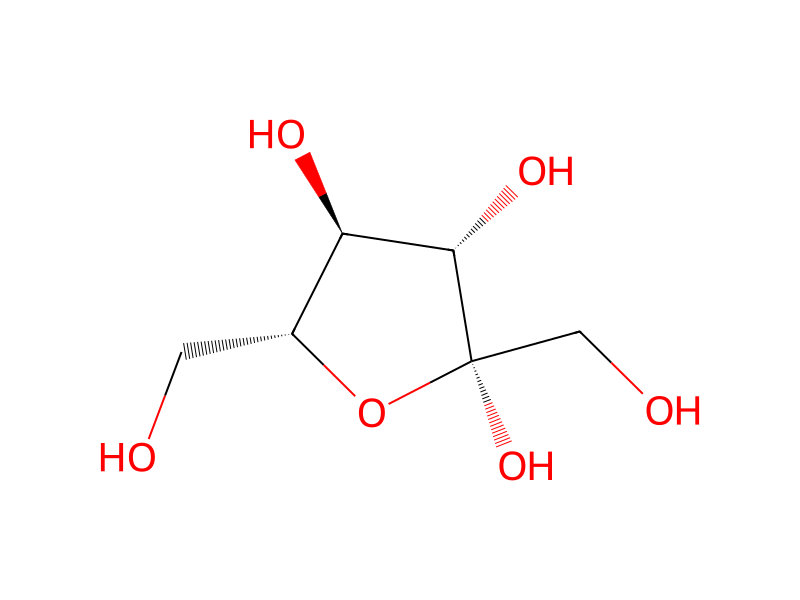
기본 정보
- CAS
470-23-5- 표준 SMILES
OC[C@H]1O[C@](O)(CO)[C@@H](O)[C@@H]1O- InChIKey
RFSUNEUAIZKAJO-ARQDHWQXSA-N- 분자식
- C6H12O6
- 평균 분자량
- 180.16 g/mol
- 단동위원소 질량
- 180.0633881
개요
Beta-D-fructofuranose is a D-fructofuranose. It has a role as a mouse metabolite. It is an enantiomer of a beta-L-fructofuranose.
이름 및 식별자
- 우선 이름
- beta-D-fructose
- IUPAC
- (2R,3S,4S,5R)-2,5-bis(hydroxymethyl)oxolane-2,3,4-triol
- 영어명
- (2R,3S,4S,5R)-2,5-Bis(hydroxymethyl)-oxolane-2,3,4-triol
- 분자식
- C6H12O6
- 분자량
- 180.16
이름 및 동의어
beta-D-fructofuranosebeta-Levulosebeta-D-Fructosebeta-Fruit sugar53188-23-1beta-D-Arabino-hexuloseB986VTP17JCHEBI:28645DTXSID60859011RefChem:937011GlyTouCan:G23778LQBETA-D.-FRUCTOFURANOSE
이름 더 보기
Lactulose Impurity 31Lactulose Impurity 11Cyanocobalamin Impurity 13 Acetate
DTXCID103081DTXSID20273991G23778LQ470-23-5Fructooligosaccharides(2R,3S,4S,5R)-2,5-bis(hydroxymethyl)tetrahydrofuran-2,3,4-triolb-D-Fructofuranose308066-66-2
데이터베이스 식별자
- CAS
470-23-5、53188-23-1、57-48-7- PubChem CID
- 439709
- DTXSID
DTXSID60859011- ChEMBL
CHEMBL604608- ChEBI
CHEBI:28645- UNII
- B986VTP17J
- Nikkaji
- J450.088A
물성
구조 계산 물성보충 중
- XLogP
- -2.3
- 극성 표면적
- 110 Ų
- 수소 결합 공여자 수
- 5
- 수소 결합 수용자 수
- 6
- 회전 가능 결합 수
- 2
- 무거운 원자 수
- 12
- 형식 전하
- 0
- 복잡도
- 162
실험 및 물리화학적 성질
Solubility778 mg/mL at 20 °C
Melting Point119 - 122 °C
Physical DescriptionSolid
물리화학적 성질
- 끓는 점
- 440.1 · 440.1±45.0 °C(Predicted)
- 밀도
- 1.694 · 1.694±0.06 g/cm3(Predicted)
- 산도 계수 (pKa)
- 11.42 · 11.42±0.70(Predicted)
안전 및 규제
안전 정보는 참고용이며, 공급업체의 물질안전보건자료(SDS), 관련 법규 및 전문가 평가를 대체하지 않습니다.
독성 정보
Health Effects
Acute consumption of fructose or high fructose corn syrup is essentially non-toxic. Chronic, excess fructose consumption has been shown to be a cause (or indirect cause) of gout, insulin resistance, hypertension, obesity, fatty liver disease, elevated LDL cholesterol and elevated triglycerides, leading to metabolic syndrome. In Wistar rats, a laboratory model of diabetes, 10% fructose feeding as opposed to 10% glucose feeding was found to increase blood triglyceride levels by 86%, whereas the same amount of glucose had no effect on triglycerides. A 2008 study found a substantial risk of incident gout associated with the consumption of fructose or fructose-rich foods. It is suspected that the fructose found in soft drinks (e.g., carbonated beverages) and other sweetened drinks is the primary reason for this increased incidence.
Exposure RoutesIngestion
Toxicity Summary
Fructose is distinct from other sugars in its ability to cause intracellular ATP depletion, nucleotide turnover, and the generation of uric acid. Uric acid is generated via fructose due to its rapid phosphorylation (to fructose-1-phosphate) in the liver, leading to a rapid drop in free phosphate and ATP. This drop in ATP leads to the stimulation of adenosine monophosphate (AMP) deaminase which deaminates AMP to produce IMP, which is subsequently converted to uric acid (A15346). Uric acid is normally an anti-oxidant but without sufficient amounts of ascorbic acid (vitamin C) present in the plasma, it functions as a pro-oxidant. Because many soft drinks and foods that are sweetened with high fructose corn syrup do not contain vitamin C, the resulting uric acid can lead to a number of harmful effects, including gout, chronic inflammation, hypertension, increased adiposity, fatty liver disease and obesity (A15346). Many studies have shown that elevated uric acid levels are associated with several metabolic and cardiovascular conditions, including diabetes and coronary artery disease (A15346). Elevated serum uric acid has also been shown to be the most reliable predictor for the development of hypertension and incident renal disease (A15347) as well as fatty liver disease (A15348). Fructose-induced uric acid generation also causes mitochondrial oxidative stress that stimulates fat accumulation independent of excessive caloric intake (A15349). Several studies have demonstrated that oxidative stress is one of the earliest phenomena observed in vascular, renal, liver cells and adipocytes exposed to uric acid (A15347). High fructose consumption is also associated with more severe depletion of liver ATP, which may impair liver "energy balance”. High-fructose beverages have also been shown to lead to lower circulating insulin and leptin levels, and higher ghrelin levels. Since leptin and insulin decrease appetite and ghrelin increases appetite, some researchers suspect that eating large amounts of fructose increases the likelihood of weight gain.
화학 및 산업
약리 정보
Metabolism/Metabolites
Free fructose is absorbed directly by the intestine. When fructose is consumed in the form of sucrose, it is digested (broken down) and then absorbed as free fructose. Fructose absorption occurs on the mucosal membrane via facilitated transport involving GLUT5 and GLUT2 transport proteins. Fructose is phosphorylated in the liver by fructokinase (Km= 0.5 mM). Fructokinase initially produces fructose 1-phosphate, which is split by aldolase B to produce the trioses dihydroxyacetone phosphate (DHAP) and glyceraldehyde. DHAP is then converted to glycerol-3-phophate which stimulates production of triglycerides. Nearly half (45%) of all pure fructose consumed is used up within 3-6 hours by the body for energy. If fructose is consumed with glucose (as it typically is in nature), up to 66% of it is used for energy within the same time frame. Roughly a third (29%) to a half (54%) of all fructose consumed is converted to glucose. Less than 1% of fructose appears to be directly converted to triglycerides.
Tissue LocationsLiver
Cellular LocationsExtracellular
Metabolite PathwaysAmino Sugar Metabolism
상·하류 제품 정보
하류 제품
관련 반응
3건


화합물 노트
불러오는 중…