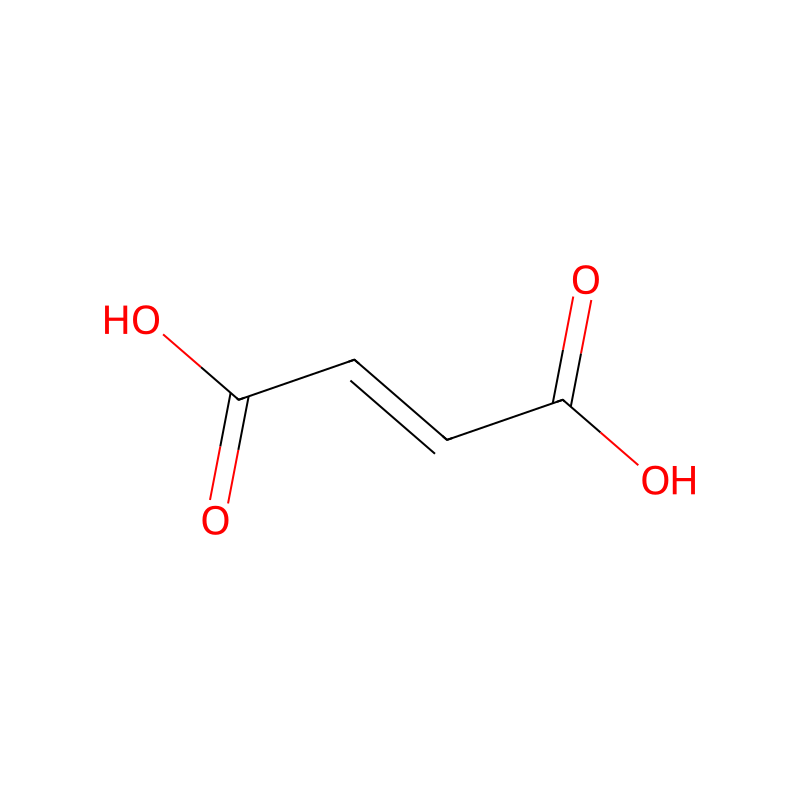
식별자 및 물리적 특성
| CAS No. | 110-17-8 |
|---|
| 분자식 | C4H4O4 |
|---|
| 평균 분자량 | 116.07 g/mol |
|---|
| 단동위원소 질량 | 116.0109586 g/mol |
|---|
| SMILES | O=C(O)/C=C/C(=O)O |
|---|
| InChIKey | VZCYOOQTPOCHFL-OWOJBTEDSA-N |
|---|
| PubChem CID | 444972 |
|---|
| ChEMBL | CHEMBL503160 |
|---|
| ChEBI | CHEBI:18012 |
|---|
| EC No. | 203-743-0 |
|---|
| DTXSID | DTXSID3021518 |
|---|
화학 및 물리적 성질
| XLogP | -0.3 |
|---|
| 극성 표면적 | 74.6 |
|---|
| 수소 결합 공여자 수 | 2 |
|---|
| 수소 결합 수용자 수 | 4 |
|---|
| 회전 가능 결합 수 | 2 |
|---|
| 무거운 원자 수 | 8 |
|---|
| 형식 전하 | 0 |
|---|
| 복잡도 | 119 |
|---|
| pH | 3,0-3,2 (0,05 % solution at 25 °C) |
|---|
| LogP(분배 계수) | 0.46log Kow = 0.460.46 (estimated) |
|---|
| 냄새 | Odorless |
|---|
| 맛 | Fruit acid |
|---|
| 밀도 | 1.635 at 68 °F (USCG, 1999) - Denser than waterwill sink1.635 g/cu cm at 20 °CIT HAS AN EXTREMELY LOW RATE OF MOISTURE ABSORPTIONBULK DENSITY: 32.6 LB/CU FTSTANDARD FREE ENERGY OF ANION FORMATION: -144.41 @ 25 °CBUFFERING INDEX 3.46Density (at 20 °C): 1.64 g/cm³ |
|---|
| Color/Form | Needles, monoclinic prisms or leaflets from waterColorless crystalsWHITE CRYSTALLINE POWDER |
|---|
| 용해도 | less than 1 mg/mL at 72 °F (NTP, 1992)7000Soluble in ethanol, concentrated sulfuric acidslightly soluble in ethyl ether, acetoneSoluble in alcohol 5.76 g/100 g at 30 °C. Insoluble in chloroform and benzenein 100 g 95% alcohol at 30 °C: 5.76gin 100 g acetone at 30 °C: 1.72 gin 100 g ether at 25 °C: 0.72 gAlmost insoluble in olive oil, ... carbon tetrachloride, xylene, ... molten camphor, liquid ammonia. |
|---|
| 인화점 | 273 °C (open cup)230 °C (closed cup) |
|---|
| 끓는 점 | 329 °F at 1.7 mmHgsublimes (NTP, 1992)522Sublimes at 200 °C |
|---|
| 녹는점 | 572 to 576 °F (NTP, 1992)287286-302 °C (closed capillary, rapid heating)287 °C decomposes549 °C |
|---|
| 증기압 | 0.000154 [mmHg]1.54X10⁻⁴ mm Hg at 25 °C |
|---|
| Heat of Combustion | -4,970 Btu/lb = 2,760 cal/g = -116X10+5 J/kg |
|---|
안전 및 규제
| GHS 분류 | WarningH319: Causes serious eye irritation [Warning Serious eye damage/eye irritation]P264+P265, P280, P305+P351+P338, and P337+P317 (click each P-code to see the statement)This chemical does not meet GHS hazard criteria for 0.4% (13 of 3331) of reports. |
|---|
| 규제 정보 | Chemical: 2-Butenedioic acid, (E)-Regulation (EC) No 1831/2003 (amended)2-Butenedioic acid (2E)- is listed on the EPA's Chemical Data Reporting (CDR) system. Manufacturers and importers of 2-Butenedioic acid (2E)- are required to report information about their production and use of this chemical to the EPA under the Toxic Substances Control Act (TSCA). (40 eCFR Part 711)Status: Active Update: 21-02-2023 https://echa.europa.eu/registration-dossier/-/registered-dossier/15099Status: Active Update: 15-06-2011 https://echa.europa.eu/registration-dossier/-/registered-dossier/6159Status: Active Update: 14-12-2022 https://echa.europa.eu/registration-dossier/-/registered-dossier/25887Fumaric acid: Does not have an individual approval but may be used under an appropriate group standardThe New Jersey Worker and Community Right to Know Act requires public and private employers to provide information about hazardous substances at their workplaces. (N.J.S.A. 34:5A-1 et. seq.) |
|---|
| 기타 안전 정보 | IMAP assessments - 2-Butenedioic acid, (E)-: Human health tier I assessmentIMAP assessments - 2-Butenedioic acid, (E)-: Environment tier I assessment |
|---|
| 화재 위험 | Special Hazards of Combustion Products: Irritating fumes of maleic anhydride may form in fires.Behavior in Fire: Dust presents explosion hazardknock down dust with water fog. (USCG, 1999)Combustible. Gives off irritating or toxic fumes (or gases) in a fire. Finely dispersed particles form explosive mixtures in air. |
|---|
| 화재 가능성 | SLIGHT |
|---|
| 건강 유해성 | Inhalation of dust may cause respiratory irritation. Compound is non-toxic when ingested. Prolonged contact with eyes or skin may cause irritation. (USCG, 1999) |
|---|
| 유해성 요약 | A skin, eye, and respiratory tract irritant[ICSC] A skin, eye, nose, and throat irritant |
|---|