3-Chlorobenzoic Acid
3-클로로벤조산 · MCBA · M-CHLOROBENZOIC ACID · m-Chlorobenzoic · 3-chlorobenzoic · 3-CHLOROBENZOATE · 3-Chlorbenzoesαure · 3-Chlorobenzoi
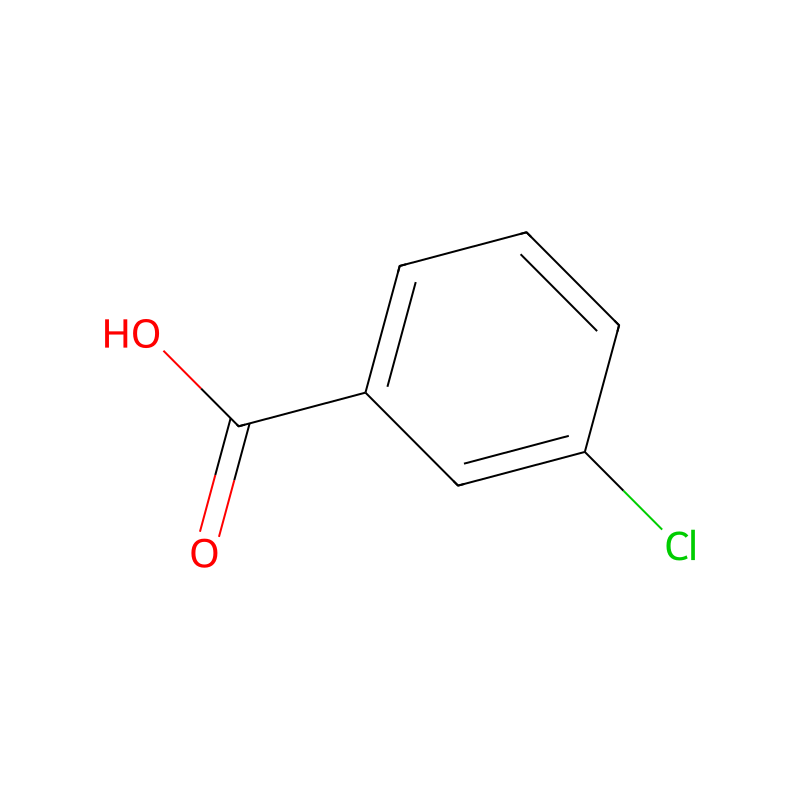
식별자 및 물리적 특성
| CAS No. | 535-80-8 |
|---|---|
| 분자식 | C7H5ClO2 |
| 평균 분자량 | 156.56 g/mol |
| 단동위원소 질량 | 155.99780708 g/mol |
| SMILES | O=C(O)c1cccc(Cl)c1 |
| InChIKey | LULAYUGMBFYYEX-UHFFFAOYSA-N |
| PubChem CID | 447 |
| ChEMBL | CHEMBL20563 |
| ChEBI | CHEBI:49410 |
| EC No. | 208-618-4 |
| DTXSID | DTXSID9024770 |
| 현지명 | 3-클로로벤조 산 |
화학 및 물리적 성질
| XLogP | 2.7 |
|---|---|
| 극성 표면적 | 37.3 |
| 수소 결합 공여자 수 | 1 |
| 수소 결합 수용자 수 | 2 |
| 회전 가능 결합 수 | 1 |
| 무거운 원자 수 | 10 |
| 형식 전하 | 0 |
| 복잡도 | 136 |
| 물질 분류 | Other Classes -> Benzoic Acid Derivatives |
| SpringerMaterials Properties | Chemical shift |
| LogP(분배 계수) | 2.68 |
| 밀도 | 1.496 at 77 °F (NTP, 1992) - Denser than waterwill sink1.496 AT 25 °C/4 °C |
| Color/Form | CRYSTALSPRISMS FROM WATER |
| 용해도 | less than 1 mg/mL at 67.1 °F (NTP, 1992)SOL IN 2850 PARTS COLD WATERMORE SOL IN HOT WATER.SLIGHTLY SOL IN BENZENE, CARBON SULFIDE, PETROLEUM ETHER, CARBON TETRACHLORIDEMORE SOL IN HOT BENZENE.SLIGHTLY SOL IN ALCOHOL AND ETHER.450 mg/l at 15 °C in water.0.45 mg/mL0.45g/L |
| 끓는 점 | Sublimes (NTP, 1992)274-276°C |
| 녹는점 | 316 °F (NTP, 1992)158 °C153-157 °C (lit.) |
| 증기압 | 0.00233 [mmHg] |
| Physical Description | Crystals or fluffy white powder. (NTP, 1992)Solid[Merck Index] White powder[MSDSonline] |
| Ionization Efficiency | Negative0.4810.5Agilent XCTElectrospray ionizationammonia (10nM) |
| Dissociation Constants | PKA 3.82 |
| 굴절률 | 1.5812 (estimate) |
| 인화점 | 150 °C |
| 저장 조건 | Store below +30°C. |
| 물리적 상태 | 결정성 분말 |
| pKa(산도 계수) | 3.82(at 25℃) |
| 색상 | 흰색에서 베이지색 |
| 용해도 | 19.5&C에서 <0.1g/100mL |
| Merck | 14,2123 |
| BRN | 907218 |
| 헨리 상수 | 5.7×101 mol/(m3Pa) at 25℃, Abraham and Jr. (2019) |
| 안정성 | 피부, 눈, 호흡기 자극제. |
| InChI | 1S/C7H5ClO2/c8-6-3-1-2-5(4-6)7(9)10/h1-4H,(H,9,10) |
| InChIKey | LULAYUGMBFYYEX-UHFFFAOYSA-N |
| SMILES | OC(=O)c1cccc(Cl)c1 |
| NIST | Benzoic acid, 3-chloro-(535-80-8) |
| EPA | m-Chlorobenzoic acid (535-80-8) |
화학적 성질
white to light yellow crystal powder
안전 및 규제
| GHS 분류 | This chemical does not meet GHS hazard criteria for 4.3% (3 of 70) of reports.WarningH315 (95.7%): Causes skin irritation [Warning Skin corrosion/irritation]P261, P264, P264+P265, P271, P280, P302+P352, P304+P340, P305+P351+P338, P319, P321, P332+P317, P337+P317, P362+P364, P403+P233, P405, and P501 (click each P-code to see the statement)Aggregated GHS information provided per 70 reports by companies from 12 notifications to the ECHA C&L Inventory. Each notification may be associated with multiple companies. |
|---|---|
| 규제 정보 | Chemical: Benzoic acid, 3-chloro-Benzoic acid, 3-chloro-: Does not have an individual approval but may be used under an appropriate group standard |
| 화재 위험 | Flash point data for this compound are not availablehowever, it is probably combustible. (NTP, 1992) |
| 건강 유해성 | SYMPTOMS: Exposure to this compound may result in eye and skin irritation. |
| 유해성 요약 | A skin irritant[HSDB] A skin, eye, mucous membrane, and upper respiratory tract irritant[CAMEO] An irritant[MSDSonline] |
| 반응성 그룹 | Acids, Carboxylic |
| Reactivity Profile | M-CHLOROBENZOIC ACID is incompatible with strong oxidizing agents. (NTP, 1992) |
| 대기 기준 | This action promulgates standards of performance for equipment leaks of Volatile Organic Compounds (VOC) in the Synthetic Organic Chemical Manufacturing Industry (SOCMI). The intended effect of these standards is to require all newly constructed, modified, and reconstructed SOCMI process units to use the best demonstrated system of continuous emission reduction for equipment leaks of VOC, considering costs, non air quality health and environmental impact and energy requirements. Chlorobenzoic acid is produced, as an intermediate or final product, by process units covered under this subpart. /Chlorobenzoic acid/ |
| Air and Water Reactions | Insoluble in water. |
| Hazard Classes and Categories | Skin Irrit. 2 (95.7%) |
| Skin, Eye, and Respiratory Irritations | SKIN IRRITANT. /FROM TABLE/ |
| 소화 | Fires involving this material can be controlled with a dry chemical, carbon dioxide or Halon extinguisher. (NTP, 1992) |
| 응급 처치 | EYES: First check the victim for contact lenses and remove if present. Flush victim's eyes with water or normal saline solution for 20 to 30 minutes while simultaneously calling a hospital or poison control center. Do not put any ointments, oils, or medication in the victim's eyes without specific instructions from a physician. IMMEDIATELY transport the victim after flushing eyes to a hospital even if no symptoms (such as redness or irritation) develop. |
| 비화재 누출 대응 | SMALL SPILLS AND LEAKAGE: Should a spill occur while you are handling this chemical, FIRST REMOVE ALL SOURCES OF IGNITION, then you should dampen the solid spill material with 60-70% ethanol and transfer the dampened material to a suitable container. Use absorbent paper dampened with 60-70% ethanol to pick up any remaining material. Seal the absorbent paper, and any of your clothes, which may be contaminated, in a vapor-tight plastic bag for eventual disposal. Solvent wash all contaminated surfaces with 60-70% ethanol followed by washing with a soap and water solution. Do not reenter the contaminated area until the Safety Officer (or other responsible person) has verified that the area has been properly cleaned. |
| Personal Protective Equipment (PPE) | RECOMMENDED RESPIRATOR: Where the neat test chemical is weighed and diluted, wear a NIOSH-approved half face respirator equipped with an organic vapor/acid gas cartridge (specific for organic vapors, HCl, acid gas and SO2) with a dust/mist filter. (NTP, 1992) |
| 환경 거동 | TERRESTRIAL FATE: If released to soil, m-chlorobenzoic acid is expected to biodegrade under both aerobic and anaerobic conditions although there may be a lengthy lag period before this process ensues(1-4). Its estimated Henry's Law constant, 3.88X10⁻⁸ atm-cu m/mol(5,SRC), and its estimated vapor pressure, 8.475X10⁻⁵ mm Hg at 25 °C(5-7,SRC) indicate that it is not expected to volatilize from either moist or dry soil to the atmosphere(SRC). Estimated soil adsorption coefficients of 152 and 684(6-8,SRC) indicate that m-chlorobenzoic acid will display moderate to high mobility in soil(9). The pKa of m-chlorobenzoic acid, 3.81 at 25 °C(10), indicates that it will be predominately dissociated in moist soil under the typical pH's found in the environment(SRC).AQUATIC FATE: If released to water, m-chlorobenzoic acid is expected to biodegrade under both aerobic and anaerobic conditions although there may be a lengthy lag period before ths process ensues(1-3). Its estimated Henry's Law constant, 3.88X10⁻⁸ atm-cu m/mol(4,SRC), indicate that it is not expected to volatilize from water to the atmosphere(SRC). The half-life for volatilization from a model river 1 m deep, flowing as 1 m/sec with a wind speed of 3 m/sec is 1180 days(5,SRC). Estimated soil adsorption coefficients of 152 and 684(5-7,SRC) indicate that m-chlorobenzoic acid will not adsorb to sediment and suspended organic matter(SRC). The pKa of m-chlorobenzoic acid, 3.81 at 25 °C(8), indicates that it wil be predominately dissociated in water under the typical pH's found in the environment(SRC).ATMOSPHERIC FATE: If released to the atmosphere, m-chlorobenzoic acid may undergo a gas-phase reaction with photochemically produced hydroxyl radicals. An estimated rate constant of 4.23X10⁻¹³ cu cm/molc-sec(1,SRC) translates to a half-life of 38 days(SRC) for this process using an average atmospheric hydroxyl radical concn of 5X10+5 molc/cu cm(1). The water solubility of m-chlorobenzoic acid, 450 mg/L at 25 °C(2), indicates that it may also undergo atmospheric removal by wet deposition processes(SRC). |
| Effluent Concentrations | m-Chlorobenzoic acid was qualitatively detected in 1 of 46 U.S. industrial effluent samples(1). It was detected in chlorinated municipal sewage effluent at a concn of 0.6 ppb(2). |
| Soil Adsorption/Mobility | Estimated soil adsorption coefficients of 152 and 684(1,SRC) obtained from m-chlorobenzoic acid's water solubility, 450 mg/l at 25 °C(2), and octanol/water partition coefficient, 2.68(3), respectivley can be obtained using an appropriate regression equation. These values indicate that it will display moderate to high mobility in soil(4). |
| Natural Pollution Sources | m-Chlorobenzoic acid is an anthropogenic compound and it is not known to occur in nature. (SRC) |
| Artificial Pollution Sources | m-Chlorobenzoic acid is used as a dye intermediate(1) and may be released to the environment as a fugitive emission during its production, formulation an use(SRC). It may also enter the environment in industrial effluent(2) or as a result of the chlorination of municipal wastewater(3). |
| Environmental Biodegradation | CONJUGATIVE PLASMID PAC25, CHARACTERIZED IN A STRAIN OF P PUTIDA, SPECIFIES BIODEGRADATION OF 3-CHLOROBENZOIC ACID BY A MODIFIED ORTHO PATHWAY THAT INVOLVES MALEYLACETATE, BUT NOT BETA-KETOADIPATE, AS AN INTERMEDIATE.In a survey of standardized tests, m-chlorobenzoic acid was found to biodegrade in the coupled units tests, the Zahn-Wellens test, the MITI test, the Sturm test, the AFNOR test, the OECD screening test and the trickling filter test but not in the closed bottle test(1-4). m-Chlorobenzoic acid was found to biodegrade when inoculated with a primary sewage sludge seed under anaerobic conditions(5). In a screening test, m-chlorobenzoic acid at a concn of 50 ppmC underwent 68% mineralization in 10 weeks after a lag period of 5 weeks and 47% mineralization in 10 weeks after a lag period of 8 weeks in 2 different 10% primary anaerobic digester sludgesit was listed as a compound partially mineralized in 10% of sludge secondary digester and completely mineralized in a 10% sludge from a primary digester(6,7). m-Chlorobenzoic acid displayed a 12 day lag period in a continuous flow through bioreactor using a sewage sludge seed(8).m-Chlorobenzoic acid underwent 105% theoretical gas production after a 29 day lag period when inoculated with a primary digester sludge under anaerobic conditions, time not stated(1). It underwent 68% and 47% theoretical methane production after 5 and 8 weeks, respectively, when incubated with two different municipal digester seeds under anaerobic conditions(2). Incubation of m-chlorobenzoic acid with organisms isolated from sewage resulted in 16% release of chlorine in 2 days when the inocula was acclimated to benzoic acid, 14% to biphenyl, 23% to sodium citrate, 8.6% to sucrose, and 0.8% to the raw sewage itself(3). Sewage sludge adapted to benzoic acid and 3- or 4- hydroxyl benzoate was found to quantitatively reduce m-chlorobenzoic acid at a concn of 313 mg/L to methane under anaerobic conditions although the unadapted sludge could not(4). m-Chlorobenzoic acid at a concn ranging from 20-800 uM displayed a lag period ranging from 71-170 days when incubated with anaerobic lake sediment(5). It was found to biodegrade when incubated with 5 different anaerobic river sediments after a lag period ranging from 4-6 months(6).m-Chlorobenzoic acid was listed as a compound amenable to biodegradation under both aerobic(1-2) and anaerobic conditions(2). Pure culture aerobic degradation of m-chlorobenzoic acid produced 3-hydroxybenzoic acid and, subsequently, 2,5-dihyroxybenzoic acid(3). m-Chlorobenzoic acid was shown to undergo 21% degradation in 3 days, 28% in 1 week, 32% in 2 weeks, 38% in 5 weeks, and 59% in 10 weeks using a mixed culture soil sample under aerobic conditions(4). m-Chlorobenzoic acid, at a concn of 100 mg/L underwent oxidation, as measured by oxygen uptake, when inoculated with microorganisms isolated from soil, compost, or mud obtained from a catalytic cracking plant waste lagoon(5). It underwent 100% removal after 96 hrs when incubated with a mixed microbial seed under aerobic conditions(6).For more Environmental Biodegradation (Complete) data for M-CHLOROBENZOIC ACID (6 total), please visit the HSDB record page. |
| Environmental Bioconcentration | Estimated bioconcentration factors of 20 and 64(1,SRC) obtained from m-chlorobenzoic acid's water solubility, 450 mg/L at 25 °C(2), and octanol/water partition coefficient, 2.68(3), respectively, can be obtained using an appropriate regression equation. These values indicate that it will not bioconcentrate in fish and aquatic organisms(SRC). |
| Volatilization from Water/Soil | An estimated Henry's Law constant of 3.88X10⁻⁸ atm-cu m/mol(1,SRC), indicates that m-chlorobenzoic acid will not volatilize from either water or moist soil(SRC). Based on this value, the estimated half-life for volatilization from a model river 1 m deep, flowing at 1 m/sec and a wind speed of 3 m/sec is 1180 days(2,SRC). An estimated vapor pressure of 8.475X10⁻⁵ mm Hg at 25 °C(2,SRC) obtained from its water solubility, 450 mg/L at 15 °C(3) and an estimated Henry's Law constant indicates that m-chlorobenzoic acid is not expected to volatilize from dry soil to the atmosphere(SRC). |
| Non-Human Toxicity Excerpts | M-CHLOROBENZOIC ACID WAS NOT MUTAGENIC IN EITHER THE SISTER CHROMATID EXCHANGE OR SALMONELLA TYPHIMURIUM HISTIDINE REVERSION MUTAGENESIS ASSAYS.HOG KIDNEY D-AMINO ACID OXIDASE WAS INHIBITED COMPETITIVELY WITH RESPECT TO THE SUBSTRATE BY 5 META SUBSTITUTED BENZOIC ACIDS.AROMATIC CARBOXYLATES WERE COMPETITIVE INHIBITORS OF L-AMINO ACID OXIDASE. |
| Environmental Abiotic Degradation | An estimated rate constant for the gas-phase reaction of m-chlorobenzoic acid with photochemically produced hydroxyl radicals of 4.23X10⁻¹³ cu cm/molc-sec(1,SRC) translates to a half-life of 38 days(SRC) using an average atmospheric hydroxyl radical concn of 5X10+5 molc/cu cm(1). |
| Probable Routes of Human Exposure | Occupational exposure to m-chlorobenzoic acid may occur by dermal contact during its production, formulation or use(SRC). The general population may be exposed by ingestion of contaminated drinking water(1,SRC). |
| Environmental Water Concentrations | DRINKING WATER: m-Chlorobenzoic acid has been qualitatively detected in U.S. drinking water supplies(1). |
| 수질 위해 등급(WGK) | 3 |
| TSCA 등재 상태 | TSCA listed |
| RTECS 번호 | DG4975990 |
| 관세 코드 | 29163900 |
| 위험 문구(R) | 36/37/38 |
| 위험 표시 | Xi |
| 안전 문구(S) | 26-36-37/39 |
| 자연 발화 온도 | >500 °C |
| 위험 등급 | Eye Irrit. 2Skin Irrit. 2 |
| 저장 분류 | 11 - Combustible Solids |
| 유해 물질 데이터 | 535-80-8(Hazardous Substances Data) |
용도
용도
A Pseudomonas species which utilized 3-chlorobenzoic acid as a carbon source converted this compound to 3-hydroxybenzoic and 2, 5-dihydroxybenzoic acids. A methanogenic consortium able to use 3-chlorobenzoic acid as its sole energy and carbon source was enriched from anaerobic sewage sludge. A Pseudomonas putida strain 87 capable of assimilating 3-chlorobenzoic acid as a sole source of carbon and energy (3Cba+) was isolated. coupling of 3-chlorobenzoic acid with phenylboronic acid proceeds at room temperature using 0.5 % Pd and at 100°C using 0.1 % Pd to provide the coupled product in 97 % yeild.
일반 설명
Crystals or fluffy white powder.