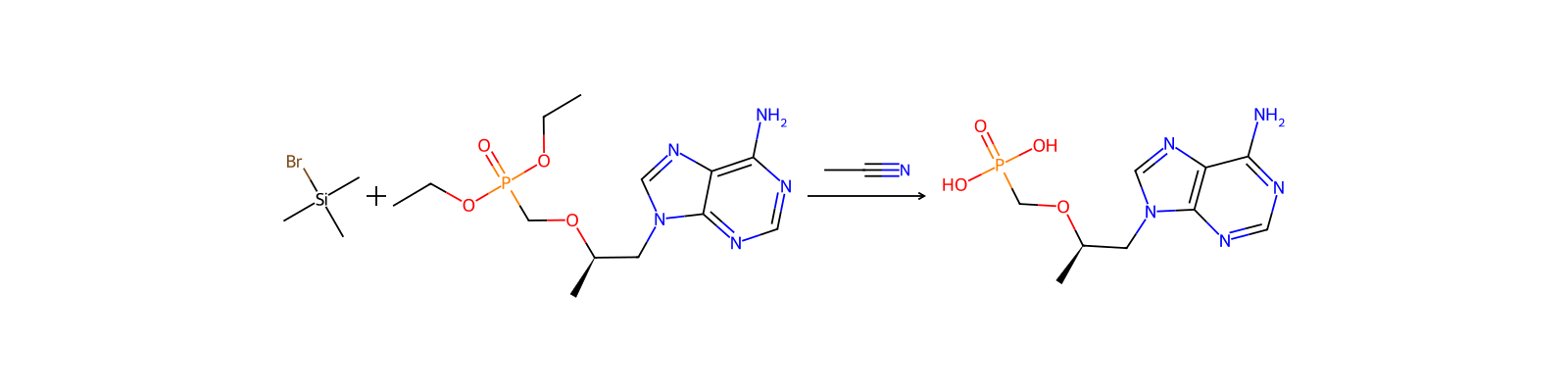
HRID 133116반응물로
Tenofovir
데이터를 보충하는 중입니다. 잠시 후 페이지를 새로 고치면 최신 내용을 볼 수 있습니다

147127-20-6C[C@H](Cn1cnc2c(N)ncnc21)OCP(=O)(O)OSGOIRFVFHAKUTI-ZCFIWIBFSA-NTenofovir (anhydrous) is a member of the class of phosphonic acids that is methylphosphonic acid in which one of the methyl hydrogens is replaced by a [(2R)-1-(6-amino-9H-purin-9-yl)propan-2-yl]oxy group. An inhibitor of HIV-1 reverse transcriptase, the bis(isopropyloxycarbonyloxymethyl) ester (disoproxil ester) prodrug is used as the fumaric acid salt in combination therapy for the treatment of HIV infection. It has a role as an antiviral drug, a drug metabolite and a HIV-1 reverse transcriptase inhibitor. It is a member of phosphonic acids and a nucleoside analogue. It is a conjugate acid of a tenofovir(1-).
147127-20-6DTXSID9040132CHEMBL3989702、CHEMBL483CHEBI:63625Pharmaceuticals -> Listed in ZINC15
Pharmaceuticals -> Metabolite of Tenofovir alafenamide, 'Tenofovir disoproxil
White Crystalline Solid
안전 정보는 참고용이며, 공급업체의 물질안전보건자료(SDS), 관련 법규 및 전문가 평가를 대체하지 않습니다.
Danger
H318 (100%): Causes serious eye damage [Danger Serious eye damage/eye irritation]
P264+P265, P280, P305+P354+P338, and P317 (click each P-code to see the statement)
Aggregated GHS information provided per 2 reports by companies from 1 notifications to the ECHA C&L Inventory.
Like all nucleoside analogues used as therapy of hepatitis B, tenofovir can cause transient increases in serum aminotransferases during or after therapy. These abnormalities appear to be due to an exacerbation or flare of the underlying hepatitis B. Three types of flares due to nucleoside analogue therapy have been described: transient flares during initiation of therapy (treatment flares), flares occurring in association with development of antiviral resistance (breakthrough flares) and flares occurring in the few months after stopping therapy (withdrawal flares). Treatment flares generally arise during the first few months of starting therapy, are usually mild, asymptomatic and self-limited and do not require dose modification or interruption of therapy. Breakthrough flares generally follow the development of antiviral resistance and subsequent rise in HBV DNA levels during nucleoside analogue therapy. Breakthrough flares can be symptomatic and severe. Because tenofovir is associated with a very low rate of antiviral resistance (
Benchmark Dataset for the Liver Toxicity Knowledge Base (LTKB)
tenofovir
Viread®
Antivirals
8
most-DILI-concern
Tenofovir
0.6
2.5
The recommended dosage of tenofovir alafenamide is 25 mg (one tablet) taken orally once daily with food.
Data used to generate the benchmarks include the following: Lowest Daily Dose (LDD): 25 mg/day, Lowest Therapeutic Dose (LTD): 0.3 mg/kg-day, and Screening Dose: 0.0001 mg/kg-day.
21-Sep-21
Tenofovir has been shown to be highly effective in patients that have never had an antiretroviral therapy and it seemed to have lower toxicity than other antivirals such as [stavudine]. In phase 3 clinical trials, tenofovir presented a similar efficacy than [efavirenz] in treatment-naive HIV patients. In hepatitis B infected patients, after one year of tenofovir treatment, the viral DNA levels were undetectable.
Once tenofovir is activated by a bi-phosphorylation it acts as an antiviral acyclic nucleoside phosphonate. It is a potent inhibitor of the viral reverse transcriptase with an inhibitory constant of approximately 0.022 micromolar. Once activated, tenofovir acts with different mechanisms including the inhibition of viral polymerase causing chain termination and the inhibition of viral synthesis. All these activities are attained by its competition with deoxyadenosine 5'-triphosphate in the generation of new viral DNA. Once tenofovir is incorporated in the chain, it induces a chain termination which in order inhibits viral replication. The safety of tenofovir relies on its low affinity towards the cellular DNA polymerase including the mitochondrial DNA polymerase gamma.
W4HFE001U5
TENOFOVIR ANHYDROUS
Established Pharmacologic Class [EPC] - Human Immunodeficiency Virus Nucleoside Analog Reverse Transcriptase Inhibitor
Established Pharmacologic Class [EPC] - Hepatitis B Virus Nucleoside Analog Reverse Transcriptase Inhibitor
Chemical Structure [CS] - Nucleosides
Mechanisms of Action [MoA] - Nucleoside Reverse Transcriptase Inhibitors
Agents used in the prophylaxis or therapy of VIRUS DISEASES. Some of the ways they may act include preventing viral replication by inhibiting viral DNA polymerase; binding to specific cell-surface receptors and inhibiting viral penetration or uncoating; inhibiting viral protein synthesis; or blocking late stages of virus assembly.
Inhibitors of reverse transcriptase (RNA-DIRECTED DNA POLYMERASE), an enzyme that synthesizes DNA on an RNA template.
Agents used to treat AIDS and/or stop the spread of the HIV infection. These do not include drugs used to treat symptoms or opportunistic infections associated with AIDS.
Tenofovir as the active moiety presents a very low bioavailability when orally administered. Hence, the administration of this active agent is required to be under its two prodrug forms, [tenofovir disoproxil] and [tenofovir alafenamide]. This reduced absorption is suggested to be related to the presence of two negative charges among its structure. This negative charge limits its cellular penetration, and its passive diffusion across cellular membranes and intestinal mucosa hindering its availability for oral administration. Intravenous tenofovir has been shown to produce a maximum plasma concentration of 2500 ng/ml with an AUC of 4800 ng.h/ml.
Tenofovir is eliminated in the urine by tubular secretion and glomerular filtration. The elimination of this compound is driven by the activity of the human organic anion transporters 1 and 3 and its secretion is mainly ruled by the activity of the multidrug resistance-associated protein 4.
Accumulation of tenofovir in plasma is related to the presence of nephrotoxic effects. It is reported that tenofovir presents a volume of distribution of 0.813 L/kg.
The clearance of tenofovir is highly dependent on the patient renal stage and hence the clearance rate in patients with renal impairment is reported to be of 134 ml/min while in patients with normal function the clearance rate can be of 210 ml/min.
개요Tenofovir is an analog of adenosine monophosphate that has antiviral activity. It is converted by cellular enzymes to tenofovir diphosphate, an obligate chain terminator that inhibits the activity of HIV reverse transcriptase and hepatitis B virus polymerase. Tenofovir diphosphate is a weak inhibitor of mammalian DNA polymerases α and β and mitochondrial DNA polymerase γ. For in vivo and cell culture use, tenofovir is supplied as a water soluble prodrug in the form of tenofovir disoproxil (fumarate) , which increases the intracellular diphosphorylated compound >1,000-fold above the level attained with unmodified tenofovir.
역사Tenofovir was developed in the 1980s by Professor Antonín Holý and his team at the Institute of Organic Chemistry and Biochemistry (IOCB Prague) of the Czech Academy of Sciences. Their research focused on the design and synthesis of nucleotide analogs, aiming to develop novel compounds with antiviral activity. As an acyclic nucleotide phosphate analog, tenofovir exhibited broad-spectrum antiviral potential in vitro, but its low oral bioavailability limited its initial development. To overcome this bottleneck, collaboration with Gilead Sciences was crucial, ultimately leading to the successful development of tenofovir disoproxil fumarate (TDF) through a prodrug synthesis strategy. This prodrug was first approved by the FDA in 2001 for the treatment of HIV-1 infection, marking a significant breakthrough in its clinical application. Subsequent research further solidified its position in the treatment of chronic hepatitis B and facilitated the market launch of tenofovir alafenamide (TAF), a prodrug with superior renal and bone safety characteristics.
용도Tenofovir is a drug used for the treatment of chronic heptatitis B as well as prevention and treatment of HIV/AIDS. It is a kind of nucleotide analog, acting as the reverse-transcriptase inhibitor (NtRTI). It inhibits the activity of HIV reverse transcriptase through competing with the natural substrate deoxyadenosine 5’-triphosphate, causing the termination of DNA chain.
정의ChEBI: A member of the class of phosphonic acids that is methylphosphonic acid in which one of the methyl hydrogens is replaced by a [(2R)-1-(6-amino-9H-purin-9-yl)propan-2-yl]oxy group. An inhibitor of HIV-1 reverse transcriptase, the bis(isopropyloxycarbonyloxy ethyl) ester (disoproxil ester) prodrug is used as the fumaric acid salt in combination therapy for the treatment of HIV infection.