
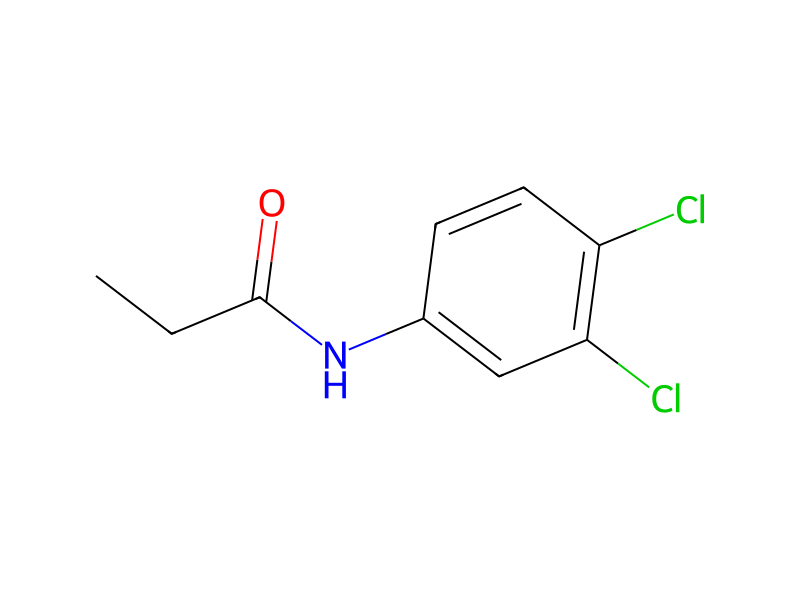
기본 정보
- 표준 SMILES
CCC(=O)Nc1ccc(Cl)c(Cl)c1- InChIKey
LFULEKSKNZEWOE-UHFFFAOYSA-N- 분자식
- C9H9Cl2NO
- 평균 분자량
- 218.08 g/mol
- 단동위원소 질량
- 217.00611927
개요
Propanil appears as colorless to brown crystals. Non corrosive. Used as an herbicide.
이름 및 식별자
- 우선 이름
- Propanil
- IUPAC
- N-(3,4-dichlorophenyl)propanamide
- 현지명
- 프로파닐
- 영어명
- Propanil
- 분자식
- C9H9Cl2NO
- 분자량
- 218.08
이름 및 동의어
propanil709-98-8N-(3,4-Dichlorophenyl)propanamidePropanidePropanexSurcopurDipramRogueGrascidePropanidStampedeSupernox
이름 더 보기
프로파닐프로파닐(PROPANIL)NOXPropaErbanDichloropropionanilide3,4-DICHLOROPROPIONANILIDEWham
Propanamide, N-(3,4-dichlorophenyl)-Chem RiceSynpran NSTAMCekupropanilRiselectHerbaxStrel
데이터베이스 식별자
- CAS
709-98-8- PubChem CID
- 4933
- DTXSID
DTXSID8022111- ChEMBL
CHEMBL1222498- ChEBI
CHEBI:34936- UNII
- F57I4G0520
- EC Number
- 211-914-6
- Nikkaji
- J4.405I
물성
구조 계산 물성
- XLogP
- 3.1
- 극성 표면적
- 29.1 Ų
- 수소 결합 공여자 수
- 1
- 수소 결합 수용자 수
- 1
- 회전 가능 결합 수
- 2
- 무거운 원자 수
- 13
- 형식 전하
- 0
- 복잡도
- 186
실험 및 물리화학적 성질
SpringerMaterials PropertiesFusion temperature
Pesticides
Pesticide -> EPA IRIS
Herbicides
Active substance -> EU Pesticides database: Not approved
Pesticides -> Herbicides, Anilide
Pesticide (Propanil) -> USDA PDB
Pesticide
LogP
log Kow = 3.07
3.12
3.3
OdorOdorless
Density
1.25 g/cu cm at 25 °C
Density (at 25 °C): 1.4 g/cm³
Color/Form
White crystalline solid /Purity not provided/
Colorless crystals /Purity not provided/
Light brown solid (pure)
Dark oily liquid
Solid, white-gray
Solubility
Solubility in water at room temperature: 225 ppm
In water 130 mg/L at 20 °C; in isopropanol and dichloromethane >200 g/L at 20 °C, toluene 50-100 g/L at 20 °C, and hexane <1 g/L at 20 °C; in benzene 7X10+4 mg/L at 25 °C, acetone 1.7X10+6 mg/L at 25 °C, and ethanol 1.1X10+6 mg/L at 25 °C.
Sparingly soluble in aromatic solvents
In water, 152 mg/L at 25 °C
Solubility in water, g/l at 20 °C: 0.13 (very poor)
Corrosivity
Corrosive to polyethylene
Non-corrosive under normal use conditions.
Flash Point>100 °C
Endocrine DisruptorsPotential endocrine disrupting compound
Boiling Point
351 °C
351 °C
DecompositionWhen heated to decomposition it emits very toxic fumes of /hydrogen chloride and nitrogen oxides./
물리화학적 성질
- 녹는점
- 92 · 92-93°C
- 끓는 점
- 369.9 · 369.9±32.0 °C(Predicted)
- 밀도
- 1.25 · 1.25
- 굴절률
- 1.568 · 1.5680 (estimate)
- 인화점
- 100 °C · 100 °C
- 저장 조건
- 0 · 0-6°C
- 용해도
- DMSO(약간 용해됨), 메탄올(약간 용해됨)
- 산도 계수 (pKa)
- 13.58 · 13.58±0.70(Predicted)
- 물리적 상태
- 고체
- 색상
- 다크 브라운, 블루 블랙
- 생물학적 소스
- rabbit
- 수용성
- 225 mg/L · 225mg/L(상온)
- Merck
- 13 · 13,7896
- BRN
- 2365645 · 2365645
- Henry's Law Constant
- 1.3 · 1.3×101 mol/(m3Pa) at 25℃, Chao et al. (2017)
- 주요 응용
- 농업환경
- InChI
- 1S/C9H9Cl2NO/c1-2-9(13)12-6-3-4-7(10)8(11)5-6/h3-5H,2H2,1H3,(H,12,13)
- InChIKey
- LFULEKSKNZEWOE-UHFFFAOYSA-N
- SMILES
- CCC(=O)Nc1ccc(Cl)c(Cl)c1
- LogP
- 3.07 · 3.070
- NIST
- Propanil(709-98-8)
- EPA
- Propanil (709-98-8)
화학적 성질
Propanil is a colorless solid. The technical product is a brown crystalline solid.
안전 및 규제
GHS 분류
GHS Classification
Warning
H302: Harmful if swallowed [Warning Acute toxicity, oral]
P264, P270, P273, P301+P317, P330, P391, and P501 (click each P-code to see the statement)
Warning
H302+H332 (47.9%): Harmful if swallowed or if inhaled [Warning Acute toxicity, oral; acute toxicity, inhalation]
P261, P264, P270, P271, P273, P301+P317, P304+P340, P317, P330, P391, and P501 (click each P-code to see the statement)
유해성 정보
Regulatory Information
Hazard Traits - Hazard Trait Undefined
Regulation (EC) No 1107/2009 (amended)
Propanil is listed in the dataset of EPA Human Health Benchmarks for Pesticides under the Safe Drinking Water Act (40 eCFR 141)
2008/769, Reg. (EU) No 1078/2011, Reg. (Eu) No 2019/148
Propanil: HSNO Approval: HSR005183 Approved with controls
The New Jersey Worker and Community Right to Know Act requires public and private employers to provide information about hazardous substances at their workplaces. (N.J.S.A. 34:5A-1 et. seq.)
Other Safety InformationIMAP assessments - Propanamide, N-(3,4-dichlorophenyl)-: Human health tier I assessment
DOT LabelClass 9
Fire Hazards
Excerpt from ERG Guide 171 [Substances (Low to Moderate Hazard)]:
Combustible. Gives off irritating or toxic fumes (or gases) in a fire. Risk of fire and explosion if formulations contain flammable/explosive solvents.
Health HazardsExcerpt from ERG Guide 171 [Substances (Low to Moderate Hazard)]:
Hazards Summary
Skin and respiratory irritant; [EPA Pesticides, p. 119] May be contaminated by chemicals that can induce chloracne. [Rosenstock, p. 714] Chloracne and methemoglobinemia reported in a study of workers in a pesticide plant producing propanil; [HSDB] The following herbicides have an oral LD50 of >1 gm/kg and have little or no acute toxicity in humans: Alachlor, Amitrole, Ammonium sulfamate, Atrazine, Dalapon, Dicamba, Glyphosphate, Monuron, Oryzalin, Picloram, Propanil, Simazine, etc. [LaDou, p. 613] Short-term exposure may affect the nervous system and blood leading to formation of methemoglobin; [ICSC]
Reactive GroupAmides and Imides
EC ClassificationSymbol: Xn, N; R: 22-50; S: (2)-22-61
UN ClassificationUN Hazard Class: 9; UN Pack Group: III
Special Reports
USEPA/Office of Pesticide Programs; Reregistration Eligibility Decision Document - Propanil. September 2003. The RED summarizes the risk assessment conclusions and outlines any risk reduction measures necessary for the pesticide to continue to be registered in the U.S.[Available from, as of February 15, 2005: http://www.epa.gov/pesticides/reregistration/status.htm]
FIFRA Requirements
Tolerances are established for the combined residues of the herbicide propanil (3',4'-dichloropropionanilide) and its metabolites convertible to 3,4-dichloroaniline (3,4-DCA) in or on the following food commodities:[Table#3007]
The Reregistration Eligibility Decision (RED) document for propanil was signed on 9/30/2003. A public comment period for the Propanil RED (and the supporting assessment) was conducted from 2/25/2004 to 4/26/2004. The risk assessments, benefit assessment, and public comments can be found on the federal docket system ... (docket # EPA-HQ-OPP-2003-0348). The Agency has reviewed the public comments submitted and has responded to those that relate specifically to the propanil RED. The Agency's responses are available for viewing under the same docket number on the Regulations.gov system. As a result of its review of the public comments and review of additional data submitted by the Propanil Task Force, the Agency is amending the Propanil RED, where appropriate. These revisions include label changes and an updated "Appendix B: Data Supporting Guideline Requirements for the Reregisrtaion of Propanil". The label changes related to dry flowable closed systems are contingent on the outcome of exposure data that are due in December 2006. In addition, the Agency has received a request from the California Rice Commission to reexamine the tolerance that was proposed in the 2003 RED on rice of 10 ppm. In order to facilitate trade in the Pacific region, the California Rice Commission would like to maintain the existing tolerance of 2 ppm. At this time, the Agency is moving forward with this Propanil Amendment decision, but will look into this request further as more information or supporting data are submitted.
Section 4(g)(2)(A) of FIFRA calls for the Agency to determine, after submission of relevant data concerning an active ingredient, whether or not products containing the active ingredient are eligible for reregistration. The Agency has previously identified and required the submission of the generic (i.e., active ingredient-specific) data required to support reregistration of products containing propanil as an active ingredient. The Agency has completed its review of these generic data, and has determined that the data are sufficient to support reregistration of all products containing propanil.
As the federal pesticide law FIFRA directs, EPA is conducting a comprehensive review of older pesticides to consider their health and environmental effects and make decisions about their continued use. Under this pesticide reregistration program, EPA examines newer health and safety data for pesticide active ingredients initially registered before November 1, 1984, and determines whether the use of the pesticide does not pose unreasonable risk in accordance to newer saftey standards, such as those described in the Food Quality Protection Act of 1996. Propanil is found on List A, which contains most pesticides that are used on foods and, hence, have a high potential for human exposure. List A consists of the 194 chemical cases (or 350 individual active ingredients) for which EPA issued registration standards prior to FIFRA '88. Case No: 0226; Pesticide type: herbicide; Registration Standard Date: 12/23/87; Case Status: OPP is reviewing data from the pesticide's producers regarding its human health and/or environmental effects, or OPP is determining the pesticide's eligibility for reregistration and developing the Reregistration Eligibility Decision (RED) document.; Active ingredient (AI): Propanil; Data Call-in (DCI) Date(s): 07/01/94, 10/13/95; AI Status: The producers of the pesticide have made commitments to conduct the studies and pay the fees required for reregistration, and are meeting those commitments in a timely manner.
Reactivity ProfilePROPANIL is incompatible with carbamates and organophosphates.
안전 및 보호
Fire Fighting
Excerpt from ERG Guide 171 [Substances (Low to Moderate Hazard)]:
Use dry powder, dry sand, foam, carbon dioxide, water spray.
First Aid Measures
Fresh air, rest. Refer for medical attention.
Remove contaminated clothes. Rinse and then wash skin with water and soap.
Rinse with plenty of water (remove contact lenses if easily possible).
Rinse mouth. Do NOT induce vomiting. Refer for medical attention .
First AidExcerpt from ERG Guide 171 [Substances (Low to Moderate Hazard)]:
Safe StorageKeep in a well-ventilated room. Store only in original container. Store in an area without drain or sewer access.
Exposure Control and Personal Protection
TIH (Toxic Inhalation Hazard) - Term used to describe gases and volatile liquids that are toxic when inhaled. Some are TIH materials themselves, e.g., chlorine, and some release TIH gases when spilled in water, e.g., chlorosilanes. [ERG 2016].
Fire Fighting Procedures
Suitable Extinguishing Media: Use dry chemicals, carbon dioxide and foam. /Propanil 80DF/
Keep out of smoke. Fight fire from upwind position. Cool closed containers exposed to fire with water spray. Dike area to prevent runoff and contamination of water sources. Equipment or materials involved in pesticide fires may become contaminated. /Propanil 80DF/
Storage Conditions
Do not contaminate water, food, or feed by storage or disposal. /Propanil 80DF/
Do not use, pour, spill or store near heat or open flame. If the entire contents are not used, protect remaining material from moisture and heat. Resealing by rolling top down and storage under roof are recommended. Keep containers closed when not in use. /Propanil 80DF/
Keep containers tightly closed. Avoid high temperatures. Keep in cool dry area above freezing 32 degrees F (0 degrees C). Provide a cool well-ventilated area. /Propanil 80DF/
Cleanup Methods
Large spillages should be dammed-off and pumped into containers; soak up remainder with absorbent material and dispose of in accordance with local regulations.
Do not contaminate /downstream/ water when cleaning equipment or disposing of equipment washwaters or rinsate. /Propanil 80DF/
Nonfire Spill ResponseExcerpt from ERG Guide 171 [Substances (Low to Moderate Hazard)]:
Disposal Methods
SRP: The most favorable course of action is to use an alternative chemical product with less inherent propensity for occupational harm/injury/toxicity or environmental contamination. Recycle any unused portion of the material for its approved use or return it to the manufacturer or supplier. Ultimate disposal of the chemical must consider: the material's impact on air quality; potential migration in soil or water; effects on animal and plant life; and conformance with environmental and public health regulations.
Must be disposed of by special means, eg, suitable incineration, in accordance with local regulations.
Wastes resulting from the use of this product must be disposed of on site or at an approved waste disposal facility. If these wastes cannot be disposed of by use according to label instructions, contact your State Pesticide or Environmental Control Agency, or the HAzardous Waste representative at the nearest EPA region office for guidance. /Propanil 80DF/
Nonrefillable container. Do not reuse or refill this container. Completely empty bag into application equipment. Then, offer for recycling, if available or dispose of empty bad in a sanitary landfill or by incineration, or, if allowed by State and local authorities, by burning. If burned, stay out of smoke. /Propanil 80DF/
Sweep or shovel into containers for disposal or reworking. Keep dusting to a minimum. Flush contaminated area with a large amount of water to a chemical or sanitary sewer containing a settling pit. /Propanil 80DF/
Spillage Disposal
Personal protection: particulate filter respirator adapted to the airborne concentration of the substance. Do NOT let this chemical enter the environment. Sweep spilled substance into covered sealable containers. If appropriate, moisten first to prevent dusting. Carefully collect remainder. Then store and dispose of according to local regulations.
Preventive Measures
Use this product only in accordance with its labeling and with the Worker Protection Standard, 40 CFR part 170. /Propanil 80DF/
SRP: Contaminated protective clothing should be segregated in such a manner so that there is no direct personal contact by personnel who handle, dispose, or clean the clothing. Quality assurance to ascertain the completeness of the cleaning procedures should be implemented before the decontaminated protective clothing is returned for reuse by the workers. Contaminated clothing should not be taken home at end of shift, but should remain at employee's place of work for cleaning.
SRP: The scientific literature for the use of contact lenses by industrial workers is inconsistent. The benefits or detrimental effects of wearing contact lenses depend not only upon the substance, but also on factors including the form of the substance, characteristics and duration of the exposure, the uses of other eye protection equipment, and the hygiene of the lenses. However, there may be individual substances whose irritating or corrosive properties are such that the wearing of contact lenses would be harmful to the eye. In those specific cases, contact lenses should not be worn. In any event, the usual eye protection equipment should be worn even when contact lenses are in place.
Users should: Wash hands before eating, drinking, chewing gum, using tobacco, aor using the toilet. Remove clothing/PPE immediately if pesticide gets inside. Then wash thoroughly and put on clean clothing. Remove PPE immediately after handling this product. Wash the outside of gloves before removing. As soon as possible, wash thoroughly and change into clean clothing. /Propanil 80DF/
For more Preventive Measures (Complete) data for PROPANIL (7 total), please visit the HSDB record page.
독성 정보
Interactions
...Herbicide potentiation was observed in field studies in which propanil was applied to rice following the application of organophosphate insecticides. ...Rice plants... /were damaged because/ organophosphates inhibited the hydrolysis of propanil. ...Inhibition of liver acylamidase by triorthocresyl phosphate (TOCP) prevented the cyanosis that was observed when mice were given toxic doses of propanil. /3,4-Dichloroaniline/
/OTHER TOXICITY INFORMATION/ Phytotoxic to many broad-leaved crops. Normally phytotoxic to crops which have been treated with organophosphate or carbamate insecticides.
Target OrgansImmune
Ecotoxicity Values
LC50; Species: Anas platyrhynchos (Mallard duck) 17 day old dietary >5000 ppm for 8 days
LC50; Species: Anas platyrhynchos (Mallard duck) 10 day old; dietary 5627 ppm for 8 days
LC50; Species: Colinus virginianus (Northern bobwhite) 11 days old; dietary 2861 ppm for 8 days
LC50; Species: Colinus virginianus (Northern bobwhite) 14 days old; dietary 2311 ppm for 8 days
For more Ecotoxicity Values (Complete) data for PROPANIL (70 total), please visit the HSDB record page.
Environmental Fate
TERRESTRIAL FATE: Based on a classification scheme(1), Koc values of 141 to 800(2-3) indicate that propanil is expected to have high to low mobility in soil(SRC). Volatilization of propanil from moist soil surfaces is not expected to be an important fate process(SRC) given an estimated Henry's Law constant of 1.7X10⁻⁹ atm-cu m/mole(SRC), based upon its vapor pressure, 9.08X10⁻⁷ mm Hg(2), and water solubility, 152 mg/L(2). Propanil is not expected to volatilize from dry soil surfaces(SRC) based upon its vapor pressure(2). Half-lives for the photolysis of propanil on soil surfaces of 21.1, 19.9, and 18.4 days were reported using sandy clay loam, clay loam, and sandy loam soils, respectively(3). A 21.1% of theoretical BOD using activated sludge in the Japanese MITI test(4) suggests that biodegradation is an important environmental fate process in soil(SRC). Propanil is reported to be rapidly metabolized in aerobic soil with a half-life of 0.5 day(5).
TERRESTRIAL FATE: ... Duration of activity /in soil/ in warm, moist conditions is only a few days.
AQUATIC FATE: Based on a classification scheme(1), Koc values of 141 to 800(2-3) indicate that propanil is expected to adsorb to suspended solids and sediment(SRC). Volatilization from water surfaces is not expected(4) based upon an estimated Henry's Law constant of 1.7X10⁻⁹ atm-cu m/mole(SRC), derived from its vapor pressure, 9.08X10⁻⁷ mm Hg(2), and water solubility, 152 mg/L(2). According to a classification scheme(5), a BCF of 1.6(6), suggests bioconcentration in aquatic organisms is low(SRC). Half-lives for the photolysis of propanil by sunlight of 60.3, 55.4, 57.3, 40.3, and 44.1 days were reported in lake, river, marine, ground, and distilled waters, respectively(7). Average aerobic biodegradation half-lives of 17 and 154 hours were determined for propanil (1 ppm initial concentration) in amended and unamended environmental waters (3 pond samples and 1 river sample), respectively(8). Propanil was almost completely degraded in 4-6 days in water from the Azov Sea (Ukraine and Russia border) and adjacent firths, but it was not degraded in distilled water(9). Propanil (50 ppm) biodegraded 100% in 5 days in non-sterile distilled water at pH 7 and 28 °C; no propanil degradation was observed in 10 days in an autoclaved solution under the same conditions(10). Hydrolysis is not expected based upon a study where propanil was stable in distilled water at 20 °C and pHs 6-9 for more than four months(11).
AQUATIC FATE: Propanil was applied to rice fields in Sardinia, Italy at rates equivalent to maximum aqueous concentration of 0.4 to 2.8 mg/kg, assuming the water to be 20 cm deep(1). Residues in 162 water samples, collected from 16 rice fields 1, 4, 7, 10, 12, 18, 21 and 120 days after last spraying, were below limit of determination 0.03 mg/kg(1). Residues in 40 water samples taken from 5 drainage canals were <0.03 mg/kg(1).
ATMOSPHERIC FATE: According to a model of gas/particle partitioning of semivolatile organic compounds in the atmosphere(1), propanil, which has a vapor pressure of 9.08X10⁻⁷ mm Hg at 25 °C(2), will exist in both the vapor and particulate phases in the ambient atmosphere. Vapor-phase propanil is degraded in the atmosphere by reaction with photochemically-produced hydroxyl radicals(SRC); the half-life for this reaction in air is estimated to be 4.2 days(SRC), calculated from its rate constant of 3.8X10⁻¹² cu cm/molecule-sec at 25 °C(SRC) that was derived using a structure estimation method(3). Particulate-phase propanil may be removed from the air by wet or dry deposition(SRC). Propanil was susceptible to photolysis by sunlight in water and on soil surfaces(4), and therefore may also be susceptible to direct photolysis in air(SRC).
Food Survey Values
Propanil was detected at a concentration of 0.003 ppm in 1 leafy vegetable composite, a concentration range of 0.003-0.006 ppm in 3 root vegetable composites, and a concentration of 0.003 ppm in 1 garden fruit composite from 20 US cities during August 1976 to Sept 1977 according to the FDA's monitoring program for chemical contaminants in the US food supply (Total Diet Study or Market Basket Study)(1). Propanil was detected at an average concentration of 0.0008 ppm in 3 leafy vegetable composites and a concentration of 0.002 ppm in 1 root vegetable composite from 20 US cities during October 1977 to September 1978 according to the FDA's Total Diet Study(2). Propanil was detected at an average concentration of 0.0027 ppm in 9 leafy vegetable composites, an average concentration of 0.0007 ppm in 12 root vegetable composites, and an average concentration of 0.0001 ppm in 2 garden fruit composites from 27 US cities during October 1980 to March 1982 according to the FDA's Total Diet Study(3).
Adverse EffectsMethemoglobinemia - The presence of increased methemoglobin in the blood; the compound is classified as secondary toxic effect
Exposure RoutesThe substance can be absorbed into the body by inhalation and by ingestion.
Milk ConcentrationsWhen propanil was fed to a cow for 4 days, 1.4% of total dose was recovered in feces, but none was detected in urine or milk.
Average Daily Intake
The Average Daily Intake (AVDI) of propanil in the young adult male(1-3).
USA Market basket surveys, infant and toddler average daily intake(1-5).
Ecotoxicity Excerpts
/BIRDS and MAMMALS/ Results were reported for embryotoxicity of 42 environmental contaminants applied externally to mallards eggs including crude and refined petroleum, and commercial formulations of herbicides and insecticides. The LC50 of herbicides and insecticides in aqueous emulsion were measured by egg immersion. Propanil, bromoxynil, methyl diclofop, prometon, endrin, sulprofos and parathion were toxic (LC50 of 7-40 lb/A; 7.8-44.8 kg/ha).
/AQUATIC SPECIES/ Biological effect of Stam f-34 on the N2-fixing cyanobacterium (blue-green alga) Nostoc calcicola was studied under cultural conditions. It caused an inhibition of the N-fixing growth of the alga which was concentration-dependent and lethal at 30 ug/mL. Glucose and acetate efficiently reversed the inhibition, even when Stam f-34 was present at a lethal dose. Low pH enhanced toxicity. It was not mutagenic since it did not induce mutations to streptomycin and methylamine resistance in the algae.
/AQUATIC SPECIES/ Fathead minnows (Pimephales promelas) were exposed to technical grade propanil in a flow-through diluter system to detect acute lethality. Median lethal concentration values were 11.5, 10.2, 8.6 and 3.4 mg/L at 24, 48, 96 and 192 hr, respectively. Eggs, newly hatched fry, and juvenile fish of same species were similary exposed but at lower concentrations for 58 days. The 58 day no effect concentration was between 0.4 and 0.6 ug/L, based upon the physiological parameters of length and dry weight of juvenile fish. Propanil did not concentrate significantly in fathead minnows (1.6 times for parent propanil in whole body).
/AQUATIC SPECIES/ ...The sensitivity of four algal species, Scenedesmus acutus, Scenedesmus subspicatus, Chlorella vulgaris and Chlorella saccharophila to pesticides propanil... was studied using single species toxicity tests. Organisms were exposed to different concentrations of /propanil/ and the algal growth was measured in a microplate reader at 410 nm, at 0, 24, 48 and 72 hr. ... 72 hr EC50 of propanil.../was between/ 0.29 to 5.98 mg/L... for the four algal species. The two species of Chlorella were more tolerant than the two species of Scenedesmus.
For more Ecotoxicity Excerpts (Complete) data for PROPANIL (6 total), please visit the HSDB record page.
Signs and Symptoms
Blue lips, fingernails and skin. Headache. Dizziness.
Redness.
Burning sensation. Confusion. Drowsiness. Nausea. Vomiting. Further see Inhalation.
Acute Toxicity LinkChemical: PROPANIL
규제 정보
FIFRA Requirements
Tolerances are established for the combined residues of the herbicide propanil (3',4'-dichloropropionanilide) and its metabolites convertible to 3,4-dichloroaniline (3,4-DCA) in or on the following food commodities:[Table#3007]
The Reregistration Eligibility Decision (RED) document for propanil was signed on 9/30/2003. A public comment period for the Propanil RED (and the supporting assessment) was conducted from 2/25/2004 to 4/26/2004. The risk assessments, benefit assessment, and public comments can be found on the federal docket system ... (docket # EPA-HQ-OPP-2003-0348). The Agency has reviewed the public comments submitted and has responded to those that relate specifically to the propanil RED. The Agency's responses are available for viewing under the same docket number on the Regulations.gov system. As a result of its review of the public comments and review of additional data submitted by the Propanil Task Force, the Agency is amending the Propanil RED, where appropriate. These revisions include label changes and an updated "Appendix B: Data Supporting Guideline Requirements for the Reregisrtaion of Propanil". The label changes related to dry flowable closed systems are contingent on the outcome of exposure data that are due in December 2006. In addition, the Agency has received a request from the California Rice Commission to reexamine the tolerance that was proposed in the 2003 RED on rice of 10 ppm. In order to facilitate trade in the Pacific region, the California Rice Commission would like to maintain the existing tolerance of 2 ppm. At this time, the Agency is moving forward with this Propanil Amendment decision, but will look into this request further as more information or supporting data are submitted.
Section 4(g)(2)(A) of FIFRA calls for the Agency to determine, after submission of relevant data concerning an active ingredient, whether or not products containing the active ingredient are eligible for reregistration. The Agency has previously identified and required the submission of the generic (i.e., active ingredient-specific) data required to support reregistration of products containing propanil as an active ingredient. The Agency has completed its review of these generic data, and has determined that the data are sufficient to support reregistration of all products containing propanil.
As the federal pesticide law FIFRA directs, EPA is conducting a comprehensive review of older pesticides to consider their health and environmental effects and make decisions about their continued use. Under this pesticide reregistration program, EPA examines newer health and safety data for pesticide active ingredients initially registered before November 1, 1984, and determines whether the use of the pesticide does not pose unreasonable risk in accordance to newer saftey standards, such as those described in the Food Quality Protection Act of 1996. Propanil is found on List A, which contains most pesticides that are used on foods and, hence, have a high potential for human exposure. List A consists of the 194 chemical cases (or 350 individual active ingredients) for which EPA issued registration standards prior to FIFRA '88. Case No: 0226; Pesticide type: herbicide; Registration Standard Date: 12/23/87; Case Status: OPP is reviewing data from the pesticide's producers regarding its human health and/or environmental effects, or OPP is determining the pesticide's eligibility for reregistration and developing the Reregistration Eligibility Decision (RED) document.; Active ingredient (AI): Propanil; Data Call-in (DCI) Date(s): 07/01/94, 10/13/95; AI Status: The producers of the pesticide have made commitments to conduct the studies and pay the fees required for reregistration, and are meeting those commitments in a timely manner.
State Drinking Water Guidelines(ME) MAINE 35 ug/L
안전 데이터
- wgk
- 3
- rtecs
- UE4900000
- ridadr
- UN 3077 9/PG 3
- 독성
- LD50 orally in rats: 1384 mg/kg (Bailey, White)
- HS 번호
- 29242990
- risk_code
- 22-50
- hazard_code
- Xn;N,N,Xn
- safety_code
- 2-22-61
- 포장분류
- III
- 위험 등급
- 9
- 기존화학 물질
- KE-10198
- Hazard Classifications
- Acute Tox. 4 OralAquatic Acute 1
- 스토리지 클래스
- 11 - Combustible Solids
- 유해 물질 데이터
- 709-98-8(Hazardous Substances Data)
화학 및 산업
약리 정보
Mechanism of Action
In this study, /investigators/ examined both the direct and indirect effects of /propanil (PRN)/ exposure on /cytotoxic T lymphocytes (CTL)/ activation and effector cell function to gauge its likely impact on cell-mediated immunity. Initial experiments addressed whether PRN alters the class I major histocompatibility complex (MHC) pathway for antigen processing and presentation by antigen-presenting cells (APCs) , thereby indirectly affecting effector function. These experiments demonstrated that PRN does not impair the activation of CTLs by PRN-treated APCs. Subsequent experiments addressed whether PRN treatment of CTLs directly inhibits their activation and revealed that 1 degrees alloreactive CTLs exposed to PRN are unimpaired in their proliferative response and only marginally inhibited in their lytic activity. Surprisingly, secondary stimulation of these alloreactive CTL effectors, however, even in the absence of further PRN exposure, resulted in complete abrogation of CTL lytic function and a delayed but significant long-term effect on CTL responsiveness. These findings may have important implications for the diagnosis and clinical management of anomalies of cell-mediated immunity resulting from environmental exposure to various herbicides and other pesticides.
... Previous studies have demonstrated that treatment of the IC-21 macrophage cell line with DCPA resulted in changes of critical macrophage functions, including a decrease in cytokine production, and in the ability to phagocytize and kill bacteria. To understand the mechanism involved in the propanil induced changes, a proteomics analysis was undertaken. For this study, IC-21 cells were exposed to 100 uM propanil or ethanol (vehicle) and stimulated with lipopolysaccharide. After 30 min of exposure, cytosolic fraction was isolated and analyzed by two-dimensional gel electrophoresis. Differential statistical analysis identified 12 spots that were all decreased in the propanil exposed cells compared to vehicle. Mass spectrometry analysis was used to identify the proteins, which was later confirmed by other methods. One of these proteins, Sorting Nexin 6 (SNX6) interacts with the TGF-beta family of receptor serine-threonine kinases and associates with early endosomes during intracellular receptor trafficking. Another protein, H+-ATPase functions as a cytoplasmic pH-regulator promoting acidification of intracellular compartments in macrophages during the respiratory burst. A third protein, fibroblast growth factor regulated-1 (FR-1) protein induced by FGF-1 stimulation is important for enhancement of phagocytosis and plays a role in promoting inflammation. Confirmation of other significantly changed proteins and linking their identity to the alterations in macrophage function is currently in progress. Together the data from toxicoproteomics analysis provides an additional evidence of the mechanism by which propanil suppresses macrophage functions.
Stimulation of T cells through the T-cell receptor results in the activation of a series of signaling pathways that leads to the secretion of interleukin (IL)-2 and cell proliferation. Influx of calcium (Ca(2+)) from the extracellular environment, following internal Ca(2+) store depletion, provides the elevated and sustained intracellular calcium concentration ([Ca(2+)](i)) critical for optimal T-cell activation. Our laboratory has documented that exposure to the herbicide 3,4-dichloropropionanilide (DCPA) inhibits intracellular signaling events that have one or more Ca(2+) dependent steps. Herein we report that DCPA attenuates the normal elevated and sustained [Ca(2+)](i) that follows internal store depletion in the human leukemic Jurkat T cell line and primary mouse T cells. DCPA did not alter the depletion of internal Ca(2+) stores when stimulated by anti-CD3 or thapsigargin demonstrating that early inositol 1,4,5-triphosphate-mediated signaling and depletion of Ca(2+) stores were unaffected. 2-Aminoethyldiphenol borate (2-APB) is known to alter the store-operated Ca(2+) (SOC) influx that follows Ca(2+) store depletion. Exposure of Jurkat cells to either DCPA or 50 uM 2-APB attenuated the increase in [Ca(2+)](i) following thapsigargin or anti-CD3 induced store depletion in a similar manner. At low concentrations, 2-APB enhances SOC influx but this enhancement is abrogated in the presence of DCPA. This alteration in [Ca(2+)](i), when exposed to DCPA, significantly reduces nuclear levels of nuclear factor of activated T cells (NFAT) and IL-2 secretion. The plasma membrane polarization profile is not altered by DCPA exposure. Taken together, these data indicate that DCPA inhibits T-cell activation by altering Ca(2+) homeostasis following store depletion.
Toxic signs after ip doses of 200 to 800 mg/kg of the herbicide propanil in mice included central nervous system depression, loss of reflex, cyanosis and death at the higher doses. Pretreatment with tri-o-cresylphosphate (triorthotolyl phosphate, TOTP), an esterase inhibitor, prevented cyanosis but slightly enhanced the CNS depressant actions of propanil. Propanil and a probable hydrolytic metabolite, 3,4-dichloroaniline (DCA), produced methemoglobinemia in mice. Comparison of the time- and dose-response relationships for equimolar doses of propanil and DCA showed that DCA was more potent and had a faster onset of methemoglobin production than propanil. The hydrolysis of propanil to yield 3,4-dichloroaniline by liver homogenates was completely inhibited 18 hr after mice were given 125 mg/kg of TOTP. Methemoglobin formation after propanil was inhibited in mice pretreated with 125 mg/kg of TOTP, but TOTP did not affect DCA-induced methemoglobinemia. Inhibition of propanil-amidase activity and propanil-induced methemoglobinemia had similar TOTP dose- and time-response relationships. Pretreatment with SKF-525A inhibited and phenobarbital pretreatment slightly increased both propanil- and DCA-induced methemoglobin formation. Neither pretreatment affected normal liver propanilamidase activity.
Biological Half-LifeIn rats given up to 1000 mg/kg orally, blood concentrations are maintained for 24 hr but undetectable after 48 to 72 hr.
Metabolism/Metabolites
.../It/ is hydrolyzed by... hepatic acylamidase, forming 3,4-dichloroaniline and propionic acid. The enzyme... /is/ present in liver of rats, mice, rabbits, and dogs. Other conversions /occur/... either on propanil... or on dichloroaniline, /producing/... six metabolites in urine. These metabolites constitute about 95% of urinary products.
Rainbow trout(Salmo gairdneri) readily metabolize technical grade propanil, forming at least 10 products. One metab recovered from bile was identified as 3',4'-dichloro-2-hydroxypropionanilide or 3',4'-dichloro-3-hydroxypropionanilide. The technical grade contained 0.67 mg/g 3,3',4,4'-tetrachloroazobenzene.
3,4-Dichloroaniline formed when propanil was added to algal cultures during growth. Experiments showed that some non-axenic algal cultures were very active in DCA formation and that the bacterial contaminants were also active when free of algae. In these studies, the non-axenic Nostoc entophytum and the axenic Polypothrix tenius were active in DCA production.
Red Rice (Oryza sativa Leguminatae) seedlings were the source of an aryl amidase. Studies showed that this enzyme was able to hydrolyze propanil, as well as some analogs. Although active between pH 7.4 to 8.7, the optimum was 8.2. Calculations showed the Km = 2.5X10⁻⁵ and that the activity was in the order propanil >>3'Cl > propionanilide > 4'-Cl greater than or equal to 3'5'-dichloro > 2'-Cl.
For more Metabolism/Metabolites (Complete) data for PROPANIL (10 total), please visit the HSDB record page.
MeSH Pharmacological ClassificationPesticides used to destroy unwanted vegetation, especially various types of weeds, grasses (POACEAE), and woody plants. Some plants develop HERBICIDE RESISTANCE.
Absorption, Distribution and Excretion
SD rats /were administered propanil/ in a single oral low dose (2.5 mg/kg), multiple oral low dose (2.5 mg/kg for 15 days), single oral high dose (300 mg/kg), or an intravenous dose (0.7 mg/kg in saline). The majority of the radioactivity (78-90%) was excreted in the urine, and 2-13% was excreted in the feces. Most of the radioactivity was eliminated within 24 hours for all except the high oral dose where it took 48 hours to eliminate 90%. For the i.v. data, females excreted 10% in the feces, while males excreted 2%. The carcass contained 0.18-0.71% of the radioactivity, with the liver having the highest residue.
Repeated inhalation (rat): after exposure to concentrations of 5.6 to 0.2 mg/m3, propanil occurs in the blood, heart and spleen.
Five minutes after oral administration of single doses (1000 mg/kg, 650 mg/kg) to rats, propanil is detectable in blood and all tissues. Maximum accumulation in lungs, liver, kidneys, spleen, adrenals and heart occurs within 1 to 6 hours of administration.
Little radioactivity from labeled propanil appeared in tissues in short-duration experiments with rats, mice, & dogs; this indicates that propensity for accumulation of propanil or its metabolites in tissues is slight.
For more Absorption, Distribution and Excretion (Complete) data for PROPANIL (6 total), please visit the HSDB record page.
용도 및 제조
Uses
A post-emergence herbicide used to control weeds in rice, potatoes, and wheat; [EXTOXNET] Used as post-emergence herbicide for rice; Also registered, but not marketed, for use on commercial sod farms; [Reference #2]
Uses on small grains voluntarily cancelled; [Reference #2]
Farming (Pesticides) [Category: Industry]
For propanil (USEPA/OPP Pesticide Code: 028201) ACTIVE products with label matches. /SRP: Registered for use in the U.S. but approved pesticide uses may change periodically and so federal, state and local authorities must be consulted for currently approved uses./
Herbicide; postemergence with no residual effect against numerous grasses and broadleaved weeds in rice.
Impurities
/The/ contaminants are 3,4,3',4'-tetrachloroazobenzene and /3,4,3',4'-tetrachloroazobenzene's/ oxy derivative... .
Presence of TCAB (3,3',4,4'-tetrachloroazobenzene) was determined by HPLC in 3,4-dichloroaniline, & in the herbicides (propanil, diuron, linuron & neburon) made from 3,4-dichloroaniline.
Methods of ManufacturingPropanil can be prepared by reaction of 3,4-dichloroaniline with propionic acid in the presence of thionyl chloride.
Formulations/Preparations
Premix Partners: Anilofos; Bensulfuron-methyl; Bentazone; Bromoxynil; Butachlor; Clomazone; 2,4-D; fentrazamide; MCPA; Metsulfuron-methyl; Quinclorac; Thiobencarb; Tricloypr.
Emulsion concentrate, liquid, dry flowable.
Formulated as an emulsifiable concentrate liquid (16.6-58% active ingredient (a.i.)), a water dispersable granule (or dry flowable) (59.6-81% a.i.), a soluble concentrate liquid (41.2-80.2% a.i.) and a flowable concentrate liquid (41.2% a.i.).
Setre Prowl Herbicide + Propanil (Helena Chemical Company), Propanil 33.7%, Pendimethalin 11.25%.
For more Formulations/Preparations (Complete) data for PROPANIL (38 total), please visit the HSDB record page.
Use ClassificationHERBICIDES
General Manufacturing Information
The WHO Recommended Classification of Pesticides by Hazard identifies propanil (technical grade) as Class II: moderately hazardous; Main Use: herbicide.
... /Propanil's/ efficacy is restricted largely to warm temp ... /it has/ limited activity at temp below 70 °F. This has confined its chief applications to tropical & semitropical areas.
응용 분야
개요propanil is used as a rice herbicide. The resistance of rice plants toward propanil has been found in an enzyme aryl-acylamidase that rapidly hydrolyzes the herbicide. This enzyme can be inhibited by carbamate insecticides, and this can lead to an increased propanil phytotoxicity (38).
용도Propanil is a a widely used herbicide. Propanil is used mainly to control weed growth in rice fields.
일반 설명Colorless to brown crystals. Non corrosive. Used as an herbicide.
상·하류 제품 정보
상류 원료
하류 제품
공급사50 곳
湖北永阔科技有限公司027-59223108 15972152991 · [email protected]
上海阿拉丁生化科技股份有限公司400-6206333 13167063860 · [email protected]
湖北万得化工有限公司15377098680 15377098680 · [email protected]
盐城通铭生物科技有限公司15195160625 · [email protected]
山东海舟生物工程有限公司130-0567-0367 13006570367 · [email protected]
河南赢创生物科技有限公司16650615803 · [email protected]
杭州品高化工有限公司0571-87658025 · [email protected]
Syntechem Co.,Ltd[email protected]
天津中信凯泰化工有限公司022-66880623 · [email protected]
安耐吉化学&3A(安徽泽升科技有限公司)021-58432009 400-005-6266 · [email protected]
梯希爱(上海)化工贸易有限公司021-61109150 · [email protected]
湖北长耀生物科技有限公司17683887209 17683887209 · [email protected]
湖北魏氏化学试剂股份有限公司027-59102966 18717199209 · [email protected]
上海艾梯西生物科技有限公司18721763493
MedChemexpress LLC021-58955995 · [email protected]
湖北广奥生物科技有限公司027-02702759223056 18162699093 · [email protected]
湖北成海化工有限公司027-59220433 18327245847 · [email protected]
BOC Sciences1-631-485-4226; 16314854226 · [email protected]
北京海岸鸿蒙标准物质技术有限责任公司13240431552 · [email protected]
武汉贝乐叶生物医药科技有限公司15871353653 18086118076 · [email protected]
湖北扬信医药科技有限公司0714-3999001 19171453112 · [email protected]
上海毕楷科技有限公司18516304666
ChemeGen 中国18818260767 · [email protected]
四川库利南科技有限公司400-1166-196 18981987031 · [email protected]
Xiamen AmoyChem Co., Ltd+86-86-5926051114 · [email protected]
艾科试剂4008-755-333 18080918076 · [email protected]
成都思天德生物科技有限公司028-83243028 19136088901 · [email protected]
武汉普洛夫生物科技有限公司17612776928 · [email protected]
湖北薪和化工有限公司027-83258456 15392830626 · [email protected]
南京生利德生物科技有限公司025-57798810 18652991625 · [email protected]
上海湄水化工科技有限公司021-60549325 18616193163
天津阿尔塔科技有限公司022-65378550-8551 · [email protected]
天津普西唐生物医药科技有限公司010-60605840 · [email protected]
上海麦克林生化科技股份有限公司15221275939 15221275939 · [email protected]
江苏艾康生物医药研发有限公司025-66028182 17714375163 · [email protected]
湖北宝凌化工科技有限公司13129969326 · [email protected]
凯试(上海)科技有限公司021-50135380 · [email protected]
池州凯隆进出口贸易有限公司[email protected]
上海一研生物科技有限公司021-69985186 13611928337 · [email protected]
天津阿尔塔科技有限公司022-6537-8550 15522853686 · [email protected]
TargetMol中国(陶术生物)021-021-33632979 15002134094 · [email protected]
Hangzhou HeRui Chemical Co., Ltd0086-571-87396576 · [email protected]
上海陶术生物科技股份有限公司+1-781-999-5354; +1-00000000000 · [email protected]
九鼎化学(上海)科技有限公司4009209199 · [email protected]
西安美川生物科技有限公司029-89275612 +8618991951683 · [email protected]
武汉鑫儒化工有限公司15927387915 15337108568
厦门志信化学有限公司+86-5922680277 +86-13806087780 · [email protected]
泰安市江舟生物科技有限公司1385-13854830759 13854830759 · [email protected]
湖北万业众诚化学试剂有限责任公司18671296875 · [email protected]
湖北美钡新材料有限公司18271819653 · [email protected]
관련 반응
5건


연결된 노트
불러오는 중…